
Being a truck driver can raise what you pay for life insurance, but in South Dakota it almost never keeps you from getting covered at all. Carriers treat the occupation as a rating factor, similar to how they treat a health condition, and South Dakota law specifically allows insurers to weigh occupation when deciding whether to issue or renew a policy.1 The problem isn’t usually the rate. It’s that a lot of drivers never ask, because somewhere along the way they decided the answer would be no. This guide walks through why carriers price the occupation the way they do, what it actually costs to assume you’re uninsurable instead of checking, and how to shop it so you don’t overpay one company for a risk another company prices lower.
The short version
- South Dakota law (SDCL 58-11-55.1) specifically allows insurers to use occupation, along with age, when deciding whether to issue or renew a life insurance policy.
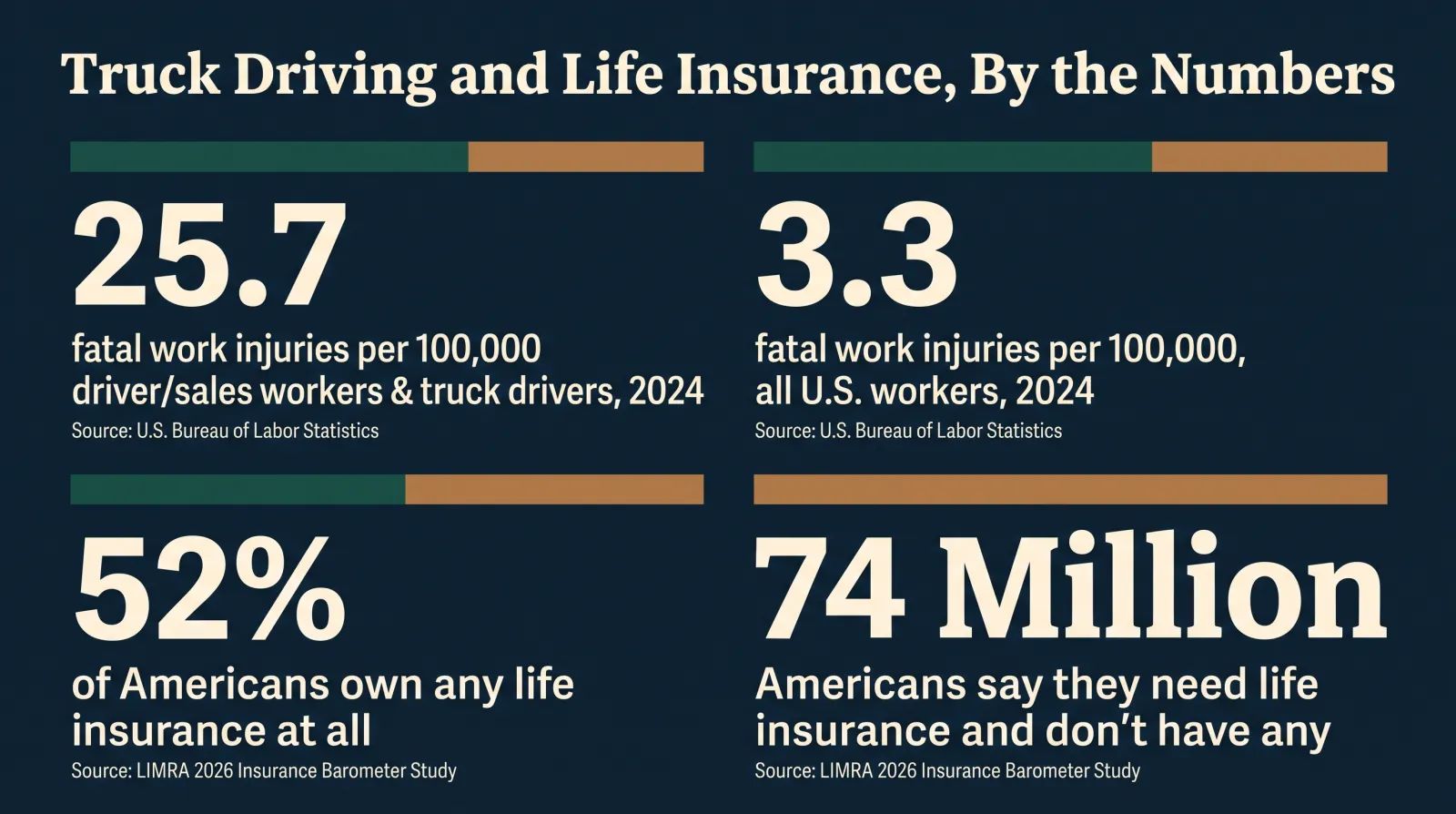
- The Bureau of Labor Statistics recorded a fatal work injury rate of 25.7 per 100,000 full-time equivalent workers for driver/sales workers and truck drivers in 2024, about eight times the all-worker rate of 3.3 per 100,000. That gap is the actual reason carriers rate the job.
- Occupational risk is usually priced with a flat extra, a fixed added charge for a defined period, not an automatic drop into a worse overall health class.
- Carriers set their own occupational guidelines, and they don't agree with each other. Comparing more than one company is the single biggest lever a driver controls.
- Nationally, 2.22 million people work as heavy and tractor-trailer truck drivers, and South Dakota's own labor department lists the occupation among the state's highest-demand, highest-wage jobs.[^sd-lmic-career] Being common doesn't make it untouchable to insure; it makes it a well-understood risk that most carriers already have a standard way to price.
The pain: you assumed the answer was no before anyone actually asked
Here’s a conversation that plays out constantly in South Dakota, on I-90 and I-29 and every county road that feeds a grain elevator or a Sioux Falls distribution center. A driver hits their 40s, has a spouse, has kids, and knows in the back of their mind that if something happened out on a run, the family would be in real trouble. They also assume, without ever calling anyone, that a company selling life insurance to an office worker in Rapid City isn’t going to want to insure someone who spends 11 hours a day in a truck. So they don’t ask. Not because they were told no. Because they told themselves no first.
That assumption isn’t crazy. Truck driving really is a physically demanding, statistically riskier occupation than a lot of jobs, and the industry itself talks about the risk constantly: hours-of-service rules, DOT physicals, fatigue, the sheer number of miles. It’s reasonable to expect an insurance company to notice that too. What’s not reasonable is treating “this job carries more risk” as the same thing as “I can’t be insured,” because those are two very different outcomes, and only one of them is usually true.
It also isn’t a small or shrinking occupation in South Dakota. The state’s Department of Labor and Regulation projects the Transportation and Warehousing sector to grow 11.8% between 2024 and 2034, one of the state’s faster-growing industry groups, driven in part by the ongoing freight needs of agriculture, food processing, and construction that don’t go away when the economy slows.2 This is a job South Dakota carriers see applications for constantly, not an unusual edge case they have to figure out from scratch.
This is general education, not a quote or a promise
This article explains how carriers generally approach occupational underwriting for truck drivers, using publicly available data and South Dakota law. It doesn't quote a premium you would pay, promise a specific rate class, or promise approval, a no-exam path, or a speed of coverage for anyone. Product availability, underwriting outcomes, and pricing vary by carrier and by individual application.
Why it happens: occupation is a rating factor, not a yes-or-no gate
To make sense of what actually happens when a truck driver applies for coverage, a few terms are worth defining first, because the industry uses them loosely and the loose version is where the confusion, and the unnecessary fear, comes from.
Underwriting class is the risk tier a carrier assigns after reviewing your application, medical information, and lifestyle factors. Classes typically run from a top tier like Preferred Plus, through Preferred, Standard Plus, and Standard, before dropping into a series of numbered or lettered table ratings for higher-risk applicants.
Table rating is a step-down from a standard health class, usually expressed as a percentage add-on to the standard premium (Table 2 might add 50%, Table 4 might add 100%, and so on, varying by carrier). It applies broadly to your whole policy’s pricing.
Flat extra works differently, and it’s the tool most carriers reach for on occupation specifically. Instead of moving your entire policy into a worse table, a flat extra adds a fixed additional dollar charge for every unit of coverage, for a defined period, sometimes as short as a few years and sometimes for the life of the policy. It’s a narrower, more targeted way to price a specific, definable added risk, like an occupation or a hobby, without treating your overall health as worse than it is.
Occupational questionnaire is the supplemental form some carriers require for jobs they consider higher-risk. For truck drivers, this typically asks about the type of driving (long-haul over-the-road versus regional or local, home most nights or not), whether you haul hazardous materials, your years of experience, and your driving record.
Motor vehicle report (MVR) is your official driving history, pulled directly from the state, and it plays a bigger role in a truck driver’s application than it does for most other occupations, simply because driving is the job.
Now, the legal backdrop. South Dakota’s insurance code, in SDCL Title 58, generally prohibits an insurer from refusing to issue or renew a policy solely because of an applicant’s occupation, race, national origin, or several other factors, under SDCL 58-11-55.3 But the very next section, SDCL 58-11-55.1, carves out a specific exception: an insurer may use age or occupation in determining whether to issue or renew a life or disability policy.1 Put those two sections together and the practical rule is this: a South Dakota insurer cannot categorically refuse every truck driver as a class, but it can, and routinely does, weigh your specific occupation, and the specific details of how you do that job, in deciding what to offer you and at what price. Rate classifications generally also have to avoid unfair discrimination between individuals of the same class with the same expectation of life, the broader standard South Dakota’s insurance code applies to rating.4 Occupation-based pricing is allowed; arbitrary, inconsistent pricing is not supposed to be.
| Statute | What it does |
|---|---|
| SDCL 58-11-55 | Generally bars an insurer from refusing to issue or renew a policy solely because of an applicant's occupation, along with several other listed factors. |
| SDCL 58-11-55.1 | Creates a specific exception: an insurer may use age or occupation in determining whether to issue or renew a life or disability policy. |
| SDCL 58-25-4 | Prohibits unfair discrimination in rates between individuals of the same class and the same expectation of life, the general standard applied to how rating factors like occupation get used. |
Source: South Dakota Legislature, South Dakota Codified Laws Title 58, Chapter 11 and Chapter 25, accessed September 2026.
Read together, these statutes describe exactly what happens in practice: occupation is a legitimate factor a carrier can weigh, but it isn’t a blanket disqualifier, and it’s supposed to be applied as a consistent classification, not a guess.
What it costs to get wrong: the number that actually justifies the rating, and the number that shows most people never ask
The reason carriers single out this occupation at all isn’t arbitrary. It’s mortality data. The Bureau of Labor Statistics’ Census of Fatal Occupational Injuries reported 5,070 fatal work injuries across all U.S. occupations in 2024, a rate of 3.3 per 100,000 full-time equivalent workers.5 Within that total, the agency’s own chart of fatal work injury rates by selected occupation put “driver/sales workers and truck drivers” at 25.7 fatalities per 100,000 full-time equivalent workers in 2024, with 950 total fatalities in that occupational category, and the broader transportation and material moving occupational group overall at 12.5 per 100,000, with 1,391 fatalities.6 Put plainly: the driver/sales worker and truck driver rate was about eight times the all-worker rate that same year. That’s the actual, sourced reason an underwriter looks twice at this job. It isn’t guesswork or a stereotype; it’s a documented gap in workplace fatality rates specific to this line of work.
Fatal work injury rate per 100,000 full-time equivalent workers, 2024
Source: U.S. Bureau of Labor Statistics, Census of Fatal Occupational Injuries, 2024 data.
But there’s a second, equally important number, and it points the opposite direction. The 2026 LIMRA Insurance Barometer Study found that only 52% of Americans own any life insurance at all, while 29% say they need life insurance and don’t have it, and another 9% say they have some but need more, together representing 74 million and 24 million Americans, respectively.7 LIMRA didn’t break that gap out by occupation, so this isn’t a truck-driver-specific figure, and it shouldn’t be read as one. What it does show is that most people who lack coverage aren’t people who were declined. They’re people who never applied, for all sorts of reasons that have nothing to do with what a carrier would have actually offered them. A driver who assumes the job disqualifies them and never calls anyone is, statistically, doing exactly what roughly a third of the country is already doing for entirely different reasons: leaving a real gap unfilled because nobody ran the numbers.
The cost of getting this wrong isn’t a bad rate. It’s zero coverage, chosen by default, for a family that would have qualified for something reasonable if anyone had actually asked.
The job doesn't disqualify you. Never asking anyone does that on its own, every single time.
— Mike Moore, Life Insurance Advisor, Big Sioux LifeHow to work it out yourself: shopping an occupational rating without guessing
None of this requires hiring anyone to get started. Here’s the method.
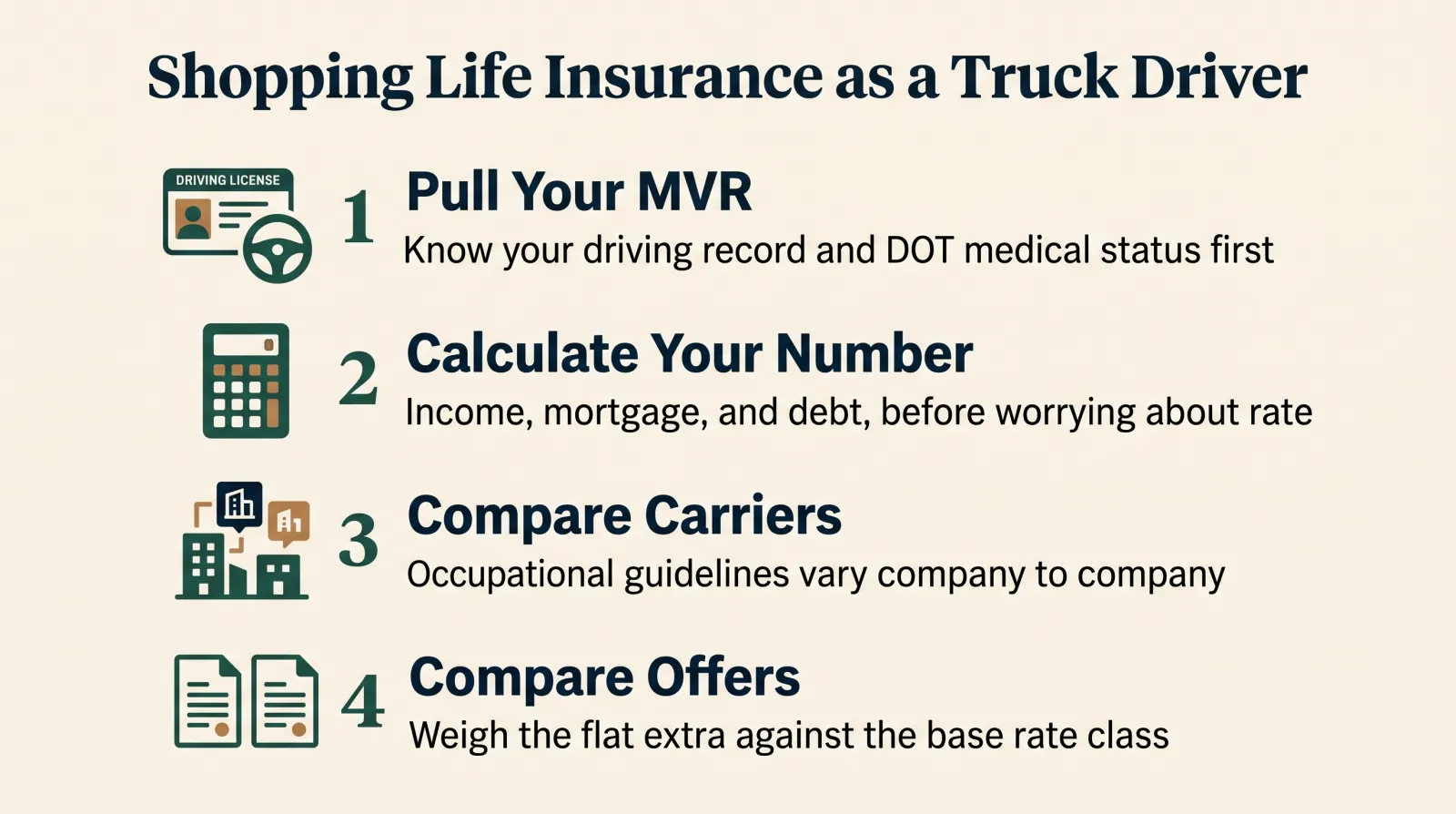
1. Pull your own motor vehicle report and know your DOT medical certificate status before you apply. Your MVR and your current DOT physical status are two of the first things an underwriter will look at, and knowing exactly what they show removes the biggest source of surprise in the process. If there’s an old violation on your record, it’s better to know its exact date and nature going in than to be caught off guard by it later.
2. Calculate your actual coverage number first, before worrying about the rate. This is the step people skip when they’re anxious about being declined, and it’s backward. Add up what your family would need to replace if your income stopped (a common approach is your income multiplied by the years your family would need it replaced), your remaining mortgage balance, your kids’ remaining education costs, and any other debt, then subtract savings and any coverage you already have. Whatever number you land on is the number to shop, whether the eventual rate is standard or comes with an added charge.
3. Apply through, or at least get quotes from, more than one carrier. This is the single most important step in this whole article. Occupational guidelines are set company by company, not industrywide. One carrier may focus almost entirely on whether you haul hazardous materials; another may care more about long-haul versus regional routes; a third may weight your driving record above the job title itself. A rating from one company tells you almost nothing about what a different company would offer for the identical application.
4. Compare flat extra offers side by side instead of accepting the first one. If more than one carrier offers you coverage with a flat extra attached, compare the dollar amount of the extra, how many years it applies for, and the base rate class underneath it. A smaller flat extra on top of a better underlying health class can end up costing less than a larger flat extra layered on a worse one, and that comparison only becomes visible once you actually have more than one offer in front of you.
A worked example
Take a hypothetical household to see the arithmetic in one place. This is an illustration with assumed, round numbers, not a real driver or a quoted rate.
A 42-year-old long-haul driver based near Sioux Falls has a spouse and two kids, ages 8 and 11. Assume this driver earns the national median annual wage for the occupation, $58,640, as reported by the Bureau of Labor Statistics for 2025.8 Using a common income-replacement approach of 10 years of income, the family’s baseline number looks like this:
| Line item | Assumed amount |
|---|---|
| 10 years of income replacement ($58,640/yr) | $586,400 |
| Remaining mortgage balance | $220,000 |
| Education, two kids ($60,000 each) | $120,000 |
| Other debt (vehicle loans, etc.) | $15,000 |
| Combined coverage target | ≈ $940,000 |
Nothing about that $940,000 figure changes because this driver hauls freight for a living. The occupation might mean the eventual premium for that amount comes with a flat extra attached at one carrier and not another, or a slightly different underwriting class at a third. What it doesn’t change is the underlying number the family actually needs, which is why running this calculation first, and shopping the rate second, keeps the occupation fear from shrinking a policy that should be sized to the real obligation.
The family stays uninsured by default
- Decides the job disqualifies them without a single quote
- Never learns their actual MVR or DOT status, so a fixable issue stays unaddressed
- The $940,000 gap in this example stays completely unfunded
The occupation becomes a price, not a wall
- Gets an actual offer, whether standard, table-rated, or with a flat extra
- Compares more than one company's occupational guidelines side by side
- The family's real coverage number gets funded instead of assumed away
How we help South Dakota drivers get an actual answer instead of a guess
We’re independent, which matters specifically here, because occupational underwriting is exactly the kind of decision that varies most from one carrier to the next.
We ask about your specific driving, not just the job title
Long-haul over-the-road, regional with most nights home, or local delivery are treated differently by different carriers. We ask the details that actually change the outcome instead of stopping at "truck driver."
We compare occupational guidelines across carriers
Because we're not tied to one company, we can compare how more than one carrier's underwriting guidelines would treat your specific situation, rather than you applying once and accepting whatever a single company decides.
We size the coverage to your family, not the fear
We start with the same income-replacement, mortgage, and debt math in this article, so the amount you apply for reflects what your family actually needs, not a smaller number picked out of worry about the rate.
We stay with you afterward
If your route, your driving record, or your health changes down the road, you're calling us to re-shop it, not starting over cold with a new company.
If you’d rather have someone local run this comparison for you instead of guessing at what a single company would say, compare your options and we’ll walk through the specifics of your route and record with you.
What you get from checking instead of assuming
The value here isn’t a lower rate for its own sake. It’s an actual answer, in place of a guess you’ve been carrying around, possibly for years. If the answer turns out to be a flat extra or a modestly higher class, you now know the real cost of protecting your family, instead of an imagined worst case that kept you from ever finding out. If it turns out standard rates are available, which happens more often than most drivers expect, you’ve been carrying an unfunded gap for no reason at all.
It also puts you in a position to make an actual decision instead of a default one. “I assumed I couldn’t get covered” and “I checked, and here’s what three companies offered” are very different positions to be making a family’s financial protection from.
Not ready to talk to anyone yet? Pull your MVR and run the coverage math from the worked example above on your own first; neither step requires us. If you’re self-employed as an owner-operator, our guide to life insurance for self-employed South Dakotans covers the income-documentation side of that situation. If a health condition is part of your picture alongside the occupation, getting life insurance after a health condition walks through how accelerated and no-exam underwriting handle that combination. And if you want to understand the no-exam product category before you apply anywhere, no-medical-exam life insurance in South Dakota explains what it actually is and isn’t.
Get an actual answer on your occupation, not a guess
An independent comparison of coverage options across more than one carrier's occupational guidelines, sized to what your family actually needs.
Frequently asked questions
Can truck drivers get life insurance in South Dakota?
Yes. Driving a truck for a living does not make you uninsurable. It’s treated as an occupational risk factor, similar to a health condition, that can move your premium above the very best rate class, not a disqualifying condition on its own. South Dakota law, SDCL 58-11-55.1, specifically permits insurers to use occupation, alongside age, when deciding whether to issue or renew a life or disability policy. Most long-haul and regional drivers end up somewhere between standard and a modestly higher rate, not declined.
Will being a truck driver make my life insurance more expensive?
It can, but not automatically and not by the same amount at every company. Fatal work injury data explains why carriers look at the occupation at all: the Bureau of Labor Statistics recorded a fatal work injury rate of 25.7 per 100,000 full-time equivalent workers for driver/sales workers and truck drivers in 2024, versus 3.3 per 100,000 for all U.S. workers, about eight times the all-worker rate. That gap is real, but individual carriers weigh it very differently, which is exactly why shopping more than one company matters here.
What is a flat extra rating, and how is it different from a worse health class?
A flat extra is a defined additional charge added on top of your base premium, tied to a specific, often temporary, risk factor like an occupation or a hobby, rather than a reclassification of your overall health rating. Instead of moving your whole policy into a lower health tier, the carrier adds a fixed charge for a set number of years, or sometimes for the life of the policy, to price the specific added risk. It’s a narrower tool than a table rating, and it’s the mechanism many carriers use for occupational risk instead of penalizing your medical underwriting class.
Does South Dakota law let insurance companies charge me more because of my job?
Within limits, yes. SDCL 58-11-55 generally bars an insurer from refusing to issue or renew a policy solely because of an applicant’s occupation, among other factors, but SDCL 58-11-55.1 creates a specific exception letting insurers use occupation, like age, in issuance and renewal decisions for life and disability policies. Rate classifications still have to avoid unfair discrimination between applicants of the same class and the same life expectancy, the general standard South Dakota’s insurance code applies to rating generally. In practice, this means occupation can affect your price, but it has to be applied consistently, not arbitrarily.
Do all life insurance companies rate truck driving the same way?
No, and that’s the single most useful fact in this article. Carriers set their own occupational guidelines. One company may focus heavily on hauling hazardous materials or a driver’s specific routes and hours; another may weigh moving-violation history more than the job title itself; a third may treat regional or local driving (home most nights) very differently from long-haul, sleeper-cab work. Because these guidelines vary company to company, working with someone who compares more than one carrier’s occupational rules, rather than applying to a single company and accepting whatever it offers, is the actual lever you control here.
Can I get no-medical-exam life insurance as a truck driver?
No-medical-exam life insurance is a real product category, including accelerated underwriting that relies on data sources like a motor vehicle report and prescription history instead of a paramedical exam, and simplified-issue products that ask a shorter set of health and occupation questions. Being a truck driver doesn’t automatically rule either path out, but your driving record and the specific coverage amount you’re asking for both still get evaluated, and carriers differ on how they treat the occupation within these no-exam products. Whether a specific no-exam option fits your situation is worth comparing across carriers rather than assuming from any single company’s marketing page.
How much life insurance does a South Dakota truck driver actually need?
The same method anyone uses works here: add up what your family would need to replace if your income stopped, plus your mortgage balance, remaining education costs for your kids, and any other debt, then subtract savings and existing coverage. Your occupation affects what that coverage costs to buy, not the underlying number your family actually needs. Running the arithmetic first, before worrying about the rate, keeps you from under-buying out of a fear that the rate will be unaffordable before you’ve actually gotten a quote.
Before you act on any of this
This article is general education, not insurance, legal, financial, or tax advice, and it does not evaluate your specific application, driving record, or health. It does not promise approval, a specific rate class, a no-exam outcome, or a speed of coverage. Product availability, features, and rates vary by carrier and by individual underwriting outcome. No coverage exists until a policy is issued and in force. Any guarantees are subject to the claims-paying ability of the issuing insurer. Please review actual policy documents and speak with a licensed agent about your specific situation.
Sources
- U.S. Bureau of Labor Statistics — Census of Fatal Occupational Injuries Summary, 2024 — released February 19, 2026; source of the 5,070 total U.S. fatal work injuries and the 3.3 per 100,000 full-time-equivalent-worker all-worker fatality rate for 2024.
- U.S. Bureau of Labor Statistics — Rate and number of fatal work injuries in selected occupations — 2024 data; source of the 25.7 per 100,000 fatal work injury rate and 950 fatalities for driver/sales workers and truck drivers, and the 12.5 per 100,000 rate and 1,391 fatalities for transportation and material moving occupations overall.
- U.S. Bureau of Labor Statistics — Occupational Outlook Handbook: Heavy and Tractor-Trailer Truck Drivers — 2025 data; source of the $58,640 national median annual wage, 2,221,200 national employment figure, and the 4% projected 2025-2035 employment growth rate.
- South Dakota Department of Labor and Regulation, Labor Market Information Center — Industry Projections 2024-2034: Top Growers — published July 2026; source of South Dakota’s Transportation and Warehousing sector’s 11.8% projected employment growth, 2024-2034.
- South Dakota Department of Labor and Regulation, Labor Market Information Center — Transportation, Distribution & Logistics Occupations — accessed September 2026; identifies Heavy and Tractor-Trailer Truck Drivers as one of South Dakota’s top 30 highest-demand, highest-wage occupations.
- South Dakota Legislature — South Dakota Codified Laws, Title 58, Chapter 11 — accessed September 2026; source for SDCL 58-11-55 (general prohibition on refusing to issue or renew based solely on occupation and other listed factors) and SDCL 58-11-55.1 (the specific exception allowing occupation and age to be used in life and disability policy issuance and renewal decisions).
- South Dakota Legislature — South Dakota Codified Laws § 58-25-4, Unfair discrimination in rates prohibited — accessed September 2026; source for the general standard against unfair discrimination in rates between individuals of the same class and the same expectation of life.
- LIMRA — 2026 Insurance Barometer Study: Rethinking Your Life Insurance — 2026; source of the 52% life insurance ownership figure and the 29%/9% (74 million/24 million Americans) need-gap figures.
Related reading: Life Insurance for Self-Employed South Dakotans in 2026, Getting Life Insurance After a Health Condition: 2026, No-Medical-Exam Life Insurance: How It Works in 2026, and How Much Life Insurance Do Sioux Falls Families Need?. See our current term life insurance and no-medical-exam life options, our who we help: people with health conditions page, or start with how it works.
Footnotes
-
South Dakota Codified Laws § 58-11-55.1, accessed September 2026. ↩ ↩2
-
South Dakota Department of Labor and Regulation, Labor Market Information Center, “Industry Projections 2024-2034: Top Growers,” published July 2026. ↩
-
South Dakota Codified Laws § 58-11-55, accessed September 2026. ↩
-
South Dakota Codified Laws § 58-25-4, “Unfair discrimination in rates prohibited,” accessed September 2026. ↩
-
U.S. Bureau of Labor Statistics, “Census of Fatal Occupational Injuries Summary, 2024,” news release, February 19, 2026. ↩
-
U.S. Bureau of Labor Statistics, “Rate and number of fatal work injuries in selected occupations,” Census of Fatal Occupational Injuries chart, 2024 data. ↩
-
LIMRA, “2026 Insurance Barometer Study: Rethinking Your Life Insurance,” presentation, 2026. ↩
-
U.S. Bureau of Labor Statistics, Occupational Outlook Handbook, “Heavy and Tractor-Trailer Truck Drivers,” 2025 data. ↩