
If you are trying to avoid a medical exam for a life insurance application, the direct answer is that “no-exam life insurance” is not one product, it is at least three different underwriting paths bundled under a marketing label, and which one actually fits you depends on your health, not your preference for skipping a needle. Accelerated underwriting, simplified issue, and guaranteed issue all let you apply without a paramedical exam, but they ask for wildly different amounts of information, cover wildly different amounts, and price the tradeoff of not knowing your health details very differently. Getting that mixed up, assuming any one of the three is what you actually need, is the mistake that costs South Dakota families the most money and the most coverage.
The short version
- "No-exam life insurance" covers at least three distinct underwriting categories: accelerated underwriting, simplified issue, and guaranteed issue. They are not interchangeable, and each fits a different kind of applicant.
- The NAIC describes simplified underwriting as trading the medical exam and lab work "in exchange for generally higher premiums," so skipping the exam is a real cost, not a free convenience.
- Guaranteed issue asks no health questions and cannot decline anyone in its eligible age range, which is exactly why it almost always carries a graded death benefit for an early stretch of years set by the carrier, and a lower maximum coverage amount.
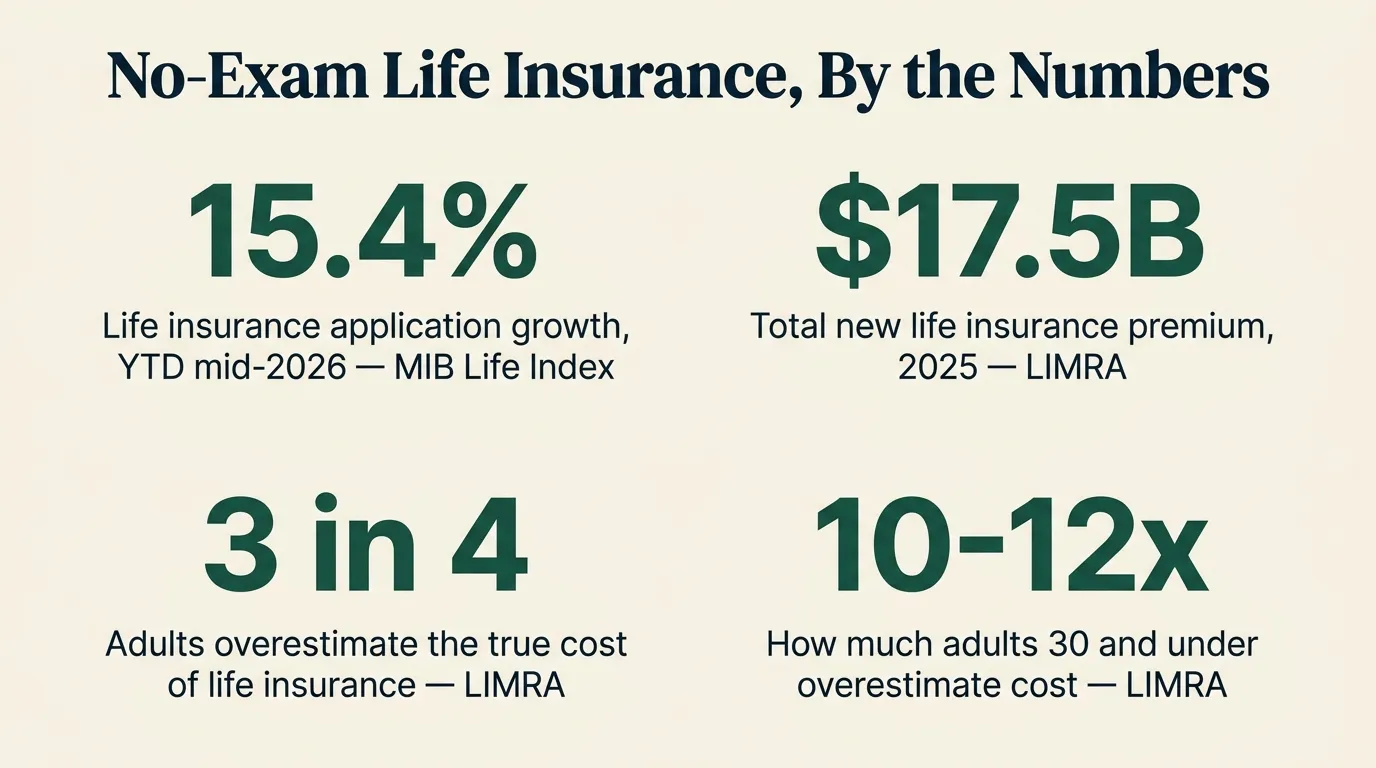
- U.S. life insurance application activity was up 15.4% year-to-date through the first half of 2026, the highest mid-year total on record, according to MIB's Life Index, and accelerated, tech-driven underwriting is a large part of why that pace is possible.
- About three in four adults overestimate the true cost of life insurance, and adults 30 and under overestimate it by 10 to 12 times the real price, per LIMRA's 2025 Insurance Barometer Study, a misconception that pushes some people toward a no-exam category they do not actually need.
The pain: the needle, the paperwork, and the six-week wait
Nobody avoids a paramedical exam because they enjoy uncertainty. They avoid it because a stranger showing up at your kitchen table to draw blood and check your blood pressure feels invasive, because scheduling it around a work week is its own small project, and because the six-week wait between application and approval is six weeks of not knowing whether you are actually covered. Add a health condition into that picture, a blood pressure medication, a family history of heart disease, a weight that has crept up since your last physical, and the exam stops being an inconvenience and starts feeling like a test you might fail.
That fear shows up constantly in the way people talk about this. A 41-year-old in Rapid City with well-controlled Type 2 diabetes assumes, without ever asking anyone, that no carrier will take her, so she never applies at all. A self-employed contractor in Brookings puts off buying coverage for three years because the idea of scheduling an exam around client work feels like more trouble than it is worth. A 58-year-old in Watertown, recently widowed, wants coverage in place quickly and assumes “no exam” automatically means “the fast, easy option,” without knowing that the fast, easy option he is picturing might cap out at a fraction of what he actually needs.
All three of these people are reacting to something real: the exam is a genuine barrier, in time, in comfort, and in uncertainty. The mistake is not being bothered by it. The mistake is assuming that “no exam” is a single door with one thing behind it, when it is actually three different doors, each with a different price tag and a different amount of coverage on the other side.
This is general education, not a recommendation
Nothing here tells you which underwriting category to choose. It explains, using the NAIC's own descriptions and current industry data, how the mechanics actually work, so you can tell whether the "no-exam" option in front of you fits your specific situation before you sign anything.
Why it happens: “no exam” is a marketing word for four different underwriting methods
Every life insurance application, no matter how it is sold, is an attempt by an insurer to answer one question: how likely is this specific person to die during the period we are agreeing to insure them for, and what should we charge for taking on that risk? Underwriting is the name for that evaluation process. The exam and lab work exist because blood pressure, cholesterol, blood sugar, nicotine metabolites, and a handful of other lab markers are some of the most reliable, hardest-to-fake inputs into that question. Take them away, and the insurer has to answer the same question with less information, which changes both who gets approved and what it costs.
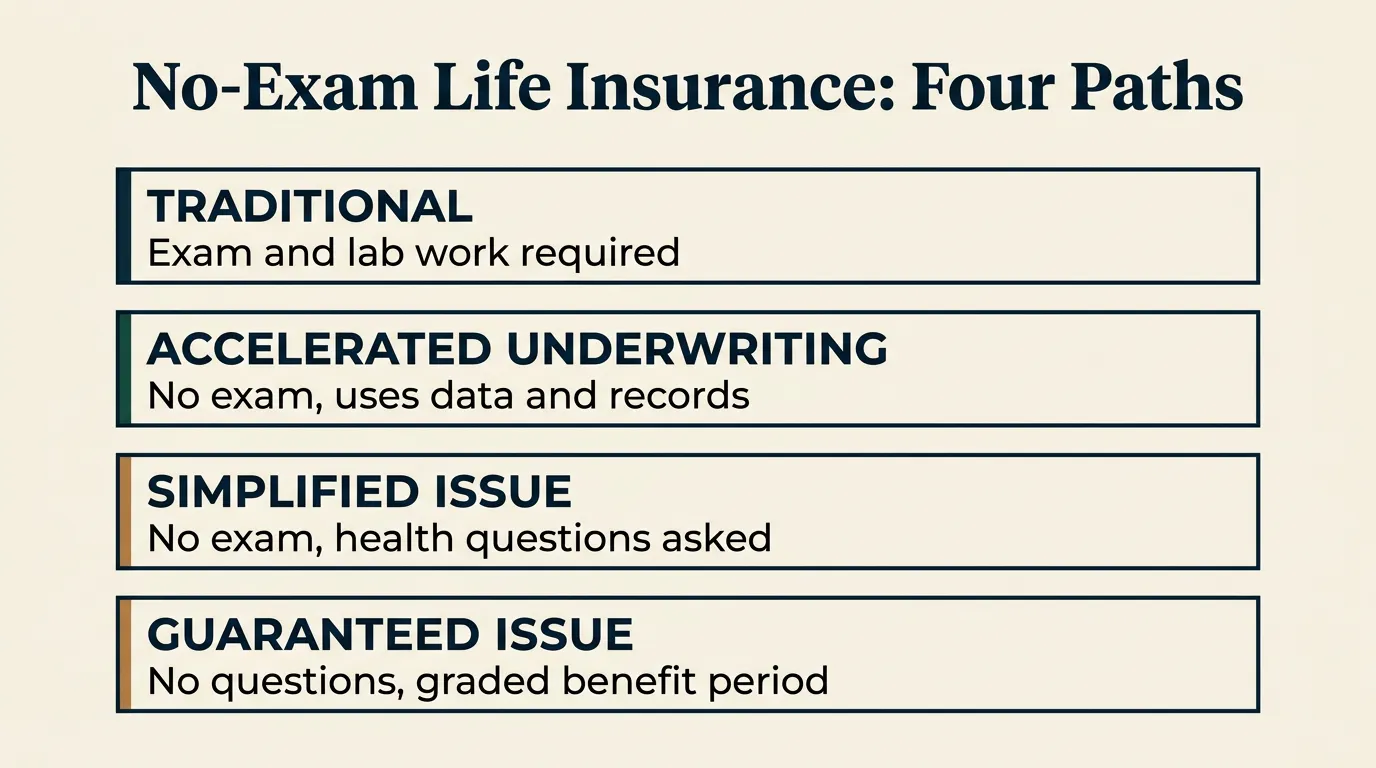
Here is what each category actually replaces the exam with, from the most information collected to the least:
- Traditional, fully underwritten life insurance uses a paramedical exam (a nurse or paramedical professional visits you or you visit a clinic), blood and urine lab work, your answers to detailed health questions, and often an Attending Physician Statement (APS), a records request sent directly to your doctor, for anyone with a meaningful health history. The insurer places you into an underwriting class (preferred plus, preferred, standard, and so on) or assigns a table rating, an additional percentage added to the standard rate for specific health conditions, based on everything it learns.
- Accelerated underwriting (AU) is a specific technique, not a separate product, where the carrier skips the in-person exam for applicants a predictive model scores as low risk, substituting prescription history (pulled from pharmacy databases), motor vehicle records, credit-based insurance scores, and other third-party data instead, according to the National Association of Insurance Commissioners. The NAIC notes this can shrink the time from application to decision “from several weeks to just a few hours” for applicants the model can confidently evaluate, but also cautions that “AU alone does not always lead to issuance of a policy,” meaning some applicants get routed back into traditional underwriting if the available data is not enough to decide.
- Simplified issue (SI) skips the exam and the third-party data modeling and relies instead on your answers to a shorter list of health questions on the application itself. The insurer can still decline you or charge more based on those answers; it is simplified, not automatic. The NAIC’s plain description of this category is that the applicant gets “to forgo the medical exam and collection of fluids in exchange for generally higher premiums.”
- Guaranteed issue (GI) asks no health questions at all and cannot decline any applicant within its eligible age range, typically an older age band aimed at final expense needs. Because the insurer accepts everyone in that age range with zero health information, it protects itself with a graded death benefit, meaning the full face amount is not paid if you die of natural causes during an early grading period set by the carrier, and with a lower maximum coverage amount than the other categories.
One protection runs underneath all four categories, regardless of how you were underwritten: the incontestability provision, defined by the NAIC’s own glossary as “a life insurance and annuity provision limiting the time within which the insurer has the legal right to void the contract on grounds of material misrepresentation in the policy application.” Once that window closes, an insurer generally cannot deny a claim by arguing you misstated something on the application, no matter which underwriting path you used to get the policy in the first place; the exact length of the window is set in your specific contract, so check your own policy for the stated period.
| Path | Exam required? | What the insurer uses instead | Typical fit |
|---|---|---|---|
| Traditional, fully underwritten | Yes, plus lab work | Exam results, lab markers, health questions, often an APS from your doctor | Applicants in good health who want the lowest cost per dollar of coverage and don't mind the exam |
| Accelerated underwriting (AU) | No, for applicants the model can score | Prescription history, motor vehicle records, credit-based insurance scores, predictive modeling, per the NAIC | Healthy applicants who want traditional-style pricing without scheduling an exam, if the model has enough data on them |
| Simplified issue (SI) | No | A shorter list of health questions on the application; can still decline or rate you, per the NAIC | Applicants who want a faster process and can accept a higher premium per dollar of coverage than fully underwritten policies |
| Guaranteed issue (GI) | No | Nothing; no health questions, cannot decline within the eligible age range | Applicants who would likely be declined elsewhere, usually for a smaller, final-expense-sized benefit with a graded period |
National Association of Insurance Commissioners, "Insurance Topics: Accelerated Underwriting," last updated April 7, 2026, and NAIC Glossary of Insurance Terms.
What it costs to get wrong: the market is moving fast, and misjudging your own file is expensive
Two separate mistakes show up over and over, and both cost real money.
The first is assuming you would be declined by traditional or accelerated underwriting and going straight to guaranteed issue, when a shorter list of simplified-issue health questions might have qualified you for meaningfully more coverage at a lower cost per dollar. Guaranteed issue exists specifically for people simplified issue would turn away, not as a shortcut for anyone who feels nervous about answering health questions. Skipping straight to it without checking is the insurance equivalent of assuming you don’t qualify for a mortgage and renting instead, without ever actually applying.
The second mistake runs the other direction: assuming any policy without an exam must be a lesser, “consolation prize” product and avoiding the whole category, including accelerated underwriting, which for the right applicant can be priced very close to a traditional exam-based policy. According to LIMRA’s 2025 Insurance Barometer Study, about three in four American adults overestimate what life insurance actually costs, and among adults 30 and under, the median overestimate runs 10 to 12 times the real price. That kind of cost misconception cuts both ways: it can push a healthy person who would qualify for accelerated underwriting toward believing they need to “settle” for guaranteed issue’s smaller benefit, or it can convince someone who would genuinely benefit from a no-exam path to avoid the whole conversation because they assume every option is expensive.
Meanwhile, the underwriting technology behind accelerated underwriting keeps expanding the pool of people it can confidently score without an exam. U.S. life insurance application activity finished the first half of 2026 up 15.4% year-to-date, the highest mid-year total on record, according to MIB’s Life Index, which tracks underwriting inquiries across the industry. Individual life insurance sales overall set a new record too: total new annualized premium reached $17.5 billion in 2025, up 10% from 2024’s $16.2 billion, with policy count rising 7% for the year, according to LIMRA, and LIMRA specifically credited final expense product sales, the category most guaranteed issue policies fall into, as a driver of that growth. The practical takeaway is that the underwriting menu you are choosing from in 2026 is not static; more applicants are being routed through faster, exam-free paths than in past years, which makes it more important, not less, to know which category you actually landed in.
U.S. individual life insurance new annualized premium, 2024 vs. 2025
LIMRA, "LIMRA: U.S. Individual Life Insurance Premium Exceeds $16 Billion in 2024, Setting New Sales Record" (January 30, 2025) and "LIMRA: Double-Digit Growth Drives Individual Life Insurance New Premium to Set New Sales Record in 2025" (March 3, 2026).
4
Distinct underwriting paths sold under the "no exam" umbrella
15.4%
Growth in U.S. life insurance application activity, YTD mid-2026, per MIB's Life Index
$17.5B
Total new individual life insurance premium in 2025, per LIMRA
A worked comparison: the same person, three different doors
Take a hypothetical 47-year-old in Sioux Falls, treated for high blood pressure with medication that has kept it controlled for four years, who wants $250,000 of coverage and does not want to schedule an exam if it can be avoided. This is an illustration built to show how the categories differ, not a quote, a projection, or a promise of any outcome for a real applicant; actual underwriting decisions depend on the specific carrier, the complete health record, and the person’s full application.
| Path considered | What would actually happen |
|---|---|
| Accelerated underwriting | If prescription and third-party records show blood pressure well-controlled for a sustained period, the model may score this file as low risk and route it to a no-exam decision at a rate close to traditional pricing; if the data is ambiguous, the NAIC notes AU can route the file back to full underwriting instead of denying it outright |
| Simplified issue | Health questions about the blood pressure diagnosis, medication, and control would be asked directly; a well-controlled, medicated condition is answerable rather than disqualifying, though the premium per dollar of coverage would run higher than a fully underwritten policy at the same face amount |
| Guaranteed issue | No health questions asked, but this path is built for applicants who would not qualify elsewhere; using it here, without checking accelerated or simplified issue first, would likely mean a smaller maximum benefit, a graded period, and a higher cost per dollar of coverage than this applicant may have actually needed to accept |
Illustrative example only, based on a hypothetical applicant. Not a quote, projection, or guarantee of underwriting outcome, rate, or approval; actual results depend on the applicant's full health record, the specific carrier, and underwriting rules current at the time of application.
The pattern in that table is the point of this whole article: a controlled, well-documented health condition is exactly the kind of file that has real options in accelerated underwriting and simplified issue, and jumping straight to guaranteed issue without checking either one first tends to leave both coverage and money on the table.
"No exam" tells you what a policy skipped. It does not tell you what the insurer used instead, and that difference is where the real cost lives.
Mike Moore, Life Insurance AdvisorHow to work it out yourself: a five-step check before you apply
You can do the first four of these steps on your own, with no one’s help, before you ever fill out an application.
- Write down your health history honestly, in plain language. List diagnoses, medications, dosages, and how long each condition has been stable. “High blood pressure, controlled on medication for four years” is a very different file than “high blood pressure, diagnosed six months ago, still adjusting medication,” even though both might describe someone reaching for a no-exam option.
- Ask what specific information each category would want from you. A fully underwritten or accelerated underwriting path wants records and, in the traditional case, an exam; simplified issue wants direct answers to a shorter question list; guaranteed issue wants nothing but your age and your premium. Match your own comfort level and your health history against that list before assuming which one applies to you.
- Do not assume “no exam” means “cheapest.” The NAIC is explicit that simplified underwriting trades the exam for “generally higher premiums.” If avoiding the exam is your only goal and your health is genuinely good, price a traditional or accelerated underwriting option before defaulting to simplified or guaranteed issue.
- Check for a graded death benefit before you sign anything. If a policy has no health questions at all, assume a graded period applies until you have confirmed otherwise in the actual contract, and understand exactly what your beneficiary would receive if you died of natural causes during that window.
- Get illustrated pricing for more than one path before deciding. This is the step where a second opinion tends to help most, because comparing what accelerated underwriting, simplified issue, and guaranteed issue would each actually offer you, across more than one carrier, is not something a single online calculator can do with your specific health file.
You can run steps 1 through 4 yourself
Those four steps just require your own health records and an honest read of your situation. Where it tends to help to have someone local look at it with you is comparing how different carriers treat the same health file across categories, since underwriting rules for the same condition can vary meaningfully from one company to the next.
If you would rather have someone local work through this with you instead of guessing, that is what we do: Compare My Options.
When traditional underwriting is genuinely the better answer
It is worth saying plainly: if you are in good health, have no meaningful prescription history, and do not mind scheduling an exam, a fully underwritten policy is very often the least expensive way to buy the coverage you need, dollar for dollar. No-exam categories exist to solve a real problem, either convenience or a health history that would slow down or complicate traditional underwriting, not to replace traditional underwriting as the default choice for everyone. If your only reason for wanting to skip the exam is that scheduling it feels like a hassle, it is worth pricing both paths before you decide that convenience is worth the premium difference.
The opposite is also true, and just as important to say. If you have a health condition and have assumed for years that it makes you flatly uninsurable, that assumption is very often wrong, and it is worth checking rather than continuing to go without coverage. Independent agencies see how differently carriers treat the same file, and a condition one company rates heavily might barely move the needle for another, especially once accelerated underwriting and simplified issue programs are part of the comparison. Our related guide on getting life insurance after a health condition goes deeper on how underwriting actually treats specific conditions in 2026.
How we help
We are independent, so we are not built around selling one company’s simplified issue product or another’s guaranteed issue plan. We start with your actual health history and the coverage amount you are trying to reach, walk through which of these categories is genuinely worth exploring for your file, and compare carrier options across the paths that make sense, rather than assuming you belong in whichever category happens to be easiest to sell. If a health condition has kept you from even asking, that is exactly the conversation worth having, since the answer is often more available than people expect.
What you get
A clear, plain-language read on which underwriting category, or categories, actually fit your health history, not a guess based on marketing language. A comparison of what more than one carrier would actually offer across the paths worth considering for your situation. And, if a traditional or accelerated underwriting policy turns out to be the more cost-effective route for you, the chance to see that before committing to a smaller, costlier guaranteed issue plan by default.
Find out which underwriting path actually fits you
We will go through your health history and the coverage you are trying to reach, and show you how accelerated underwriting, simplified issue, and guaranteed issue would each actually treat your file.
Not ready to talk to anyone yet? Read How It Works first and come back when you are.
Frequently asked questions
What is no-medical-exam life insurance and how is it different from a traditional policy?
It is an umbrella term for any life insurance you can apply for without a paramedical exam and blood or urine sample. It is not one product. The NAIC groups these applications into a few distinct categories, mainly accelerated underwriting and simplified issue, plus a separate category called guaranteed issue, and each one uses a different amount of information to decide whether to insure you and at what price. A traditional, fully underwritten policy uses an exam, lab work, and often your medical records; no-exam categories substitute some or all of that with health questions, prescription history, and data analytics instead.
What is the difference between simplified issue and guaranteed issue life insurance?
Simplified issue asks you a set of health questions on the application and can decline you or rate you based on your answers. Guaranteed issue asks no health questions at all and cannot decline anyone in the eligible age range, which is why it almost always carries a graded death benefit for an early stretch of years set by the carrier and a lower maximum coverage amount than simplified issue. Guaranteed issue exists for people simplified issue would decline, not as a shortcut for people who would otherwise qualify for more.
What is accelerated underwriting, and how is it different from no-exam life insurance in general?
Accelerated underwriting, or AU, is a specific method some carriers use to skip the exam for certain applicants by pulling prescription history, motor vehicle records, and other third-party data and running it through a predictive model instead, according to the NAIC. It is one path to a no-exam outcome, not a separate product category from simplified issue; some AU programs are built on top of a simplified issue or even a fully underwritten application, they just skip the in-person exam step for applicants the model scores as low risk.
Why do no-exam policies typically cost more than fully underwritten coverage?
Because the insurer knows less about you. The NAIC’s own description of simplified underwriting states plainly that applicants forgo the medical exam and lab work “in exchange for generally higher premiums.” An insurer that cannot verify your blood pressure, cholesterol, or lab markers has to price in more uncertainty, and that uncertainty shows up as a higher premium per dollar of coverage than a fully underwritten policy would charge the same healthy applicant.
What is a graded death benefit, and which policies include one?
A graded death benefit means the full face amount is not payable if you die of natural causes during an early grading period set by the carrier and stated in the contract; instead, your beneficiary typically receives a return of premiums paid, sometimes with modest interest, and the full benefit applies once that period ends. It is standard on guaranteed issue policies and occasionally appears on simplified issue plans for older applicants or certain health answers. Death by accident is usually paid in full from day one even during the grading period, but check the specific contract language.
Is no-medical-exam life insurance a good fit for me if I am healthy and just want to avoid the exam?
It can be, but it is worth pricing against a traditionally underwritten policy first if you are in good health, since a healthy applicant who qualifies for a preferred underwriting class on a fully underwritten policy will often find that policy costs less than a no-exam alternative for the same coverage. No-exam underwriting earns its keep most clearly for people whose health history would slow down or complicate traditional underwriting, not as a default convenience upgrade for someone who would sail through the exam easily.
How do I find out if I actually need to go the no-exam route, or if I would qualify for something better?
Start with an honest self-read of your health history using the checklist earlier in this article, then get illustrated pricing for more than one category before you commit. The only way to know for certain which underwriting path fits your file is to have the conversation, since online calculators cannot see your actual health history or a specific carrier’s current underwriting rules.
Does South Dakota regulate no-exam and accelerated underwriting life insurance differently than other states?
South Dakota licenses and regulates the carriers and products sold here the same way most states do, through the South Dakota Division of Insurance, and national model frameworks from the NAIC shape how accelerated underwriting programs are reviewed for fair treatment of applicants. There is no separate South Dakota-only category of no-exam coverage; the products available are the same national categories described in this article, sold by carriers licensed to do business in this state.
Before you sign anything
This article is general education, not insurance, legal, financial, or tax advice. Product availability, underwriting categories, coverage limits, and rates vary by carrier and by state, and are subject to underwriting. No coverage exists until a policy is issued and in force. Any guarantees are subject to the claims-paying ability of the issuing insurer. Please review actual policy documents and speak with a licensed agent about your situation.
Sources
- National Association of Insurance Commissioners — Insurance Topics: Accelerated Underwriting — last updated April 7, 2026; definitions of accelerated underwriting and simplified underwriting, processing-time description, and regulatory background
- National Association of Insurance Commissioners — Glossary of Insurance Terms — incontestability provision, cash value, and endorsement/rider definitions
- LIMRA — Adults Age 30 and Younger Overestimate Life Insurance Cost by 10–12 Times — published June 25, 2025, from the 2025 Insurance Barometer Study; ownership rate and cost-overestimation figures
- LIMRA — Double-Digit Growth Drives Individual Life Insurance New Premium to Set New Sales Record in 2025 — published March 3, 2026; 2025 premium and policy-count figures
- LIMRA — U.S. Individual Life Insurance Premium Exceeds $16 Billion in 2024, Setting New Sales Record — published January 30, 2025; 2024 premium figure
- MIB Group — June 2026 U.S. Life Index — published July 14, 2026; year-to-date application activity growth
Related reading: Getting Life Insurance After a Health Condition: 2026 Underwriting Trends, How Much Life Insurance Do You Actually Need? A Working Method, and Life Insurance Cost by Age: 30, 40 and 50 in 2026. See current options for no-medical-exam life insurance and guaranteed-issue coverage, or learn more about who we help.