
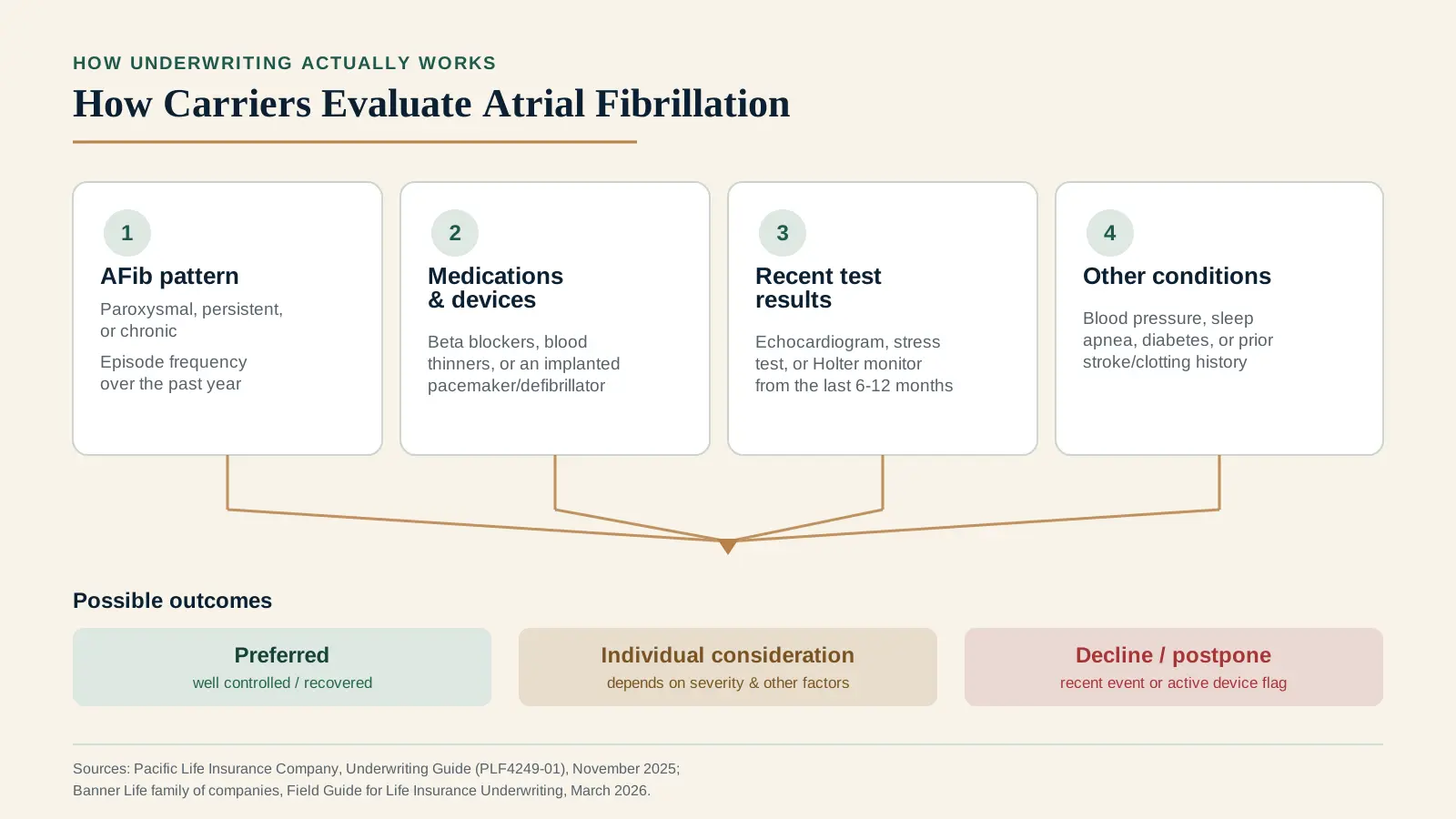
Often, yes. A diagnosis of atrial fibrillation, AFib for short, does not automatically shut the door on life insurance, and it rarely means what people assume it means on an application. What actually drives the outcome, according to two national carriers’ own published underwriting guides, is the pattern of your AFib, how it’s managed, your most recent testing, and what else is in your file, not the diagnosis code by itself. This guide walks through how carriers in 2025 and 2026 actually underwrite atrial fibrillation, using real underwriting documents and federal health data, so you can find out where you likely stand instead of assuming the answer is no.
The short version
- More than 2 million U.S. adults are estimated to have atrial fibrillation today, according to the National Heart, Lung, and Blood Institute, and the CDC projects that figure will reach 12.1 million by 2050 as the population ages.
- Pacific Life's current underwriting guide states that "Preferred classes may be available" for atrial fibrillation "if well controlled or recovered" — AFib is not automatically rated down, let alone declined.
- Banner Life's guide doesn't list AFib by name, but it does flag an implanted defibrillator as a decline-or-postpone trigger, which is a different thing from the arrhythmia itself.
- AFib carries roughly a fivefold increase in ischemic stroke risk, according to American Heart Association statistics cited by the CDC, which is part of why an Attending Physician Statement is required for every case, at every carrier we reviewed.
- SDCL 58-15-10 makes a South Dakota life insurance policy incontestable, apart from fraud or nonpayment, two years after it's issued — a protection for coverage you already hold, separate from how a new application gets underwritten.
Why “I have AFib, so I assume no” is the wrong starting point
Here’s the pain point in the words we actually hear: My doctor said atrial fibrillation, I looked it up, saw the word “stroke” attached to it, and decided applying for life insurance wasn’t worth the rejection. That reaction is understandable. It’s also not what the carriers’ own underwriting rules say will happen, and it keeps people from ever finding out what they’d actually qualify for.
Atrial fibrillation (AFib) is an irregular and often rapid heart rhythm that starts in the heart’s upper chambers, the atria. It’s the most common type of arrhythmia, a general term for any abnormal heartbeat, irregular in rhythm, too fast, or too slow. AFib shows up in a few patterns: paroxysmal, meaning episodes that come and go on their own, usually lasting minutes to days; persistent, meaning episodes that last longer than seven days or require treatment to stop; and chronic (sometimes called permanent), meaning the irregular rhythm is ongoing and the decision has been made not to try to restore a normal rhythm. The pattern you have is one of the first things an underwriter will want to understand, because it changes the picture considerably.
Underwriting is the process a life insurance company uses to evaluate an applicant’s risk and decide whether to offer coverage, at what price, and in which risk class, also called a rate class, a tier like Preferred Plus, Preferred, Standard Plus, or Standard that sets your premium relative to the carrier’s base rate. A table rating is a priced step above Standard, used for elevated but not disqualifying risk; each step adds a set percentage to the premium, set by the individual carrier. An Attending Physician Statement (APS) is a formal request for your medical records from your doctor or cardiologist, used whenever an underwriter needs more detail than the application provides, and it is required in essentially every arrhythmia case. A contestability period is the window, two years under South Dakota law, during which an insurer can investigate and potentially deny a claim over a material misstatement on the application.

None of this is hidden information. Life insurance carriers publish underwriting field guides for their own agents, laying out in table form what best-case and worst-case outcomes look like for dozens of conditions, AFib included. We pulled the current guides from two national carriers, Pacific Life Insurance Company and the Banner Life family of companies (Banner Life Insurance Company and William Penn Life Insurance Company of New York), to show what they actually say, in plain terms, with no guesswork filling the gaps.
How common is atrial fibrillation, really?
Before getting into the underwriting mechanics, it helps to see the scale of what’s being underwritten, because a lot of the fear behind this pain point comes from treating AFib as rare or unusual. It isn’t.
| Measure | Figure | Period |
|---|---|---|
| U.S. adults estimated to have AFib currently | More than 2 million | As of Nov. 2022 update |
| U.S. adults projected to have AFib | 12.1 million | 2050 projection |
| All Medicare fee-for-service beneficiaries with a diagnosed case | 8.0% | 2014 |
| Medicare beneficiaries 65+ with AFib, men | 10.5% | 2014 |
| Medicare beneficiaries 65+ with AFib, women | 8.4% | 2014 |
| Increased ischemic stroke risk associated with AFib | ~Fivefold | AHA 2022 statistics |
| South Dakota adults ever told they had a cardiac condition or stroke (general measure) | 8.4% | 2024 |
Sources: National Heart, Lung, and Blood Institute, "Atrial Fibrillation" (last updated Nov. 30, 2022); CDC, "Atrial Fibrillation," citing Miyasaka et al., Circulation (2006) and Colilla et al., American Journal of Cardiology (2013), and citing Tsao et al., "2022 Heart Disease and Stroke Statistics," American Heart Association, Circulation; CMS Office of Minority Health, Data Snapshot No. 16, "Health Disparities in the Medicare Population: Atrial Fibrillation" (Aug. 2016), Chronic Condition Data Warehouse, 2014 data; America's Health Rankings analysis of CDC Behavioral Risk Factor Surveillance System data, 2024. Accessed October 2026.
These figures measure different things
The "more than 2 million" and "12.1 million by 2050" figures describe the same condition at two different points in time, from two different federal sources, not a sudden sixfold jump that already happened. The Medicare figures are diagnosed prevalence among fee-for-service beneficiaries only, from 2014, so they undercount the true total and exclude Medicare Advantage enrollees. The South Dakota figure is a broader cardiovascular measure, not AFib-specific; it's included to show that South Dakota's overall cardiac-history rate tracks close to the national average, not as a direct AFib statistic.
Put plainly: AFib is already common enough that the National Heart, Lung, and Blood Institute puts the current U.S. count over 2 million, and the CDC’s own projection, built on two separate epidemiological studies, expects that to reach 12.1 million by 2050 as the population ages. Among people already on Medicare, where AFib becomes far more common with age, roughly 1 in 12 had a diagnosed case in 2014, per the CMS data below, rising higher among men than women. A condition at that scale isn’t an edge case sitting in a drawer somewhere in an underwriting manual. It’s common enough that carriers underwrite it routinely.
AFib diagnosis rate among Medicare fee-for-service beneficiaries 65+, by sex (2014)
Source: CMS Office of Minority Health, Data Snapshot No. 16, "Health Disparities in the Medicare Population: Atrial Fibrillation" (Aug. 2016), Chronic Condition Data Warehouse, 2014 data. Accessed October 2026.
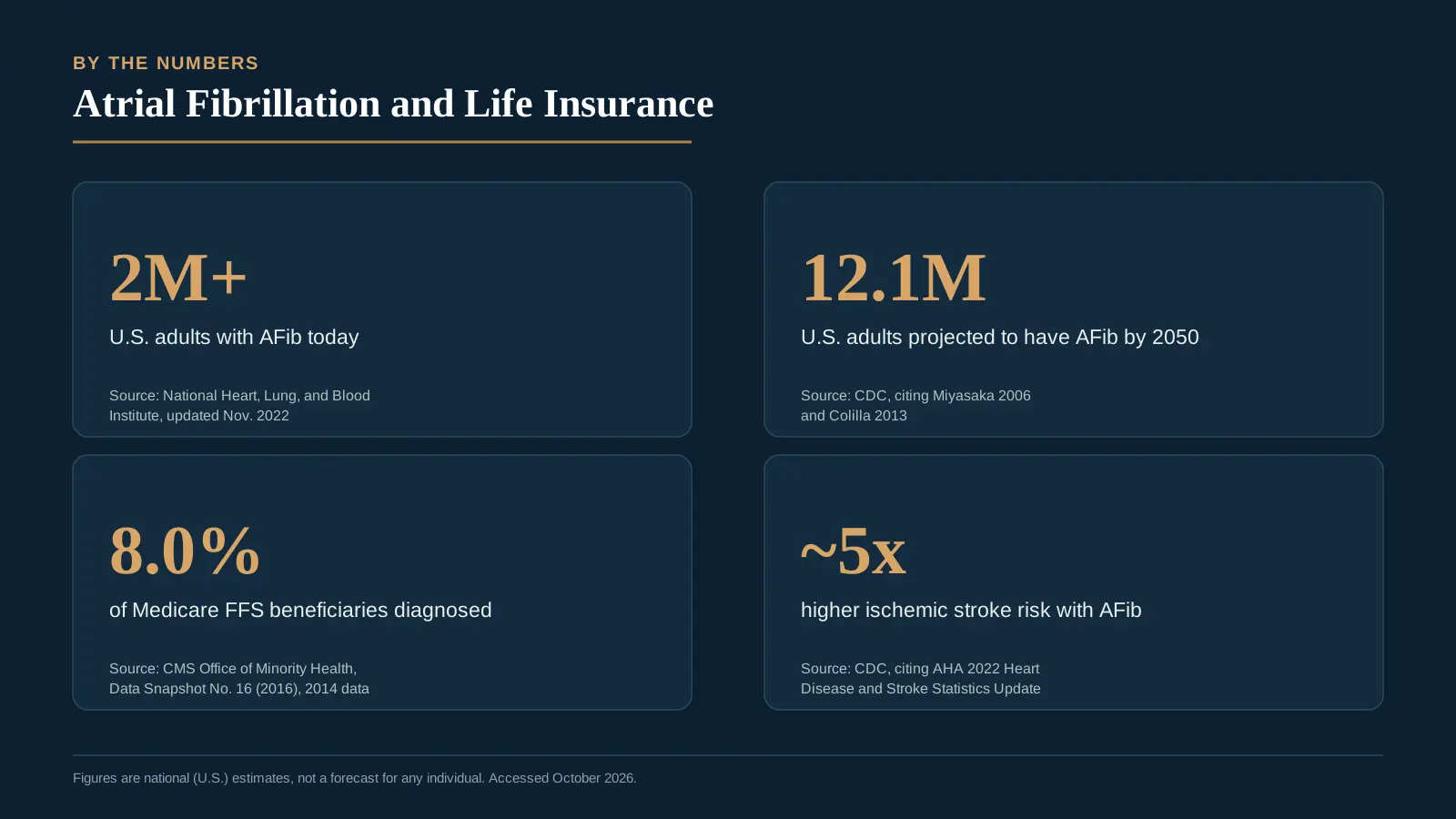
Stroke risk is the other number worth sitting with. AFib lets blood pool in the heart’s upper chambers instead of moving through efficiently, which raises the odds of a clot forming and traveling to the brain. The CDC, citing the American Heart Association’s 2022 statistical update, puts the increased risk of ischemic stroke associated with AFib at roughly fivefold, after accounting for standard stroke risk factors. That single number is a large part of why every carrier guide we reviewed requires medical records before making a decision, rather than relying on the application alone.
What underwriters actually look at, in their own published guides
This is the mechanism behind the pain point: people picture underwriting as a single box to check next to “arrhythmia.” That isn’t how either guide we reviewed actually works.
Pacific Life’s Underwriting Guide (PLF4249-01, dated November 2025) groups “Arrhythmia/Palpitations (including Atrial Fibrillation, Ventricular Tachycardia, etc.)” as its own line item. It requires an Attending Physician Statement for all cases, and states directly: “Preferred classes may be available if well controlled or recovered,” with the outcome otherwise “depending on severity and presence of other conditions.” That’s a meaningfully open door, not a rating floor. The same guide treats a separate but related condition, heart valve problems, more narrowly: mild mitral valve prolapse with no other heart conditions can also reach Preferred classes, while valve surgery within the last six months is a decline.
Banner Life’s Field Guide for Life Insurance Underwriting (March 2026) doesn’t break out atrial fibrillation as its own line, which is a real difference between the two guides worth knowing about before you assume every carrier documents conditions the same way. What Banner Life’s guide does list, among its declines-and-postpones triggers, is an “Automatic implantable cardioverter-defibrillator,” the device sometimes implanted to manage dangerous heart rhythms. It also includes “Heart (Cardiac) Disease” generally among the conditions that keep an applicant out of its top, Preferred Plus non-medical best class, requiring individual consideration instead. In other words: Banner Life’s published guide tells you less about AFib specifically, and more about the device and general-category thresholds that would apply around it.
| Scenario | Pacific Life | Banner Life family of companies |
|---|---|---|
| Paroxysmal AFib, well controlled, infrequent episodes | Named line item; "Preferred classes may be available if well controlled or recovered" | Not named separately; evaluated under its general "Heart (Cardiac) Disease" individual-consideration category |
| Chronic or persistent AFib with other cardiac findings | Outcome "depends on severity and presence of other conditions" | Same general cardiac-disease category; individual consideration |
| AFib managed with an implanted defibrillator (ICD) | APS required for all cases; individual consideration | Automatic implantable cardioverter-defibrillator listed as a decline-or-postpone trigger |
| Any arrhythmia or palpitations case | Attending Physician Statement required for all cases, by name | Not a standalone line item; grouped under cardiac disease generally |
Sources: Pacific Life Insurance Company, Underwriting Guide: Confidence for Generations (PLF4249-01), November 2025; Banner Life family of companies (Banner Life Insurance Company and William Penn Life Insurance Company of New York), Field Guide for Life Insurance Underwriting, March 2026. Both guides state individual underwriting decisions depend on the full case and may differ from these examples. Every carrier sets its own guidelines; these two are shown as examples, not the full market.
These are illustrative examples, not a promise
The table above reflects two carriers' published guidelines as of the dates shown, describing example outcomes under specific, stated conditions. Underwriting decisions are made case by case, guidelines change, and other carriers set their own rules that may differ from either example here. Nothing here is a quote, an approval, or a guarantee for any individual applicant.
The real takeaway from putting these side by side isn’t that one carrier is “better” for AFib. It’s that the two guides document the same condition at completely different levels of detail, which means the carrier you apply to can change how your case gets read before an underwriter ever opens your file. That’s exactly the kind of difference an independent comparison is built to catch.
Two worked, hypothetical examples
Take a hypothetical case: a 46-year-old Rapid City resident was diagnosed with paroxysmal AFib 18 months ago. She’s had two brief episodes in the past year, takes a low-dose beta blocker daily, and had a normal echocardiogram at a cardiology follow-up six months ago. She doesn’t smoke and has no other cardiac history.
Under Pacific Life’s published guide, this case lines up closely with the language “well controlled or recovered,” which keeps Preferred classes on the table rather than assuming a rated Standard outcome from the start. An Attending Physician Statement would still be required, as it is for every arrhythmia case, but the specifics here, infrequent episodes, consistent medication, a clean recent test, work in her favor rather than against her. Under Banner Life’s guide, the same case would likely be evaluated under its general cardiac-disease category, which calls for individual consideration rather than an automatic class; nothing in the published guide treats a well-managed paroxysmal case as disqualifying.
Now take a different hypothetical: a 68-year-old Sioux Falls resident has chronic, persistent AFib, takes a daily blood thinner, and also has high blood pressure managed with medication. Under Pacific Life’s guide, the outcome explicitly “depends on severity and presence of other conditions,” language that signals a more involved underwriting review, not an automatic decline. Banner Life’s defibrillator-specific decline trigger wouldn’t apply unless a device is actually implanted; absent that, this case also falls under its general cardiac-disease individual-consideration category. Both examples are built to show how the mechanics work, not a benefit estimate or approval for any real applicant. Every case is evaluated on its own facts and its own test results, at whichever carrier it’s submitted to.
Compare both of those to the version of this story that keeps people from ever applying: I was told I have AFib, so I assume I’m stuck with the worst possible outcome, or no coverage at all. Based on what these two carriers actually publish, that assumption looks wrong for a well-managed paroxysmal case, and incomplete, not automatically bleak, even for a more complicated chronic case with other conditions in the mix.
Assuming an AFib diagnosis means "no" before applying
- Treats any arrhythmia diagnosis as automatically disqualifying, regardless of pattern or how well it's managed
- Never checks what a specific, current carrier's guidelines actually say about AFib or related devices
- Either skips applying for coverage entirely or defaults to one option without comparing
Common outcomeCoverage never gets sized or bought, based on an assumption that isn't checked
Laying out the specifics and comparing carriers
- Gathers the AFib pattern, diagnosis date, medications, devices, and recent cardiology results up front
- Compares how more than one carrier's guidelines treat that specific history, since detail and outcomes vary
- Applies with a carrier whose published criteria and documentation actually fit the applicant's situation
Common outcomeAn actual underwriting decision, not a guess, and a comparison across carriers instead of one
What it costs to guess wrong
The real cost here isn’t a specific premium figure; no honest source can quote you one without underwriting your actual file. It’s what happens when the assumption of “I’ll be declined” goes unchecked, at a scale that’s easy to underestimate given that more than 2 million U.S. adults already carry this diagnosis, per the National Heart, Lung, and Blood Institute. Two outcomes tend to follow, and both are avoidable:
- Going without coverage entirely, because applying feels pointless. If something happens to that person, the mortgage, the income replacement, the final expenses, none of it gets covered, not because they were actually uninsurable, but because they never found out.
- Applying with only one carrier, usually whichever company came up first in a search, and treating that single answer as the final word on “am I insurable,” when a different carrier’s guidelines, as the comparison table above shows, document the same condition very differently.
Both trace back to the same root problem: treating an assumption about AFib as a fact instead of checking it against what carriers actually publish. If you’d rather have someone local walk through your specific diagnosis and compare carrier options directly, that’s a conversation worth having before you decide coverage isn’t available to you. Compare My Options.
Don't confuse this with no-exam or guaranteed-issue coverage
No-medical-exam and guaranteed-issue life insurance are real product categories for people whose health history makes traditional underwriting harder. They're worth knowing about as a category. But jumping straight to one of those without first checking what a fully underwritten policy would actually offer for a well-documented AFib case can mean paying for less coverage than you may have qualified for through standard underwriting. Compare both paths before assuming you need the second one.
How to work through this yourself before you apply
Here’s the method, laid out step by step, no gatekeeping:
- Write down your AFib pattern. Paroxysmal, persistent, or chronic, the date of diagnosis, episode frequency over the past year, and whether it’s associated with any other diagnosis like high blood pressure, sleep apnea, or a thyroid condition. Underwriters ask for exactly this level of detail, so having it ready before you apply speeds up the process.
- List your current management. Medications and dosages (beta blockers, blood thinners, antiarrhythmics), any procedure performed (cardioversion, ablation), and whether a pacemaker or defibrillator is involved. A device changes the picture, as Banner Life’s guide shows with its specific decline-or-postpone trigger for implanted defibrillators.
- Pull your most recent cardiology results. An echocardiogram, stress test, or Holter monitor report from the last six to twelve months gives an underwriter something concrete to evaluate, rather than relying on the diagnosis alone.
- Understand what the published guides actually reward. Based on the two guides above, a well-controlled, infrequent, paroxysmal pattern with no other cardiac findings is the profile most likely to keep Preferred classes on the table. A chronic pattern with other conditions, or an implanted device, is more likely to need individual underwriting, not an automatic decline.
- Answer every application question completely and honestly. South Dakota policies carry a two-year contestability period under SDCL 58-15-10, during which an insurer can investigate a claim and deny it for a material misstatement. Leaving something out to improve your odds up front creates real risk for your beneficiaries later.
- Compare more than one carrier before drawing a conclusion. The side-by-side table above shows one carrier documents AFib by name while another folds it into a general cardiac category. If one company’s guide reads more cautiously than you expected, that isn’t necessarily the final answer across the market.
How we help
We’re an independent agency, which means we aren’t tied to one carrier’s risk appetite or its documentation style. When AFib is part of someone’s picture, that independence is exactly the point: instead of taking one company’s guidelines as the final word, we can look at how different carriers actually treat your specific pattern, medications, and test results, and compare the real options side by side. We start with your specifics, the diagnosis, the episodes, the follow-up care, not a guess, and work from there. If you have a health condition you’ve assumed disqualifies you, it’s worth asking; independent agencies see how different carriers treat the same file. Compare My Options.
What you get
An actual underwriting answer instead of an assumption you never checked. A comparison across carriers instead of one company’s guidelines standing in for “what’s possible.” And, if coverage makes sense once you have real numbers in front of you, a policy sized to your actual situation rather than whatever felt safest to guess at.
An AFib diagnosis in your chart is not the same thing as a decline letter in your mailbox. One carrier's own guide says a well-controlled case can still reach its best rate class. The pattern and the paperwork decide this, not the three letters on the diagnosis.
Mike MooreRelated reading
If a different cardiac condition is the concern, see our guide on life insurance with heart disease. AFib risk climbs alongside other conditions worth checking too: life insurance with high blood pressure, life insurance with sleep apnea, and life insurance with diabetes. For the broader picture on how carriers are handling health conditions generally in 2026, see getting life insurance after a health condition. If you’re weighing the exam-free path, see underwritten vs. no-exam life insurance and how no-medical-exam life insurance actually works.
Not sure this is the only condition in your file?
Weighing the no-exam route?
Read about no-medical-exam life insurance as a category before deciding.
Not ready to talk to anyone yet?
Read how it works first and come back when you are, or reach us through our contact page when you have questions.
Frequently asked questions
Can you get life insurance if you have atrial fibrillation?
Often, yes. Pacific Life’s current underwriting guide groups atrial fibrillation under “Arrhythmia/Palpitations” and states that “Preferred classes may be available if well controlled or recovered,” with the outcome otherwise depending on severity and other conditions in the file. An Attending Physician Statement, a request for your medical records, is required for every case, but that’s a standard step, not a sign the application is in trouble. AFib is also common enough that carriers underwrite it constantly: more than 2 million U.S. adults are estimated to have it today, and the Centers for Disease Control and Prevention projects that figure will reach 12.1 million by 2050.
Does paroxysmal AFib get treated differently than chronic AFib?
The pattern matters to an underwriter, even though the published guides we reviewed don’t break out paroxysmal versus chronic as separate line items. Pacific Life’s guide ties its best outcome, access to Preferred classes, to being “well controlled or recovered,” language that fits an applicant whose episodes are infrequent and managed, better than one with ongoing, persistent AFib plus other cardiac findings. In practice, the fewer episodes, the more stable the medication, and the cleaner the follow-up testing, the stronger the case for a better rate class.
What is a table rating, and would AFib put me in one?
A table rating is a priced step above a carrier’s Standard rate class, used when combined risk factors are elevated but not high enough to decline the application. It isn’t a decline. Whether AFib alone results in a table rating depends on the carrier and the specifics of the case; Pacific Life’s guide explicitly keeps the door open to a Preferred class for well-controlled AFib, while a case with a recent episode, an implanted defibrillator, or other cardiac history is more likely to land in a rated class or need individual underwriting.
Does having a pacemaker or defibrillator for AFib automatically disqualify you?
Not automatically, but it is treated as a flag worth checking before you apply. Banner Life’s March 2026 field guide lists an automatic implantable cardioverter-defibrillator among its decline-or-postpone triggers, which means it’s a case to run past underwriting rather than assume the worst about. Pacific Life’s guide requires an Attending Physician Statement for every arrhythmia case regardless of device, and evaluates the outcome based on severity and the rest of the file.
How common is atrial fibrillation, really?
Common enough that it’s one of the most frequent cardiac conditions carriers underwrite. The National Heart, Lung, and Blood Institute estimates AFib affects more than 2 million U.S. adults as of its most recent update. The CDC projects that number will grow to 12.1 million by 2050 as the population ages. Among Medicare fee-for-service beneficiaries, 8.0% had a diagnosed case in 2014, according to a CMS Office of Minority Health data snapshot, rising to 10.5% among men and 8.4% among women age 65 and older.
Why does AFib raise stroke risk, and does that affect underwriting?
AFib allows blood to pool in the heart’s upper chambers, which raises the chance of a clot forming and traveling to the brain. The CDC, citing the American Heart Association’s 2022 statistical update, puts the increased risk of ischemic stroke associated with AFib at roughly fivefold after accounting for standard stroke risk factors. Underwriters weigh stroke risk indirectly, through the severity of the AFib itself, any history of stroke or clotting events, and the medications used to manage it, such as blood thinners, rather than applying a flat stroke-risk surcharge.
Will being declined by one carrier because of AFib follow me everywhere?
No, and South Dakota law doesn’t require identical thresholds across carriers. SDCL 58-33-26 prohibits an insurer from unfairly discriminating between insureds with genuinely similar risk characteristics, but each company still sets its own underwriting guidelines. Because those guidelines differ, as the Pacific Life and Banner Life comparison in this guide shows, a cautious answer from one carrier reflects that carrier’s own risk appetite for your file, not a verdict on your insurability industry-wide.
Does an AFib diagnosis ever stop mattering for a policy I already own?
For a policy already in force, yes, in a specific legal sense. SDCL 58-15-10 requires South Dakota life insurance policies to become incontestable, except for fraud or nonpayment of premium, once the policy has been in force for two years from its issue date. After that two-year mark, the insurer generally can’t rescind the policy over an application misstatement discovered later. That protection covers coverage you already hold; a new application is underwritten fresh, on its own facts, at whichever carrier you apply to.
Sources
- National Heart, Lung, and Blood Institute — Atrial Fibrillation — “affects more than 2 million adults in the United States”; risk increases with age; last updated November 30, 2022; accessed October 2026
- CDC — Atrial Fibrillation — 12.1 million people in the U.S. projected to have AFib by 2050, citing Miyasaka et al., Circulation (2006) and Colilla et al., American Journal of Cardiology (2013); AFib associated with an approximately fivefold increased risk of ischemic stroke, citing Tsao et al., “2022 Heart Disease and Stroke Statistics,” American Heart Association, Circulation; 232,030 death certificates mentioned AFib in 2021, citing NCHS Multiple Cause of Death data; accessed October 2026
- CMS Office of Minority Health — Data Snapshot No. 16: Health Disparities in the Medicare Population, Atrial Fibrillation — in 2014, 8.0% of all Medicare Fee-For-Service beneficiaries had a diagnosis of AF; among beneficiaries 65 and older, 10.5% of men and 8.4% of women; source: CMS Chronic Condition Data Warehouse; published August 2016; accessed October 2026
- America’s Health Rankings — Cardiovascular Diseases, South Dakota — analysis of CDC Behavioral Risk Factor Surveillance System data; South Dakota 8.4% of adults ever told they had angina, coronary heart disease, a heart attack, or a stroke (rank 11 of 50) vs. 9.2% U.S. average, 2024 data; accessed October 2026
- Pacific Life Insurance Company — Underwriting Guide: Confidence for Generations (PLF4249-01) — November 2025 edition; Arrhythmia/Palpitations (including Atrial Fibrillation, Ventricular Tachycardia) underwriting criteria; Heart Attack/Myocardial Infarction and valve-condition criteria; accessed October 2026
- Banner Life family of companies — Field Guide for Life Insurance Underwriting — March 2026 edition; automatic implantable cardioverter-defibrillator decline/postpone trigger; Heart (Cardiac) Disease individual-consideration category; accessed October 2026
- South Dakota Legislature — SDCL 58-15-10, Incontestability provision required — two-year incontestability period for South Dakota life insurance policies, except fraud or nonpayment of premium; accessed October 2026
- South Dakota Legislature — SDCL 58-33-26, Unfair discrimination as to terms and conditions of insurance — prohibits unfair discrimination between insureds with like risk characteristics; accessed October 2026
Related reading: life insurance with heart disease, life insurance with high blood pressure, life insurance with sleep apnea, life insurance with diabetes, getting life insurance after a health condition, underwritten vs. no-exam life insurance, and no-medical-exam life insurance in South Dakota.
Before you act on any of this
This article is general education, not insurance, legal, financial, medical, or tax advice, and it is not an underwriting decision or a promise of coverage for any individual. Carrier guidelines shown here are illustrative examples current as of the dates listed and are subject to change; other carriers set different rules. Product availability, features, and rates vary by carrier and are subject to underwriting. No coverage exists until a policy is issued and in force. Any guarantees are subject to the claims-paying ability of the issuing insurer. Please review actual policy documents and speak with a licensed agent about your own situation.
The pattern and the paperwork decide this, not the diagnosis
Most people who assume AFib closes the door on life insurance have never actually checked, because the fear of a “no” feels worse than not asking. What the two carriers’ own published guides show is more specific, and less bleak, than that fear: the pattern of your AFib, how it’s managed, your recent test results, and anything else in your file, not the three letters on the diagnosis by themselves. You can write down your own specifics this week, the pattern, the medications, the last echocardiogram, and see how they line up against the guidelines above. That comparison is worth more than another year of guessing.
Want an actual answer instead of a guess?
We'll walk through your specific AFib history and compare carrier options sized to what's actually in your file, not an assumption about it.