
Often, yes. A history of heart disease, including a past heart attack, coronary artery disease, or bypass surgery, does not automatically disqualify you from life insurance in South Dakota, and the diagnosis alone usually isn’t what decides your outcome. What actually moves the needle, according to two national carriers’ own published underwriting guides, is the specific event, how long ago it happened, what your follow-up testing shows, and what else is in your file. This guide walks through how life insurance underwriting actually treats cardiac history in 2026, using real carrier documents and federal health data, so you can find out where you likely stand instead of assuming the answer is no.
The short version
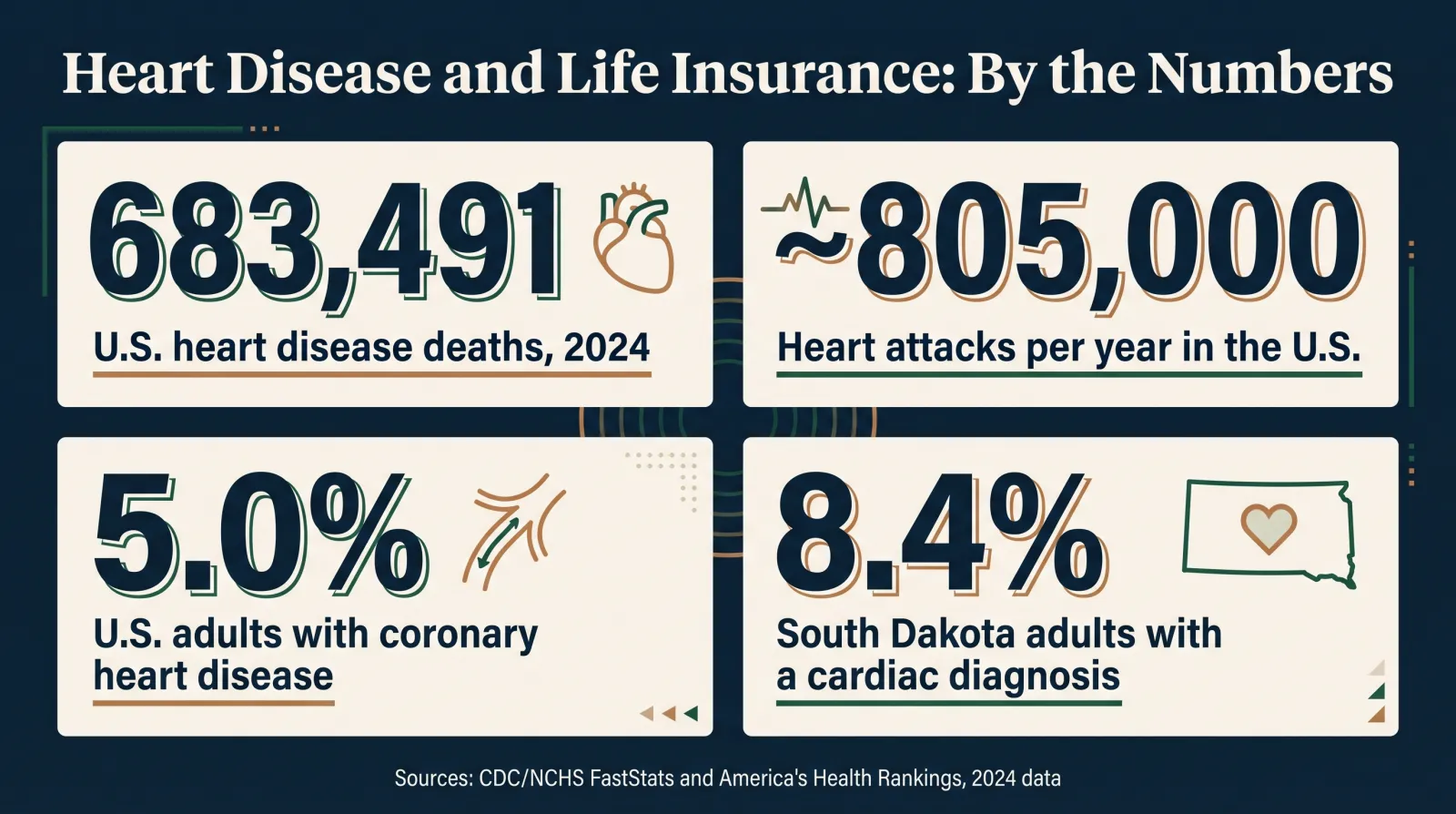
- Heart disease caused 683,491 deaths in the United States in 2024, more than any other single cause, according to the CDC's National Center for Health Statistics — carriers underwrite this history every day, not as a rare exception.
- About 1 in 20 U.S. adults age 20 and older, roughly 5%, have coronary artery disease, and about 805,000 Americans have a heart attack every year, per the American Heart Association's 2026 statistical update as reported by the CDC.
- Both Banner Life family of companies and Pacific Life Insurance Company treat a heart attack or bypass surgery within the last 3 to 6 months as a decline-or-postpone trigger, which means the outcome changes once you're past that window, not that the history disqualifies you permanently.
- In South Dakota, 8.4% of adults reported ever being told they had angina, coronary heart disease, a heart attack, or a stroke as of 2024, according to America's Health Rankings' analysis of CDC survey data, slightly better than the 9.2% national rate.
- Managing heart disease costs the U.S. health care system more than $168 billion in services and medications between 2021 and 2022, according to National Heart, Lung, and Blood Institute data cited by the CDC — a scale that's exactly why carriers built specific, published underwriting rules for it instead of a blanket decline.
Why “I probably can’t get covered now” is the wrong starting assumption
Here’s the pain point in the words we hear most often: I had a heart attack, or I have a stent, or my doctor found blocked arteries, so I’ve just assumed life insurance is either off the table or too expensive to bother applying and finding out. That assumption keeps a lot of people from ever starting the process, and it isn’t supported by how carriers actually underwrite cardiac history in 2026.
Underwriting, for anyone new to the term, is the process a life insurance company uses to evaluate an applicant’s risk and decide whether to offer coverage, at what price, and in which risk class (also called a rate class), a tier like Preferred Plus, Preferred, Standard Plus, or Standard that sets your premium relative to the carrier’s base rate. A table rating, sometimes written as Table 1 through Table 12 or Table A through Table J depending on the carrier, is a priced step above Standard used for higher-risk applicants; each step adds a set percentage to the premium, with the exact percentage set by the individual carrier. An Attending Physician Statement (APS) is a request for your medical records from a doctor, cardiologist, or clinic, used when an underwriter needs more detail than the application alone provides, and it’s required in nearly every cardiac case. A contestability period is the window, commonly two years, during which an insurer can investigate and potentially deny a claim if the application contained a material misstatement.

None of that is secret information. Life insurance carriers publish underwriting field guides for their agents that lay out, in table form, what best-case and worst-case outcomes look like for dozens of health conditions, heart disease included. We pulled the current guides from two national carriers, Banner Life family of companies (Banner Life Insurance Company and William Penn Life Insurance Company of New York) and Pacific Life Insurance Company, to show what those guides actually say about cardiac history, in plain terms, with no guesswork.
How common is heart disease and a heart attack, really?
Before getting into underwriting mechanics, it’s worth establishing the scale of what we’re talking about, because a lot of the fear behind this pain point comes from treating a cardiac diagnosis as rare or unusual. It isn’t. Heart disease has been the leading cause of death in the United States for decades, and the numbers behind that fact are large enough that carriers have built entire sections of their underwriting guides around it.
| Measure | Figure | Period |
|---|---|---|
| U.S. deaths from heart disease (leading cause of death) | 683,491 | 2024 |
| U.S. adults age 20+ with coronary artery disease | ~1 in 20 (about 5%) | 2026 report |
| U.S. adults ever diagnosed with coronary heart disease | 5.0% | 2024 |
| Heart attacks per year in the U.S. (605,000 first-time, 200,000 recurrent) | ~805,000 | 2026 report |
| U.S. deaths from cardiovascular disease overall | 919,032 (1 in 3 deaths) | 2023 |
| South Dakota adults ever told they had angina, CHD, heart attack, or stroke | 8.4% | 2024 |
| U.S. adults, same measure | 9.2% | 2024 |
Sources: CDC/National Center for Health Statistics, FastStats — Heart Disease and FastStats — Deaths and Mortality (2024 National Vital Statistics System data via CDC WONDER); CDC, Heart Disease Facts, citing Palaniappan et al., "2026 Heart Disease and Stroke Statistics," American Heart Association, Circulation (Jan. 2026); America's Health Rankings analysis of CDC Behavioral Risk Factor Surveillance System data. Accessed August 2026.
These figures measure different things
"Heart disease" deaths (2024), "cardiovascular disease" deaths (2023, a broader category that includes stroke), and "coronary artery disease" deaths specifically (371,506 in 2022, per the same CDC source) use different definitions and different years, so they aren't directly interchangeable. None of these are a life insurance approval rate. They're included to show scale, not to predict any individual's underwriting outcome.
Put plainly: heart disease killed more Americans in 2024 than cancer did, by a margin of roughly 64,000 deaths (683,491 versus 619,876, both per the CDC’s National Center for Health Statistics), and it has held the position of the nation’s leading cause of death for decades. A condition on that scale isn’t an edge case for a life insurance underwriter. It’s one of the most common things in the file, which is exactly why carriers have built specific, published rules for it, the same way they have for blood pressure or cholesterol.
Leading causes of death in the United States, 2024
Source: CDC/National Center for Health Statistics, FastStats — Deaths and Mortality, 2024 data (Mortality in the United States, 2024, data table for figure 4). Accessed August 2026.
What underwriters actually look at, in their own published guides
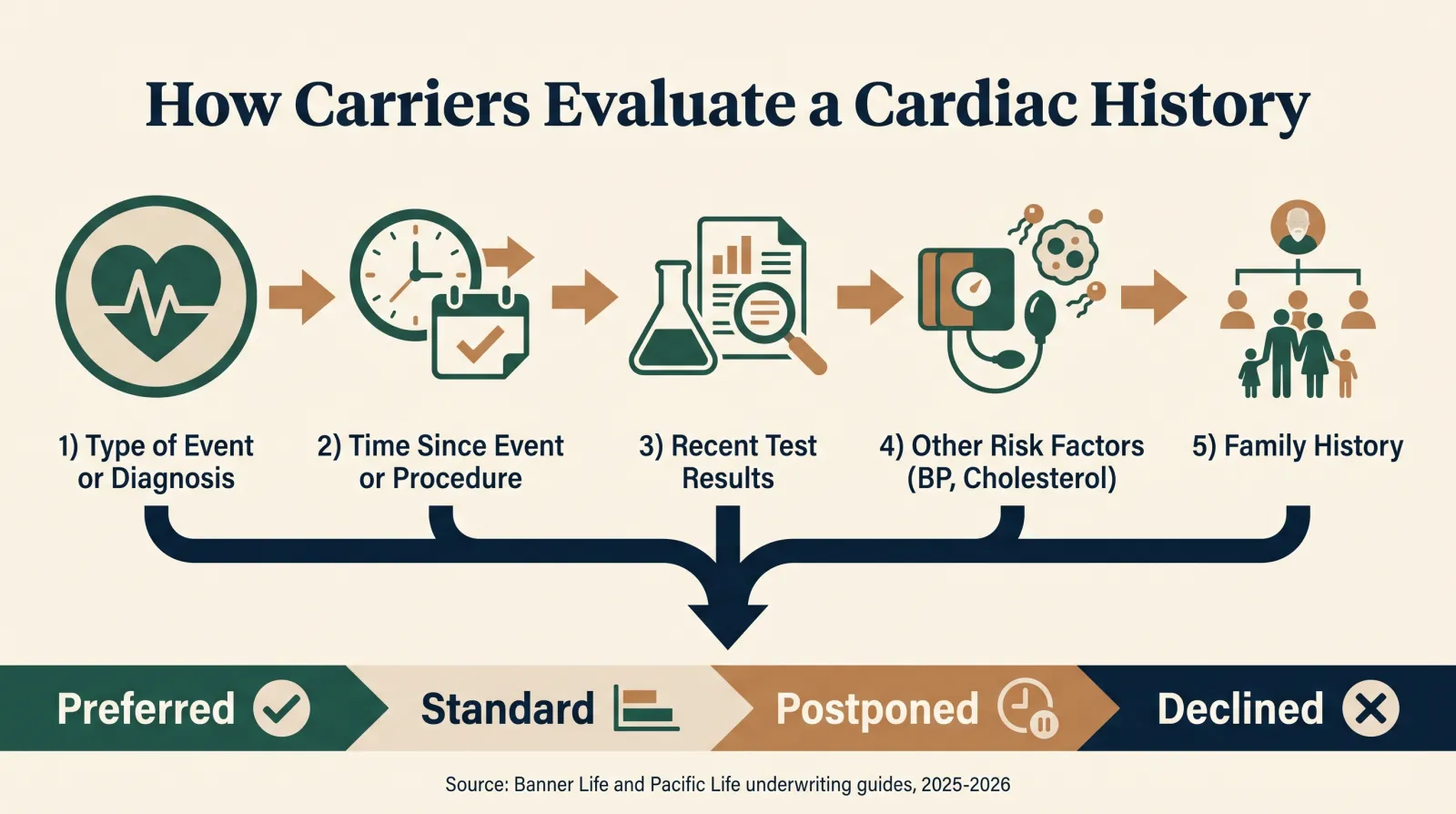
This is the mechanism behind the pain point: most people picture underwriting as a single yes/no checkbox next to “heart disease.” That isn’t how it works. Both carrier guides we reviewed break the question into specific conditions, specific timelines, and specific test results, not a blanket rule.
Banner Life’s Field Guide for Life Insurance Underwriting (March 2026) lists coronary artery disease under its “Declines and postpones” section with a narrow trigger: a stent or bypass within the last 6 months. Outside that window, the guide treats CAD as something to evaluate individually rather than an automatic decline. The same guide lists a heart attack (MI) within the last 6 months on the same decline-or-postpone list. On the credit side, Banner Life’s Preferred and Preferred Plus family-history criteria require “no cardiovascular death in either parent or sibling before age 60,” but the guide also states that “CAD is disregarded for applicants over age 70 who don’t use tobacco,” and its credit program can move an applicant who’s held back only by a parent’s cardiovascular death at a young age up one full rate class if other criteria, like a recent normal cardiac test, are met.
Pacific Life’s Underwriting Guide (PLF4249-01, dated November 2025) groups “Heart Disease Angina, Angioplasty, Bypass (Coronary Artery Disease, Coronary Bypass CABG)” together and requires an Attending Physician Statement for all cases. It states outcomes get “individual consideration” and lists specific decline triggers: uninvestigated unstable angina, angioplasty surgery less than 1 month ago, CABG (bypass) less than 3 months ago, or a heart attack within the last 6 months. The same guide treats “Heart Attack/Myocardial Infarction” as its own line: APS required for all cases, outcome “depends on severity and presence of other conditions,” and decline for an event within the last 6 months. Separately, Pacific Life’s guide states that arrhythmia and atrial fibrillation can still reach “Preferred classes” if “well controlled or recovered,” and that mild mitral valve prolapse with no other heart conditions can also qualify for Preferred classes, while heart valve surgery within the last 6 months is a decline.
| Scenario | Banner Life family of companies | Pacific Life |
|---|---|---|
| Coronary artery disease, stable, no recent procedure | Individual consideration; not on the decline list outside a recent stent/bypass | APS required for all cases; individual consideration |
| Stent or angioplasty within the last month | Within its 6-month stent/bypass decline-or-postpone window | Listed as a specific decline trigger under 1 month |
| Bypass surgery (CABG), 4-6 months ago | Still inside the 6-month decline-or-postpone window | Past its 3-month decline window; individual consideration |
| Heart attack (MI) within the last 6 months | Listed as a decline-or-postpone trigger | Listed as a decline trigger; individual consideration after |
| Well-controlled atrial fibrillation | Not separately listed; evaluated as an impairment overall | Preferred classes may be available if well controlled or recovered |
| Family history: one parent, cardiovascular death before age 60 | Standard Plus baseline; credit program may restore Preferred | Not addressed as a standalone family-history rule in this guide |
Sources: Banner Life family of companies (Banner Life Insurance Company and William Penn Life Insurance Company of New York), Field Guide for Life Insurance Underwriting, March 2026; Pacific Life Insurance Company, Underwriting Guide: Confidence for Generations (PLF4249-01), November 2025. Both guides state that individual underwriting decisions depend on the full case and may differ from these best-case scenarios. Every carrier sets its own guidelines; these two are shown as examples, not the full market.
Two things stand out from putting these side by side. First, both carriers converge on the same rough timeline for the highest-risk window: a heart attack, a stent, or a bypass within the last several months to a year is what actually triggers a decline or a “contact underwriting first” flag, not the diagnosis itself. Second, the two carriers don’t handle every scenario identically, especially arrhythmia and family history, which is exactly why shopping matters when a cardiac history is part of the picture. A file that gets a cautious answer from one carrier can get a meaningfully different one from another, because each company sets its own underwriting philosophy and risk appetite.
These are illustrative examples, not a promise
The table above reflects two carriers' published guidelines as of the dates shown, describing example outcomes under specific, stated conditions. Underwriting decisions are made case by case, guidelines change, and other carriers set their own rules that may differ from either example here. Nothing here is a quote, an approval, or a guarantee for any individual applicant.
A worked, hypothetical example
Take a hypothetical, illustrative case: a 52-year-old South Dakota resident had a heart attack 14 months ago, received a stent (angioplasty) at the time, has taken cholesterol and blood pressure medication consistently since, had a follow-up stress test six months ago that came back normal, and has not smoked in over ten years. Nothing about daily life has changed; this person works full time and sees a cardiologist for regular follow-up care.
Under Banner Life’s published guide, this case is well outside the 6-month decline-or-postpone window for both the heart attack and the stent, which means it moves into individual consideration rather than an automatic decline. Under Pacific Life’s guide, an Attending Physician Statement would be required, as it is for every cardiac case, and the outcome would “depend on severity and presence of other conditions,” language that leaves room for a range of outcomes from a rated Standard offer up to, in some files, one of the carrier’s better classes, depending on what the full record shows. This is a hypothetical example built to show how the mechanics work, not a benefit estimate or approval for any real applicant; every case is evaluated on its own facts and its own test results.
Compare that to the version of this story that keeps people from ever applying: I had a heart attack, so I assume I’m stuck with the worst possible outcome, or no coverage at all. Based on what these two carriers actually publish, that assumption is very likely wrong for a stable, well-documented case like the one above, more than a year past the event.
Assuming a cardiac event means "no" before applying
- Treats any heart attack, stent, or diagnosis as automatically disqualifying, regardless of how long ago it happened
- Never checks what a specific, current carrier's guidelines actually say about the timeline and test results in the file
- Either skips applying for coverage entirely or defaults to one option without comparing
Common outcomeCoverage never gets sized or bought, based on an assumption that isn't checked
Laying out the specifics and comparing carriers
- Gathers the diagnosis, event date, procedures, medications, and recent test results up front
- Compares how more than one carrier's guidelines treat that specific history, since guidelines vary
- Applies with a carrier whose published criteria and timeline actually fit the applicant's situation
Common outcomeAn actual underwriting decision, not a guess, and a comparison across carriers instead of one
What it costs to guess wrong
The real cost here isn’t a specific premium figure, since no honest source can quote you one without underwriting your actual file. It’s what happens when the assumption of “I’ll be declined” goes unchecked, at a scale that’s easy to underestimate. Roughly 1 in 20 U.S. adults have coronary artery disease and about 805,000 people have a heart attack every year, according to the American Heart Association’s 2026 statistical update as cited by the CDC, and treating the U.S. health care system’s more-than-$168-billion annual cost for heart disease services and medications (2021-2022, National Heart, Lung, and Blood Institute data cited by the CDC) as a backdrop, this is not a small population making the same assumption. Two outcomes tend to follow, and both are avoidable:
- Going without coverage entirely, because applying feels pointless. If something happens to that person, the mortgage, the income replacement, the final expenses, none of it gets covered, not because they were actually uninsurable, but because they never found out.
- Applying with only one carrier, usually whichever company an ad or a search result surfaced first, and treating whatever answer comes back as the final word on “am I insurable,” when a different carrier’s published guidelines, as the comparison table above shows, might land somewhere else entirely.
Both of those trace back to the same root problem: treating an assumption as a fact instead of checking it against what carriers actually publish.
Don't confuse this with no-exam or guaranteed-issue coverage
No-medical-exam and guaranteed-issue life insurance are real product categories that exist for people whose health history makes traditional underwriting harder. They're worth knowing about as a category. But jumping straight to one of those, without first checking what a fully underwritten policy's actual outcome would be for a specific, well-documented cardiac history, can mean paying for a smaller amount of coverage than a person may have qualified for through the standard process. Compare both paths before assuming you need the second one.
How to work through this yourself before you apply
Here’s the method, laid out step by step, no gatekeeping:
- Write down the specifics of your history. The exact diagnosis or event (heart attack, angina, arrhythmia, valve issue), the date, any procedure performed (stent, angioplasty, bypass, valve surgery), current medications and dosages, and the results of your most recent cardiology follow-up or stress test. Underwriters ask for exactly this level of detail, so having it ready before you apply speeds up the process and reduces back-and-forth.
- Note your timeline against the 3-to-6-month windows. Both carriers’ guides above weight how long it’s been since a stent, bypass, or heart attack, with the highest-risk window sitting in the first several months after the event. A stent from over a year ago with a normal follow-up stress test reads very differently to an underwriter than one from six weeks ago.
- Understand what actually triggers a decline versus a rated offer. Based on the two guides above, that’s mainly: a very recent stent, bypass, or heart attack (within roughly 1 to 6 months depending on the procedure and carrier), uninvestigated unstable angina, or recent heart valve surgery. Outside those specific triggers, most cardiac histories are rated, not declined, meaning they get an offer at some class, even if it isn’t the very top one.
- Answer every application question honestly and completely. Life insurance applications typically carry a contestability period, commonly two years under South Dakota law (SDCL 58-15-10), during which an insurer can investigate a claim and deny it for a material misstatement. Leaving something out to improve your odds up front creates real risk for your beneficiaries later.
- Compare more than one carrier before drawing a conclusion. The side-by-side table above shows two carriers can land in different places on the same scenario, especially around arrhythmia and family history. If one company’s answer doesn’t feel right, that isn’t necessarily the final answer; it may just be that company’s particular risk appetite for your specific history.
How we help
We’re an independent agency, which means we’re not tied to one carrier’s risk appetite. When a cardiac history is part of someone’s picture, that independence is exactly the point: instead of taking one company’s guidelines as the final word, we can look at how different carriers actually treat that specific history, timeline, and test results, and compare the real options. We start with the specifics, the event, the date, the procedure, the follow-up care, not a guess, and work from there. Compare My Options.
What you get
An actual underwriting answer instead of an assumption you never checked. A comparison across carriers instead of a single company’s guidelines standing in for “what’s possible.” And, if coverage makes sense once you have real numbers in front of you, a policy sized to your actual situation rather than whatever felt safest to guess at.
A stent in your chart is not the same thing as a decline letter in your mailbox. The two carriers whose own guides we reviewed here would tell you the same thing: it depends on the timeline and the test results, and most timelines don't end in "no" forever.
Mike MooreRelated reading
If you’re weighing a heart condition specifically against other paths, see our answer on getting life insurance with a heart condition. If a different health condition is the concern, see our guides on life insurance with diabetes, life insurance with high blood pressure, life insurance after cancer, and life insurance with a mental health history. If you’re specifically weighing the exam-free path, see underwritten vs. no-exam life insurance and how no-medical-exam life insurance actually works.
Not sure this is the only condition in your file?
Weighing the no-exam route?
Read about no-medical-exam life insurance as a category before deciding.
Not ready to talk to anyone yet?
Read how it works first and come back when you are, or reach us through our contact page when you have questions.
Frequently asked questions
Can you get life insurance after a heart attack?
Often, yes. Underwriting field guides published by two national carriers in 2025 and 2026 treat a heart attack as a condition to evaluate on its specifics, not an automatic decline, once enough time has passed since the event. Pacific Life’s guide states outcomes for a heart attack “depend on severity and presence of other conditions,” and Banner Life’s guide lists a heart attack within the last 6 months as a decline-or-postpone trigger, which means the calculation changes once you’re past that window. Roughly 805,000 Americans have a heart attack every year, according to the American Heart Association’s 2026 statistical update as cited by the CDC, so carriers underwrite this exact scenario constantly.
How long after a heart attack can you apply for life insurance?
There’s no single industry-wide waiting period, and any specific number you read elsewhere without a named source should be treated with skepticism. What’s actually documented: Banner Life’s March 2026 field guide lists a heart attack (MI) within the last 6 months as a trigger to contact underwriting before applying, since it may result in a decline. Pacific Life’s guide (PLF4249-01, November 2025) states its Heart Attack/Myocardial Infarction category is “required for all cases” to submit an Attending Physician Statement, that outcomes “depend on severity and presence of other conditions,” and that it declines for an event within the last 6 months. Two different carriers, two versions of the same six-month line, which is exactly why comparing carriers matters once you’re past it.
What is a table rating, and how does it apply to heart disease?
A table rating is a priced step above a carrier’s standard rate class, used when an applicant’s combined risk factors are elevated but not high enough to decline. It is not a decline. Both Banner Life and Pacific Life describe coronary artery disease, angioplasty, and bypass history as needing individual, case-by-case underwriting rather than a single fixed rating, which means the actual rate class for a given file depends on the specifics: how long ago the event was, what the follow-up testing shows, and what else is in the file.
Does high cholesterol or a stent automatically raise your rate?
Not automatically, and not the same way at every carrier. Banner Life’s underwriting criteria for its top non-tobacco classes allow a cholesterol/HDL ratio up to 4.5 for Preferred Plus and up to 5.5 for Preferred, both with or without treatment, so cholesterol managed with medication doesn’t rule out its best classes on its own. A stent (angioplasty) is treated differently: Pacific Life’s guide lists angioplasty surgery less than 1 month ago as a decline trigger, which means the timeline, not the fact that a stent exists in your history, is what an underwriter is weighing.
Will a decline at one insurance company follow you to another?
Not automatically, and it isn’t something South Dakota law requires. SDCL 58-33-26 prohibits an insurer from unfairly discriminating between insureds with genuinely similar risk characteristics, but it doesn’t require every carrier to use identical underwriting thresholds. Because guidelines differ by company, as the Banner Life and Pacific Life comparison in this guide shows, an unfavorable outcome at one carrier reflects that carrier’s specific rules applied to your file, not a verdict on your insurability everywhere.
Does an old cardiac event ever stop mattering for a policy you already own?
For a policy you already own and have paid premiums on, yes, in a specific legal sense. SDCL 58-15-10 requires South Dakota life insurance policies to become incontestable, except for fraud or nonpayment of premium, after the policy has been in force for two years from its issue date. Once a policy passes its second anniversary, the insurer generally can’t rescind it over an application misstatement discovered later. That protection applies to coverage you already hold; a new application is a separate process with its own underwriting rules at each carrier.
How common is heart disease and a heart attack, really?
Very common. Heart disease caused 683,491 deaths in the United States in 2024, more than any other cause, according to the CDC’s National Center for Health Statistics. About 1 in 20 adults age 20 and older, roughly 5%, have coronary artery disease, and about 805,000 Americans have a heart attack every year, per the American Heart Association’s 2026 statistical update as reported by the CDC. In South Dakota, 8.4% of adults reported ever being told they had angina, coronary heart disease, a heart attack, or a stroke as of 2024, according to an analysis of CDC Behavioral Risk Factor Surveillance System data by America’s Health Rankings, slightly below the 9.2% national rate.
What should I actually do if I’m worried a cardiac history will get me declined?
Gather the specifics before you apply: the exact diagnosis or event, the date, any procedure (stent, bypass, valve surgery), current medications, your most recent stress test or cardiology follow-up results, and any other conditions like diabetes or high blood pressure. Then compare how more than one carrier’s published guidelines treat that specific history, since guidelines vary company to company, rather than assuming the worst from one company’s rules or a single past experience.
Sources
- CDC/National Center for Health Statistics — FastStats: Heart Disease — 683,491 U.S. deaths in 2024 (rate 201.0 per 100,000, cause-of-death rank 1), source: National Vital Statistics System via CDC WONDER; 5.0% of adults ever diagnosed with coronary heart disease (2024), source: National Health Interview Survey 2019-2024; last reviewed February 20, 2026; accessed August 2026
- CDC/National Center for Health Statistics — FastStats: Deaths and Mortality — 2024 leading causes of death comparison: heart disease 683,491, cancer 619,876, accidents 197,449, stroke 166,852; total U.S. deaths 3,072,666 (2024); source: Mortality in the United States, 2024, data table for figure 4; last reviewed February 20, 2026; accessed August 2026
- CDC — Heart Disease Facts — 919,032 cardiovascular disease deaths in 2023 (1 in 3 deaths); coronary artery disease killed 371,506 people in 2022; about 1 in 20 adults age 20+ (about 5%) have CAD; about 805,000 heart attacks per year (605,000 first-time, 200,000 recurrent), one every 40 seconds, about 1 in 5 silent; more than $168 billion in health care services and medication costs for heart disease, 2021-2022; sources cited on the page: National Center for Health Statistics Multiple Cause of Death 2018-2023 via CDC WONDER, and Palaniappan et al., “2026 Heart Disease and Stroke Statistics: A Report of US and Global Data From the American Heart Association,” Circulation, January 2026, plus an unpublished National Heart, Lung, and Blood Institute tabulation of the Medical Expenditure Panel Survey published in the 2025 AHA Statistical Summary; reviewed October 24, 2024; accessed August 2026
- America’s Health Rankings — Cardiovascular Diseases, South Dakota — analysis of CDC Behavioral Risk Factor Surveillance System data; percentage of adults who reported ever being told by a health professional they had angina or coronary heart disease, a heart attack, or a stroke; South Dakota 8.4% (rank 11 of 50, lower is better) vs. 9.2% U.S. average, 2024 data; accessed August 2026
- Banner Life family of companies — Field Guide for Life Insurance Underwriting — March 2026 edition; coronary artery disease and heart attack decline/postpone triggers; Preferred/Preferred Plus family-history and credit-program criteria; accessed August 2026
- Pacific Life Insurance Company — Underwriting Guide: Confidence for Generations (PLF4249-01) — November 2025 edition; Heart Disease Angina/Angioplasty/Bypass and Heart Attack/Myocardial Infarction underwriting criteria; arrhythmia and valve-surgery criteria; accessed August 2026
- South Dakota Legislature — SDCL 58-15-10, Incontestability provision required — two-year incontestability period for South Dakota life insurance policies, except fraud or nonpayment of premium; accessed August 2026
- South Dakota Legislature — SDCL 58-33-26, Unfair discrimination as to terms and conditions of insurance — prohibits unfair discrimination between insureds with like risk characteristics; accessed August 2026
Related reading: getting life insurance with a heart condition, life insurance with diabetes, life insurance with high blood pressure, life insurance after cancer, life insurance with a mental health history, underwritten vs. no-exam life insurance, and no-medical-exam life insurance in South Dakota.
Before you act on any of this
This article is general education, not insurance, legal, financial, medical, or tax advice, and it is not an underwriting decision or a promise of coverage for any individual. Carrier guidelines shown here are illustrative examples current as of the dates listed and are subject to change; other carriers set different rules. Product availability, features, and rates vary by carrier and are subject to underwriting. No coverage exists until a policy is issued and in force. Any guarantees are subject to the claims-paying ability of the issuing insurer. Please review actual policy documents and speak with a licensed agent about your own situation.
The timeline matters more than the diagnosis
Most people who assume a cardiac history closes the door on life insurance have never actually checked, because the fear of a “no” feels worse than not asking. What two carriers’ own published underwriting guides show is a lot more specific, and a lot less bleak, than that fear: the type of event, how long ago it happened, your follow-up test results, and what else is in your file, not the diagnosis by itself. You can write down your own specifics this week, the event, the date, the procedure, the follow-up care, and see how they line up against the timelines above. That comparison is worth more than another year of guessing.
Want an actual answer instead of a guess?
We'll walk through your specific cardiac history and compare carrier options sized to what's actually in your file, not an assumption about it.