
An epilepsy diagnosis does not close the door on life insurance, and neither does taking an anti-seizure medication every day. Underwriters are estimating mortality risk, not judging your neurology file as a label, and a stable, well-documented seizure disorder with a clear treatment history is a workable file for most carriers. What actually moves the outcome is how long it has been since your last seizure, how consistent your treatment has been, and how complete your medical records are when you apply. This guide walks through how an application actually gets read, what the current federal data says about how common epilepsy is in South Dakota specifically, and what you can work out yourself before you talk to anyone.
The short version
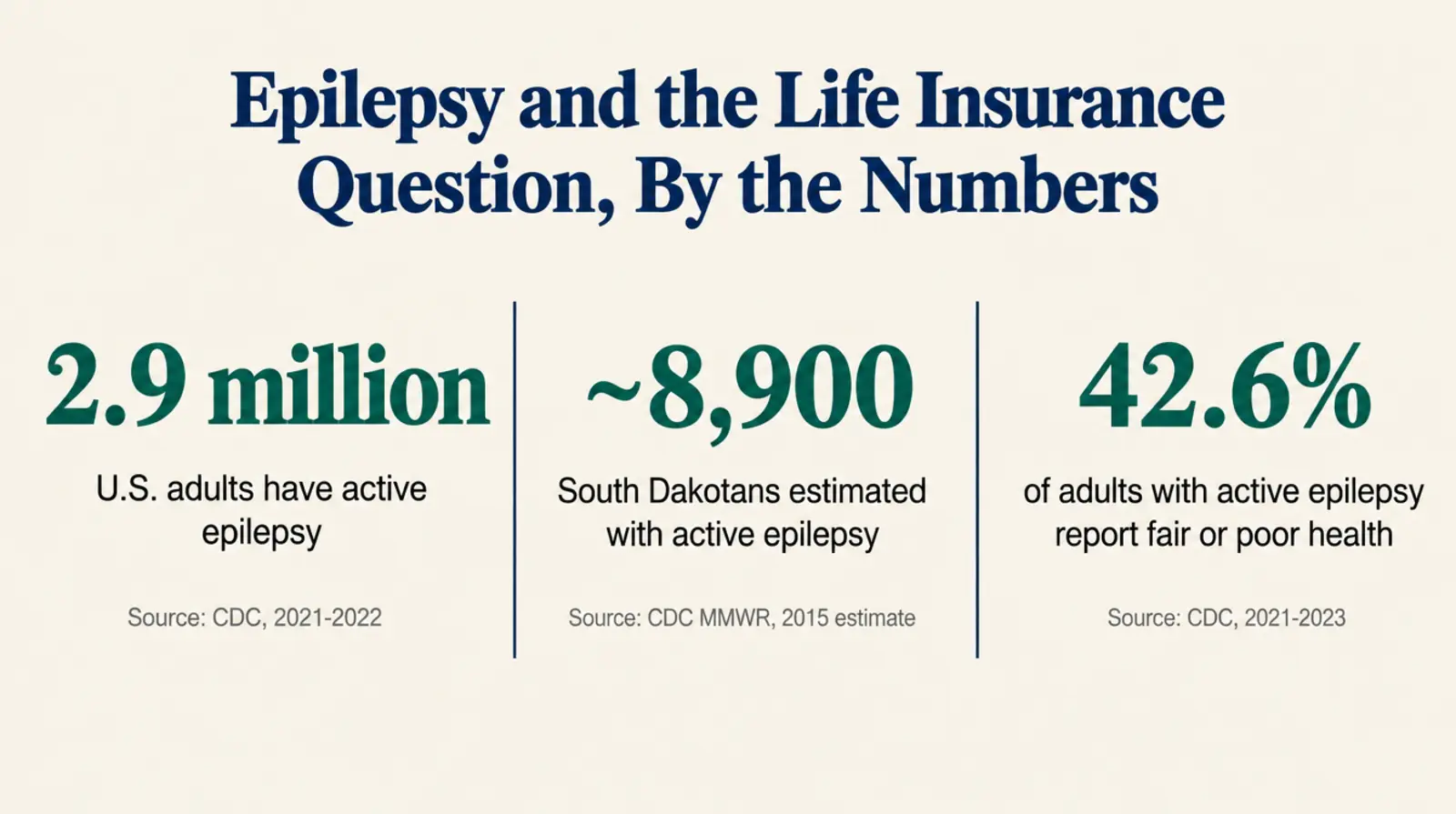
- About 2.9 million U.S. adults, roughly 1% of the adult population, had active epilepsy as of 2021-2022 federal survey data, according to the CDC.
- CDC modeling estimated 8,900 South Dakotans of all ages, about 7,600 adults and 1,300 children, had active epilepsy as of 2015, the most recent state-level estimate published.
- Among U.S. adults with active epilepsy, 42.6% report fair or poor overall health and 38.4% report having a disability, per 2021-2023 CDC survey data.
- Even with treatment, epilepsy is a managed condition for most people, not a cured one: CDC data from 2013-2015 found 90% of adults with active epilepsy were taking medication, 67% had seen a neurologist or specialist in the past year, and only 44% of those on medication reported their seizures were fully controlled.
- South Dakota law gives every life insurance policy sold here a two-year incontestability period from its issue date, under SDCL 58-15-10, which is the practical reason accurate disclosure matters regardless of what you expect underwriting to decide.
The pain: assuming a seizure disorder already decided the answer
A lot of people with epilepsy, especially those diagnosed as adults after a single unexplained seizure, quietly assume life insurance is off the table before they have ever looked at an actual application. The condition sounds disqualifying on its face: a diagnosis tied to the brain, a prescription you’ll likely take for years, maybe even a driving restriction right after diagnosis. It feels like exactly the kind of thing an insurance company would use to say no.
This shows up in ordinary South Dakota situations constantly. A 34-year-old teacher in Sioux Falls who had a single generalized seizure last year, now stable on levetiracetam with no seizures since, who has never applied for life insurance because she assumes the diagnosis alone disqualifies her. A machinist in Rapid City who was diagnosed with epilepsy at age 9, hasn’t had a seizure since high school, and still avoids the topic because the word “epilepsy” sits on an old chart he’d rather not explain. A new father in Watertown recently diagnosed after a nighttime seizure, assuming that because his neurologist mentioned it could take months to know if medication fully controls it, no carrier would even consider him yet.
What actually happens in underwriting is narrower than the fear. Life insurance pricing is built around mortality risk: how likely you are to die during the length of the specific policy you’re buying. A condition that measurably shortens life expectancy when it’s active and poorly controlled, like uncontrolled diabetes or advanced heart disease, moves that estimate directly. Epilepsy that is diagnosed, treated, and stable reads very differently than epilepsy that is new, active, and still being figured out. An underwriter’s real question is simple: is this a settled, well-managed file, or an unsettled one with open questions? A clear diagnosis, a documented treatment plan, and time without a seizure are evidence of the former, not evidence against you.
This is general education, not medical, legal, or insurance advice
Nothing here tells you whether to pursue or continue a specific epilepsy treatment, recommends a medication, or promises that any specific carrier will approve any specific applicant at any specific rate. It is a plain explanation of how a seizure disorder diagnosis factors into a life insurance application, sourced from federal health data and South Dakota law, so you can see the mechanics before you decide when and how to apply.
Why it happens: how an application actually reads an epilepsy file
An underwriter reading your file is not asking “does this person have epilepsy.” They’re asking a narrower set of questions: how long have you been diagnosed, when was your most recent seizure, how long have you been on your current treatment, and what type of seizures does your record show. A handful of terms carry this entire topic, worth defining once since applications and the people reading them don’t always spell them out:
- Epilepsy, also called a seizure disorder, is a neurological condition marked by a tendency toward recurring, unprovoked seizures. A single seizure does not automatically mean a diagnosis of epilepsy; a diagnosis typically follows two or more unprovoked seizures, or one seizure with a high likelihood of recurrence based on testing.
- Anti-seizure medication, sometimes called an anticonvulsant or ASM, is a prescription drug used to prevent or reduce seizures. Levetiracetam, lamotrigine, and valproate are common examples. The classification describes the drug’s medical purpose, not whether any individual patient’s condition is severe.
- Seizure-free interval is the length of time since your most recent seizure. Underwriters generally treat a longer interval as a stronger signal of a stable, well-controlled condition than a recent one, though exactly how long varies by carrier and by the details of your file.
- Focal seizure and generalized seizure describe where in the brain a seizure starts. A focal seizure begins in one area and may or may not spread; a generalized seizure, such as a tonic-clonic seizure, involves both sides of the brain from the onset. The type and pattern documented in your chart shape how an underwriter reads the overall file.
- Underwriting class, also called a rate class, is the risk tier a carrier assigns an approved applicant, which sets the premium. It is built from mortality factors, including age, health history, and seizure control, not from a diagnosis label by itself.
- Attending physician statement, often shortened to APS, is the medical records request a carrier sends to your neurologist or prescribing doctor to confirm diagnosis date, seizure history, current medication, and treatment response. For an epilepsy file, this document is usually what actually answers the stability question, more than anything written on the application itself.
- Contestability period is the window, two years from a policy’s issue date under South Dakota law (SDCL 58-15-10), during which an insurer can investigate a claim and deny it over fraud or a material misstatement on the original application. It is the practical reason accurate disclosure matters on any application, this one included.
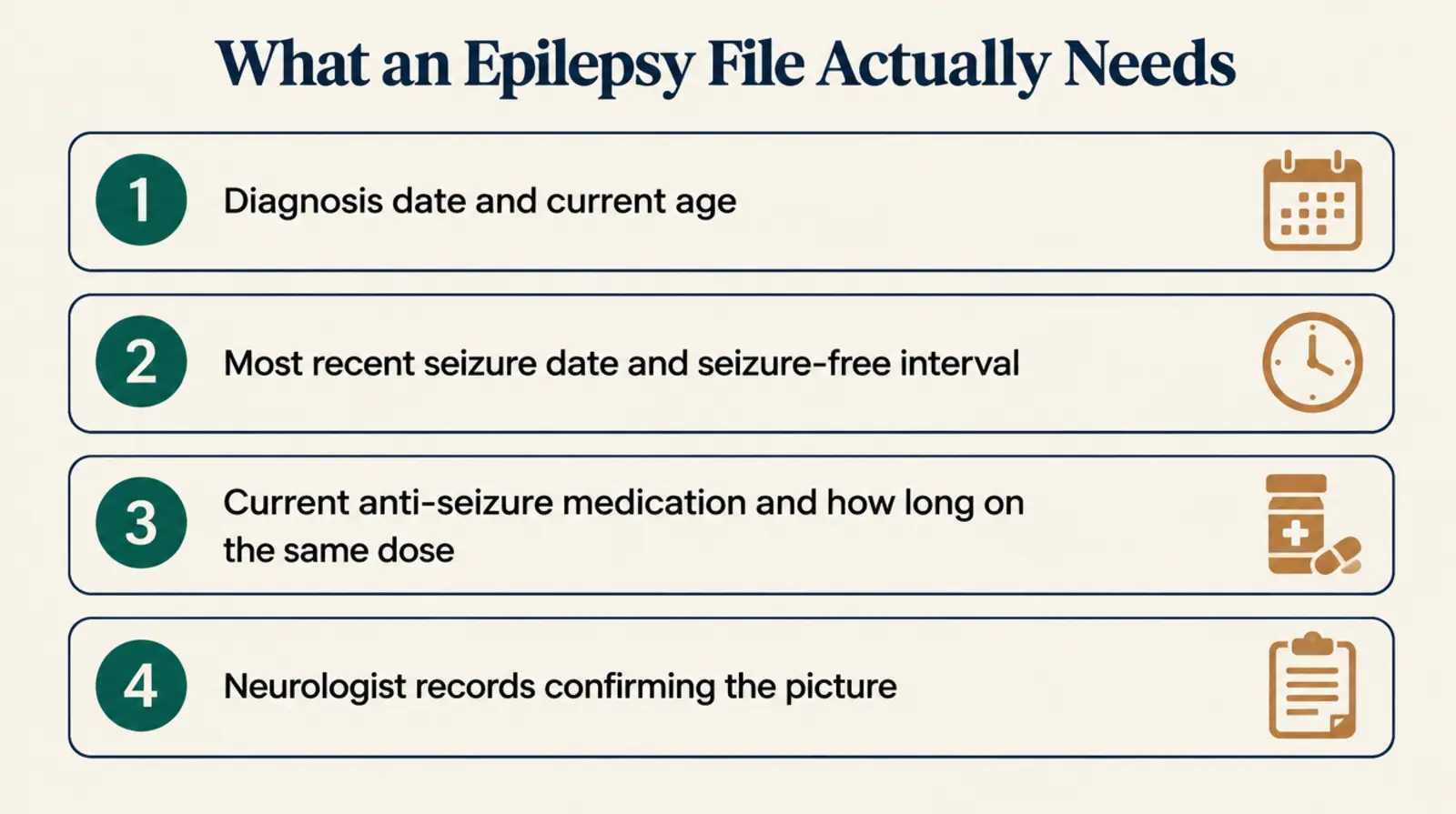
The mechanical detail that surprises most people: taking a prescribed anticonvulsant is not itself a mark against you. An underwriter reading “levetiracetam, 500mg twice daily, same dose for three years” is reading evidence of a managed, stable condition, not a liability. What changes the read is a recent medication change, a recent dose increase, or a recent seizure despite treatment, because those details suggest the condition is still being figured out rather than settled. A consistent regimen, filled on schedule, under one neurologist’s ongoing care, is close to the best-case version of this file; a string of medication switches or gaps in care is a different file entirely, and that distinction, not the prescription itself, is what underwriting actually weighs.
What it costs to get wrong: the numbers behind epilepsy and insurability
Epilepsy is considerably more common, and considerably more of a long-term managed condition rather than a one-time event, than most applicants assume.
The national prevalence figure comes from two separate CDC analyses, which is useful because it lets the number be checked against itself rather than standing alone. The more recent estimate, from Kobau et al., published in Epilepsy & Behavior in 2024 using 2021-2022 National Health Interview Survey data, put active epilepsy at about 1% of U.S. adults, or roughly 2.9 million people. An earlier CDC modeling study, published in the Morbidity and Mortality Weekly Report in 2017 using 2015 data, estimated 1.2% of the population, or 3.4 million people nationally (3 million adults and 470,000 children), had active epilepsy, and broke that estimate down state by state. For South Dakota specifically, that 2017 report put the number at roughly 8,900 residents of all ages, about 7,600 adults and 1,300 children, accounting for the state’s age distribution and income levels at the time. Two different CDC methods, run six years apart, land in the same rough range: epilepsy affects somewhere near 1% of the population, which in South Dakota’s case is a few thousand more neighbors than most people would guess.
What the data also makes clear is that epilepsy, for most people who have it, is a long-term managed condition rather than something that resolves after one scare. A CDC analysis of 2013 and 2015 National Health Interview Survey data, published in the Morbidity and Mortality Weekly Report in 2018, looked specifically at treatment and seizure control among the roughly 2.6 million U.S. adults who self-reported active epilepsy at that time. Ninety percent were taking anti-seizure medication. Sixty-seven percent had seen a neurologist or epilepsy specialist in the past year. And among those taking medication, only 44% reported their seizures were fully controlled.
Treatment and seizure control among U.S. adults with active epilepsy, 2013-2015
CDC, "Active Epilepsy and Seizure Control in Adults — United States, 2013 and 2015," Morbidity and Mortality Weekly Report, Vol. 67, No. 15, 2018. *Among adults with active epilepsy who were taking medication.
| Data year | National estimate | Source |
|---|---|---|
| 2015 | 1.2% of the population, 3.4 million people (3M adults, 470,000 children) | CDC, MMWR Vol. 66, No. 31 (2017) |
| 2021-2022 | About 1% of adults, 2.9 million adults | CDC, Kobau et al., Epilepsy & Behavior (2024) |
Two separate CDC methods, six years apart, landing in the same rough range of roughly 1% of the population.
That last figure is the one worth sitting with. Fewer than half of adults on epilepsy medication in that study reported full seizure control, which is exactly why underwriters look past the diagnosis itself and focus on the seizure-free interval and the documented treatment response in each individual file. Two people can carry the same diagnosis and the same prescription and still represent very different underwriting pictures, because one has been seizure-free for years and the other has not. That gap is also why this blog keeps returning to the broader coverage problem: LIMRA’s 2025 Insurance Barometer Study found that 74 million Americans lack life insurance but say they need it, with another 25 million who already own a policy but recognize they are underinsured. Someone who assumes an epilepsy diagnosis rules out coverage and never applies is adding one gap on top of the other, often for a condition that, once stable, underwrites far more routinely than they expect.
To make this concrete with an illustration, not a quote: a 36-year-old in Brookings with a $210,000 mortgage balance, a spouse earning less, and two kids under 10, diagnosed with focal epilepsy at age 30, seizure-free for the past four years on the same dose of lamotrigine, has a straightforward file by underwriting standards. The arithmetic for how much coverage that family needs, built from the mortgage balance plus years of income replacement for the kids, doesn’t change because of the diagnosis. What can change is how quickly that person finds a carrier that reads a four-year seizure-free file comfortably, which is a shopping question, not a health question.
How to work it out yourself: read your own file before you apply
You don’t need anyone’s help to get an honest, specific read on your own situation before you talk to a carrier or an agent.
Step 1: Write down your diagnosis date, your seizure history, and your current medication timeline. Note when you were diagnosed, the date of your most recent seizure, what you were prescribed first, and any changes since, including dose adjustments. If you’ve been seizure-free for several years on a stable medication, that’s useful to know going in; if your diagnosis or last seizure was recent, that’s useful to know too, since it shapes which carriers are likely to be comfortable with your file today.
Step 2: Note your seizure type if your neurologist has documented one. Focal, generalized, or another classification, along with any identified triggers, gives a fuller picture than “I have seizures” on its own, and it’s exactly what an attending physician statement will show regardless.
Step 3: Gather your neurology records before you apply, not after a carrier asks for them. Your neurologist’s name, the dates of your diagnosis and any seizures, and your current medication and dose speed up the attending physician statement request that carriers typically order on a neurological file. A thin or inconsistent record slows this step down regardless of how well-controlled your epilepsy actually is.
Step 4: Calculate the coverage amount you actually need, using the same arithmetic this blog uses for every reader: add your outstanding debts (mortgage, car loans, remaining balances), then add five to ten years of your income for anyone who depends on it. A diagnosis doesn’t change this math at all; it only affects which carriers you’re likely to have the easiest time with.
Step 5: Compare two realistic scenarios to see how timing and documentation change the picture.
| Detail | Applicant A | Applicant B |
|---|---|---|
| Diagnosis timing | Diagnosed at age 11, well-documented childhood history | Diagnosed 8 months ago at age 29, after a single generalized seizure |
| Seizure-free interval | 14 years, off medication since age 19 | No second seizure yet, but under 1 year since diagnosis |
| Current treatment | None; discontinued under neurologist's care | Started levetiracetam 8 months ago, one dose adjustment so far |
| Records available | Years of consistent neurology follow-up notes | One diagnosing visit, limited follow-up history yet |
| Likely underwriting posture | Reviewed as a routine, stable file | May be asked to wait for more seizure-free history, or reviewed with a higher rate class; varies by carrier |
Illustrative scenario, not an underwriting outcome or a quote. Actual results depend on the specific carrier, the complete application, and underwriting at the time of application.
Applicant A and Applicant B both carry the same underlying diagnosis; what differs is how much settled, seizure-free history exists behind it. Applicant B isn’t uninsurable, but the file is newer, which is exactly the situation where shopping more than one carrier, rather than taking one company’s answer as the final word, tends to produce a meaningfully different outcome.
You can gather all of this yourself first
Steps 1 through 4 just require your own diagnosis date, your neurologist's name, and about twenty minutes. Where a second opinion tends to help most is knowing which carriers are currently comfortable with a recent diagnosis or a shorter seizure-free interval, since that answer changes by company and is hard to guess from outside the industry.
If you’d rather have someone local walk through your seizure history and your numbers with you, that’s what we do: Compare My Options.
The prescription on your file isn't the question an underwriter is asking. How long it has been since your last seizure, and how well-documented your treatment is, is.
Mike Moore, Life Insurance AdvisorWhy South Dakota shopping matters here specifically
The National Association of Insurance Commissioners, the organization that coordinates state insurance regulators nationally, tells consumers plainly to compare similar policies from different companies to find the best value, because life insurance is a competitive marketplace rather than a single fixed price. That advice carries extra weight for a diagnosis like epilepsy, where CDC data shows fewer than half of adults on medication reach full seizure control, meaning files genuinely vary in how settled they are, and how a carrier weighs a given seizure-free interval, a specific seizure type, or a recent medication change differs by company, sometimes significantly.
Disclosure matters regardless of which carrier you choose. Under South Dakota law, SDCL 58-15-10, a life insurance policy becomes incontestable, meaning the insurer generally can’t deny a claim over a misstatement on the original application, two years after the policy’s issue date, except in cases of fraud. That two-year window is the practical reason an epilepsy diagnosis belongs on an application whenever the health questions ask about it, whether or not you expect the answer to change your rate.
If you ever have a concern about how an insurance application was handled, South Dakota’s Division of Insurance, the state agency that licenses and regulates every carrier authorized to sell here, maintains a consumer complaint process and information line at (605) 773-3563, with an office at 124 South Euclid Avenue in Pierre. You can also confirm that any company you’re considering is actually licensed to sell in South Dakota through the division’s own listings before you apply.
How we help
We’re independent, so we’re not tied to one carrier’s view of an epilepsy diagnosis or a seizure history. We start with your actual diagnosis timeline, your seizure-free interval, and your current treatment, not a guess about what a single company will say, and compare how the carriers we work with treat a file like yours today. Because this varies by company and changes as carriers update their own underwriting guidelines, that comparison is one of the more useful things an independent agency can do for someone in exactly this situation. We’re local to Sioux Falls and licensed to serve all of South Dakota, so the person doing that comparison is someone you can actually talk to, not a call center reading from a script.
What you get
A clear, honest read on how your diagnosis timeline, your seizure-free interval, and your current treatment line up against what several carriers are actually looking for right now, not an outdated assumption about what an epilepsy diagnosis means on an application. A comparison across more than one carrier’s view of seizure disorders, instead of a single company’s answer treated as universal. And a plain explanation, in advance, of South Dakota’s own disclosure rules and consumer protections, so there are no surprises two years into a policy.
Find out what your file actually supports
We'll go through your diagnosis timeline, your seizure history, and what you need to protect, and show you how the carriers we work with actually evaluate a file like yours today.
Not ready to talk to anyone yet? Read How It Works first and come back when you are.
If you assume an epilepsy diagnosis rules you out entirely, it’s worth asking rather than deciding for yourself in advance. Reach out when you’re ready, or run the arithmetic above on your own first.
Frequently asked questions
Does epilepsy disqualify you from getting life insurance?
No. Epilepsy on its own is not an automatic decline. Underwriters are estimating mortality risk, meaning how likely you are to die during the length of the specific policy you buy, and a well-documented, stable seizure disorder does not move that estimate the way an uncontrolled or newly diagnosed one can. What actually drives the outcome is how long it has been since your last seizure, how consistent your treatment has been, and how complete your neurology records are.
How long do carriers want you to be seizure-free before applying?
There is no single industry-wide rule, and it varies by carrier, but a longer stretch without a seizure, often framed in year-long increments, is treated as a stronger file than a recent one. A seizure within the past year is read very differently than one five or ten years back with a clean record since. If you were diagnosed recently or had a breakthrough seizure, you can still apply; the file is just newer, which is exactly the situation where comparing more than one carrier’s view tends to matter most.
Does it matter what type of seizures you have?
Yes, generally. Underwriters read a seizure disorder through its documented pattern, not a single label. A focal seizure that stays localized and a generalized tonic-clonic seizure that involves the whole brain carry different mortality considerations, and a clear diagnosis from a neurologist, including the seizure type and any triggers identified, gives an underwriter a more complete and favorable picture than a vague or incomplete one.
Do you have to disclose an epilepsy diagnosis on your application?
If the application’s health questions ask about it, yes, the same as any other diagnosed condition. South Dakota law, SDCL 58-15-10, gives a life insurance policy an incontestability period of two years from its issue date, after which the insurer generally cannot deny a claim over a misstatement on the original application except in cases of fraud. Before that window closes, an inaccurate or incomplete answer about a seizure history is exactly what that period exists to review.
What if you’re still having breakthrough seizures?
It makes the file more complex, not automatically closed. Frequency matters: someone with occasional, well-documented breakthrough seizures on an otherwise stable medication regimen is viewed differently than someone with frequent, unpredictable ones. Carriers vary widely in how they weigh an active, ongoing seizure pattern, which is exactly the kind of file where an independent comparison across more than one company’s underwriting guidelines tends to produce a meaningfully different answer than asking just one.
Does a childhood diagnosis you’ve since outgrown still need to be disclosed?
Disclose it if the application’s health questions ask about your medical history, even if you consider it resolved. A childhood epilepsy diagnosis with years of documented seizure freedom and no current medication is a very different file from an active adult diagnosis, and it usually underwrites far more favorably, but the diagnosis itself is still part of your history. Letting the attending physician statement show the full, resolved timeline works in your favor; leaving it off the application does not.
Will a recent medication change delay your application?
It can. A recent change in your anti-seizure medication, or a recent increase in dose, is something underwriters typically want to see settle before finalizing a decision, since it suggests the treatment plan is still being adjusted. This does not mean a decline; it often means an underwriter asks for a short observation period or additional records before making a final call, similar to how a recent diagnosis of any kind is read as a newer, thinner file.
Can a carrier decline you just for taking anti-seizure medication?
No. Anti-seizure medications, also called anticonvulsants, are standard, FDA-approved treatment for a diagnosed neurological condition, prescribed and monitored by a physician. Taking one as directed is evidence that your condition is being actively managed, not a red flag on its own. What underwriters weigh is the same thing they weigh with any prescription: how long you’ve been stable on it, and whether anything else is layered on top of the diagnosis.
Before you apply
This article is general education, not medical, legal, insurance, or financial advice. It does not recommend any treatment, medication, or course of action for your situation; speak with your neurologist or prescribing physician about your care. Product availability, features, underwriting criteria, and rates vary by carrier and are subject to underwriting; a specific outcome for any individual applicant cannot be predicted or guaranteed. No coverage exists until a policy is issued and in force. Any guarantees are subject to the claims-paying ability of the issuing insurer.
Sources
- CDC — Epilepsy Facts and Stats — 2.9 million U.S. adults (about 1%) with active epilepsy, 2021-2022 NHIS data (Kobau et al., Epilepsy & Behavior, 2024); 456,000 U.S. children with active epilepsy, 2022 National Survey of Children’s Health; $24.5 billion total annual health care spending on epilepsy and seizures ($19 billion seizure-related, $5.4 billion epilepsy-specific), 2019 data (Moura et al., Epilepsia, 2022); accessed October 2026
- CDC — Data and Statistics on Adults with Active Epilepsy — 42.6% of U.S. adults with active epilepsy report fair or poor overall health; 38.4% report having a disability; 2021-2023 National Health Interview Survey data; accessed October 2026
- CDC — “National and State Estimates of the Numbers of Adults and Children with Active Epilepsy,” Morbidity and Mortality Weekly Report, Vol. 66, No. 31, 2017 — 1.2% of the U.S. population (3.4 million: 3 million adults, 470,000 children) with active epilepsy, 2015 estimate; South Dakota estimate of 8,900 total (about 7,600 adults, 1,300 children)
- CDC — “Active Epilepsy and Seizure Control in Adults — United States, 2013 and 2015,” Morbidity and Mortality Weekly Report, Vol. 67, No. 15, 2018 — 2.6 million U.S. adults with self-reported active epilepsy; 90% taking anti-seizure medication; 67% saw a neurologist or epilepsy specialist in the past year; 44% of those on medication reported seizures fully controlled; 2013 and 2015 National Health Interview Survey data
- South Dakota Legislature — SDCL 58-15-10 — accessed October 2026; two-year incontestability period for life insurance policies issued in South Dakota
- LIMRA — 2025 Insurance Barometer Study — 74 million Americans lack life insurance but say they need it; 25 million additional Americans say they are underinsured
- National Association of Insurance Commissioners — Tips for Buying Life Insurance — accessed October 2026; consumer guidance on comparison shopping across carriers
- South Dakota Division of Insurance — Consumer Information — accessed October 2026; complaint process and consumer contact information
Related reading: Life Insurance With a Mental Health History: 2026 SD Guide, Life Insurance With ADHD: A 2026 South Dakota Guide, and Getting Life Insurance After a Health Condition: 2026 Underwriting Trends. See current options for term life, learn more about coverage for people with health conditions, or read how it works.