
If you work for yourself, no employer is going to send you a group life insurance enrollment form, and the number on your tax return does not look like a salary. That combination is why so many self-employed South Dakotans either skip life insurance entirely or guess at a coverage amount that does not match what their household actually spends. The fix is not a different multiple to memorize. It is running the math on the income figure a life insurance underwriter would actually recognize, your net profit after business expenses and after self-employment tax, and then sizing coverage against your real obligations: debt, years of income, a mortgage balance, and what your kids’ education would cost if you were not there to help pay for it.
The short version
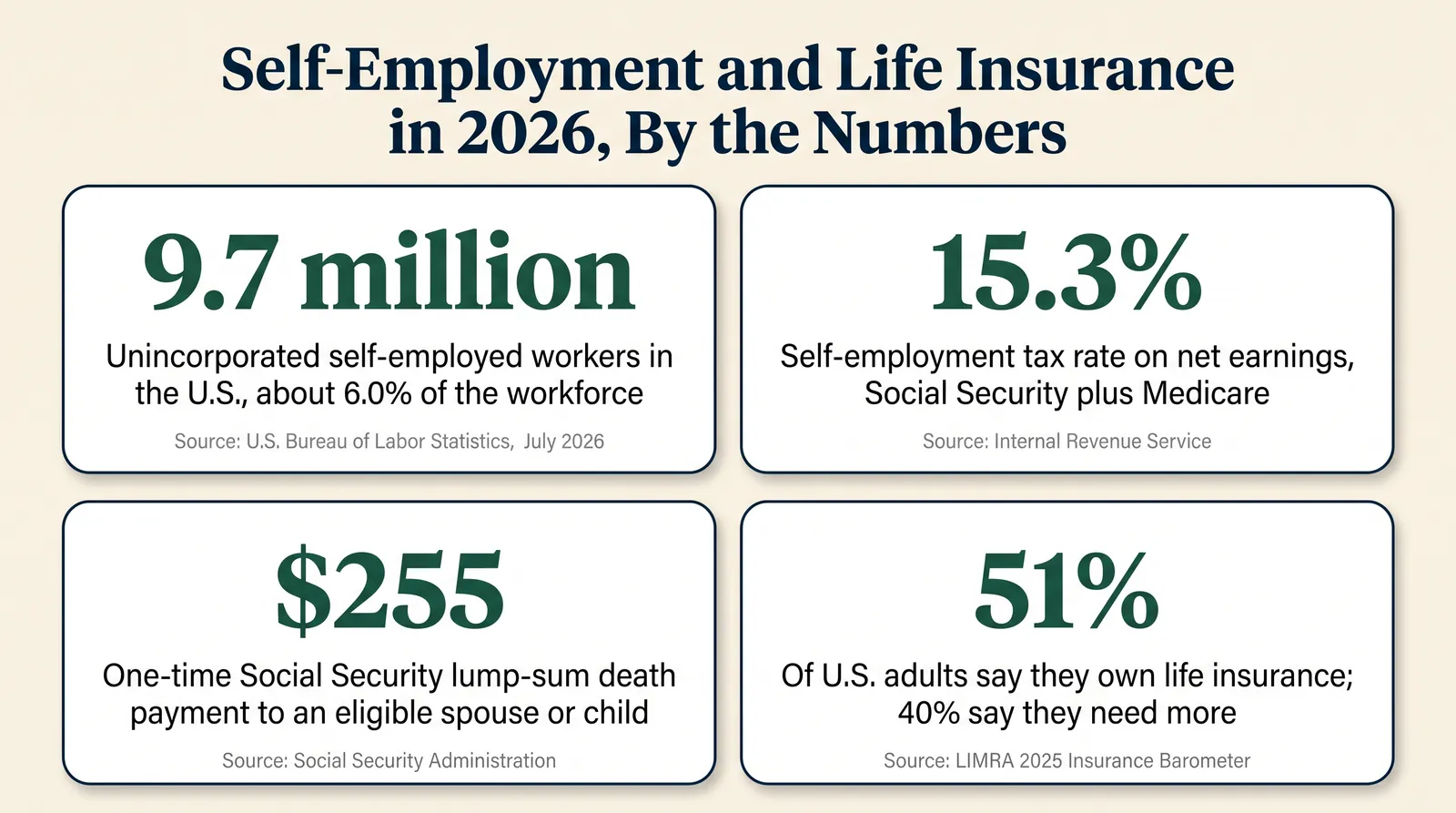
- An estimated 9.7 million Americans were unincorporated self-employed workers in July 2026, about 6.0% of total civilian employment, according to the U.S. Bureau of Labor Statistics.
- Self-employment tax is 15.3% of 92.35% of your net earnings (12.4% Social Security plus 2.9% Medicare), according to the IRS, and it comes out before that money ever reaches your household budget.
- The 2026 Social Security taxable maximum is $184,500, according to the Social Security Administration, the ceiling on earnings subject to the 12.4% Social Security portion of self-employment tax.
- 51% of American adults say they own some form of life insurance, and 40% say they need more, roughly 100 million people, according to LIMRA's 2025 Insurance Barometer Study.
- Social Security's one-time lump-sum death payment to an eligible spouse or child is $255, according to the SSA, a figure that has not changed in decades and is not designed to replace lost income.
The pain: no employer safety net, and your income doesn’t fit the calculators
When you work a W-2 job, somebody in HR already made a decision about your life insurance, even if it was a small one. Most employers offer some amount of group life, often one to two times salary, automatically, without you asking. It is not much, but it exists, and it gives people a baseline to compare against when they think about whether they need more.
Self-employed workers do not get that starting point. There is no enrollment period, no default amount, no HR reminder email. If something happens to you, the honest answer for a lot of solo business owners, freelancers, and contractors is that your household goes from your net income to zero income, on top of losing whoever was managing the business itself. That is a bigger gap than the one a W-2 employee is closing when they buy supplemental coverage beyond their group plan, and it is one nobody is nudging you to think about.
The other half of the problem is math. Most online life insurance calculators ask for your annual salary and multiply it by some number between eight and fifteen. That works reasonably well for a W-2 employee whose salary is a stable, known figure on a pay stub. It works poorly for someone whose income is net profit on a Schedule C, the tax form self-employed individuals use to report business income and expenses, because that number moves year to year, gets reduced by a federal tax most salaried workers do not pay directly, and does not represent take-home pay the way a salary does.
This is general education, not a recommendation
Nothing here tells you to buy a specific policy or a specific coverage amount. It explains, using current 2026 figures and your own numbers, how self-employed income actually flows through an underwriting decision, so you can run a first pass yourself or bring the math to someone to check.
Why it happens: your income doesn’t fit the calculators because it isn’t a salary
A few terms are worth defining once, since the whole calculation depends on using them correctly.
- Net profit. The amount left on Schedule C, line 31, after subtracting business expenses from gross revenue. This is the figure life insurance underwriters generally use to evaluate a self-employed applicant’s income, not the total revenue the business collected.
- Self-employment tax. A 15.3% federal tax covering the Social Security and Medicare contributions that an employer and employee normally split for a W-2 worker. A self-employed person pays both halves. It applies to 92.35% of net earnings, according to the IRS, and is calculated and paid separately from federal income tax.
- Term life insurance. Coverage that pays a death benefit if you die during a set period, such as 20 years, and pays nothing if you outlive the term. It is the product most people, self-employed or not, use for pure income replacement because it is priced for that specific job.
- Level term. A term policy where the death benefit and the premium stay the same for the entire term, rather than declining or resetting.
- Underwriting class. The health and risk category a carrier assigns an applicant after reviewing medical history, lab work, and in some cases a paramedical exam, which determines the premium charged for a given coverage amount.
- Income-replacement multiple. A shorthand many calculators use, coverage equal to some number of years of income, meant to approximate what a lump sum would need to generate to replace lost earnings over time. It is a starting point, not a complete method, for anyone whose income is not a fixed salary.
Here is the mechanism that actually matters: when a carrier underwrites a self-employed applicant, they are not asking what your business billed last year. They are asking what was actually left over, and often they average that figure across the last one to two years of tax returns to smooth out a strong year or a slow one. A graphic designer who billed $140,000 in gross revenue but spent $55,000 on subcontractors, software, and a home office deduction is going to be evaluated on roughly $85,000 of net profit, not $140,000. That is not a carrier being stingy. It is the carrier sizing the policy to the income your household actually depends on.
Self-employment tax compounds that gap. Take that same $85,000 net profit. Self-employment tax applies to 92.35% of it, which is $78,497.50, at a rate of 15.3%, according to the IRS. That works out to roughly $12,010 in self-employment tax alone, before any federal income tax is calculated on top of it. The Social Security portion of that tax, 12.4%, applies to net earnings up to the 2026 taxable maximum of $184,500, according to the Social Security Administration; the Medicare portion, 2.9%, has no ceiling and applies to all net earnings. For most self-employed South Dakotans, whose net profit sits well under that $184,500 ceiling, the full 15.3% rate applies to essentially all of their self-employment income.
| Step | Calculation | Amount |
|---|---|---|
| Average net profit (Schedule C, last 2 years) | Reported income | $85,000 |
| Amount subject to self-employment tax | $85,000 × 92.35% | $78,497.50 |
| Self-employment tax owed | $78,497.50 × 15.3% | $12,010 |
| Net profit after self-employment tax | $85,000 − $12,010 | $72,990 |
Illustrative example only, not a projection for any specific person's taxes. Self-employment tax rate and 92.35% factor per the IRS; 2026 Social Security taxable maximum of $184,500 per the SSA. Federal and any applicable state income tax are calculated separately and are not included here.
That $72,990, not the original $85,000, is closer to what the household actually lives on. Sizing an income-replacement figure off the pre-tax number overstates what a policy would need to replace by more than $12,000 a year in this example, every year the multiple is applied.
What it costs to get wrong: a real gap, with real numbers behind it
An estimated 9.7 million Americans were unincorporated self-employed workers in July 2026, about 6.0% of the 162.2 million people employed in the United States, according to the Bureau of Labor Statistics’ Employment Situation report. That is the Bureau’s narrower definition, unincorporated sole proprietors and independent contractors; it does not include people who formally incorporated their business, so the true number of people without an employer offering them group life insurance is larger still.
Nationally, 51% of American adults say they own some form of life insurance, and 40% say they need more coverage than they currently have, a gap representing roughly 100 million people, according to LIMRA’s 2025 Insurance Barometer Study, published June 25, 2025. LIMRA’s barometer does not break the need gap out by employment type specifically, but the mechanism is straightforward: people without an employer-provided baseline start further behind than people who at least have some group coverage to build on, even a modest amount.
The cost of getting this wrong is not abstract. If you die without adequate coverage, Social Security pays a one-time lump-sum death payment of $255 to an eligible spouse or child, according to the SSA, a figure that has been unchanged for decades and was never intended to replace ongoing income. Ongoing Social Security survivor benefits do exist for a spouse and dependent children, calculated as a percentage of the deceased worker’s benefit, starting around 71.5% for a surviving spouse and rising to 100% at full retirement age, or 75% for each eligible child subject to a family maximum, according to the SSA. Those benefits are real and worth understanding, but they are built on your Social Security earnings record, which itself is only as large as the self-employment income you reported and paid tax on, and they are not designed to fully replace what a self-employed household was living on.
The number nobody sends you a reminder about is the one you have to size yourself. That is the whole difference between a W-2 job and self-employment when it comes to life insurance: not whether you need it, but whether anyone is going to prompt you to figure out how much.
Mike Moore, Life Insurance AdvisorThere is a second cost worth naming: what happens to the business itself. For a solo service business, consulting practice, or one-person contracting operation, a large share of revenue is tied directly to the owner’s own time and relationships. Life insurance proceeds cannot run that business for a surviving spouse, but they can buy months of runway to wind down client work, pay a subcontractor to finish open jobs, or cover the gap while the business is sold or dissolved instead of the family scrambling to make that decision while also grieving.
How to size your own coverage: the self-employed method
You can run a real first pass on this yourself, using your own tax returns and the same categories a full DIME-style calculation uses (debt, income, mortgage, and education), adjusted for how self-employment income actually works.
- Find your true net income. Pull Schedule C, line 31, from your last two federal tax returns and average the two figures. Averaging smooths out one unusually strong or unusually slow year, which matters more for self-employed income than for a fixed salary.
- Subtract self-employment tax. Multiply that average by 92.35%, then by 15.3%, to find your self-employment tax. Subtract it from the average. What is left is closer to the income your household actually lives on, and the number worth using for the “years of income” part of the calculation below.
- Add your non-mortgage debt. Business loans, a line of credit, a vehicle loan, credit card balances, anything a family would need to pay off rather than carry.
- Add a number of years of after-tax income. Decide how many years of income replacement would give your family real breathing room, commonly 5 to 15 years depending on the ages of any children and how quickly a surviving spouse could realistically replace part of that income. Multiply your after-self-employment-tax income figure by that number of years.
- Add your remaining mortgage balance, if paying off the house is part of what you want covered.
- Add future education costs, if you are covering that, using a reasonable per-child estimate for the type of school you expect.
- Subtract liquid savings your family would not need replaced, such as an emergency fund or business reserve that would still be there.
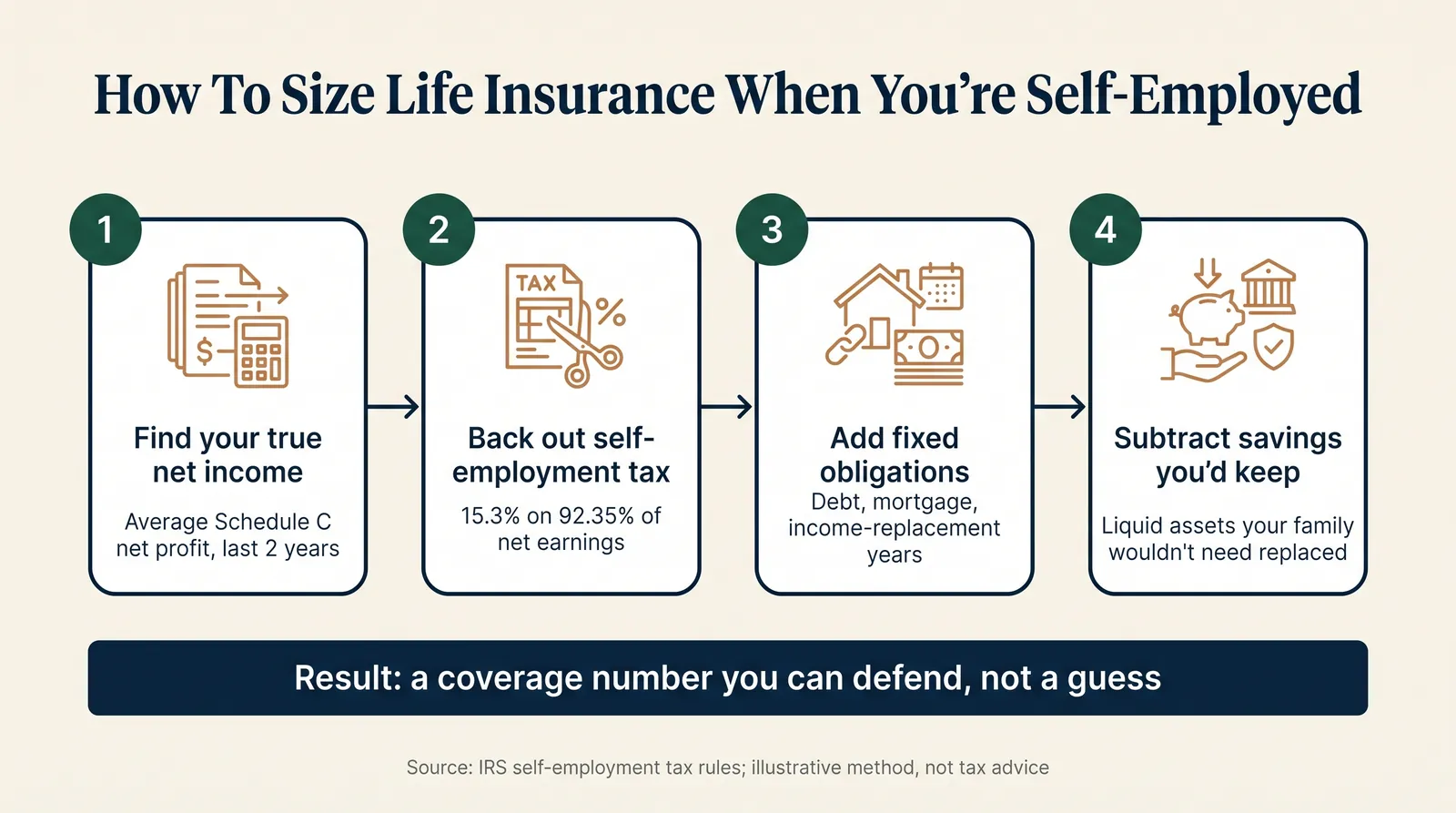
Here is what that looks like with real numbers, for a self-employed graphic designer in Sioux Falls, married with two kids, using the after-self-employment-tax income figure from the table above.
| Category | Detail | Amount |
|---|---|---|
| Non-mortgage debt | Business line of credit plus one vehicle loan | $18,000 |
| Income replacement | $72,990 × 10 years | $729,900 |
| Remaining mortgage balance | Current payoff amount | $210,000 |
| Future education, 2 children | $50,000 per child, in-state estimate | $100,000 |
| Less: liquid savings kept | Emergency fund and business reserve | −$30,000 |
| Illustrative coverage total | Sum of the above | $1,027,900 |
Illustrative example only, not a projection or recommendation for any specific person. Every assumption (years of income replacement, education cost per child, savings kept aside) is a choice the household makes, not a fixed rule. Change any input and the total changes with it.
That $1,027,900 is not a number a generic salary-times-multiple calculator would have produced, because it starts from after-tax self-employment income rather than gross revenue, and it is built from this specific household’s actual debt, mortgage, and family size rather than a flat rule of thumb.
You can do steps 1 through 7 yourself, today
All you need is your last two years of Schedule C filings, your current debt balances, and a rough idea of what you want covered. Where a second opinion tends to help most is comparing how different carriers actually treat self-employed income documentation, since some ask for one year of returns and some ask for two, and that difference can change what coverage amount they are willing to offer.
You can run these numbers yourself in about twenty minutes with your tax returns in front of you. Most self-employed people who go through this find the carrier comparison, not the math, is the part worth a second opinion, since documentation requirements and pricing for self-employed applicants vary more between carriers than they do for W-2 employees.
How self-employed South Dakotans actually get underwritten
Because there is no employer HR department vouching for your income, a life insurance application from a self-employed person usually asks for more paperwork than one from a W-2 employee, not less. Expect to provide one to two years of federal tax returns, specifically the Schedule C or the relevant business return, so the carrier can verify net profit rather than take a self-reported number at face value. Some carriers also ask for a profit-and-loss statement if your most recent full tax year is not yet filed.
Beyond income documentation, underwriting for a self-employed applicant runs through the same health and risk review as anyone else: medical history, prescription history, and in most cases either a paramedical exam or a data-based alternative depending on the coverage amount and the carrier. No-exam and simplified-issue underwriting categories exist in the market generally, built around health questions and available data instead of a physical exam, and self-employment status by itself does not exclude someone from being considered for that category. What actually applies, whether an exam is required, what documentation is needed, and what the resulting premium looks like, is determined during underwriting for your specific application, carrier, and health profile, not guaranteed in advance by any calculator or article.
Starting point
- Income verified with a pay stub or W-2, a single stable figure
- Often already has some group life through the employer as a baseline
- Income multiple applied to gross salary, since there is no separate self-employment tax
- Coverage gap is usually "how much more" beyond the employer plan
Starting point
- Income verified with 1 to 2 years of tax returns, evaluated on net profit
- No employer baseline; starting point is zero coverage
- Self-employment tax (15.3% on 92.35% of net earnings) should be backed out before applying a multiple
- Coverage gap is usually the full amount, not a supplement to something already in place
How we help
We are independent, so we are not built around one carrier’s documentation requirements or one carrier’s appetite for self-employed applicants. We start with your actual tax returns and your real obligations, not a generic multiple, and compare how different carriers price and document a policy for someone in your specific self-employment situation, whether that is a sole proprietor with two years of consistent returns or a newer freelancer with one year of income to show. If a straightforward level term policy solves the problem, we say so. If your situation, a business partner, a buy-sell need, key person exposure, points toward something more than personal income replacement, we say that too, and point you toward the right conversation.
What you get
A coverage number built from your own tax returns and your own obligations, not a stock multiple applied to gross revenue. A comparison across more than one carrier’s documentation requirements and pricing for self-employed applicants, since that varies meaningfully company to company in ways it generally does not for W-2 employees. And a plain answer about whether a personal term policy covers what you are actually worried about, or whether your situation calls for something more, before you commit to either.
Bring your tax returns, and we'll size it with you
We'll walk through your actual net profit, your self-employment tax, and your real obligations together, then compare what carriers are currently offering for someone in your situation.
Not ready to talk to anyone yet? Read How It Works first and come back when you are.
Frequently asked questions
Does self-employment income count differently than a salary when I apply for life insurance?
Yes. A carrier underwriting a W-2 employee usually asks for a pay stub or a W-2 form and takes the gross salary at face value. A carrier underwriting a self-employed applicant typically asks for one to two years of federal tax returns and works from net profit, the amount left on Schedule C line 31 after business expenses, not the total revenue the business collected. Two self-employed people who each brought in $150,000 in gross revenue can get very different coverage offers if one nets $110,000 after expenses and the other nets $60,000, because the carrier is sizing the policy to the income that actually would have supported the household, not the number on the invoices.
How much life insurance do self-employed people in South Dakota typically need?
There is no single multiple that fits every self-employed situation, which is exactly why a flat 10-times-income rule tends to under- or overshoot. A more defensible approach adds up what a household would actually need to replace: any business or personal debt, a number of years of net income replaced, the remaining mortgage balance, and future education costs, then subtracts liquid savings the family would not need replaced. That total, not a memorized multiple, is the number worth pricing out. The worked example earlier in this guide walks through real math using this method.
Does self-employment tax affect how much coverage I actually need?
It affects the income figure you should be running the math on. Self-employment tax is 15.3% of 92.35% of your net earnings, according to the IRS, covering the Social Security and Medicare contributions an employer would otherwise split with a W-2 worker. That tax comes out before the money ever reaches a household budget, so sizing coverage off gross Schedule C profit instead of profit after self-employment tax overstates the income a policy would actually need to replace. Running the math on the after-tax figure gives a more honest starting number.
What happens to my business if I die and I am the only person who does the work?
For a large share of solo self-employed businesses, especially service businesses built around one person’s time, revenue drops sharply or stops the day that person is gone, whether or not the business has debt. Life insurance proceeds cannot keep a one-person consulting practice or contracting business running by themselves, but they can cover a wind-down period, buy time for a spouse to sort out contracts and receivables, or fund a transition if there is a plan to sell client relationships or equipment. Businesses with a partner or employees who could keep operating have a different, narrower need: covering the debt and the income gap during a transition, not the entire enterprise value.
Can I deduct life insurance premiums as a business expense if I am self-employed?
Generally no. The IRS does not allow a deduction for premiums on a life insurance policy where you or your business is directly or indirectly a beneficiary, which covers most personal term life insurance a self-employed person buys to protect their family. This is a tax question specific to your return and business structure, so confirm the current treatment with a tax professional before assuming any deduction applies; nothing here is tax advice.
Does no-medical-exam life insurance exist for self-employed applicants?
No-exam and simplified-issue underwriting exist as a category in the life insurance market generally, built around health questions and data checks instead of a paramedical exam. Self-employment status by itself does not disqualify someone from that category, but availability, underwriting requirements, and pricing for any specific applicant depend on the carrier, the coverage amount requested, and the applicant’s health, and are determined during underwriting, not guaranteed in advance.
Does South Dakota’s lack of a state income tax change any of this math?
It removes one layer of tax from the after-self-employment-tax income figure, but not the federal layer. South Dakota is one of seven states with no state individual income tax, according to the South Dakota Department of Revenue, so a self-employed South Dakotan’s net profit is reduced by federal self-employment tax and federal income tax, but not by a state income tax the way it would be in most other states. The self-employment tax math itself, 15.3% on 92.35% of net earnings, is federal and applies the same regardless of which state you live in.
Before you sign anything
This article is general education, not insurance, legal, financial, or tax advice. Product availability, underwriting requirements, documentation, and pricing vary by carrier and are subject to underwriting. No coverage exists until a policy is issued and in force. Any guarantees are subject to the claims-paying ability of the issuing insurer. Please review actual policy documents and speak with a licensed agent and a tax professional about your situation.
Sources
- U.S. Bureau of Labor Statistics — Employment Situation, Table A-9, Selected employment indicators — July 2026 data; 9.735 million unincorporated self-employed workers, seasonally adjusted, against 162.177 million total civilian employment
- Internal Revenue Service — Self-Employment Tax (Social Security and Medicare Taxes) — 15.3% self-employment tax rate, 12.4% Social Security plus 2.9% Medicare, applied to 92.35% of net earnings
- Social Security Administration — Cost-of-Living Adjustment, Contribution and Benefit Base — 2026 Social Security taxable maximum of $184,500
- LIMRA — Adults Age 30 and Younger Overestimate Life Insurance Cost by 10-12 Times — published June 25, 2025; 51% of adults own life insurance, 40% say they need more, roughly 100 million people, from the 2025 Insurance Barometer Study
- Social Security Administration — Survivors Benefits — $255 one-time lump-sum death payment; survivor benefit percentages by relationship and age
- U.S. Census Bureau — Number of U.S. Nonemployers Grew Faster Than Employer Businesses Nearly Every Year From 2012 to 2023 — nonemployer businesses accounted for about 6.4% ($1.8 trillion) of 2023 U.S. GDP
- South Dakota Department of Revenue — Individual Taxes — confirmation South Dakota does not impose a state individual income tax
Related reading: How Much Life Insurance Does Your Farm or Business Need?, How Much Life Insurance Do You Actually Need? A Working Method for South Dakota Families, and Term vs. Whole Life in 2026: A Data-Driven Comparison. See current options for term life insurance, business life insurance, or learn more about who we help: business owners.