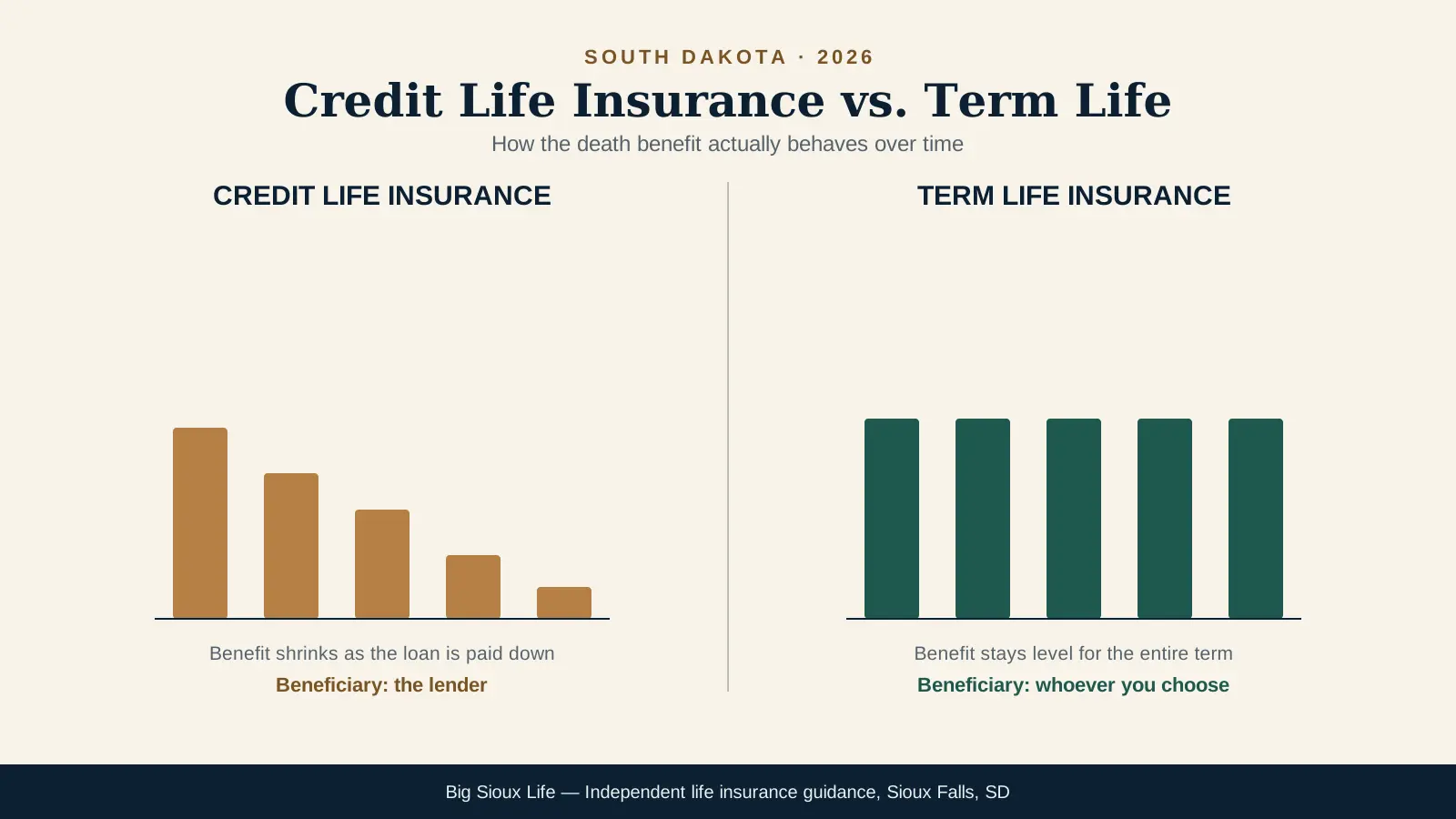
Somewhere in your separation paperwork was a line about Servicemembers’ Group Life Insurance, and there’s a decent chance you signed it without reading past the dollar amount. That’s the honest starting point for most veterans: SGLI covers up to $500,000 at a flat premium unrelated to your age or health, coverage most of us will never qualify for at that price again, and it ends the moment your military status changes, whether that’s an honorable discharge, a retirement after 20 years, or a transfer off orders. The VA builds in a 120-day grace period after separation where the coverage keeps working at no cost, and then it’s gone unless you’ve done something about it. What replaces it, if anything, is entirely up to you, and the deadlines that govern your options are shorter and less forgiving than most people realize until they’ve already passed one.
This guide walks through exactly what happens to SGLI when you leave the military, the three deadlines that actually matter, how VGLI and VALife work as replacement coverage, and how to decide whether either one, or a private term policy instead, fits a South Dakota veteran’s actual situation. It’s general education, not a recommendation for your specific circumstances. (For the condensed side-by-side, see our answer page on the difference between SGLI and VGLI. And for American Indian veterans — whose communities the VA notes have one of the highest representations in the armed forces — the trust-land angle, including why an SGLI or VGLI benefit pays a named beneficiary outside the federal trust probate process, is covered in can American Indian veterans keep SGLI coverage after service?)
The short version
- SGLI coverage ends automatically when you leave the military, but the VA extends it free for 120 days after separation so you're not immediately uninsured, according to the VA's guidance on converting SGLI.
- You have one year and 120 days after separation to apply for VGLI, the SGLI replacement program. Apply within the first 240 days and no health questions are asked; apply later and you'll need to prove good health.
- VGLI's monthly cost is set by five-year age bands, not your individual health, and runs from $0.60 per $10,000 of coverage under age 30 to $44 per $10,000 at 80 and older, per the VA's published rate table.
- Veterans with any VA service-connected disability rating, even 0%, can also apply for VALife, a separate guaranteed-acceptance whole life program capped at $40,000, with full coverage phasing in over two years, according to the VA.
The pain: you assumed SGLI just kept going
This is the mistake that catches people who did everything else right during a transition out of the military: treating SGLI like it’s permanent because it always has been. For years, maybe your whole career, that line item on your Leave and Earnings Statement was just there, deducted automatically, never something you had to think about or apply for. It’s genuinely one of the best life insurance deals available anywhere: up to $500,000 in coverage for a flat premium that doesn’t change with your age or health, with no medical exam required to get it in the first place.
Then you separate, retire, or transition to a status that isn’t covered, and the automatic part stops being automatic. The government doesn’t cut you off the day you clear post; there’s a 120-day extension built in specifically so you’re not uninsured while you’re sorting out terminal leave, a new job, and everything else that comes with leaving the service, according to the VA’s page on converting SGLI. But 120 days moves fast when you’re also moving households, starting a new job, and possibly relocating across South Dakota or out of state entirely. A lot of veterans reach day 121 having never made a decision, because nobody sat them down and said the clock was already running.
This is general education, not a recommendation
Nothing here tells you to buy VGLI, VALife, or a private policy. It explains how each program actually works under current VA rules, so you can compare what you're eligible for against what your household would need and decide for yourself.
Why it happens: three deadlines, and nobody walks you through all three
Here’s the mechanism, because it genuinely is more complicated than a single expiration date. Leaving SGLI behind isn’t one deadline, it’s three, stacked on top of each other, and missing the first two doesn’t disqualify you from the third, it just changes what you have to do to use it.
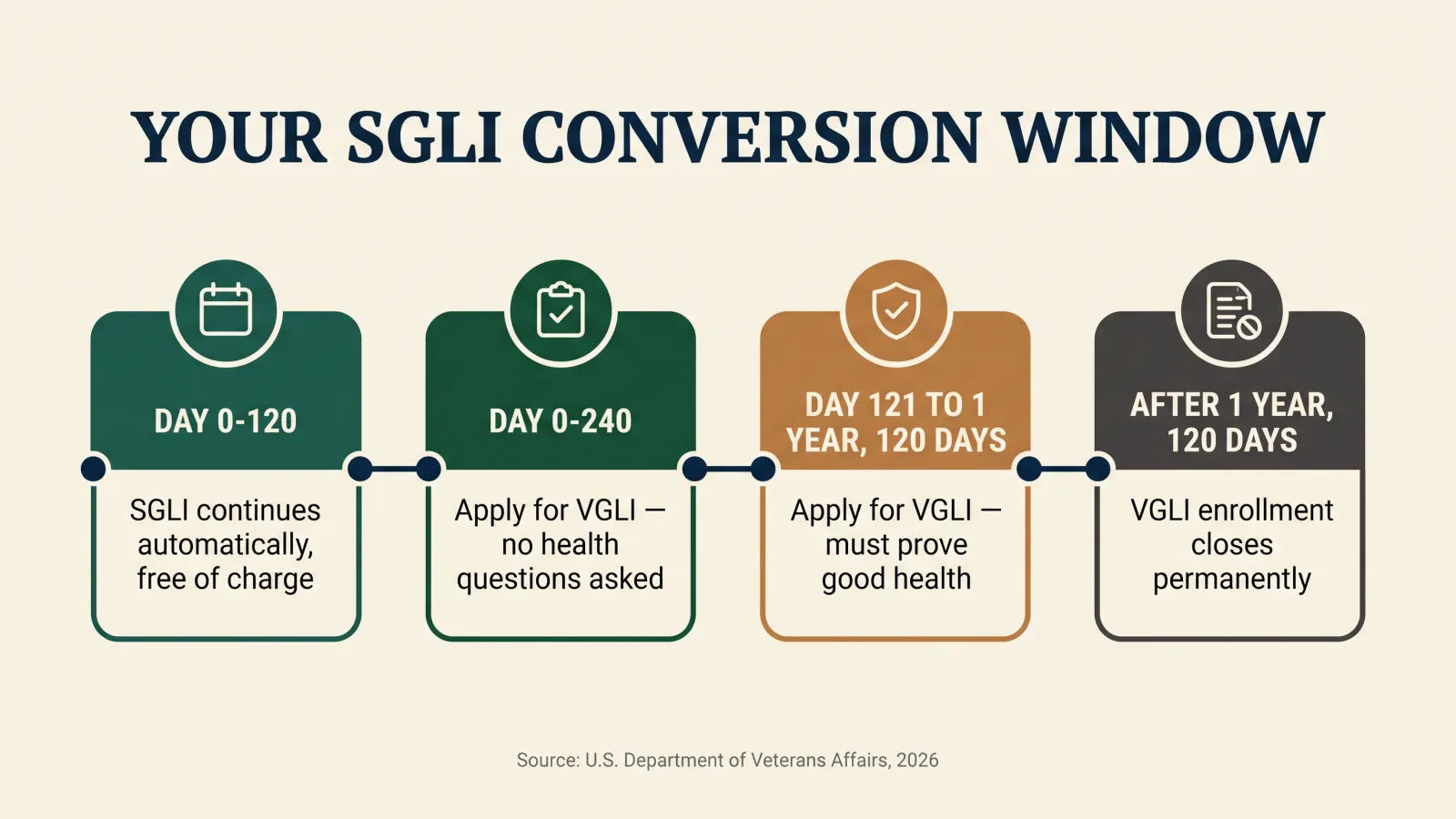
Deadline one: the 120-day free extension. SGLI coverage itself doesn’t end the instant you separate. The VA extends it automatically for 120 days after your separation date, at no cost, specifically to cover the gap while you figure out your next move, according to the VA’s guidance on converting SGLI. This isn’t VGLI yet; it’s SGLI continuing to run on autopilot for a limited window.
Deadline two: the 240-day no-questions window for VGLI. Veterans’ Group Life Insurance, VGLI, is the individual policy you convert into once SGLI ends. If you submit your VGLI application within 240 days of your separation date, you’re enrolled without answering a single health question, according to the VA’s VGLI eligibility page. This is the deadline that matters most if you have any health condition, past or present, that could complicate underwriting elsewhere. Miss it, and the no-questions-asked door closes.
Deadline three: one year and 120 days, the hard stop. You can still apply for VGLI after the 240-day mark, but from day 121 through one year and 120 days after separation, you have to submit evidence of good health, and the VA can decline your application based on that evidence, the same way a private insurer can decline a case, according to both the VA’s VGLI eligibility page and its separate page on applying for VGLI, which independently confirm the same one-year-120-day final cutoff. After that date, the door closes completely. There’s no VGLI enrollment path at all.
| Deadline | What happens | Health questions required? |
|---|---|---|
| Day 0–120 | SGLI continues automatically, free of charge | No — you're still covered under SGLI |
| Day 0–240 | Apply for VGLI with no health questions asked | No |
| Day 121–day 485 (1 yr, 120 days) | Apply for VGLI with evidence of good health | Yes — the VA can decline the application |
| After 1 yr, 120 days | VGLI enrollment is no longer available | Not applicable — the window is closed |
Source: U.S. Department of Veterans Affairs, VGLI eligibility page (benefits.va.gov/INSURANCE, accessed 2026) and VA's page on converting SGLI. Two separate VA.gov pages independently state the same 240-day and one-year-120-day figures.
A couple of terms worth defining plainly while we’re here, because the VA’s own materials use them without much explanation. Evidence of good health is essentially a simplified underwriting questionnaire, sometimes with follow-up records requests, that the VA uses to decide whether to accept a late VGLI application; it’s the same basic concept as the health questions on a private simplified-issue policy. Group term insurance, which is what both SGLI and VGLI are, means the coverage is term life insurance, meaning it pays a death benefit only if you die during the covered period and it doesn’t build cash value, issued to a group (the military, and then a pool of veterans) rather than underwritten individually the way most civilian policies are.
What it costs to get wrong: VGLI’s price climbs with age, not with your health
VGLI is priced in five-year age bands, and the rate you pay is tied strictly to your age bracket, not your individual health profile, according to the VA’s published VGLI premium table. That’s the tradeoff for skipping underwriting: you don’t get medically evaluated, but you also don’t get a healthy-person discount, and the price climbs steadily as you move through each band, regardless of whether you’re the healthiest person in your bracket or not.
| Age band | Rate per $10,000 | Monthly cost for $500,000 |
|---|---|---|
| 29 and younger | $0.60 | $30.00 |
| 30–34 | $0.80 | $40.00 |
| 35–39 | $1.00 | $50.00 |
| 40–44 | $1.40 | $70.00 |
| 45–49 | $1.90 | $95.00 |
| 50–54 | $2.90 | $145.00 |
| 55–59 | $5.00 | $250.00 |
| 60–64 | $8.50 | $425.00 |
| 65–69 | $13.80 | $690.00 |
| 70–74 | $21.50 | $1,075.00 |
| 75–79 | $38.50 | $1,925.00 |
| 80 and older | $44.00 | $2,200.00 |
Source: U.S. Department of Veterans Affairs, VGLI premium rate table (va.gov, life insurance options and eligibility, accessed 2026). The $500,000 column is calculated by multiplying each published per-$10,000 rate by 50; the underlying per-$10,000 rates are the VA's published figures.
VGLI monthly premium for $500,000 of coverage, by age band
U.S. Department of Veterans Affairs, VGLI premium rate table (va.gov, accessed 2026). Bars scaled proportionally; ages 70 and older omitted from the chart for readability but appear in the table above.
Walk through what that means for one veteran across a career. Say you separate at 32 and enroll in VGLI for the full $500,000. In the 30-34 band you’d pay $40 a month, or $480 a year, using the VA’s published rate. Do nothing else and stay enrolled, and by the time you age into the 55-59 band, the same $500,000 in coverage costs $250 a month, more than six times the starting rate, purely because of age, not health. By 80, it’s $2,200 a month for the same coverage amount. None of that reflects anything about your actual health; it reflects the age band you’re in, because VGLI doesn’t re-underwrite you as you get older, it just moves you to the next published rate.
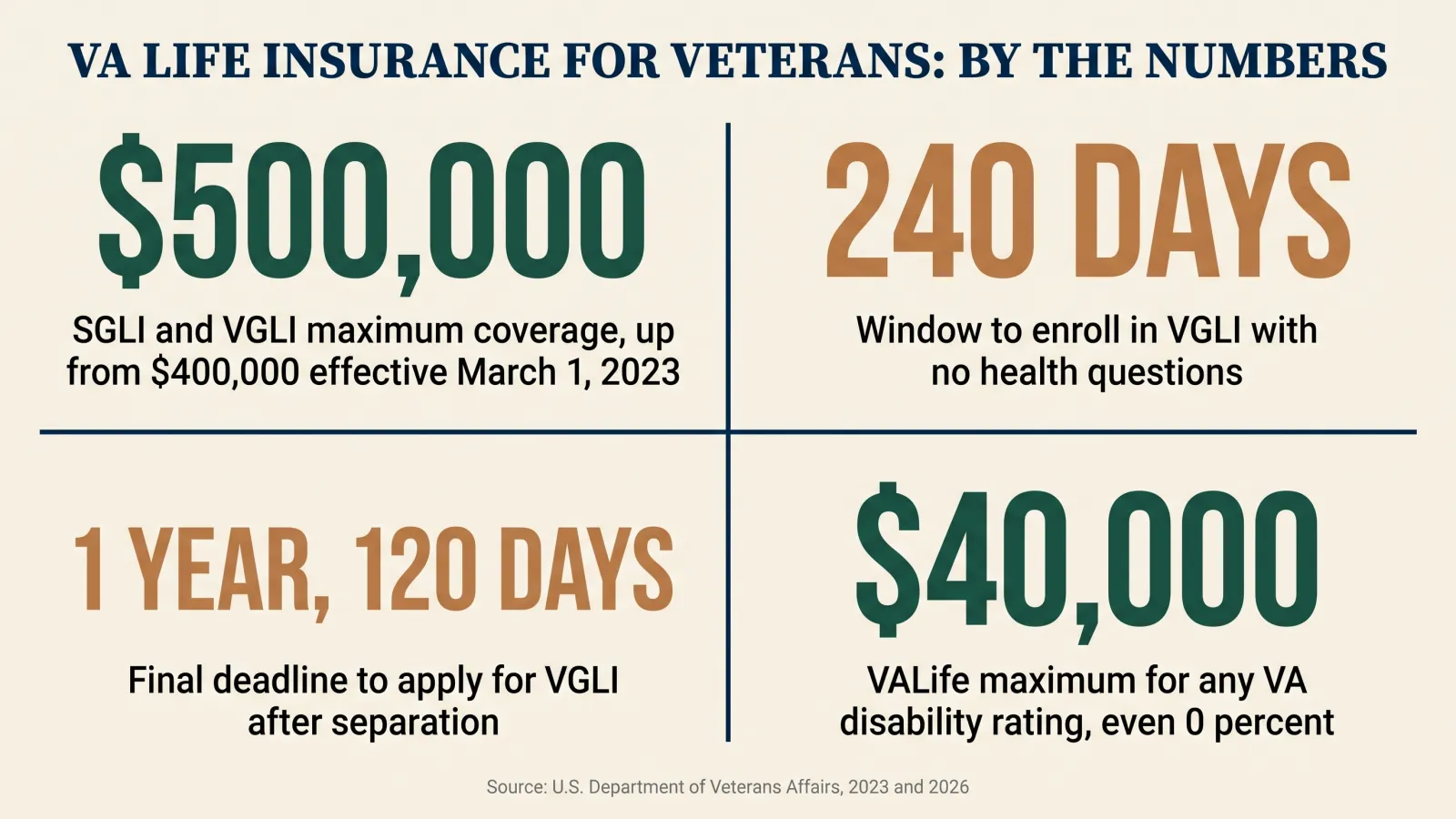
This is also where it’s worth being precise about the maximum coverage amount itself, since it changed relatively recently and older information floating around still cites the old figure. The VA raised the maximum SGLI and VGLI coverage from $400,000 to $500,000 effective March 1, 2023, under Public Law 117-209, with all eligible service members automatically insured for the new $500,000 amount, including those who had previously declined or reduced coverage, according to both the VA’s official FAQ on the increase and a separate VA news release announcing it independently. At the new maximum, SGLI itself costs $30 a month plus $1 for Traumatic Injury Protection coverage, per that same VA guidance, regardless of the service member’s age, which is part of what makes SGLI such strong value while you’re still in uniform.
A worked example: does $500,000 actually cover a South Dakota household?
Here’s an honest way to check, using a method sometimes called DIME: Debt, Income replacement, Mortgage, and Education. It’s not an official VA or government formula, it’s just a widely used way to organize the arithmetic so you don’t forget a category. The method itself needs no citation; the dollar inputs do, so here’s a fully labeled illustration using real South Dakota figures where they exist and clearly flagged assumptions where they don’t.
Say a hypothetical veteran, age 32, separates and buys a first home in South Dakota using a VA loan, which typically requires no down payment. South Dakota’s median listing price was $378,350 as of July 2026, according to the Federal Reserve Bank of St. Louis’s FRED database, sourced from Realtor.com. With no down payment, the starting mortgage balance for this illustration is the full $378,350. This veteran’s household earns South Dakota’s median household income, $79,850 as of 2024, according to FRED, sourced from the U.S. Census Bureau.
| DIME category | Illustrative amount | Basis for this illustration |
|---|---|---|
| D — Other debt (auto loan, credit cards) | $10,000 | Assumed for this example, not a South Dakota average |
| I — Income replacement | $798,500 | 10 years × $79,850 SD median household income (FRED, 2024); 10 years is an illustrative choice |
| M — Mortgage balance | $378,350 | SD median listing price (FRED, July 2026), assuming a zero-down VA loan |
| E — Future education costs (one child) | $20,000 | Assumed for this example, not a sourced tuition figure |
| Illustrative total need | ~$1,206,850 | Sum of the rows above, for teaching purposes only |
Illustrative example only, not a recommendation or a promise of what any household needs. Income and home-price figures: Federal Reserve Bank of St. Louis (FRED) series MEHOINUSSDA646N (South Dakota median household income, 2024) and MEDLISPRISD (South Dakota median listing price, July 2026). Debt, income-replacement years, and education figures are assumptions chosen for this example, not South Dakota averages.
Set that roughly $1.21 million illustrative need against even the maximum $500,000 VGLI or SGLI benefit, and there’s still an illustrative gap of about $706,850. That’s not a criticism of the program; $500,000 at $40 a month in your early 30s is genuinely hard to beat on price, and it’s meaningfully more than the old $400,000 cap. It’s a demonstration that the federal maximum and your household’s actual need are two different numbers that don’t automatically match, the same way an employer’s flat group life benefit doesn’t automatically match a civilian household’s needs either. Run your own DIME number with your own mortgage, your own income, and your own family size; don’t borrow this one.
Five hundred thousand dollars is the most VGLI or SGLI can ever pay. It isn't a promise that five hundred thousand is what your household would need.
Mike Moore, Life Insurance AdvisorHow to work it out yourself: five steps before you decide anything
- Find your exact separation date. Every deadline above counts from that date, not from when you clear out your locker or out-process. Pull your DD-214 or equivalent documentation and confirm it.
- Mark day 240 and day 485 (one year, 120 days) on an actual calendar. Not a mental note. A missed deadline here isn’t a paperwork inconvenience; it’s a closed door.
- Check whether you have a VA service-connected disability rating, even a small one. If you do, you may also be eligible for VALife, covered in detail below, which asks no health questions regardless of when you apply.
- Run your own DIME number, using your real mortgage or planned home purchase, your real income, your real dependents, and your own assumptions for years of income replacement and future costs.
- Compare that number against VGLI’s maximum, VALife’s maximum if you qualify, and what a private term policy might cost for your specific health and age. If there’s a gap, that’s the amount worth shopping for separately, not a reason to assume VGLI alone has to stretch to cover everything.
You can run this math yourself
All five steps above just require your separation paperwork, your DIME number, and the VA's published rate tables, all linked in the sources below. Where a second opinion tends to help is comparing VGLI's age-band pricing against actual private term quotes for your health and age, since a single source can't tell you which one is competitive for your specific case.
Three paths after separation, side by side
There isn’t one right answer here, there are three different tools built for different situations, and most veterans will genuinely benefit from understanding all three before picking.
VGLI is the direct continuation of SGLI: individual group term insurance, up to $500,000, priced by age band, available with no health questions if you apply within 240 days of separation, according to the VA. It’s the simplest option and, for veterans with a health condition that would complicate other underwriting, often the most valuable one, because eligibility doesn’t depend on your health during that window.
VALife is a separate, newer VA program specifically for veterans with any VA service-connected disability rating, including a 0% rating, and it asks no health questions at all regardless of when you apply, according to the VA’s VALife page. It caps at $40,000 in whole life coverage, meaning permanent coverage that includes a cash value component, purchased in $10,000 increments. A 50-year-old veteran buying the full $40,000 pays $130 a month, or $1,542.40 paid annually, per the VA’s published example. The tradeoff: full coverage doesn’t begin until two years after you apply. If you die before that two-year mark, your beneficiary receives only the premiums you paid plus interest, not the full $40,000 death benefit, according to the VA.
Private term life insurance, purchased through the open market from a civilian carrier, is priced individually based on your specific age and health at the time of application, then locked for the length of the term you choose, commonly 10, 20, or 30 years. It requires underwriting, which can mean a health questionnaire or a medical exam depending on the product, but a healthy applicant typically pays less than VGLI’s age-band rate for the same coverage amount, since the price reflects that individual’s actual risk rather than an averaged bracket.
| Feature | VGLI | VALife | Private term life |
|---|---|---|---|
| Who's eligible | Veterans applying within 1 yr, 120 days of separation | Veterans with any VA disability rating, 0%–100% | Anyone who applies and qualifies through underwriting |
| Maximum coverage | $500,000 | $40,000 | Varies by carrier and applicant |
| Health questions | No, if applied within 240 days | Never asked | Yes, typically |
| Policy type | Term (no cash value) | Whole life (cash value after 2 years) | Term (no cash value) |
| Pricing basis | Age band, not individual health | Age at application | Individual age and health, locked for the term |
| Full benefit from day one? | Yes | No — 2-year phase-in | Yes, after the policy's contestability period |
Sources: U.S. Department of Veterans Affairs, VGLI and VALife program pages, accessed 2026. Private term life terms vary by carrier and are not standardized; described generally here, not as a quote or offer.
What if you have a service-connected disability?
This is worth its own section, because it’s the single most overlooked option in this whole picture. If you have a VA service-connected disability rating of any percentage, even 0%, you qualify for VALife with no health questions asked, at any point after your rating is assigned, not just during a short post-separation window, according to the VA. There’s no age cutoff under 80 the way there is with some other programs; veterans applying after turning 81 have their own separate eligibility path tied to when their disability rating was assigned.
The two-year vesting period is the detail that trips people up. VALife is designed like many guaranteed-acceptance whole life products: because no one is screened out for health reasons, the insurer, in this case the VA program itself, builds in a waiting period before the full death benefit applies, to manage against someone enrolling while already gravely ill. If you die within that first two years, your beneficiary gets back your premiums plus interest, not the $40,000. After two years, full coverage applies for the rest of your life as long as premiums are current, and the policy begins accumulating cash value.
$40,000 is a real number worth being honest about: it’s meaningful for final expenses and a portion of near-term costs, but it is not, on its own, going to replace a working adult’s income or pay off a mortgage the way the DIME worked example above illustrates. Veterans who qualify for VALife often use it as one layer, guaranteed and permanent, alongside VGLI or a private term policy sized to cover the larger income-replacement need, rather than treating either program alone as the complete answer.
How we help
We’re independent, so we’re not steering you toward VGLI, VALife, or a private policy because it’s the only thing we sell; we’re helping you see where the gap actually is between what the VA programs cover and what your household would need, then, if a gap exists, comparing individual term options across more than one civilian carrier priced for your actual age and health. If your VGLI or VALife coverage already covers your real DIME number, we’ll tell you that too rather than manufacture a reason to add more.
What you get
A clear comparison between what SGLI, VGLI, and VALife actually promise, worked against your household’s real numbers instead of a hypothetical. If the deadlines above still apply to you, a straight walk-through of exactly which window you’re in and what it means for your options today. And if there’s a genuine gap, a look at private term policies from more than one carrier, priced for your age and health rather than an averaged VA age band.
Know your deadline before it passes
Bring your separation date and we'll walk through where you stand on the VGLI and VALife windows, then show what closing any remaining gap would look like across more than one carrier.
Not ready to talk to anyone yet? Read How It Works first and come back when you are. If you have a health condition you’re worried would complicate a private policy, it’s worth asking rather than assuming; independent agencies see how different carriers treat the same file, and VALife’s no-questions eligibility may already apply to you if you have any VA disability rating.
Frequently asked questions
What happens to my SGLI when I leave the military?
It ends. Servicemembers’ Group Life Insurance is active-duty group term coverage, and it stops the day your military status changes, though the government gives you a 120-day grace period afterward where the coverage stays in effect at no cost while you decide what to do next, according to the VA’s own guidance on converting SGLI. After that 120-day window closes, you’re uninsured under SGLI unless you’ve already moved to VGLI or another policy.
How long do I have to convert SGLI to VGLI?
You have one year and 120 days from your separation date to apply for VGLI, and that deadline cannot be extended, according to the VA. Within the first 240 days of that window you can enroll without answering any health questions; apply between day 121 and day 120-past-a-year and you’ll need to provide evidence of good health, which the VA can use to deny the application.
How much does VGLI cost?
It depends on your age and how much coverage you buy, priced in five-year age bands per $10,000 of coverage, according to the VA’s published VGLI rate table. A veteran age 29 or younger pays $0.60 a month per $10,000, or $30 a month for $500,000 in coverage; a veteran 80 or older pays $44 per $10,000, or $2,200 a month for the same $500,000. The rate resets to a higher band every five years regardless of your health.
What is VALife and how is it different from VGLI?
VALife is a separate VA program for veterans with any VA service-connected disability rating, even a 0% rating, and it doesn’t ask health questions at all, according to the VA. It caps out at $40,000 in whole life coverage, far below VGLI’s $500,000 maximum, and full coverage doesn’t begin until two years after you apply; if you die before that, beneficiaries get back only the premiums paid plus interest, not the full death benefit.
Is VGLI more expensive than private term life insurance?
It can be, especially as you age, because VGLI is priced by age band regardless of your individual health, while private term life insurance is priced on your specific health profile at the time you apply and then locked for the full term. A healthy 35-year-old veteran will often find a lower rate shopping the private market than paying VGLI’s age-band rate, but a veteran with a health condition that would complicate private underwriting may find VGLI’s no-questions-asked enrollment worth the higher cost. There’s no universal answer; it depends on your health and the specific quotes you’d actually qualify for, which is why comparing rather than assuming either way matters.
Can I get VGLI if I have a health condition?
Yes, as long as you apply within the 240-day window after separation, since no health questions are asked during that period, according to the VA. Miss that window and you’ll need to provide evidence of good health for any application submitted between day 121 and the final deadline of one year and 120 days, and the VA can decline coverage based on that evidence, the same way a private insurer might.
Does South Dakota have any additional veteran life insurance benefits beyond the federal VA programs?
The VA programs covered here, SGLI, VGLI, and VALife, are federal and apply the same way to every veteran regardless of state. South Dakota’s own Department of Veterans Affairs administers state-level benefits like property tax reductions and education benefits, but life insurance itself runs through the federal VA and the Office of Servicemembers’ Group Life Insurance, not a South Dakota-specific program. If you have a complaint about a private life insurance policy sold to you in South Dakota, the South Dakota Division of Insurance is the state regulator to contact.
Before you decide anything
This article is general education, not insurance, legal, financial, or tax advice. SGLI, VGLI, and VALife are federal programs administered by the U.S. Department of Veterans Affairs and the Office of Servicemembers' Group Life Insurance, not products Big Sioux Life sells or administers. Product availability, features, and rates for any private coverage discussed vary by carrier and are subject to underwriting. No coverage exists until a policy is issued and in force. Any guarantees are subject to the claims-paying ability of the issuing insurer. Please review your actual VA and policy documents and speak with a licensed agent or the VA directly about your situation.
Sources
- U.S. Department of Veterans Affairs — Converting SGLI — 120-day free SGLI extension after separation
- U.S. Department of Veterans Affairs — VGLI Eligibility, va.gov — 240-day no-health-question window, one year and 120 day final deadline, full premium rate table, coverage range
- U.S. Department of Veterans Affairs — Apply for VGLI — independent confirmation of the 240-day and one-year-120-day deadlines
- U.S. Department of Veterans Affairs — SGLI Increase to $500,000 FAQs — March 1, 2023 effective date, prior $400,000 maximum, premium rates, Public Law 117-209
- U.S. Department of Veterans Affairs — News release on the coverage increase — independent confirmation of the $500,000 maximum and effective date
- U.S. Department of Veterans Affairs — VALife Eligibility, va.gov — eligibility for any disability rating, $40,000 maximum, two-year vesting period, premium example
- South Dakota Division of Insurance — Consumer Information — state regulator contact information
- Federal Reserve Bank of St. Louis (FRED) — Median Household Income in South Dakota (MEHOINUSSDA646N) — 2024 estimate, sourced from the U.S. Census Bureau
- Federal Reserve Bank of St. Louis (FRED) — Housing Inventory: Median Listing Price in South Dakota (MEDLISPRISD) — July 2026 observation, sourced from Realtor.com
Related reading: Is Your Employer’s Life Insurance Enough? A 2026 SD Guide, What Happens to Your Life Insurance When You Change Jobs? and No-Medical-Exam Life Insurance: How It Works in 2026. See current options for term life insurance and guaranteed-issue coverage, or learn more about how it works.