If you are changing jobs, getting laid off, or thinking about retiring, the honest answer to “what happens to my life insurance” is that it almost always ends, and you have a narrow, specific window to do anything about it. South Dakota law gives departing employees a right to convert group life insurance into an individual policy, but that right runs on a 31-day clock, and the replacement policy is not the same coverage you had. Roughly four in ten American adults carry at least some of their life insurance through an employer, according to LIMRA, and a lot of them have never read the fine print on what happens to that coverage the day they walk out the door for the last time.
The short version
- Group life insurance from work is not portable. It ends when your employment ends, whether by choice, layoff, or retirement.
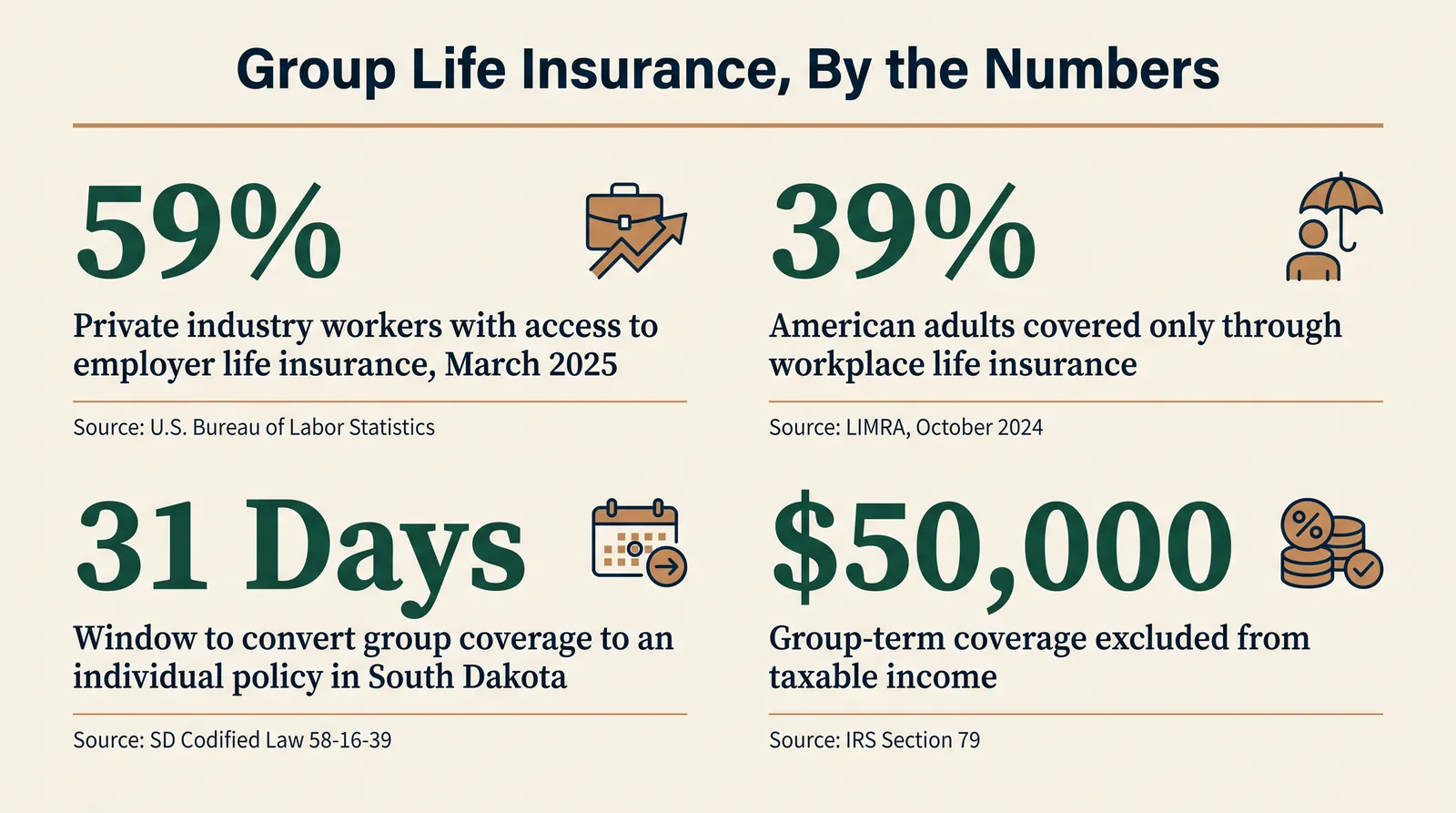
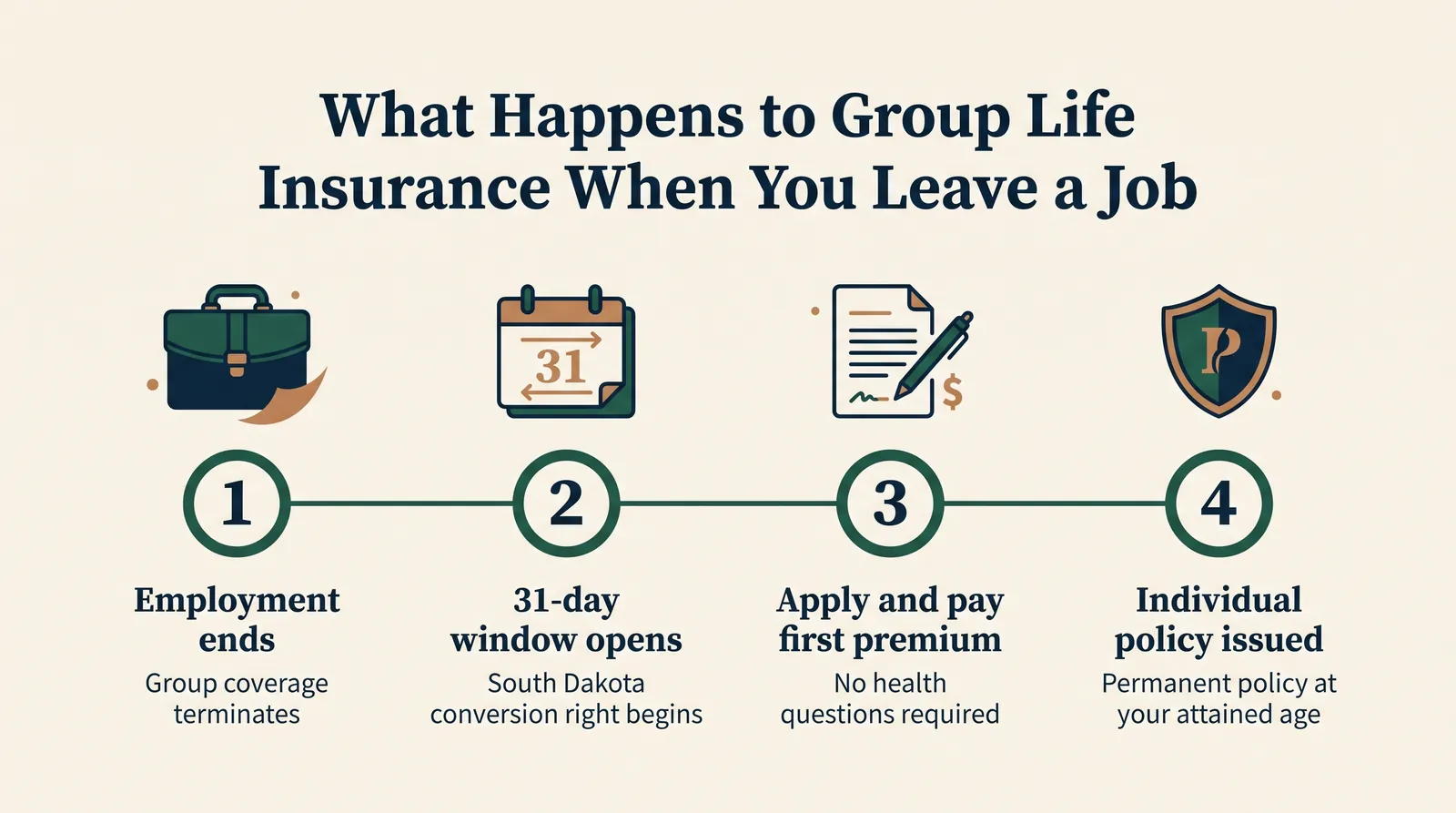
- South Dakota Codified Law 58-16-39 gives you 31 days after your coverage ends to convert it to an individual policy without answering any health questions, but the conversion policy must be a permanent form, not term, priced at your attained age.
- Only 59% of private industry workers in the U.S. had access to any employer life insurance benefit as of March 2025, and access ranges from 39% at small employers to 87% at large ones, per the Bureau of Labor Statistics.
- Group coverage over $50,000 creates taxable "imputed income" under IRS Section 79, a detail that shows up on your paycheck stub and catches higher earners off guard.
- Because the amount, the portability, and the underlying rules are all set by your employer's plan, not by you, an individual policy is the only form of coverage that stays yours no matter who you work for.
The pain: you find out your coverage is gone at the worst possible time
Nobody thinks about their group life insurance until they are filling out a benefits form on their way out the door, or worse, until a family member calls the HR department after a death and learns the policy lapsed months earlier. It is not that people are careless. It is that group life insurance is designed to be invisible while you have it. The premium comes out of a paycheck you barely notice, often at no direct cost to you for the base amount, and the coverage just sits there in the background of your financial life, doing its job without asking anything of you. Then the job ends, and the invisible thing you never had to think about becomes the thing you had thirty-one days to think about, except you did not know the clock had started.
This shows up in a few common, very human situations. A nurse at a Sioux Falls hospital system takes a new position across town for better hours, and it does not occur to her that the $110,000 in group life coverage she has carried for six years does not transfer with her, because her new employer’s plan starts fresh, often with a waiting period before new coverage begins. A construction worker gets laid off in a slow winter and, six weeks later, still has not thought about life insurance at all, because unemployment paperwork, job searching, and the mortgage payment are eating every hour of his attention. A 61-year-old office manager retires after 22 years, genuinely believing her group policy would somehow continue since she had it for so long, only to learn that South Dakota’s conversion right is available to her precisely because the group policy is ending, not despite it, and that the individual policy she is entitled to will look and cost very different from what she has been paying.
None of these are edge cases. They are the ordinary mechanics of how group life insurance works, and the reason this catches so many people off guard is that the plan document uses the word “insurance” the whole way through, when what changes at termination is closer to “this specific insurance stops, and a different, more expensive insurance becomes available to you if you ask for it in time.”
This is general education, not a recommendation
Nothing here is a recommendation to convert, decline, or replace any specific policy. It is the mechanics behind how group life insurance actually works in South Dakota, sourced from the statute and from federal data, so you can see your own situation clearly before deciding anything.
Why it happens: group life insurance was never designed to be yours
Group life insurance answers a question within its first two sentences here: why does it disappear when you leave? Because the policy itself was never issued to you. It is issued to your employer (or to a union, association, or creditor, under South Dakota’s group insurance statutes), and you are a covered person under someone else’s contract, not a policyholder in your own right. When the relationship that made you eligible ends, so does your place on that contract.
A handful of terms explain the mechanics precisely, and they are worth defining once, plainly, because the fine print in a group certificate uses them without translation:
- Group term life insurance is life insurance issued under a single master policy that covers a group of people, usually employees of one employer, with the amount typically set as a flat dollar figure or a multiple of salary rather than an amount you chose yourself.
- Evidence of insurability is proof of your health, usually a questionnaire or a medical exam, that an insurer normally requires before issuing or increasing coverage. Group plans commonly waive it for the base amount, which is a large part of why group coverage feels easy to get.
- Portability is a feature, offered on some but not all voluntary group plans, that lets you keep your coverage after leaving the employer by paying premiums directly to the insurer, usually at the group rate or close to it. It is different from, and less commonly offered than, the state-law conversion right described below.
- Conversion right is your legal right, under South Dakota Codified Law 58-16-39, to turn ending group coverage into an individual policy without evidence of insurability, provided you apply and pay the first premium within 31 days.
- Attained age is your age on the date a new policy is issued. A conversion policy is priced using your attained age at conversion, not the age you were when your original group coverage started, which is a major reason conversion premiums run higher than what you were paying through payroll.
- Imputed income is the dollar value the IRS treats as taxable wages when your employer-provided group-term life coverage exceeds $50,000, even though you never received that value in cash.
Put together, these terms describe a structure that makes sense from the employer’s side, a low-cost, easy-to-administer benefit for a large group, but that was never built around what happens to any one individual when the group relationship ends. That is not a flaw in your specific employer’s plan. It is how group insurance works everywhere, and South Dakota’s conversion statute exists specifically because state lawmakers recognized the gap and required insurers to offer a way to bridge it, even if that bridge is not free or automatic.
What it costs to get wrong: the coverage gap, in real numbers
Getting this wrong costs you the coverage itself, and the numbers on how many people are actually exposed to that risk are larger than most people assume. Bureau of Labor Statistics data from the National Compensation Survey shows that access to employer-provided life insurance is far from universal to begin with, and it splits sharply by employer size.
| Establishment size | Workers with access to life insurance |
|---|---|
| 1 to 49 workers | 39% |
| 50 to 99 workers | 53% |
| 100 to 499 workers | 72% |
| 500 workers or more | 87% |
| All private industry workers | 59% |
U.S. Bureau of Labor Statistics, National Compensation Survey, "Employee Benefits in the United States – March 2025," released September 25, 2025.
Access to employer life insurance by establishment size, March 2025
U.S. Bureau of Labor Statistics, National Compensation Survey, "Employee Benefits in the United States – March 2025," released September 25, 2025. Figures cover private industry workers only.
Two things follow from that table. First, if you work for a small or mid-sized South Dakota employer, the odds that you have any group life insurance at all are meaningfully lower than if you work for a large one, which means the coverage you might be counting on may not exist in the first place. Second, of the workers who do have access, the take-up rate, meaning the share who actually enroll once offered, sits at 98% in the same BLS data, which tells you that almost everyone who is offered this benefit accepts it. People are not skipping it. They simply are not thinking about what happens to it later.
The ownership side of the picture, tracked separately by LIMRA, the life insurance industry’s own research organization, tells a similar story from a different angle. As of LIMRA’s October 2024 analysis, 59% of American adults own some form of life insurance, workplace coverage accounts for at least 39% of adults, and individually purchased, or “retail,” coverage accounts for approximately 34%. Those categories overlap, since some people carry both, but the workplace figure alone means a substantial share of insured Americans have coverage that depends entirely on staying at their current job.
Zoom out further and the LIMRA and Life Happens 2026 Insurance Barometer Study estimates that roughly 74 million Americans have no life insurance at all despite saying they need it, plus another 24 million who have some coverage but say they need more, a combined need gap of about 98 million people, or 38% of adults, in 2026. Group coverage that quietly evaporates at the next job change is one of the mechanisms that keeps feeding that gap. Someone with what feels like “enough” coverage through work is not counted as needing more, right up until the day the job ends and the coverage goes with it.
How to work it out yourself: a five-step check
You do not need anyone’s help to find out where you actually stand. This takes about fifteen minutes with your benefits paperwork in front of you.
- Find your certificate of coverage. This is the document your employer’s group insurer issued to you, separate from the general benefits summary, and it will state your exact coverage amount, whether it is a flat dollar figure or a multiple of salary, and the plan’s specific conversion and portability provisions.
- Confirm whether it is portable, convertible, or both. Some voluntary group plans include a portability rider that lets you keep the coverage by paying the insurer directly. All South Dakota group life plans, at minimum, must offer the statutory conversion right described in the next section. Read which one, or both, your plan provides, since the cost and process differ.
- Add up what the coverage is actually protecting. A flat $50,000 benefit or a 1.5x-salary benefit is a number, not a plan. Compare it against your actual obligations: your mortgage balance, years of income your household would need replaced, and any debts that would not disappear if you died. If you have not run this math recently, our related article on figuring out how much coverage you need walks through the same four-part method (income replacement, debt, final expenses, and education) that applies whether the coverage comes from an employer or an individual policy.
- Check whether you are near, at, or over the $50,000 group-term threshold. If your group benefit is a multiple of a six-figure salary, you may already be paying imputed income tax on the amount above $50,000, a detail worth confirming on your pay stub rather than assuming it does not apply to you.
- Decide, before you need to, what you will do if your job ends. You do not have to act today. But knowing in advance whether you would convert, let it lapse, or already have independent coverage in place means you are not making that decision for the first time during the same week you are also processing a layoff, a resignation, or a retirement.
You can run this yourself
Steps 1 through 4 just require reading documents you already have and doing arithmetic you can check twice. Where a second opinion tends to help is step 5, comparing what a South Dakota conversion policy would actually cost at your attained age against what an independent term policy costs today, while you still qualify for it on your own terms.
If you’d rather have someone local walk through this arithmetic with you instead of doing it alone, that’s what we do: Compare My Options.
The South Dakota conversion right, explained in plain language
South Dakota’s group insurance law answers a specific question within its first sentence: what am I entitled to if my group coverage ends? Under South Dakota Codified Law 58-16-39, if your group life insurance ends because your employment or membership in the eligible class ends, you are entitled to have an individual policy issued to you by the same insurer, without answering any health questions, provided you apply and pay the first premium within 31 days after your group coverage ends.
Three conditions shape what that individual policy actually looks like, straight from the statute:
| Condition | What the law requires |
|---|---|
| Deadline | Apply and pay the first premium within 31 days after group coverage ends |
| Health questions | None required; issued without evidence of insurability |
| Allowed policy forms | Any form the insurer customarily issues, except term insurance |
| Maximum amount | Not more than the group coverage that ended, minus any new group coverage you become eligible for elsewhere within 31 days |
| Premium rate | The insurer's customary rate for the policy form, amount, and your risk class and attained age at issue |
South Dakota Codified Law 58-16-39, "Termination of employment or membership causing policy to cease," South Dakota Legislature.
The clause that trips people up most is “except term insurance.” Whatever term coverage you had through work, the conversion policy cannot also be term. It has to be a permanent form, typically whole life, which the insurer prices using standard mortality-based rates for your attained age. That means a 45-year-old converting a $150,000 group term benefit does not get a $150,000 term policy. He gets a $150,000 whole life policy, priced at 45-year-old whole life rates, which runs substantially higher per month than either the group term premium he was paying or what a medically underwritten term policy would cost a healthy 45-year-old shopping the open market. The conversion right guarantees you can get coverage without a health exam. It does not guarantee that coverage is cheap, and for most healthy people, it is the most expensive way to replace the benefit.
There is a second, related rule worth knowing if your employer’s entire group policy is discontinued or amended, rather than just your individual employment ending. South Dakota Codified Law 58-16-40 gives the same conversion right to anyone who was insured under that group policy for at least five years before the termination date, subject to the same 31-day window and the same conditions in 58-16-39. If you have been with an employer long enough to hit that five-year mark and the company later switches group carriers or drops the benefit entirely, this is the provision that protects you, not the standard job-change rule.
The conversion right guarantees you can get coverage without a health exam. It does not guarantee that coverage is affordable. For most healthy people, it is the most expensive way to replace what they had.
Mike Moore, Life Insurance AdvisorA worked example: converting versus shopping the individual market
Take a 42-year-old South Dakota worker earning $79,850, close to the state’s 2024 median household income according to Census Bureau data reported through the Federal Reserve Bank of St. Louis. Her employer provides a standard 1.5x-salary group term benefit, which works out to roughly $120,000 in coverage. She is leaving that job for a new position, and her new employer’s group plan has a 90-day waiting period before benefits begin, a common structure that leaves a gap regardless of which employer she is working for.
| Path | What happens |
|---|---|
| Do nothing | Group coverage ends on her last day or shortly after; after 31 days, the conversion right expires and she has $0 in coverage until her new employer's plan activates, and no coverage at all if she also lacks savings to self-insure the gap |
| Convert under SDCL 58-16-39 | She keeps up to $120,000 in coverage with no health questions, but only as a whole life policy priced at her attained age of 42, not the term coverage she had, and not the lower group rate she was paying |
| Apply for an individual term policy before leaving | If she is in good health, she can typically qualify for term coverage priced on her actual health class rather than a group-average rate, and the policy stays with her regardless of future job changes |
Illustrative example based on SDCL 58-16-39 and 58-16-40 and a hypothetical $120,000 group benefit. Not a quote, projection, or guarantee of any specific rate; actual premiums depend on age, health, tobacco use, carrier, and underwriting outcome.
None of the three paths in that table is automatically wrong. Someone with a health condition that would make new underwriting difficult may genuinely be better off paying more for a guaranteed-issue conversion policy than facing rejection on the open market, which is exactly the scenario South Dakota’s statute exists to protect. Someone in good health, on the other hand, usually finds that shopping the individual market before the job ends, while she is still healthy and still has group coverage as a bridge, gets her more coverage for less money, coverage that will not depend on her employment status ever again.
The tax detail that surprises higher earners
If your group life benefit is large enough, there is a second mechanism working against you the whole time you are employed, not just when you leave. Under Internal Revenue Code Section 79, the first $50,000 of employer-provided group-term life insurance is excluded from your taxable income, and there are no tax consequences on coverage at or below that amount. But the IRS requires that the value of coverage above $50,000 be calculated using its published Table I rates and added to your taxable wages as “imputed income,” which is also subject to Social Security and Medicare tax, according to the IRS.
This applies more often than people expect. A worker earning $100,000 with a standard 2x-salary group benefit carries $200,000 in group-term coverage, $150,000 of which is over the threshold and generating imputed income on every paycheck. It is a small line item, easy to miss on a pay stub, but it is a real cost of carrying a large group benefit, one more reason the “free” employer benefit is not entirely free once your coverage amount climbs with your salary.
How we help
We are independent, so we are not selling you a replacement for your group coverage on behalf of one company, and we are not trying to talk you out of using your employer’s benefit either. We look at what your group policy actually covers, what the South Dakota conversion rules would mean for your specific age and health if that coverage ended tomorrow, and whether an individual policy, shopped across the carriers we work with, closes a real gap or duplicates something you already have. If your health makes individual underwriting hard, that is worth asking about directly. Independent agencies see how different carriers evaluate the same file, and options exist that a single-carrier group plan will never show you.
What you get
A clear answer to what your specific group coverage would and would not do if your job ended this month, in writing, not a guess. A comparison of what a South Dakota conversion policy would cost at your attained age against what an individually underwritten policy costs today, while you are still eligible to apply on your own health terms. And coverage that, if you choose to add it, belongs to you rather than to your employer, so the next job change is a career decision instead of an insurance decision.
Find out what your coverage actually does
We'll go through your group certificate, your age, and your health together, and show you exactly what South Dakota's conversion rules mean for your coverage if your job changed tomorrow.
Not ready to talk to anyone yet? Read How It Works first and come back when you are.
Frequently asked questions
What happens to my life insurance when I leave my job?
In most cases, it ends. Group life insurance is tied to your employment, so when your job ends, whether you quit, get laid off, or retire, the coverage typically terminates on your last day or shortly after. South Dakota law gives you a right to convert that coverage to an individual policy, but you have to act, and the default outcome if you do nothing is zero coverage.
Can I convert my employer’s group life insurance to an individual policy?
Yes, if you act fast enough. Under South Dakota Codified Law 58-16-39, you can convert group life coverage that ends because of a job change to an individual policy without answering any health questions, but you must apply and pay the first premium within 31 days after the coverage ends. The conversion policy can be any form the insurer customarily issues except term insurance, meaning you convert into a permanent policy priced at your attained age, not the term rate you may have had.
Is group life insurance through work portable, meaning can I keep it if I change employers?
No. Group life insurance is not portable in the way a 401(k) or an HSA can be. It belongs to the employer’s policy, not to you, and it does not follow you to a new job. Some employers offer a separate “portability” rider on voluntary group life that lets you keep coverage by paying premiums directly to the insurer, but this is different from, and less common than, the standard state-law conversion right, and it is not available on every group plan.
How much life insurance does a typical employer provide?
Basic group life insurance is most commonly one to two times an employee’s annual salary, and employers with fewer than 100 workers are considerably less likely to offer any life insurance benefit at all. Bureau of Labor Statistics data for March 2025 shows life insurance access ranging from 39% of workers at employers with 1 to 49 workers, up to 87% of workers at employers with 500 or more, so the benefit itself is far from universal, and even where it exists, it is usually a modest, capped amount.
Is there a tax cost to having a lot of group life insurance through work?
There can be. Under Internal Revenue Code Section 79, the first $50,000 of employer-provided group-term life insurance is excluded from your taxable income. Coverage above $50,000 creates imputed income, calculated using the IRS’s Table I rates, which is added to your W-2 wages and subject to Social Security and Medicare tax, according to the IRS. This mostly affects higher earners with a salary-multiple benefit large enough to cross the $50,000 line.
Should I rely only on my employer’s life insurance, or get my own policy?
That depends on what the coverage is actually protecting, which is arithmetic you can do yourself. If your employer’s benefit, or your employer’s benefit plus your own savings, would cover your mortgage, years of income replacement, and your dependents’ needs if you died tomorrow, it may be enough for now. If there is a gap, or if you would lose access to any of it the day you leave the job, an individual policy closes that gap and stays with you regardless of your employer, because you, not your employer, are the applicant and the owner.
Does South Dakota require insurers to notify me of my conversion rights?
South Dakota’s group insurance statutes require group life policies to contain the conversion provisions described in this article, including the 31-day window and the terms under which an individual policy is issued. Ask your employer’s HR or benefits department for your certificate of coverage, which should spell out the conversion process, or contact the insurer directly the day your group coverage ends rather than waiting for a notice to arrive.
Before you sign anything
This article is general education, not insurance, legal, financial, or tax advice. Product availability, features, and rates vary by carrier and state and are subject to underwriting. No coverage exists until a policy is issued and in force. Any guarantees are subject to the claims-paying ability of the issuing insurer. Please review actual policy documents and speak with a licensed agent about your situation.
Sources
- U.S. Bureau of Labor Statistics — Employee Benefits in the United States, March 2025 — released September 25, 2025; life insurance access by establishment size and take-up rate
- LIMRA — New Life Insurance Ownership Data Suggests a Need for New Strategies to Engage Consumers — published October 22, 2024; adult ownership, workplace, and retail coverage rates
- LIMRA and Life Happens — 2026 Insurance Barometer Study — 2026; life insurance need gap and uninsured/underinsured estimates
- Internal Revenue Service — Group-Term Life Insurance — IRC Section 79 exclusion and imputed income rules, current law
- South Dakota Codified Law 58-16-39 — Termination of employment or membership causing policy to cease — South Dakota Legislature
- South Dakota Codified Law 58-16-40 — Termination of group policy, issuance of individual policy to insured person — South Dakota Legislature
- Federal Reserve Bank of St. Louis (FRED) — Median Household Income in South Dakota — U.S. Census Bureau data, 2024, updated September 9, 2025
Related reading: How Much Life Insurance Do You Actually Need? A Working Method for South Dakota Families, Life Insurance in Sioux Falls, SD: What Local Families Buy, and Term vs. Whole Life in 2026: A Data-Driven Comparison. See current options for term life and whole life, or learn more about who we help.