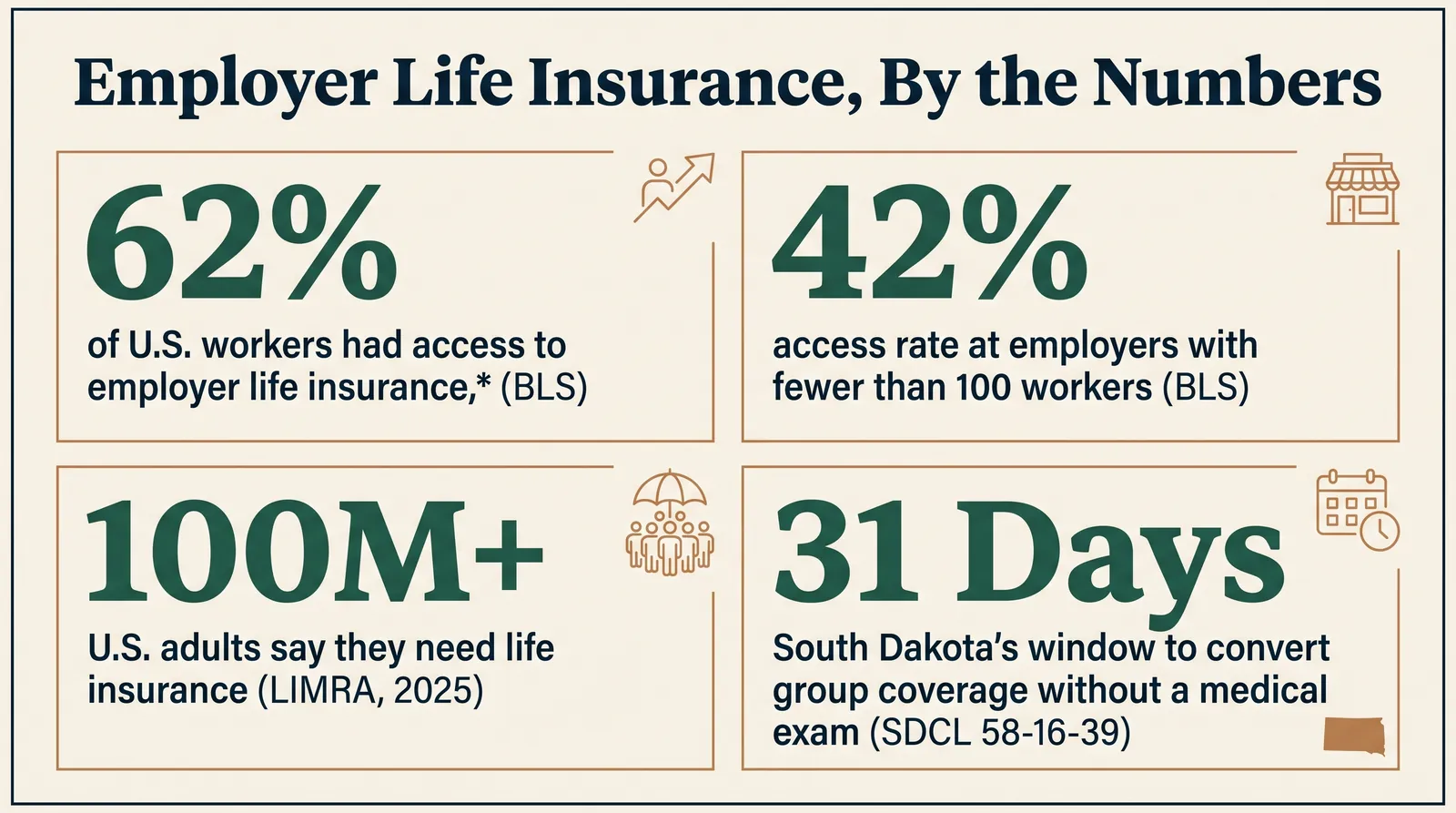
If you’ve ever skimmed a benefits packet, seen “Basic Life Insurance: 1x coverage” or a flat dollar figure, and moved on without doing the math, you’re not alone, and you’re also not necessarily covered the way you think you are. Employer-provided group life insurance is real coverage, but it’s built around your employer’s plan design, not your mortgage balance or your kids’ ages. In March 2025, 62% of all U.S. civilian workers had access to employer life insurance, according to the Bureau of Labor Statistics, and access to a benefit is not the same question as whether that benefit is enough. The honest answer for most South Dakota households with a mortgage, a partner, or kids at home is that the group policy through work is a starting point, not a finish line, and it typically disappears the day the job does.
The short version
- 62% of all U.S. civilian workers had access to employer-provided life insurance in March 2025, but access at establishments with fewer than 100 workers was only 42%, versus 87% at establishments with 500 or more workers, according to the Bureau of Labor Statistics.
- Group life insurance is written on a master policy your employer owns, not you, under South Dakota Codified Law 58-16-2. It's their contract, and your coverage typically ends when your employment does.
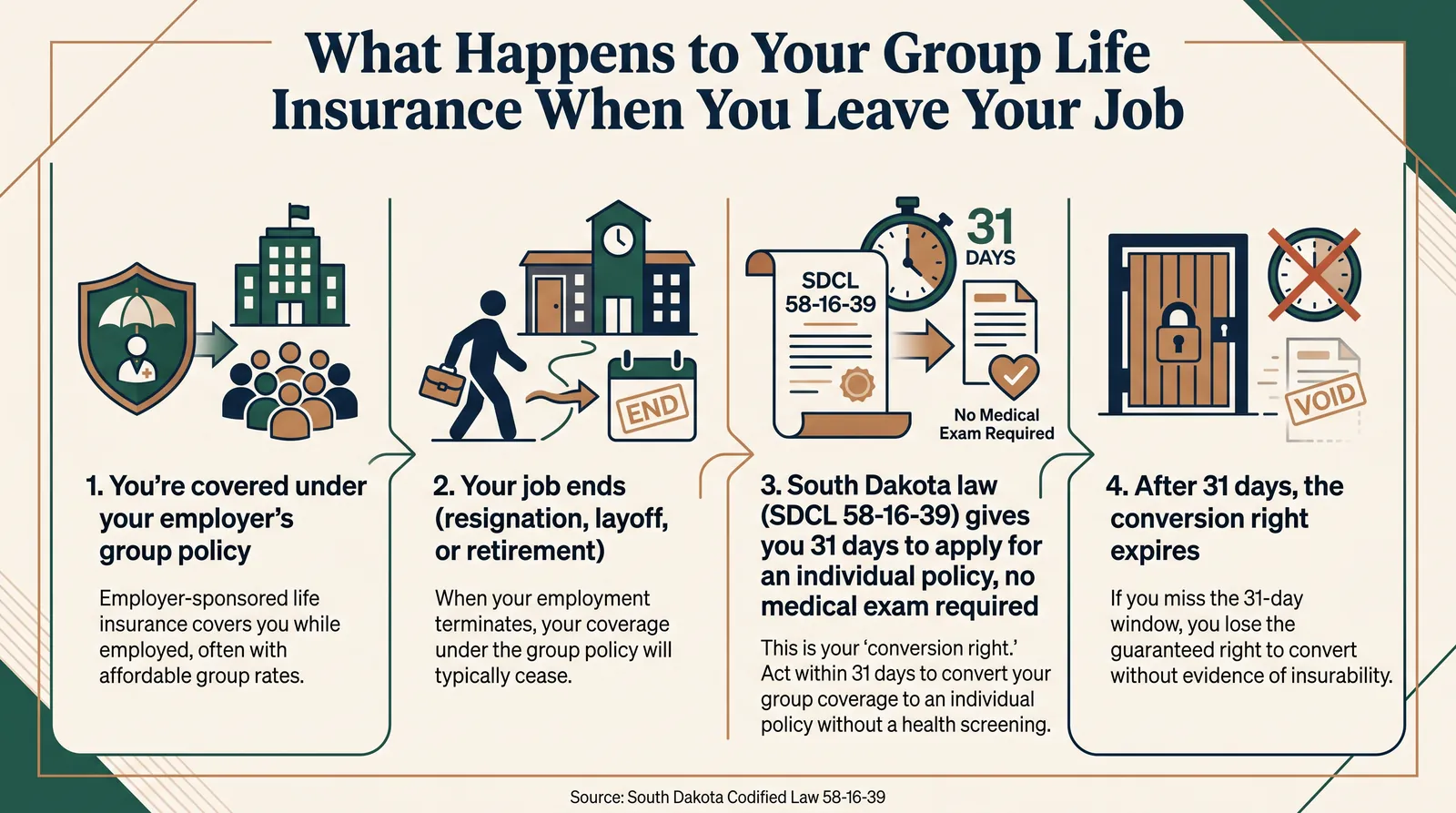
- South Dakota law (SDCL 58-16-39) gives you 31 days after your job ends to convert group coverage to an individual policy without a medical exam. Miss that window and the guaranteed-issue right is gone.
- More than 100 million U.S. adults say they need life insurance, or more of it, according to LIMRA's Life Insurance Awareness Month 2025 research, and relying on a single employer-set benefit amount is one of the more common reasons why.
The pain: “I have life insurance through work” isn’t the same as “I have enough”
This is the assumption that trips up more people than almost any other in life insurance: seeing a line item in your benefits enrollment, checking the box, and treating the question as closed. (For the short version of this whole article, see our answer page on whether employer life insurance is enough.) It’s an understandable mistake. The form makes it look settled. There’s a dollar figure right there next to your name.
But that dollar figure came from your employer’s plan design, not from anyone sitting down with your mortgage statement, your kids’ ages, or what your spouse would need to keep the house and stay afloat if your income stopped tomorrow. Some group plans pay a flat amount, the same figure for the executive and the new hire. Others tie the benefit to a multiple of salary, which scales a little better but still isn’t calculated around your specific debts or dependents. Either way, the number on your enrollment form is a plan parameter, not a needs assessment.
The second part of the pain point is less obvious until it happens to someone: the coverage isn’t yours. It belongs to a master policy your employer holds, and when the employment relationship ends, whether you leave for a better job, get laid off, or retire, the coverage generally ends with it. South Dakota law gives you a narrow window to do something about that, which we’ll walk through in detail below, but the window is short and easy to miss if you don’t know it exists.
This is general education, not a recommendation
Nothing here tells you to buy or cancel any policy. It explains how group life insurance actually works under South Dakota law and current federal data, so you can compare what you have against what your household would need and decide for yourself what, if anything, to add.
Why it happens: group life insurance is your employer’s contract, not yours
Here’s the mechanism almost nobody explains at open enrollment: a group life insurance policy is issued to your employer, or to the trustee of a fund your employer establishes, to insure employees for the benefit of someone other than the employer, under South Dakota Codified Law 58-16-2. Read that again slowly. The policyholder named on the contract is your employer. You’re a covered person under that contract, not a party to it. That single structural fact explains almost everything else about why the coverage behaves the way it does.
Because the employer is the policyholder, the employer picks the plan design: how much coverage to offer, whether it’s a flat amount or a salary multiple, whether employees can buy supplemental amounts, and how much of the premium, if any, gets passed on to employees. None of those decisions are made with your household’s specific obligations in mind, because a single group plan has to work for every employee at once, from someone just out of school with no dependents to someone with a mortgage, a spouse, and three kids. A one-size-fits-most benefit is, almost by definition, not sized to fit any one household precisely.
The other reason it happens is more structural than most people realize: not everyone even has access to the benefit in the first place, and access itself depends heavily on the size of the employer. According to the Bureau of Labor Statistics’ National Compensation Survey, life insurance access varied sharply by establishment size in March 2025.
| Group | Access to employer life insurance |
|---|---|
| All U.S. civilian workers | 62% |
| Private-industry establishments, fewer than 100 workers | 42% |
| Private-industry establishments, 100–499 workers | 72% |
| Private-industry establishments, 500 workers or more | 87% |
Source: U.S. Bureau of Labor Statistics, "Employee Benefits in the United States, March 2025" (news release USDL-25-1464, September 25, 2025). This is a single federal survey; we did not find an independent second source that breaks out access by establishment size the same way, so treat the size-based figures as directionally accurate rather than exact to the decimal for your specific employer.
If you work for a small business, which is common across South Dakota, there’s a real chance you don’t have employer life insurance at all, let alone enough of it. And even the 98% take-up rate among workers who do have access, also from BLS’s Table 5 for March 2025, only tells you that people who are offered the benefit generally accept it. It says nothing about whether the amount they accepted would actually cover what their household needs.
Employer life insurance access by employer size, March 2025
U.S. Bureau of Labor Statistics, "Employee Benefits in the United States, March 2025," news release USDL-25-1464 (September 25, 2025) and Table 5, "Life insurance benefits: Access, participation, and take-up rates."
What it costs to get wrong: a worked example with real South Dakota numbers
The clearest way to see the gap is to build one number: what your household would actually need to replace, using a common industry method called DIME, which stands for Debt, Income, Mortgage, and Education. It’s not a formula from any single official source; it’s a widely used way to organize the arithmetic so you don’t forget a category. Nothing about the method itself needs a citation. The dollar inputs do, so here’s a fully labeled illustration using real South Dakota figures for the parts that have one, and clearly flagged assumptions for the parts that don’t.
Say a hypothetical South Dakota household earns the state’s median household income, which was $79,850 in 2024, according to the Federal Reserve Bank of St. Louis’s FRED database, sourced from the Census Bureau. This household bought a home financed near South Dakota’s median listing price, which was $378,350 as of July 2026, also per FRED. Assume, for this illustration only, a 20% down payment, leaving a mortgage balance of roughly $302,680.
| DIME category | Illustrative amount | Basis for this illustration |
|---|---|---|
| D — Other debt (credit cards, auto loans) | $15,000 | Assumed for this example, not a South Dakota average |
| I — Income replacement | $798,500 | 10 years × $79,850 SD median household income (FRED, 2024); 10 years is an illustrative choice, not a rule |
| M — Mortgage balance | $302,680 | 80% of $378,350 SD median listing price (FRED, July 2026), assuming a 20% down payment |
| E — Future education costs (one child) | $40,000 | Assumed for this example, not a sourced tuition figure |
| Illustrative total need | ~$1,156,180 | Sum of the rows above, for teaching purposes only |
Illustrative example only, not a recommendation or a promise of what any household needs. Income and home-price figures: Federal Reserve Bank of St. Louis (FRED) series MEHOINUSSDA646N (South Dakota median household income, 2024) and MEDLISPRISD (South Dakota median listing price, July 2026). Debt, income-replacement years, and education figures are assumptions chosen for this example, not South Dakota averages.
Now hold that roughly $1.16 million illustrative need against a group life certificate. Group plans vary enormously, so for this illustration only, say this household’s employer provides a flat $20,000 death benefit, a common shape for a flat-dollar group plan, though yours could be a different flat amount, a salary multiple, or nothing at all if your employer doesn’t offer the benefit. Compare your own certificate of coverage to find your real number; don’t borrow this one.
Set next to an illustrative $1.16 million need, a $20,000 flat benefit covers roughly two and a half weeks of the income-replacement piece alone, before touching the mortgage, the other debt, or a dime of future education costs. That’s not a knock on group life insurance as a benefit; free or low-cost coverage is still coverage. It’s a demonstration of why “I have life insurance through work” and “I have enough life insurance” are two different sentences that happen to share some words.
The number on your enrollment form is a plan parameter your employer chose. It was never a promise that it matches what your family would need.
Mike Moore, Life Insurance AdvisorHow to work it out yourself: four steps, no one else required
You can do all four of these steps yourself, this week, without talking to anyone in sales.
- Pull your actual certificate of coverage. Ask HR, or check your benefits portal, for the exact dollar amount or formula that applies to you today, not what you remember from onboarding. Plans change year to year.
- Run your own DIME number. Add up your real non-mortgage debt, a realistic number of years of income replacement for your household, your actual mortgage balance, and any future education costs you want covered. Use your own figures, not the illustrative ones above.
- Subtract your group benefit from your DIME number. Whatever is left is the size of the gap you’re carrying uncovered, whether or not you’ve ever thought of it in those terms.
- Check your conversion rights before you need them, not after. If you were to leave this job tomorrow, South Dakota law gives you a specific, short window to convert your group coverage, covered next. Know the number before the clock starts.
You can run this math yourself
All four steps above just require your certificate of coverage and honest numbers for your own household. Where a second opinion tends to help is comparing individual term policy costs across carriers once you know your gap, since a single quote can't tell you whether it's competitive.
What happens to your coverage when the job ends
South Dakota law does provide a real, if time-limited, protection here. Under SDCL 58-16-39, if your group coverage ends because your employment or membership ends, you have the right to apply for an individual life insurance policy without evidence of insurability, meaning without a medical exam or health questions, but you must apply and pay the first premium within 31 days after the termination date. The individual policy has to be issued in one of the insurer’s standard permanent forms, not term insurance, at the insurer’s regular rates for your age and policy form. If you’d been covered under the group plan for five years or more, SDCL 58-16-40 adds a cap: the individual policy amount can’t exceed the difference between your prior group coverage and any new group coverage you picked up within that same 31-day window.
| Rule | What it means | Governing statute |
|---|---|---|
| Who owns the group policy | Your employer or its plan trustee, not you | SDCL 58-16-2 |
| Deadline to convert | 31 days after employment or membership ends | SDCL 58-16-39 |
| Medical exam required to convert | No; issued without evidence of insurability | SDCL 58-16-39 |
| Form of the converted policy | A standard permanent form, not term insurance | SDCL 58-16-39 |
| Amount cap after 5+ years covered | Limited to prior group amount minus any new group coverage within 31 days | SDCL 58-16-40 |
Source: South Dakota Legislature, Codified Law Chapter 58-16, Group Life Insurance Policies. Current codified law, accessed 2026.
The conversion right is genuinely useful if you have a health condition that would complicate buying a new individual policy on the open market. It’s also expensive relative to buying term coverage while you’re healthy: you’re converting to a permanent policy at standard rates for your age, not shopping competitively across carriers for the best term rate available to someone in your health class. That tradeoff is worth knowing before you assume the conversion right alone is your safety net.
When employer coverage might genuinely be enough
It’s worth saying plainly, because this isn’t a pitch to buy more insurance regardless of your situation: if you’re young, single, with no dependents and no mortgage, a modest employer-provided benefit might reasonably cover what you’d actually want it to, a funeral and some winding-down costs, and adding a large individual policy on top of that may not be worth the premium for you right now. The gap math matters because of what it’s replacing, income for dependents, a mortgage payment, future costs for kids, not because more insurance is automatically better. Run your own DIME number. If it comes back small or close to your group benefit, you may be genuinely fine as-is, and it’s worth saying so rather than manufacturing urgency that doesn’t fit your household.
How we help
We’re independent, so we’re not selling you a policy to fill a quota; we’re helping you see the actual gap between what your employer provides and what your household needs, then comparing individual term options across carriers if a gap is real. If your group benefit and your DIME number are already close, we’ll tell you that too. The point is matching coverage to your specific mortgage, your specific dependents, and your specific timeline, not assuming a one-size-fits-most employer benefit was ever meant to be your whole answer.
What you get
A clear comparison between what your certificate of coverage actually promises and what your household would need to replace, worked out with your real numbers instead of a hypothetical. If there’s a gap, a look at individual term policies from more than one carrier, priced for your age and health rather than averaged across your entire workplace. And a straight answer about your South Dakota conversion rights if you’re between jobs or thinking about a move, including the 31-day deadline that most people never hear about until it’s already passed.
Find out what your real gap is
Bring your certificate of coverage and we'll walk through your actual DIME number together, then show you what closing the gap would look like across more than one carrier.
Not ready to talk to anyone yet? Read How It Works first and come back when you are. If you have a health condition you’re worried would complicate an individual policy, it’s worth asking rather than assuming; independent agencies see how different carriers treat the same file.
Frequently asked questions
Is the life insurance I get through work actually enough?
For most people with a mortgage, kids, or a partner who depends on their income, no. Employer group life insurance is usually one flat dollar amount set by your employer’s plan design, not a number calculated around what your specific family would need. In March 2025, 62% of all U.S. civilian workers had access to employer-provided life insurance, according to the Bureau of Labor Statistics, but access to the benefit says nothing about whether the amount is enough. The only way to know your own number is to pull your certificate of coverage and compare it to what your household would actually need to replace, not to assume the benefit was sized with you in mind.
How much life insurance does my employer actually provide?
It depends entirely on your employer’s specific plan, and there is no single national figure we can honestly quote you, because plan design varies by employer, industry, and whether you work for a small business or a large one. Some employers offer a flat amount, such as $10,000 or $25,000. Others tie the benefit to a multiple of your salary. The only reliable way to find your real number is to ask your HR department for your certificate of coverage or summary plan description, which will state the exact formula and dollar amount that applies to you.
What happens to my group life insurance if I quit or get laid off?
It generally ends. Group life insurance is written on a master policy owned by your employer or its plan trustee, not by you individually, under South Dakota Codified Law 58-16-2. When your employment ends, so does your coverage under that master policy, subject to whatever conversion rights South Dakota law requires the insurer to offer, covered in the next question.
Can I convert my group life insurance to an individual policy without a medical exam in South Dakota?
Yes, within a strict deadline. Under SDCL 58-16-39, a South Dakota group life insurance policy must give a terminated employee the right to apply for an individual policy without evidence of insurability, meaning no medical exam or health questions, but you must apply and pay the first premium within 31 days after your employment ends. Miss the window and the guaranteed-issue conversion right is gone. The individual policy you convert to must be a permanent form, not term insurance, per the statute, and if you were covered for five or more years, SDCL 58-16-40 caps the amount at the difference between your prior group coverage and any new group coverage you picked up within that same 31 days.
Does group life insurance cost me anything?
Often the base amount is employer-paid at no direct cost to you, though this varies by plan, and some employers charge employees for coverage above a certain threshold or for supplemental amounts you elect. Check your pay stub or benefits portal for any life insurance premium deduction, and ask HR directly if you are not sure whether you are paying for any part of your current coverage.
Should I buy my own life insurance if I already have coverage through work?
It is worth checking the math rather than assuming either way. If your certificate of coverage shows an amount that would genuinely replace your income, pay off your mortgage, and cover your family’s needs for as long as you’d want it to, a supplemental policy may not be necessary. If there’s a meaningful gap, or if you’d lose the coverage entirely the day you changed jobs, an individual term policy you own yourself stays with you regardless of your employer and can be sized to your actual situation. Neither choice is automatically right; it depends on the number you calculate for your own household.
What’s the difference between portability and conversion for group life insurance?
Conversion, which South Dakota law requires under SDCL 58-16-39 and 58-16-40, lets you turn ended group coverage into an individual permanent policy without a medical exam, generally at standard age-based rates, within 31 days. Portability, where offered, lets you continue a group-style term policy as an individual arrangement, sometimes at group-negotiated rates, but it is not guaranteed by South Dakota statute the way conversion is, and not every employer’s group plan includes a portability feature. Check your specific certificate of coverage to see whether portability is offered in addition to the statutory conversion right.
Is group life insurance income taxable?
The death benefit itself is generally not taxable income to your beneficiary, the same as most life insurance proceeds, under 26 U.S.C. Section 101(a) of the Internal Revenue Code. However, if your employer provides more than $50,000 of group term coverage, the IRS generally treats the cost of coverage above that $50,000 threshold as imputed income to you while you’re alive and employed, meaning it can show up as taxable wages on your W-2, according to IRS guidance on fringe benefits. This is general education, not tax advice for your specific paycheck.
Before you decide anything
This article is general education, not insurance, legal, financial, or tax advice. Product availability, features, and rates vary by carrier and are subject to underwriting. No coverage exists until a policy is issued and in force. Any guarantees are subject to the claims-paying ability of the issuing insurer. Please review your actual plan documents and speak with a licensed agent about your situation.
Sources
- U.S. Bureau of Labor Statistics — Employee Benefits in the United States, March 2025 (news release USDL-25-1464) — published September 25, 2025; life insurance access by establishment size
- U.S. Bureau of Labor Statistics — Table 5, Life insurance benefits: Access, participation, and take-up rates, March 2025 — all civilian workers access and take-up rate
- LIMRA — Life Insurance Awareness Month 2025 — more than 100 million U.S. adults say they need life insurance
- South Dakota Legislature — SDCL 58-16-2, Group life insurance issued to employer — employer or trustee as policyholder
- South Dakota Legislature — SDCL 58-16-39, Conversion on termination of employment — 31-day guaranteed-issue conversion window
- South Dakota Legislature — SDCL 58-16-40, Conversion on termination of group policy — conversion amount cap after five or more years covered
- Federal Reserve Bank of St. Louis (FRED) — Median Household Income in South Dakota (MEHOINUSSDA646N) — 2024 estimate, sourced from the U.S. Census Bureau
- Federal Reserve Bank of St. Louis (FRED) — Housing Inventory: Median Listing Price in South Dakota (MEDLISPRISD) — July 2026 observation, sourced from Realtor.com
- Internal Revenue Service — Publication 15-B, Employer’s Tax Guide to Fringe Benefits — taxation of group term life insurance over $50,000
Related reading: What Happens to Your Life Insurance When You Change Jobs?, How Much Life Insurance Do You Actually Need? and Mortgage Protection Insurance vs Term Life: Which Is Better?. See current options for term life insurance, or learn more about who we help.