
No. Taking Ozempic, Wegovy, Zepbound, Mounjaro, or another GLP-1 medication does not automatically disqualify you from life insurance, and it does not automatically raise your rate either. What actually happens depends on why the drug was prescribed, how your weight and lab numbers have moved since you started it, and how long you’ve been taking it. This is genuinely new ground for underwriting: GLP-1s only became common in the last few years, carriers are still catching up to each other on how to treat them, and that gap between carriers is exactly the thing worth understanding before you apply.
The short version
- About 12% of U.S. adults say they've taken a GLP-1 drug like Ozempic or Wegovy, and 6% say they're currently taking one, per a nationally representative KFF poll fielded in 2024.
- A GLP-1 prescription is not, by itself, a reason for decline. Underwriters weigh why it was prescribed, your lab and weight trend, and how long you've been on it.
- An analysis of 41 million insured lives by the reinsurer Munich Re, covering 2015 through January 2025, found lower relative all-cause mortality among GLP-1 users versus non-users across most age groups.
- South Dakota's own adult obesity rate sits at 35% or higher, per 2023 CDC data, which is part of why this question keeps coming up for South Dakota families specifically.
- Carriers don't all treat GLP-1 use the same way yet. That gap is precisely where an independent agent shopping more than one carrier can change your outcome.
What is a GLP-1 drug, and why does it show up on a life insurance application?
GLP-1 stands for glucagon-like peptide-1, a hormone your gut releases naturally after you eat that helps regulate blood sugar and appetite. GLP-1 receptor agonists are medications that mimic that hormone, and they’ve become the fastest-moving category in American medicine in the last five years. Semaglutide (sold as Ozempic for diabetes and Wegovy for weight management) was first approved for diabetes in December 2017, followed by Wegovy’s obesity approval in 2021. Tirzepatide (Mounjaro for diabetes, approved May 2022, and Zepbound for obesity, approved November 2023) works on a related but broader hormone pathway, according to Munich Re’s clinical summary of the drug class.
These drugs show up on a life insurance application because the application asks about current and recent medications, and because the conditions they treat, type 2 diabetes, obesity, and cardiovascular risk, are the same conditions underwriters have always asked about. A GLP-1 prescription is a new data point layered onto an old underwriting question, not a new category of question.
This is more common than most people assume. About one in eight U.S. adults, 12%, say they’ve taken a GLP-1 drug, and 6% say they’re currently taking one, according to a nationally representative KFF Health Tracking Poll fielded April 23 to May 1, 2024, among 1,479 adults. Use is higher still among people with diabetes: 26.5% of U.S. adults with diagnosed diabetes used a GLP-1 injectable in 2024, per the CDC’s National Center for Health Statistics, drawing on the 2024 National Health Interview Survey. In South Dakota specifically, the backdrop is a state adult obesity rate of 35% or higher, one of 23 states in that top tier, according to CDC data based on 2023 state-level survey figures. Put plainly: if you’re applying for life insurance in South Dakota in 2026, there’s a real chance either you or someone in your household is dealing with this question.
This is general education, not a promise about your application
Underwriting outcomes depend on your complete health history, the specific carrier, and current guidelines that continue to evolve. Nothing here is a quote or a guarantee of approval, a rate class, or coverage terms. Coverage availability and pricing vary by carrier and are subject to underwriting.
Why does an underwriter care about a GLP-1 prescription at all?
Because it’s a proxy for something underwriters have always priced: your metabolic and cardiovascular risk, and how well it’s controlled. An underwriter reading your file isn’t scoring the drug name; they’re reading it as a signal and then checking the signal against your actual numbers.
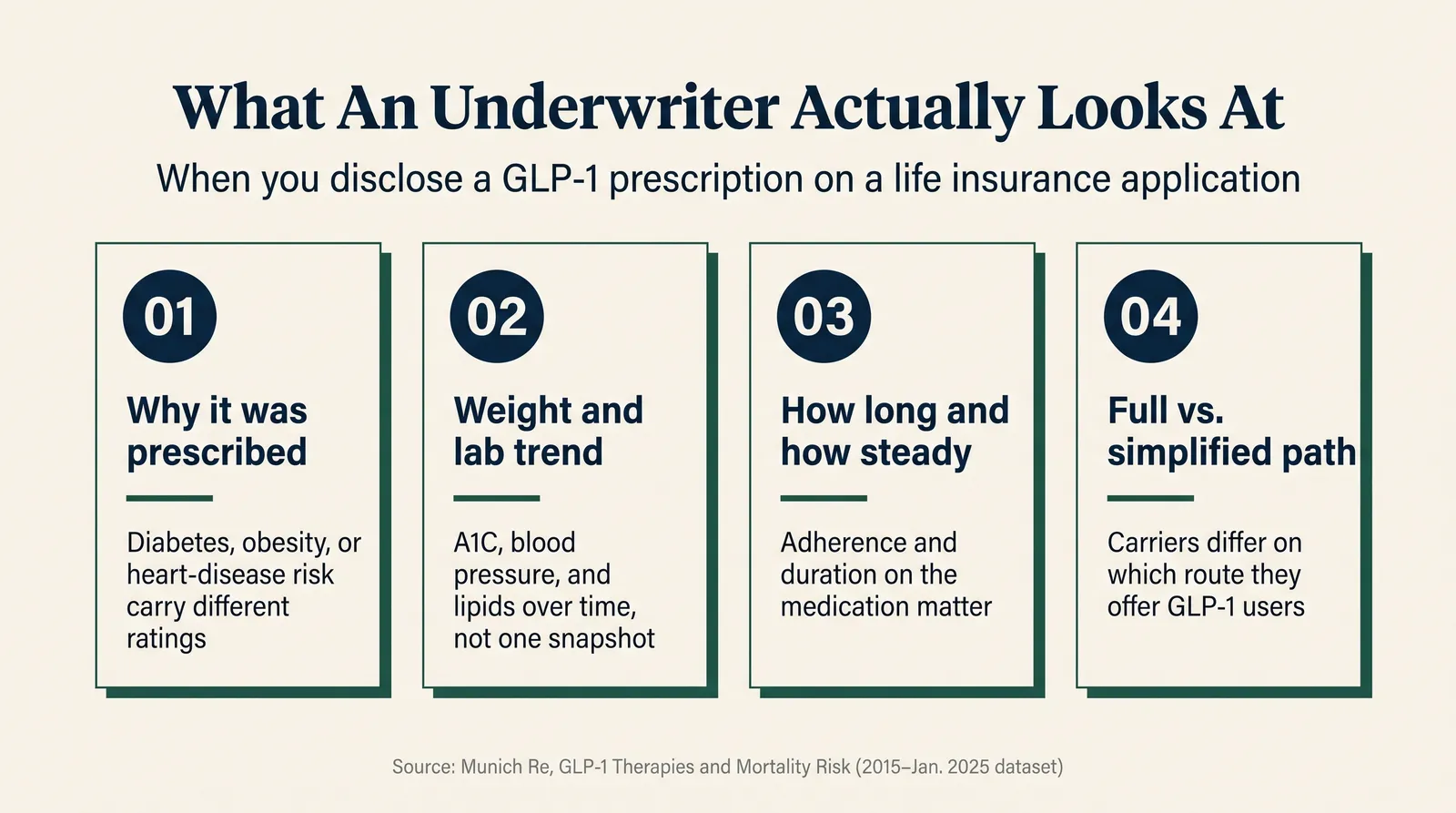
In practice, that means four things get evaluated together, not any one of them in isolation.
| Factor | What it tells the underwriter |
|---|---|
| Reason for the prescription | Type 2 diabetes, obesity, cardiovascular risk reduction, and off-label weight loss carry different starting risk profiles and get evaluated differently. |
| Weight and lab trend | A1C, blood pressure, and lipid panels over multiple visits, not a single snapshot, show whether the medication is working and whether the trend is holding. |
| Duration and adherence | A few months on the drug reads differently than two years of consistent use with stable, improving numbers. |
| Underlying condition control | Whether diabetes, obesity, or heart-disease risk factors are actually managed, independent of which drug is managing them. |
Source: Munich Re, "GLP-1 therapies and mortality risk: Implications for life insurers," clinical insights, dataset spanning 2015 to January 1, 2025, accessed 2026.
One adherence detail matters more than people expect: Munich Re’s dataset found roughly 60% one-year adherence among diabetics prescribed a GLP-1, but under 40% among non-diabetics, and fewer than 30% among non-diabetics aged 30 to 40 specifically. Underwriters have learned that a lot of people start these drugs and don’t stay on them, which is part of why a longer, steadier track record tends to carry more underwriting weight than a prescription filled two months before you apply.
What does the new mortality data actually show?
This is the part that’s genuinely changed since GLP-1s went mainstream, and it’s worth understanding because it cuts against the instinct that any new medication must be a red flag.
Munich Re’s analysis covers a de-identified U.S. dataset of 41 million lives, ages 18 to 80, average age 54, spanning 2015 through January 1, 2025. Across that population, both diabetic and non-diabetic GLP-1 users showed lower relative all-cause mortality than non-users, with similar-sized reductions in both groups, and the pattern held consistently across age groups under 60, with less pronounced (though still present) reductions over 60. Based on that pattern, Munich Re’s own forecast is that GLP-1s could support an additional 0.2% to 0.5% annual mortality improvement, realized over a 20-year period, on top of existing mortality-improvement assumptions carriers already build into their pricing.
That reinsurer-level analysis lines up with a separate, independent clinical trial. The SELECT trial, a randomized cardiovascular outcomes study of semaglutide published in the New England Journal of Medicine, enrolled 17,604 adults with established cardiovascular disease and overweight or obesity, without diabetes, and followed them for up to four years. Semaglutide was associated with a 20% reduction in major adverse cardiovascular events (a composite of cardiovascular death, non-fatal heart attack, or non-fatal stroke) compared with placebo: a hazard ratio of 0.80 (95% CI 0.72 to 0.90, p < 0.001), meaning the difference is very unlikely to be due to chance.
SELECT trial: major adverse cardiovascular events, semaglutide vs. placebo
Source: SELECT trial (semaglutide, obesity or overweight with established cardiovascular disease, no diabetes), New England Journal of Medicine, hazard ratio 0.80, 95% CI 0.72–0.90, p < 0.001; 17,604 participants; follow-up up to 4 years. Data accessed via PubMed Central (National Library of Medicine), 2026.
Two independent sources, a reinsurer analyzing 41 million real insurance-relevant lives and a randomized clinical trial of over 17,000 people, point the same direction: for the cardiovascular and metabolic risk factors GLP-1s are prescribed for, well-managed use is associated with lower risk, not higher. That’s the opposite of the instinct a lot of applicants walk in with.
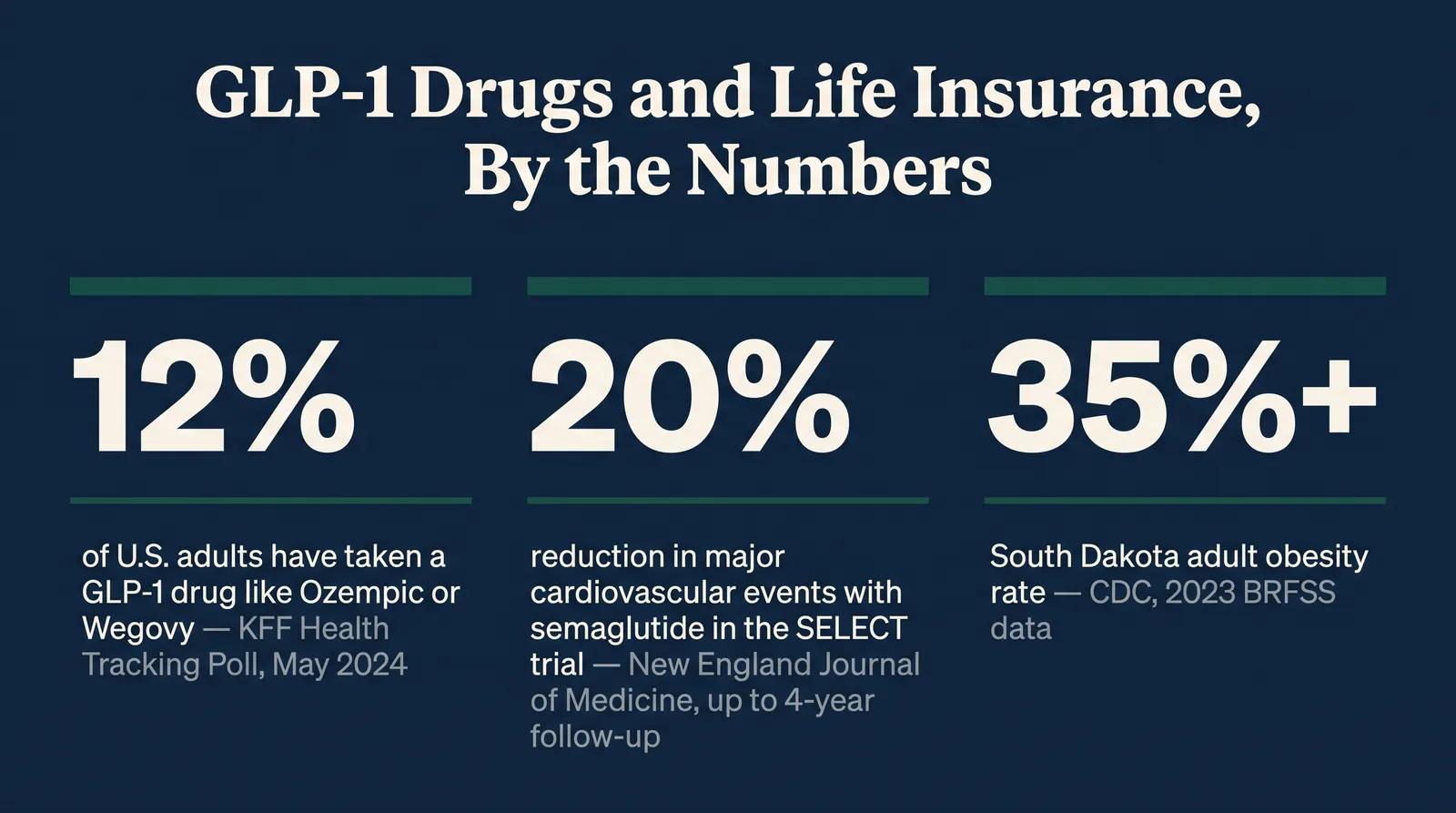
12%
of U.S. adults have taken a GLP-1 drug (KFF Health Tracking Poll, fielded April–May 2024)
41M
insured lives in Munich Re's GLP-1 mortality dataset, 2015 to January 2025
20%
reduction in major cardiovascular events with semaglutide, SELECT trial (NEJM)
35%+
South Dakota adult obesity rate (CDC, 2023 state-level data)
What does it cost you if you assume the worst and skip shopping around?
Here’s the real financial risk in this whole topic, and it isn’t the drug. It’s applicants who assume a GLP-1 prescription means an automatic decline or a steep rate-up, so they either don’t apply at all, or they apply to a simplified-issue or guaranteed-issue product that skips underwriting entirely, and pay a real premium for that assumption.
Simplified and guaranteed-issue policies exist for good reasons and fit some situations well, covered in detail in our guide to no-medical-exam life insurance and our comparison of underwritten versus no-exam coverage. But they’re priced for the uncertainty of not checking, which means a healthy, well-managed GLP-1 user who could qualify for standard or even preferred rates through full underwriting may pay meaningfully more per dollar of coverage by defaulting to a no-questions-asked product out of an unverified assumption.
For scale, a healthy 40-year-old nonsmoking man buying a $500,000, 20-year term policy through full underwriting averaged $321 a year, and a nonsmoking woman of the same age and coverage averaged $278 a year, according to NerdWallet’s own rate data, sourced from Policygenius and current as of August 1, 2026. That’s an illustration of what full underwriting can look like for a healthy applicant, not a quote or a promise for anyone reading this; smoking status, health history, the specific carrier, and underwriting outcome all move the number, and a GLP-1 prescription’s effect on that number depends entirely on the four factors covered above.
| Path | What happens | The tradeoff |
|---|---|---|
| Assume decline, buy guaranteed issue | Skip health questions entirely, accept a smaller death benefit and a graded early-year benefit | Highest price per dollar of coverage; never actually finds out what full underwriting would have offered |
| Apply to one carrier, take what's offered | Full or simplified underwriting with a single company's specific GLP-1 guidelines | Outcome depends entirely on that one carrier's current guidelines, which vary company to company |
| Compare carriers before applying | An independent agent checks which carriers' current guidelines fit a well-documented GLP-1 file | Takes a short conversation up front; aims the application at carriers likelier to underwrite it well |
How do you work this out for yourself before you apply?
You don’t need anyone’s help to get your own file in order first. This is the same method that works for any maintenance medication on a life insurance application.
- Pull your own medical records covering when the prescription started, why it was prescribed, and your weight, A1C, blood pressure, and lipid readings at each visit since. You’re building the trend an underwriter will look for anyway; having it organized before you apply saves time and shows a clear picture instead of a partial one.
- Know your own numbers, not just that you’re “on Ozempic.” Is your A1C in range? Has your blood pressure come down? Has weight loss been steady? These specifics are what actually move a rating, far more than the drug’s brand name.
- Be honest about duration and consistency. If you started a few months ago, that’s fine to say plainly. Underwriters have seen the adherence data too; a short but clearly improving trend is a real, common file, not a disqualifying one.
- Disclose fully, including past use you’ve since stopped. Applications ask about medication history, and a pharmacy database or an attending physician statement will show it whether or not you mention it. Omitting it isn’t a shortcut, it’s a misrepresentation that can jeopardize a claim later during the contestability period.
- Decide whether full, accelerated, or simplified underwriting fits your situation, using our guide to how underwriting works and our piece on what convenience actually costs as a starting point. A well-documented GLP-1 file with strong labs is often a stronger candidate for full or accelerated underwriting than people assume.
- Shop more than one carrier before you commit to an application. Because carriers haven’t converged on identical GLP-1 guidelines yet, the same file can land differently at different companies. This is the step people skip most often, and it’s the one that costs the most when they do.
How does South Dakota law factor into this?
South Dakota regulates how insurers can treat applicants with similar risk profiles. Under SDCL 58-33-26, no insurer may make or permit unfair discrimination between insureds having like insuring or risk characteristics, in premium, rates, dividends, or any other term or condition of the insurance; a violation is a Class 2 misdemeanor. In plain terms, a carrier’s underwriting decision has to be tied to an actual, individualized risk assessment, not an arbitrary blanket rule applied to everyone who fills a GLP-1 prescription regardless of their actual labs, history, or the reason it was prescribed.
That protection doesn’t mean every carrier will land on the same answer for the same file; underwriting guidelines are a business decision each company sets for itself within the law, and this is exactly the area where guidelines are still evolving fastest. It does mean a decision has to be grounded in your actual risk profile rather than the medication name alone, and it’s part of why comparing carriers, not just accepting the first answer, is a reasonable and legally grounded thing to do.
"I'm on Ozempic, so I probably can't get coverage"
- Never applies, or applies only to guaranteed-issue coverage at the highest price per dollar
- Never finds out what a full underwriting look would actually offer
- Treats one company's hypothetical guideline as if it applied everywhere
ResultCoverage decision made without ever checking
Gathers records, knows the trend, compares carriers
- Pulls A1C, blood pressure, and weight trend before applying
- Discloses fully, including past use, and lets the file speak for itself
- Has an independent agent check which carriers currently underwrite GLP-1 files well
ResultA decision grounded in an actual offer, not a guess
A worked example: two South Dakota applicants
Applicant A is 44, was prescribed semaglutide fourteen months ago for type 2 diabetes, and has records showing A1C dropping from 8.1% to 6.4%, steady weight loss, and blood pressure now in normal range. Rather than assume the diagnosis alone rules out standard rates, they gather those records before applying. Because the file shows over a year of consistent improvement, not a recent start, it’s a stronger candidate for a favorable full-underwriting outcome at a carrier whose current guidelines credit a well-controlled, improving trend, which an independent agent can help identify rather than guessing at.
Applicant B is 37, started tirzepatide two months ago for off-label weight loss through a telehealth prescription, with no diabetes diagnosis and only one weigh-in on record so far. There isn’t a trend to show yet. Rather than treat that as a dead end, Applicant B discloses the prescription fully, understands that a short history is a normal, common file rather than a disqualifying one, and either proceeds with a carrier whose guidelines don’t require extensive history for off-label use, or waits a few months to build a longer record before reapplying, a genuine option worth weighing against buying nothing while it’s decided.
Same drug class, two different underwriting pictures, because the underlying trend, not the prescription name, is what an underwriter is actually reading.
How we help
We’re an independent life insurance agency, which means we aren’t limited to one carrier’s guidelines on GLP-1 use, and those guidelines are exactly the part that’s still shifting fastest across the industry. When a South Dakota applicant comes to us with a GLP-1 prescription on their record, we help gather the right documentation, then compare how the carriers we represent currently treat that kind of file, rather than sending one application in and hoping. Compare My Options.
What you get
A clear answer to whether the medication itself should worry you (generally, no, if the underlying trend is good). A method for organizing your own records before you ever talk to anyone. And, if you decide to move forward, a side-by-side look at how more than one carrier’s current guidelines would treat your specific file, instead of a single yes-or-no from a single company.
Underwriters aren't rating the prescription. They're rating the trend behind it. Know your own trend before you ask anyone else to judge it.
Mike MooreRelated reading
This guide focuses on GLP-1 drugs specifically. For a broader look at underwriting after any health diagnosis, see our guide on getting life insurance after a health condition and our diabetes-specific underwriting guide. If speed and convenience matter more to you than price, our no-medical-exam life insurance guide and our underwritten-versus-no-exam comparison walk through that tradeoff directly.
Have a health condition already?
See how coverage works for people with health conditions.
Curious how underwriting works overall?
Our underwriting timeline answer page is a good starting point.
Not sure where to start?
Read how it works first and come back when you're ready.
Frequently asked questions
Does taking Ozempic or another GLP-1 drug automatically disqualify you from life insurance?
No. A GLP-1 prescription by itself is not an automatic decline. Underwriters look at why it was prescribed (diabetes, obesity, or cardiovascular risk reduction), how your weight and lab values have trended since you started, and how long you’ve been on it. A well-documented, stable case is treated very differently from a recent prescription with no track record yet. Carriers also differ from each other in how they weigh GLP-1 use, which is exactly why shopping more than one carrier matters here.
What does an underwriter actually want to know if you’re on a GLP-1 drug?
Four things, in practice: the reason it was prescribed, your weight and lab trend over time (A1C, blood pressure, lipids), how long you’ve taken it and how consistently, and whether any underlying condition it treats (diabetes, obesity, heart disease) is otherwise well controlled. None of this is unique to GLP-1s; it’s the same pattern underwriters use for any maintenance medication.
Does GLP-1 use ever help your life insurance rate rather than hurt it?
It can, indirectly. Underwriters aren’t rating the drug itself; they’re rating the underlying risk factors it treats. If a GLP-1 has meaningfully improved your A1C, blood pressure, or weight-related risk since your diagnosis, that improvement can support a better rate class than the same file would have gotten before treatment. The reinsurer Munich Re’s analysis of a 41-million-life dataset from 2015 through January 2025 found lower relative all-cause mortality among GLP-1 users compared with non-users, consistently across age groups under 60 and in both diabetic and non-diabetic groups.
Should you wait to apply until you’ve been on a GLP-1 drug longer?
Sometimes, and it’s worth asking a carrier-savvy agent before you apply rather than guessing. Munich Re’s data shows one-year adherence around 60% for diabetics and under 40% for non-diabetics, which is part of why underwriters want to see a trend, not a single recent prescription. If you’re a few months in with clearly improving labs, some carriers will still underwrite favorably; others prefer more history. This is precisely the kind of case where comparing carriers, rather than applying to just one, changes the outcome.
What if you took a GLP-1 drug in the past but aren’t on it now?
You still disclose it. Life insurance applications ask about medication history, not just current use, typically going back several years. Underwriters will want to know why you stopped, whether the underlying condition is still controlled, and whether your weight has stayed off or come back. Stopping doesn’t erase the history; it just becomes another data point in the file.
Do you have to disclose GLP-1 use if you got it from a telehealth company instead of your regular doctor?
Yes. The application asks about medications and diagnoses, not about which type of provider prescribed them. Telehealth prescriptions still show up in a pharmacy database or an attending physician statement, and underwriters check both. Leaving it off the application is a misrepresentation, not a shortcut, and it can jeopardize a claim later if it’s discovered, since insurers can investigate statements made on the application during the contestability period.
Can a life insurance company deny you coverage just for being on a weight-loss drug?
A carrier can decline any individual application based on its own underwriting guidelines, and guidelines vary by company. What South Dakota law prohibits is unfair discrimination between people with like risk characteristics; SDCL 58-33-26 bars unfair discrimination in the terms, conditions, or premiums of insurance between insureds with similar risk profiles. In practice, that means a decision has to trace back to an actual risk assessment, not an arbitrary rule against GLP-1 users as a category. Since carriers set their own guidelines within that framework, a decline from one company is often not a decline everywhere, which is the whole case for comparing more than one.
Sources
- KFF — Poll: 1 in 8 Adults Say They’ve Taken a GLP-1 Drug — 12% of adults have taken a GLP-1 drug, 6% currently taking one; nationally representative poll fielded April 23–May 1, 2024; accessed 2026
- CDC / National Center for Health Statistics — NCHS Data Brief No. 537, GLP-1 Injectable Use Among Adults With Diagnosed Diabetes: United States, 2024 — 26.5% of adults with diagnosed diabetes used a GLP-1 injectable in 2024, based on the 2024 National Health Interview Survey; published August 2025; accessed 2026
- CDC Newsroom — New CDC Data Show Adult Obesity Prevalence Remains High — South Dakota among 23 states with adult obesity rate of 35% or higher; based on 2023 state-level survey data; released September 12, 2024; accessed 2026
- Munich Re — GLP-1 therapies and mortality risk: Implications for life insurers — 41-million-life dataset, 2015 to January 1, 2025; mortality and adherence findings; FDA approval timeline; accessed 2026
- SELECT trial results, via PubMed Central / National Library of Medicine — semaglutide associated with 20% reduction in major adverse cardiovascular events, hazard ratio 0.80 (95% CI 0.72–0.90, p < 0.001); 17,604 participants; follow-up up to 4 years; originally published in the New England Journal of Medicine; accessed 2026
- South Dakota Legislature — Codified Law 58-33-26, Unfair Discrimination as to Terms and Conditions of Insurance — prohibits unfair discrimination in premiums, rates, or terms between insureds with like risk characteristics; current codified law, accessed 2026
- NerdWallet — Average Life Insurance Rates in 2026 — illustrative $500,000, 20-year term rates for a healthy 40-year-old nonsmoker, sourced from Policygenius rate data valid as of August 1, 2026; accessed 2026
Related reading: Life Insurance With Diabetes: A 2026 South Dakota Guide, Underwritten vs. No-Exam Life Insurance in 2026, and No-Medical-Exam Life Insurance: How It Works in 2026. See who we help: people with health conditions and current options for term life insurance.
Before you act on any of this
This article is general education, not insurance, legal, financial, or medical advice. Coverage availability, features, and rates vary by carrier and state and are subject to underwriting. No coverage exists until a policy is issued and in force. Any guarantees are subject to the claims-paying ability of the issuing insurer. Nothing here should be read as guidance about starting, stopping, or continuing any medication; that's a conversation for you and your physician.
The prescription isn’t the verdict
A GLP-1 drug on your medical record is a fact an underwriter will read, not a sentence they’ve already handed down. What actually moves the outcome is the trend behind it: why it was prescribed, what your numbers have done since, and how long that pattern has held. Gather that picture honestly, disclose it fully, and let more than one carrier’s current guidelines weigh in before you accept any single answer as the final one.
Want a second opinion before you apply?
We'll help you organize your records and compare how the carriers we represent currently underwrite GLP-1 files.