
Federally, yes; at the state level, no. The taxable part of an annuity distribution is taxed as ordinary federal income, the same rate you pay on wages, not a lower capital-gains rate. South Dakota adds nothing on top of that, because South Dakota does not impose a state individual income tax, according to the South Dakota Department of Revenue. Beyond that starting point, how much of a given payment is actually taxable, and when, depends on three things: whether the annuity was funded with pre-tax or after-tax money, whether you’re taking a partial withdrawal or converting the contract into a stream of payments, and how old you are when you take the money. Getting those three things straight before you withdraw anything is the whole game.
The short version
- Annuity earnings grow tax-deferred, but the taxable portion of a withdrawal is taxed as ordinary federal income, per IRS Topic no. 410. South Dakota adds no state income tax on top, per the South Dakota Department of Revenue.
- A qualified annuity (pre-tax IRA or 401(k) money) is generally fully taxable on withdrawal. A nonqualified annuity (after-tax savings) is only taxed on the earnings, using either the LIFO rule for partial withdrawals or the exclusion ratio for annuitized payments, per IRS Publication 939.
- A withdrawal before age 59½ can trigger an additional 10% federal penalty on the taxable portion, on top of regular income tax, per IRS Topic no. 558, unless a specific exception applies.
- Required minimum distributions on a qualified annuity start at age 73. Missing one triggers a 25% excise tax on the shortfall, reduced to 10% if corrected within the IRS correction window, per the Instructions for Form 5329 (2025).
- A Section 1035 exchange lets you move an annuity's value into a new contract without triggering tax at the time of the move, per IRS Publication 575. And large annuity withdrawals can push more of your Social Security benefit into taxable territory, per the Social Security Administration.
What actually gets taxed when you take money out of an annuity?
Not the whole withdrawal, in most cases, and not automatically at the same rate for everyone. The IRS taxes annuity distributions based on your “investment in the contract,” a term that just means the after-tax dollars you personally put in. Money that’s already been taxed once doesn’t get taxed again on the way out; only the growth does, plus any pre-tax money that was never taxed to begin with.
That distinction splits annuities into two tax categories that behave very differently:
| Type | Funded with | How withdrawals are taxed |
|---|---|---|
| Qualified annuity | Pre-tax money, usually an IRA or a 401(k) rollover | Generally fully taxable as ordinary income on the way out, the same as any other traditional IRA withdrawal |
| Nonqualified annuity | After-tax savings, money you already paid income tax on | Only the earnings are taxable; your original contribution (cost basis) comes out tax-free, using LIFO for partial withdrawals or an exclusion ratio if annuitized |
Source: Internal Revenue Service, Topic no. 410, "Pensions and annuities," and Publication 575, "Pension and Annuity Income." Accessed 2026.
If you funded an annuity by rolling over a traditional IRA or 401(k), the IRS treats every dollar you eventually withdraw as ordinary taxable income, the same as if you’d withdrawn from the IRA directly. If you funded it with money already sitting in a taxed savings or brokerage account, only the growth is taxable when it comes out.
This is general education, not tax advice for your specific return
Your actual tax situation depends on your full return, your filing status, and details specific to your contract. Nothing here is a substitute for a conversation with a CPA or tax preparer about your own numbers. This article covers federal rules that apply nationally and South Dakota's state tax treatment specifically.
Why does the IRS use two different methods, LIFO and the exclusion ratio?
Because a lump sum and a stream of payments are fundamentally different things to tax, and the IRS built a separate method for each.
Last-in-first-out (LIFO) applies when you take a partial withdrawal from a nonqualified annuity that hasn’t been converted into a payment stream. The IRS treats your earnings as sitting on top of your original contribution, so the first dollars out are earnings, fully taxable as ordinary income, and stay that way until every dollar of gain has been withdrawn. Only after the gain is exhausted do withdrawals start coming out tax-free as a return of your own principal. Practically, this means an early, large withdrawal from a profitable nonqualified annuity is taxed hard, because you’re pulling out gain first whether you want to or not.
The exclusion ratio applies when you annuitize a nonqualified contract, meaning you convert the account value into a guaranteed stream of payments for a period certain or for life. The IRS divides your investment in the contract by the expected total return under the contract (which, for a lifetime payout, uses IRS life-expectancy tables) to calculate a fixed percentage of every payment that counts as a tax-free return of principal. The rest of each payment is taxed as ordinary income. That ratio is calculated once, at the start, and then applies consistently to every payment, according to IRS Publication 939, “General Rule for Pensions and Annuities.”
| Method | When it applies | How it works |
|---|---|---|
| LIFO | Partial withdrawals from a nonqualified contract that hasn't been annuitized | Earnings are treated as coming out first, fully taxable, until all gain is withdrawn; principal comes out tax-free only after that |
| Exclusion ratio | Annuitized (payment-stream) income from a nonqualified contract | A fixed percentage of every payment is tax-free return of principal; the remainder is taxed as ordinary income, calculated once at the start |
Source: Internal Revenue Service, Topic no. 410, and About Publication 939, "General Rule for Pensions and Annuities" (current revision December 2025). Accessed 2026.
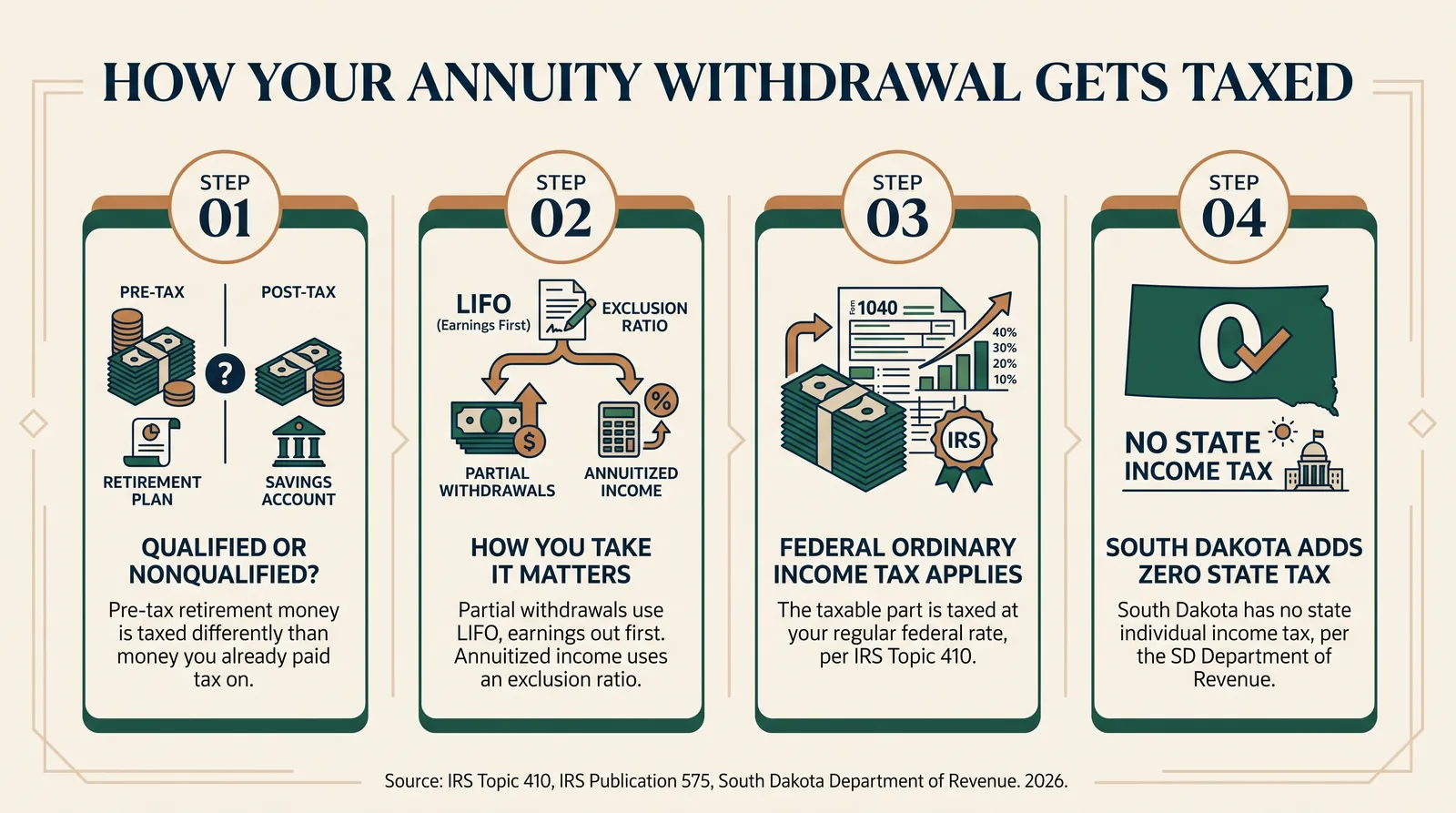
What does South Dakota add to the federal tax bill? Nothing.
This is the part of the question that’s genuinely specific to living here, and it’s a real, quantifiable advantage, not marketing language. South Dakota does not impose a state individual income tax, according to the South Dakota Department of Revenue’s own published guidance. That means every category of retirement income, annuity distributions, Social Security, pension payments, 401(k) and IRA withdrawals, is taxed the same at the state level: not at all.
For an annuity specifically, that removes one full layer of the calculation that a retiree in a state with an income tax has to do. You still work out the federal taxable portion using the qualified/nonqualified distinction and either LIFO or the exclusion ratio, and you still pay federal tax on that amount at your marginal rate. You just stop there. There’s no separate state form, no state withholding to calculate, no state bracket to check.
$0
South Dakota state tax on annuity income, per the SD Department of Revenue
Age 73
When RMDs must start on a qualified annuity, per the IRS
$250,000
SD annuity guaranty coverage limit per contract owner, per SDLIGA
$464.1B
Total US retail annuity sales in 2025, a fourth straight record year, per LIMRA
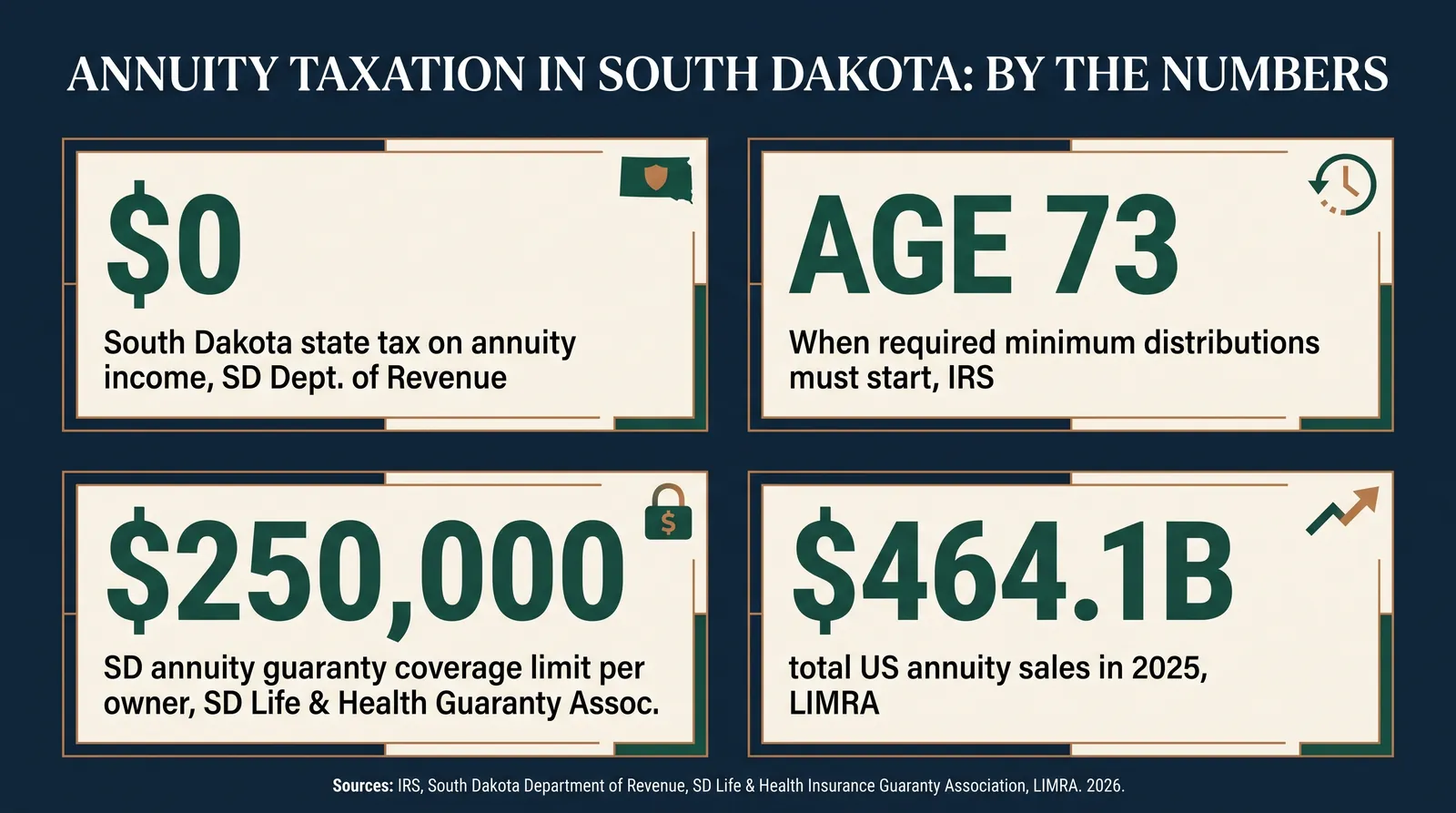
It’s worth naming why this matters right now, not just as trivia. U.S. retail annuity sales hit $464.1 billion in 2025, a 7% increase over the prior year and the industry’s fourth consecutive record year, according to LIMRA’s final 2025 sales data, published March 23, 2026. More South Dakota retirees are buying annuities than in past years, which means more of them are also going to eventually face this exact withdrawal-tax question, often for the first time, with real money on the table.
South Dakota also regulates the annuity purchase itself, separate from taxation. Under the state’s adoption of the NAIC’s Annuity Best Interest Standards, producers selling annuities in South Dakota must satisfy obligations of care, disclosure, conflict-of-interest management, and documentation, according to the South Dakota Division of Labor and Regulation. And if a carrier were ever to become insolvent, South Dakota’s guaranty association caps protection at $250,000 in present value per contract owner for annuity benefits, and $300,000 in aggregate for life insurance death benefits on the same insured life, according to the South Dakota Life & Health Insurance Guaranty Association. None of that changes how the IRS taxes a distribution, but it’s part of the same decision and worth knowing before you commit a large sum to any single carrier.
What does it actually cost you to get the timing wrong?
Here’s where this stops being abstract. The tax rules above don’t just determine whether money is taxable, they determine how much tax you pay depending on when and how you take it, because federal tax brackets are graduated. Stacking a large taxable withdrawal on top of your other income in a single year can push part of it into a higher bracket than spreading the same withdrawal across a few years would.
Consider a single filer with $40,000 of other 2026 taxable income (after their standard deduction) who has $30,000 of taxable gain sitting in a nonqualified annuity, funded years ago with after-tax savings. Under 2026 federal brackets, the 12% rate applies to taxable income above $12,400, and the 22% rate kicks in above $50,400 for a single filer, according to the IRS’s 2026 inflation adjustments (Revenue Procedure 2025-32).
Option A: withdraw the full $30,000 gain in one year. Stacked on $40,000 of other income, taxable income rises to $70,000. The portion from $40,000 to $50,400 ($10,400) is taxed at 12% = $1,248. The portion from $50,400 to $70,000 ($19,600) is taxed at 22% = $4,312. Total federal tax on the withdrawal: $5,560.
Option B: spread the same $30,000 gain over three years, $10,000 per year. Each year, taxable income is $40,000 + $10,000 = $50,000, staying under the $50,400 threshold where the 22% bracket begins. All $10,000 is taxed at 12% = $1,200 per year, for a three-year total of $3,600.
Federal tax on the same $30,000 nonqualified annuity gain, lump sum vs. spread over 3 years
Illustration only, not a projection for any individual return. Assumes a single filer, $40,000 of other 2026 taxable income after the standard deduction, no other credits or deductions, and 2026 federal marginal rates from IRS Revenue Procedure 2025-32 (12% bracket above $12,400; 22% bracket above $50,400 for single filers). South Dakota adds no state tax, per the SD Department of Revenue. Accessed 2026.
That’s $1,960 in additional federal tax on the identical $30,000 of income, purely from the order of operations. Nothing about the annuity changed; only the timing did. Nothing about a lump-sum withdrawal feels like a mistake in the moment. It shows up on the 1099-R the following spring.
How do you work out your own after-tax annuity income?
You don’t need anyone’s help to get the basic picture right. This is the same method that applies whether the amount involved is small or large.
- Find out whether the annuity is qualified or nonqualified. Check your original paperwork or ask the carrier directly. If it was funded from an IRA or a 401(k) rollover, treat withdrawals as fully taxable. If it was funded with after-tax savings, only the earnings are taxable.
- Know your cost basis. For a nonqualified annuity, this is the after-tax amount you put in. Your annual statement or the carrier’s client portal should show it; if it doesn’t, ask for it directly before you take any withdrawal.
- Identify which method applies to your situation. A partial, non-annuitized withdrawal uses LIFO (earnings out first). A lifetime or period-certain payment stream from an annuitized contract uses the exclusion ratio, which your carrier calculates and reports.
- Check your 1099-R before you file. Box 1 shows the gross distribution; box 2a shows the taxable amount, already worked out using the applicable method; box 7 shows a distribution code that flags things like an early-distribution penalty or a direct rollover.
- Check your age against 59½ and 73. Before 59½, a taxable distribution may trigger the additional 10% federal penalty unless an exception applies. At 73, a qualified annuity inside an IRA or retirement plan becomes subject to required minimum distributions.
- Model more than one withdrawal year before committing to a lump sum, the way the worked example above does, especially if the amount is large enough to push you into a higher bracket. A conversation with whoever prepares your taxes, held before you withdraw rather than after, is what prevents the $1,960 kind of mistake.
When does the 10% early withdrawal penalty apply?
To the taxable portion of a distribution taken before age 59½, on top of whatever regular income tax is owed, according to IRS Topic no. 558. It’s not a South Dakota rule and it’s not annuity-specific; it’s the same federal early-distribution penalty that applies to IRAs and 401(k)s, applied here to the taxable part of an annuity payout.
The exceptions are specific, not general hardship categories, which is where people get tripped up:
| Exception | Basic condition |
|---|---|
| Substantially equal periodic payments | A series of payments based on life expectancy, taken on a set schedule |
| Total and permanent disability | The owner meets the IRS definition of disabled |
| Death of the owner | Distributions to a beneficiary or the estate after death |
| Terminal illness | Distributions to an individual certified as terminally ill |
| Qualified birth or adoption | Up to $5,000, tied to a birth or adoption |
| Medical expenses | The portion exceeding 7.5% of adjusted gross income |
| Domestic relations order | Distributions to a spouse or former spouse under a qualifying court order |
Source: Internal Revenue Service, Topic no. 558, "Additional tax on early distributions from retirement plans other than IRAs." Accessed 2026. Not an exhaustive list; several narrower exceptions also exist.
Assuming an exception applies without confirming it against your specific distribution is a common, avoidable way to end up owing a penalty you didn’t expect. If a withdrawal before 59½ is even a possibility, confirm the exact exception and its documentation requirements before you take the money, not after.
What about required minimum distributions on a qualified annuity?
If your annuity sits inside a traditional IRA or an employer retirement plan, it’s subject to the same required minimum distribution (RMD) rules as any other qualified account. You generally must start taking withdrawals by age 73, with the first RMD deadline falling on April 1 of the year after you turn 73, according to the IRS. After that first year, each subsequent RMD is due by December 31.
Missing one has a real cost. The shortfall, the difference between what you should have withdrawn and what you actually withdrew, is subject to a 25% excise tax, according to the IRS Instructions for Form 5329 (2025), reduced to 10% if you correct it and file the appropriate return within the IRS’s correction window, generally by the end of the second year after the missed distribution. A concrete example: a $4,000 shortfall left uncorrected costs $1,000; corrected promptly, it costs $400.
An annuitized qualified contract typically satisfies its own RMD through the payment schedule itself, since payments are already structured around your life expectancy. A qualified annuity you haven’t yet annuitized is treated like any other IRA balance for RMD purposes; confirm which applies to you with the carrier before your deadline each year, not after it’s passed.
Can you move annuity money to a different contract without paying tax now?
Often, yes. A Section 1035 exchange allows you to move the value of one annuity contract directly into a new one, from one carrier to another, without recognizing the accumulated gain as taxable income at the time of the exchange, according to IRS Publication 575. This is the mechanism that lets someone move out of an annuity with features they’ve outgrown, high fees, a surrender period long behind them, a payout structure that no longer fits, and into a different contract without triggering the tax bill a straight withdrawal-and-reinvest would create.
Two things matter here. First, the exchange has to be handled directly, carrier to carrier; taking a distribution yourself and then buying a new annuity with the proceeds is a taxable event, not a 1035 exchange. Second, a 1035 exchange doesn’t erase your original cost basis, it carries forward into the new contract, so the eventual tax treatment of withdrawals from the new annuity is still governed by the same LIFO or exclusion-ratio rules described above, just applied to the original basis inside the new contract.
Does an annuity withdrawal affect how your Social Security gets taxed?
It can, and this is one of the more commonly missed interactions. The Social Security Administration determines how much of your benefit is taxable using a “combined income” formula: your other income (which includes the taxable portion of an annuity distribution) plus half of your Social Security benefit for the year. If that combined figure exceeds $25,000 for a single filer or $32,000 for a joint filer, part of your Social Security benefit becomes taxable, according to the Social Security Administration.
That means a large annuity withdrawal taken in the same year you start Social Security, or in any year your combined income is near those thresholds, doesn’t just get taxed on its own; it can also push more of your Social Security benefit into taxable territory at the same time. This is another argument for the same principle as the worked example above: modeling a withdrawal against your full tax picture, not just the annuity balance in isolation, before you take it.
"It's my money, I'll just take what I need"
- Withdraws a large lump sum without checking qualified vs. nonqualified status first
- Doesn't check the year's other income before deciding how much to take
- Finds out about bracket stacking and Social Security taxability on the 1099-R the following spring
ResultA tax bill that's bigger than it needed to be, discovered after the fact
Checks the contract type and models the withdrawal first
- Confirms cost basis and whether LIFO or the exclusion ratio applies
- Checks the withdrawal against 2026 federal brackets and the Social Security combined-income thresholds before taking it
- Spreads a large withdrawal across tax years when the math supports it
ResultThe same money, a smaller and more predictable tax bill
A worked example: two South Dakota retirees
Retiree A is 68, single, and holds a nonqualified MYGA that matured with $28,000 of gain on top of the original $90,000 she put in from a savings account years ago. She’s also drawing a modest pension. Rather than withdraw the full $28,000 in one year, she checks her other 2026 taxable income first, finds it’s close to the top of the 12% bracket already, and works with whoever prepares her taxes to take the gain across two tax years instead of one. Because South Dakota adds no state tax to any of it, her only variable is the federal bracket math, and splitting the withdrawal keeps more of it inside the 12% bracket instead of spilling into the 22% bracket.
Retiree B is 74 and has a qualified immediate annuity inside a rollover IRA that he annuitized last year. Because the contract is already paying out on a schedule designed around his life expectancy, it’s satisfying his RMD automatically; he confirms this with his carrier rather than assuming it, since not every annuitized schedule automatically covers the full RMD in every year, and an assumption here is exactly the kind of thing that turns into a 25% excise tax on a shortfall he didn’t know existed. He also checks how his fixed annuity payments interact with his Social Security combined income, since his annuity income alone puts him close to the $25,000 single-filer threshold.
Same asset class, two different tax pictures, because the type of annuity, the funding source, and the withdrawal method changed every downstream number.
How we help
We’re an independent agency, so when a South Dakota client is deciding how to structure annuity income, whether to annuitize a contract, move it through a 1035 exchange, or take withdrawals on a schedule, we lay out the carrier-specific mechanics of the products we represent and how the federal rules above apply to your contract type. We are not tax preparers, and nothing here replaces a conversation with a CPA about your actual return; what we do is make sure the annuity decision itself is grounded in how the product actually works. Compare My Options.
What you get
A clear framework for whether your annuity income is fully or only partly taxable, and why. The two federal methods, LIFO and the exclusion ratio, explained well enough that you can read your own 1099-R. A worked example showing what the timing of a withdrawal can cost or save. And, if you want it, a comparison of how the annuity products we represent handle withdrawals and exchanges differently.
The annuity doesn't decide your tax bill. The order you take the money in does.
Mike MooreRelated reading
This guide focuses on federal and South Dakota tax treatment specifically. For the mechanics of each annuity type, see our guides to fixed indexed annuities, immediate income annuities, and MYGAs compared with bank CDs. For the required-minimum-distribution side specifically, including the QLAC option that can reduce future RMDs, see our QLAC and RMD guide. And for the bigger question this all serves, whether your money will actually last, see Will Your Retirement Savings Last?
Not sure which annuity type fits?
Start with our annuities overview before comparing specific products.
Planning retirement income as a senior?
See how we work with seniors on income and coverage decisions.
Not ready to talk to anyone?
Read how it works first and come back when you're ready.
Frequently asked questions
How are annuities taxed in South Dakota?
The same way they’re taxed everywhere at the federal level, plus nothing extra at the state level. Earnings inside an annuity grow tax-deferred, and when you take money out, the taxable portion is taxed as ordinary federal income, not a lower capital-gains rate. South Dakota does not impose a state individual income tax, according to the South Dakota Department of Revenue, so no state tax applies to annuity income on top of the federal bill. The exact mechanics, how much of each payment is taxable, depend on whether the annuity is qualified or nonqualified and whether you’re taking partial withdrawals or annuitized payments.
Do I owe South Dakota state tax on annuity income?
No. South Dakota does not have a state individual income tax, so it does not tax annuity withdrawals, annuitized payments, Social Security, pensions, or any other form of retirement income at the state level, per the South Dakota Department of Revenue. You still owe federal income tax on the taxable portion of any annuity distribution; South Dakota’s advantage is entirely on the state side of the ledger.
What’s the difference between a qualified and a nonqualified annuity for tax purposes?
A qualified annuity is funded with pre-tax money, typically inside an IRA or a 401(k) rollover, so you never paid tax on those dollars going in. Every dollar you take out is generally taxable as ordinary income, the same as any other traditional IRA withdrawal, according to how the IRS treats qualified retirement distributions. A nonqualified annuity is funded with money you already paid tax on, so only the earnings are taxable when you withdraw; the portion that represents your original contribution comes out tax-free, per IRS Topic no. 410.
What is the exclusion ratio, and how is it different from the LIFO rule?
Both are methods for figuring out how much of an annuity payment is taxable, and they apply to different situations. The exclusion ratio applies when you annuitize a nonqualified contract, converting it into a stream of guaranteed payments; it divides your investment in the contract by the expected total return to find a fixed percentage of each payment that’s a tax-free return of principal, with the rest taxed as ordinary income, per IRS Publication 939. The LIFO rule, last-in-first-out, applies to partial withdrawals from a nonqualified annuity that hasn’t been annuitized; the IRS treats earnings as coming out first, so withdrawals are fully taxable as ordinary income until all the gain is out, per IRS Topic no. 410.
When does the 10% early withdrawal penalty apply to an annuity, and when doesn’t it?
It applies to the taxable portion of a distribution taken before age 59½, on top of regular income tax, per IRS Topic no. 558. It’s a federal rule that applies to annuities the same way it applies to IRAs and 401(k)s. Common exceptions include distributions after total and permanent disability, distributions after the owner’s death, substantially equal periodic payments based on life expectancy, and a handful of narrower exceptions such as qualified birth or adoption distributions up to $5,000. The exceptions are specific; assuming one applies without checking is a common, expensive mistake.
What happens if I miss a required minimum distribution from a qualified annuity?
The shortfall, the amount you should have withdrawn but didn’t, is subject to an IRS excise tax of 25%, reduced to 10% if you take the missed amount and file a corrected return within the correction window, per the IRS Instructions for Form 5329 (2025). This is a real, quantifiable cost: a $4,000 shortfall left uncorrected costs $1,000; corrected promptly, it costs $400. It applies to RMDs starting at age 73, per current IRS rules following the SECURE 2.0 Act.
Can I move money from one annuity to another without triggering tax right now?
Often yes, through a Section 1035 exchange, which lets you move the cash value of one annuity contract directly into another without recognizing the gain as taxable income at the time of the exchange, per IRS Publication 575. The exchange has to go directly from carrier to carrier, and it doesn’t erase the original cost basis; it carries forward into the new contract. It’s worth understanding before you assume the only way out of an annuity you no longer want is a taxable withdrawal.
Does taking annuity income affect how much of my Social Security benefit is taxed?
It can. The Social Security Administration determines how much of your benefit is taxable using a combined-income formula: your other income (which includes taxable annuity distributions) plus half of your Social Security benefit. If that combined figure exceeds $25,000 for a single filer or $32,000 for a joint filer, a portion of your Social Security benefit becomes taxable, per the Social Security Administration. Timing a large annuity withdrawal in the same year you start Social Security can push more of your benefit into taxable territory than spreading it out would.
Sources
- Internal Revenue Service — Topic no. 410, Pensions and annuities — general rule and simplified method for taxing pension and annuity distributions, cost-basis recovery; accessed 2026
- Internal Revenue Service — Topic no. 558, Additional tax on early distributions — 10% additional tax on distributions before age 59½ and list of exceptions; accessed 2026
- Internal Revenue Service — About Publication 939, General Rule for Pensions and Annuities — exclusion ratio methodology; current revision December 2025; accessed 2026
- Internal Revenue Service — Publication 575, Pension and Annuity Income — Section 1035 tax-free exchange of annuity contracts, excess-accumulation rules; accessed 2026
- Internal Revenue Service — Retirement topics: Required minimum distributions (RMDs) — RMD starting age of 73 and the April 1 first-year deadline; accessed 2026
- Internal Revenue Service — Instructions for Form 5329 (2025) — 25% excise tax on a missed RMD, reduced to 10% if corrected within the correction window; accessed 2026
- Internal Revenue Service — IRS releases tax inflation adjustments for tax year 2026 — 2026 federal bracket thresholds and standard deduction, Revenue Procedure 2025-32; published October 2025; accessed 2026
- South Dakota Department of Revenue — Individuals: Taxes — South Dakota does not impose a state individual income tax; accessed 2026
- South Dakota Life & Health Insurance Guaranty Association — FAQ — $250,000 per-owner annuity present-value coverage limit; $300,000 aggregate life insurance death-benefit cap per insured life; accessed 2026
- South Dakota Division of Labor and Regulation — Annuity Best Interest Standards — producer care, disclosure, conflict-of-interest, and documentation obligations under the NAIC 2020 Annuity Best Interest Model; accessed 2026
- LIMRA — Final U.S. Retail Annuity Sales Set New Sales High, Totaling $464.1 Billion in 2025 — $464.1 billion total 2025 U.S. retail annuity sales, 7% growth, fourth consecutive record year; published March 23, 2026; accessed 2026
- Social Security Administration — Benefits Planner: Income Taxes and Your Social Security Benefit — combined-income formula and the $25,000 single / $32,000 joint taxability thresholds; accessed 2026
Related reading: QLACs and Required Minimum Distributions in South Dakota, Fixed Indexed Annuities in South Dakota, MYGA vs. CD in South Dakota, and Will Your Retirement Savings Last?. See who we help: seniors and our annuities overview.
Before you act on any of this
This article is general education, not insurance, legal, financial, or tax advice. Product availability, features, and rates vary by carrier and are subject to underwriting where applicable. No coverage or contract exists until it is issued and in force. Any guarantees are subject to the claims-paying ability of the issuing insurer. The worked examples in this article are hypothetical illustrations built from 2026 federal tax figures and clearly stated assumptions; they are not a projection or promise for any individual's actual tax return. Speak with a CPA or tax preparer about your specific situation before making a withdrawal decision.
The order of operations is the decision
An annuity’s tax treatment isn’t a mystery once you know two things: whether the money going in was pre-tax or after-tax, and whether you’re taking it out as a withdrawal or a payment stream. South Dakota simplifies half of the equation by adding no state tax at all. The federal half still rewards planning, because the same dollar of gain can cost meaningfully more or less in tax depending entirely on when you take it and what else is on your return that year. Work out your cost basis, check your age against 59½ and 73, and model the withdrawal against your full tax picture before you take it, not after.
Want help comparing how different annuity products handle withdrawals?
We'll walk through how the annuity products we represent structure withdrawals, annuitization, and exchanges, so you can compare them against your own tax picture before you commit.