
A qualified longevity annuity contract, or QLAC, is a deferred income annuity you buy inside a traditional IRA, 401(k), 403(b), or governmental 457(b) plan that lets the premium you put in skip your required minimum distribution calculation until the contract actually starts paying you, up to a 2026 lifetime limit of $210,000 per person, according to IRS Notice 2025-67. You are not avoiding tax on that money. You are choosing when the IRS forces you to start counting it, and in exchange you get a stream of guaranteed income that starts later in retirement, when you may need it more and have fewer other options for generating it. That trade, a smaller required withdrawal now for a larger guaranteed check later, is the entire idea. Whether it fits your situation depends on numbers you can actually work out, not a feeling about annuities in general.
The short version
- The 2026 QLAC premium limit is $210,000 per person, a lifetime cap unchanged from 2025, per IRS Notice 2025-67 (Internal Revenue Bulletin 2025-49).
- Final IRS regulations (T.D. 10001) eliminated the old 25%-of-account-balance cap on QLAC premiums, effective for RMD calendar years beginning on or after January 1, 2025.
- QLAC income must begin no later than the first day of the month after your 85th birthday, per the IRS's instructions for Form 1098-Q.
- Required minimum distributions currently start at age 73, calculated by dividing your prior year-end balance by an IRS life-expectancy divisor; that divisor is 26.5 at age 73, per IRS Publication 590-B.
- U.S. retail annuity sales hit a record $464.1 billion in 2025, the fourth straight record year, though deferred income annuity sales, the category QLACs belong to, actually fell 3% to $4.8 billion, according to LIMRA's final 2025 report.
The pain: the IRS is making you withdraw money you don’t need yet
You did what you were supposed to do. You funded the 401(k), rolled it into an IRA, watched it grow for thirty years, and never touched it. Then you turn 73, and the rules change on you without asking. The IRS now requires you to withdraw a set amount every year, whether you need the money or not, whether it is a good year to sell investments or not, and whether the extra income pushes you into a higher tax bracket or not. That is a required minimum distribution, and for a lot of retirees who saved well and live modestly, it is the first time in decades that the government, not their own budget, is deciding how much comes out of an account.
The frustration is not really about the tax. It is about the loss of control at exactly the moment you expected to finally have some. You spent your working years choosing how much to save. Now, in the years when the balance is often at its largest, someone else’s formula tells you how much to take out, and that withdrawal can ripple into places that have nothing to do with your day-to-day spending: more of your Social Security benefit becomes taxable, and your Medicare Part B and Part D premiums can jump through a surcharge called the income-related monthly adjustment amount, which is based on your reported income from two years earlier. None of that shows up on a simple “how much will I need to live on” worksheet, which is exactly why it catches people off guard.
This is general education, not a recommendation
Nothing here tells you to buy a QLAC, delay a specific RMD, or take a specific action with your own accounts. It explains, using the IRS's own rules and current 2026 figures, how the mechanism works, so you can do the first pass of this math yourself or bring it to someone to check.
Why it happens: the RMD formula doesn’t ask what you need, only what you have
A required minimum distribution isn’t calculated from your expenses, your other income, or anything about your actual life. It’s arithmetic applied to a balance. Each year, the IRS requires you to divide your retirement account’s value as of December 31 of the prior year by a distribution period, a number pulled from an IRS life-expectancy table that shrinks slightly each year as you age, according to IRS Publication 590-B. Divide the balance by that number, and the result is the minimum you must withdraw that year. Withdraw less, and you owe an excise tax on the shortfall.
A few terms worth defining once, since they come up constantly in this conversation and get used loosely elsewhere:
- Required minimum distribution (RMD). The minimum amount the IRS requires you to withdraw each year from most tax-deferred retirement accounts, starting at age 73 under current law, according to the IRS.
- Uniform Lifetime Table. The IRS table most retirees use to find their distribution period. At age 73, the divisor is 26.5; it declines a little further each year you age, which is part of why RMD amounts tend to climb over time even if your balance stays flat.
- Qualifying longevity annuity contract (QLAC). A deferred income annuity that meets specific IRS requirements under Treasury Regulation 1.401(a)(9)-6, letting its premium be excluded from the account balance your RMD is calculated on, for as long as the contract has not started paying you.
- Annuitization. Converting a lump sum into a stream of periodic payments, usually for life, through an insurance contract. A QLAC is annuitized later, on a date you pick when you buy it.
- Income-related monthly adjustment amount (IRMAA). A surcharge added to your Medicare Part B and Part D premiums when your reported income exceeds certain thresholds, based on your tax return from two years prior. A large RMD can push you over an IRMAA threshold without you spending an extra dollar of it.
Here’s the part that actually creates the QLAC strategy: money you move into a QLAC is treated, for RMD purposes, as if it left the account balance entirely, for as long as it stays inside the QLAC and hasn’t started paying you. Your December 31 balance, the number the whole RMD formula runs on, is smaller. A smaller balance divided by the same distribution period produces a smaller required withdrawal, every year, until the QLAC itself starts paying income, usually years later.
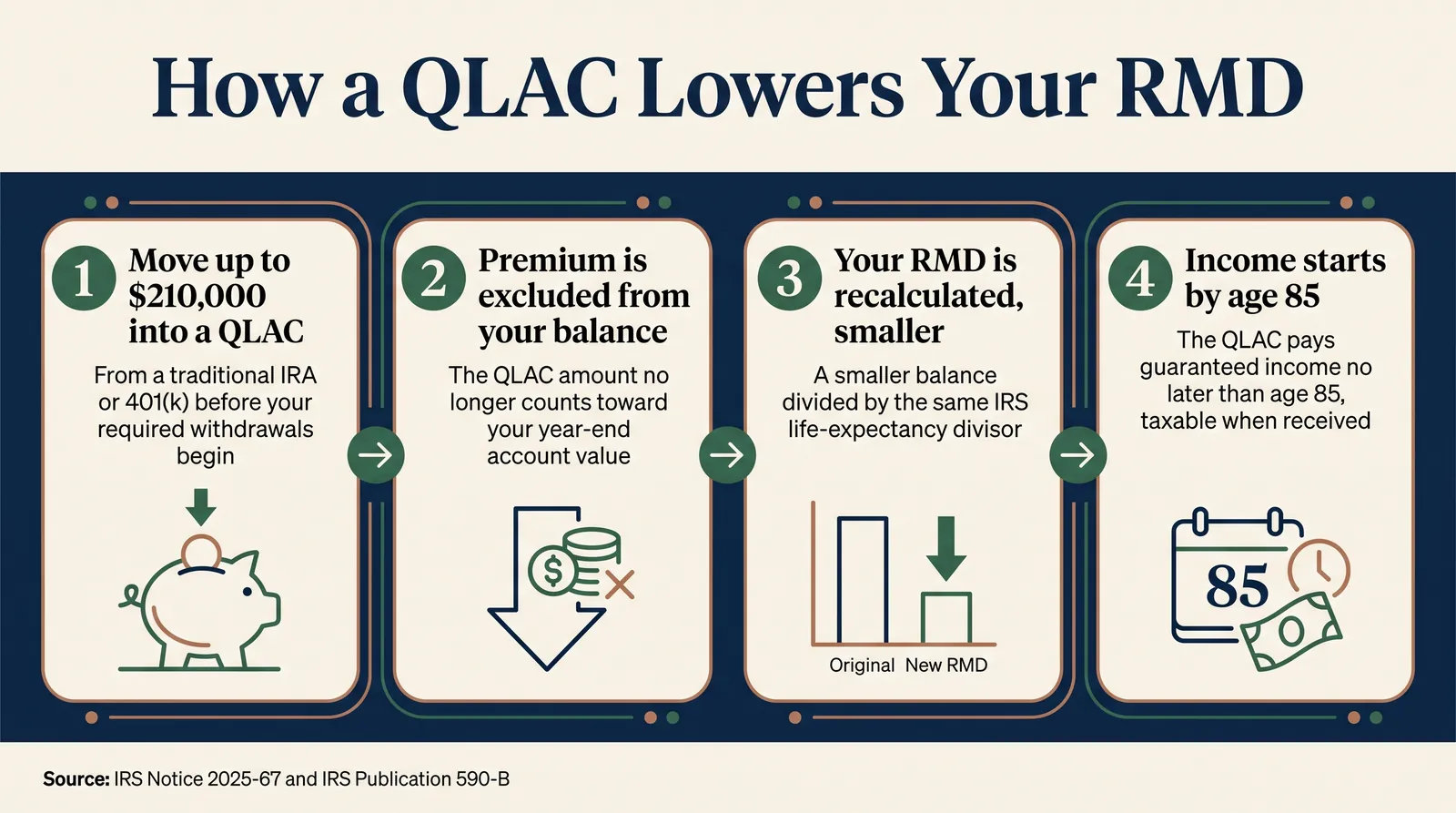
What it costs to get wrong: a real divisor, applied to a real balance
Let’s put actual numbers on this instead of describing it abstractly. This is an illustration built to show how the mechanics work, using the real 2026 QLAC limit and the real IRS distribution period, not a projection or promise of any outcome for your own accounts.
Say a 73-year-old in Watertown has $700,000 combined across a traditional IRA and a rollover 401(k), and does not need all of the mandated withdrawal to cover monthly expenses. Under the standard Uniform Lifetime Table, the math looks like this:
| Scenario | Year-end balance used for RMD | Divided by (age-73 distribution period) | Required minimum distribution |
|---|---|---|---|
| No QLAC | $700,000 | 26.5 | $26,415 |
| $210,000 moved into a QLAC | $490,000 | 26.5 | $18,491 |
| Difference | $210,000 excluded | Same divisor | $7,924 less required that year |
Illustrative example only, not a projection for any specific account. Distribution period of 26.5 for age 73 per IRS Publication 590-B; 2026 QLAC limit of $210,000 per IRS Notice 2025-67. Actual RMDs depend on your own account balance, age, and any applicable spousal adjustment.
That $7,924 gap repeats every year the QLAC hasn’t started paying, and it compounds in a specific way: because the excluded $210,000 also isn’t factored into future years’ balances, the gap in required withdrawals tends to persist across the deferral period, not just show up once. What it costs to ignore this entirely, for someone who genuinely doesn’t need the extra withdrawal, is the difference between a required distribution that lines up with their actual spending and one that forces taxable income onto a return with no corresponding need for the cash, potentially triggering the IRMAA surcharge and a higher marginal tax bracket in the same year.
There’s a second, sharper cost worth naming: missing an RMD altogether. If you fail to withdraw the required amount by the deadline, the IRS applies a 25% excise tax on the shortfall, reduced to 10% if you correct the mistake within two years, according to the IRS. That penalty applies whether the shortfall was intentional or simply the result of not knowing the rule, which is exactly why anyone using a QLAC to lower a balance needs to keep tracking the recalculated RMD on the remaining account each year, not assume the strategy runs on autopilot.
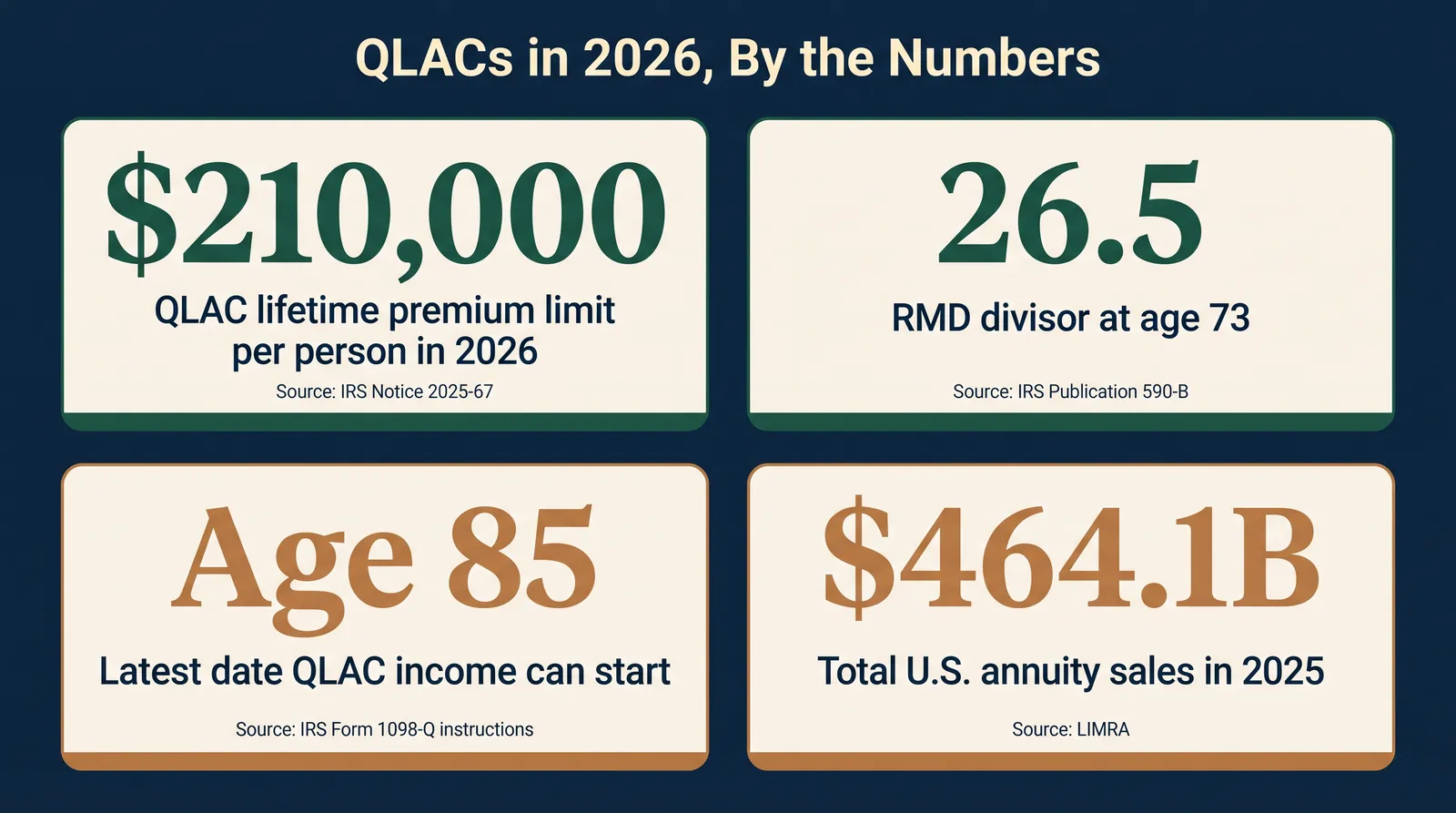
$210,000
2026 QLAC lifetime premium limit per person, per IRS Notice 2025-67
26.5
IRS distribution period (RMD divisor) at age 73, per IRS Publication 590-B
Age 85
Latest date QLAC income can begin, per the IRS's Form 1098-Q instructions
The 2026 rules, in full
A QLAC only gets this tax treatment if it follows a specific set of IRS requirements. Here’s what actually governs one in 2026:
The dollar limit. You can put up to $210,000 of your own retirement money into QLACs over your lifetime, unchanged from 2025, per IRS Notice 2025-67. That figure is indexed for inflation in $10,000 increments going forward, but it did not rise for 2026. It’s a per-person lifetime cap across every QLAC you own, not an annual allowance and not a household limit; a married couple can each fund their own $210,000 QLAC from their own retirement accounts.
No more percentage cap. Before 2025, QLAC premiums were also capped at 25% of your account balance, whichever was lower between that percentage and the flat dollar limit. Final IRS regulations, T.D. 10001, eliminated that percentage test entirely, effective for required minimum distribution calendar years beginning on or after January 1, 2025, according to the IRS. In practice, that means someone with a $400,000 IRA can now put the full $210,000 into a QLAC, more than half the account, something the old 25% rule would have blocked.
The age-85 deadline. QLAC income has to start no later than the first day of the month following your 85th birthday, according to the IRS’s instructions for Form 1098-Q. You choose the actual start date when you buy the contract, anywhere from a few years out up to that deadline, and once the contract is issued, that date is generally locked in.
Which accounts qualify. A QLAC can be funded from a traditional IRA, a 401(k) or other qualified employer plan, a 403(b) plan, or a governmental 457(b) plan, the eligible retirement plans defined under Internal Revenue Code section 402(c)(8)(B), according to the IRS. Defined benefit pension plans are excluded. Because Roth IRAs don’t carry lifetime RMDs in the first place, a QLAC funded from a Roth wouldn’t solve the problem this whole strategy addresses.
A QLAC doesn't make required minimum distributions go away. It moves a chunk of the clock to age 85 and turns that chunk into a paycheck instead of a lump sum you have to manage yourself.
Mike Moore, Life Insurance AdvisorHow a QLAC compares to the other ways to handle this
QLACs aren’t the only tool for the “I don’t need this required withdrawal yet” problem, and they solve a narrower question than people often assume. Here’s how the realistic options line up against each other.
What actually happens
- You withdraw the full required amount every year starting at 73
- Full liquidity: the money stays invested and accessible
- The entire withdrawal counts as taxable income the year you take it
- No change to your IRMAA exposure or bracket pressure
- Balance keeps compounding, so future RMDs tend to grow too
What actually happens
- That premium is excluded from your RMD calculation until payments start
- Illiquid: generally no access to the lump sum once purchased
- No taxable income from that portion until the QLAC starts paying
- Smaller reported income for years, which can ease bracket and IRMAA pressure
- Guaranteed lifetime income begins by age 85, backed by the issuer's claims-paying ability
Other tools solve adjacent but different problems. A Roth conversion moves taxable money into a Roth IRA and pays the tax now, permanently removing that portion from future RMDs, which is a different trade: you accept tax today in exchange for tax-free growth and no future RMDs at all, rather than deferring the tax to a later age. A qualified charitable distribution lets IRA owners 70½ or older send up to a set annual amount directly from an IRA to a qualified charity, satisfying part of the RMD without it counting as taxable income, which only helps if giving to charity is already part of your plan. Neither replaces a QLAC’s specific function: converting a chunk of savings into guaranteed income that starts later and lasts as long as you do.
| Feature | QLAC | Immediate income annuity (SPIA) | Stay invested, take RMDs |
|---|---|---|---|
| When income starts | You choose, no later than age 85 | Within about a year of purchase | N/A, you control timing of withdrawals above the RMD |
| Effect on your RMD | Premium excluded from RMD balance until payout starts | Funds used are gone from the balance immediately, and payments are generally treated as satisfying RMDs on that annuitized portion | Full balance counted every year |
| 2026 funding limit | $210,000 lifetime, per person | No QLAC-style dollar cap; limited only by what you choose to annuitize | N/A |
| Liquidity | None once purchased, beyond any elected death benefit | None once purchased, beyond any elected payout option | Full liquidity, standard market risk |
General mechanics per the IRS and the National Association of Insurance Commissioners. Specific contract terms, payout options, and tax treatment vary by carrier and product; confirm details with the actual contract before purchase.
Deferred income annuity sales moved opposite the broader annuity market in 2025
LIMRA, "LIMRA: Final U.S. Retail Annuity Sales Set New Sales High, Totaling $464.1 Billion in 2025" (March 2026). Deferred income annuity figure covers the broader DIA category that QLACs are part of; LIMRA does not break out QLAC-only sales separately in this release.
How to work it out yourself: the math you can do before anyone else is involved
You can run the first pass of this entirely on your own, using your own account statements and the IRS’s public tables.
- Find your current RMD divisor. Look up your age for the year in question on the IRS Uniform Lifetime Table in Publication 590-B. At 73, it’s 26.5; it declines by roughly one each year after that.
- Calculate your RMD without a QLAC. Take your account’s value as of December 31 of the prior year and divide it by your divisor. That’s the minimum you’re required to withdraw this year.
- Model the QLAC version. Subtract the QLAC premium you’re considering, up to $210,000, from that same year-end balance, then divide by the same divisor. Compare the two RMD figures side by side, the way the worked example above does.
- Check whether the gap actually matters to you. If the smaller required withdrawal doesn’t change your tax bracket, doesn’t affect how much of your Social Security is taxed, and doesn’t move you across an IRMAA threshold, the tax benefit may not be worth giving up access to the premium. If it does move any of those numbers, that’s the real case for the strategy, not the existence of a QLAC option in general.
- Confirm the account is eligible and you haven’t already used part of your lifetime limit. A QLAC premium counts against your $210,000 lifetime cap the moment you purchase it, even if you buy from more than one carrier over time, so track any prior QLAC purchases before assuming you have the full amount available.
You can do steps 1 through 4 yourself, today
All you need is your December 31 account statement and IRS Publication 590-B, which is free and public. Where a second opinion tends to help is comparing actual QLAC quotes across carriers, since the guaranteed payout rate at your chosen start age varies company to company for what looks like the same product on paper.
If you’d rather have someone local run these numbers with you than work through IRS tables alone, that’s what we do: Compare My Options.
When a QLAC is genuinely not the right tool
It’s worth saying plainly: if you might need that premium back as a lump sum for an emergency, a large purchase, or a health event, a QLAC is the wrong place for it. Once purchased, the money is generally locked in beyond whatever death benefit option you selected, with no cash surrender value the way some other annuities offer. If your current RMD already sits comfortably within your existing tax bracket, doesn’t push you toward an IRMAA threshold, and you’re simply looking for guaranteed growth, a QLAC isn’t solving a problem you actually have; a MYGA or fixed indexed annuity funded outside a QLAC structure might fit that goal better without the age-85 payout deadline.
The opposite is also true. If you are consistently reinvesting RMD money you don’t need, watching your tax bracket creep up each year as the balance and the required withdrawal both grow, and you’d genuinely value a guaranteed income stream starting later in retirement when other assets may be drawn down, a QLAC is solving a real, specific version of that problem rather than a hypothetical one. It won’t make the tax disappear. It changes when it shows up and turns part of the eventual bill into a paycheck instead of a lump-sum withdrawal you have to manage yourself. Our related guide on whether your retirement savings will last goes deeper on the broader withdrawal-rate and longevity-risk math this decision sits inside.
How we help
We’re independent, so we’re not built around one carrier’s QLAC payout rate. We start with your actual account balances, your current or projected RMD, and what you’re trying to solve, whether that’s smoothing a tax bracket, avoiding an IRMAA jump, or simply wanting guaranteed income later in retirement, and compare how different carriers price a QLAC at your chosen start age against that specific goal. If the numbers don’t actually move anything meaningful for your situation, or if a Roth conversion or a qualified charitable distribution fits better, we say so.
What you get
A clear read on your actual current RMD and what a specific QLAC premium would change about it, based on your own account balances rather than a generic example. A comparison across more than one carrier’s guaranteed payout rate at your chosen start age, since QLAC pricing varies meaningfully company to company. And an honest answer about whether the tradeoff, locking up part of your savings until a chosen age up to 85, is worth it for your specific tax and income picture, or whether a simpler approach serves you better.
Find out what a QLAC would actually change about your RMD
Bring your account balance and we'll work through the real numbers together, your current RMD, what a QLAC premium would exclude, and what carriers are currently offering at your chosen start age.
Not ready to talk to anyone yet? Read How It Works first and come back when you are.
Frequently asked questions
What is a QLAC and how is it different from a regular deferred income annuity?
A qualifying longevity annuity contract (QLAC) is a deferred income annuity that meets a specific set of IRS requirements under Treasury Regulation section 1.401(a)(9)-6, which lets its value be excluded from your required minimum distribution calculation until the contract actually starts paying you. Any deferred income annuity delays payments to a future date you choose. What makes a QLAC different is the tax treatment: because it follows the IRS’s rules on funding limits, timing, and contract features, the premium you put into it stops counting toward the account balance your RMD is based on, for as long as the money sits inside the QLAC. A deferred income annuity that does not meet those requirements does not get that treatment; its value stays in your RMD calculation like any other IRA asset.
How much can I put into a QLAC in 2026?
The 2026 QLAC premium limit is $210,000 per person, unchanged from 2025, according to IRS Notice 2025-67 as published in Internal Revenue Bulletin 2025-49. That is a lifetime cap on total QLAC premiums across all the contracts you own, not an annual limit. A married couple can each put up to $210,000 of their own retirement money into their own QLAC, for a combined $420,000, because the limit applies per individual, not per household. There is no longer a separate cap tied to a percentage of your account balance; the old 25%-of-balance limit was eliminated by final regulations (T.D. 10001) effective for distribution calendar years beginning on or after January 1, 2025, per the IRS.
How does a QLAC actually reduce my required minimum distribution?
Your RMD each year is calculated by dividing your prior year-end account balance by an IRS life-expectancy divisor, per IRS Publication 590-B. Money inside a QLAC is excluded from that account balance for as long as the QLAC has not started paying you, which lowers the balance the divisor is applied to and therefore lowers the dollar amount you are required to withdraw. It does not eliminate the tax on that money; it defers it. Once the QLAC starts paying income, usually years later, those payments become taxable income themselves and get added back into your picture, just later and typically over a longer, more predictable stream.
What is the latest age QLAC payments can start?
QLAC income payments must begin no later than the first day of the month following your 85th birthday, according to the IRS’s instructions for Form 1098-Q, the form carriers use to report QLAC contracts. You can choose an earlier start date when you buy the contract, anywhere from a few years out to age 85, but you cannot push it later than that. Once you pick a start date and the contract is issued, that date is generally fixed; this is not a decision you revisit annually.
Which retirement accounts can fund a QLAC?
A QLAC can be funded from a traditional IRA, a 401(k) or other qualified employer plan, a 403(b) plan, or a governmental 457(b) plan, all of which fall under the eligible retirement plans defined in Internal Revenue Code section 402(c)(8)(B), per the IRS. Defined benefit pension plans are specifically excluded. Because Roth IRAs are not subject to required minimum distributions during the original owner’s lifetime, a QLAC does not solve a problem a Roth IRA already does not have, which is worth knowing before you assume the strategy applies to every account you hold.
What happens to my money if I die before the QLAC starts paying, or shortly after it starts?
That depends entirely on the death benefit option you select when you buy the contract, and it is one of the most important choices in the purchase. A life-only QLAC pays nothing to heirs if you die before or shortly after payments begin, in exchange for the highest possible future income. A return-of-premium option pays your beneficiary any premium not yet paid out as income if you die early. A period-certain option guarantees payments for a minimum number of years even if you die sooner, with the remainder going to a named beneficiary. None of these options can be changed after the contract is issued, so match the choice to your actual family situation before you sign, not after.
Is a QLAC a good idea, or should I just take my RMDs and manage the tax bill directly?
It depends on what you are solving for. If you do not need the income and the size of your RMD is pushing you into a higher tax bracket, increasing how much of your Social Security benefit is taxable, or raising your Medicare Part B and Part D premiums through the income-related monthly adjustment amount, a QLAC delays that specific pressure by shrinking the balance your RMD is calculated on for several years. The tradeoff is real: the premium becomes illiquid, generally irreversible once purchased, and does not grow the way the rest of your portfolio might. A QLAC is a timing and income-certainty tool, not a way to avoid tax on the money permanently, and it is not the right fit if you might need that lump sum back for an emergency or a large purchase.
Does South Dakota’s lack of a state income tax change the QLAC math?
It changes the size of the number, not the mechanics. South Dakota is one of seven states that does not impose a state individual income tax, according to the South Dakota Department of Revenue, so an IRA withdrawal or QLAC payment you receive here is taxed federally but not taxed again by the state the way it would be in many other states. That means the annual RMD you delay by buying a QLAC is federal tax exposure only for a South Dakota resident, plus the indirect state-independent effects like Social Security taxation and Medicare premium surcharges, both of which are federal programs unaffected by which state you live in.
Before you sign anything
This article is general education, not insurance, legal, financial, or tax advice. Product availability, payout rates, contract features, and tax treatment vary by carrier and are subject to underwriting, current IRS rules, and your specific accounts. No coverage exists until a contract is issued and in force. Any guarantees are subject to the claims-paying ability of the issuing insurer. Please review actual contract documents and speak with a licensed agent and a tax professional about your situation.
Sources
- Internal Revenue Service — Internal Revenue Bulletin 2025-49 (Notice 2025-67) — published December 1, 2025; 2026 QLAC premium limit of $210,000
- Current Federal Tax Developments — Annual Adjustments to Retirement Plan Limitations: Analysis of Notice 2025-67 for 2026 — November 2025; independent confirmation of the 2026 QLAC limit
- Internal Revenue Service — Internal Revenue Bulletin 2024-33 (T.D. 10001) — final regulations eliminating the 25%-of-balance QLAC cap, effective for RMD years beginning on or after January 1, 2025
- Internal Revenue Service — Instructions for Form 1098-Q — QLAC age-85 latest annuity starting date rule
- Internal Revenue Service — Retirement Topics: Required Minimum Distributions (RMDs) — RMD start age 73, first-RMD deadline, missed-RMD excise tax
- Internal Revenue Service — Publication 590-B — Uniform Lifetime Table distribution period of 26.5 at age 73
- Social Security Administration — Period Life Table — remaining life expectancy at ages 65 and 85, 2023 mortality data
- LIMRA — Final U.S. Retail Annuity Sales Set New Sales High, Totaling $464.1 Billion in 2025 — published March 2026; total annuity sales and deferred income annuity sales figures
- South Dakota Life & Health Insurance Guaranty Association — FAQ — annuity benefit coverage limits if a carrier becomes insolvent
- South Dakota Department of Revenue — Individual Taxes — confirmation South Dakota does not impose a state individual income tax
Related reading: Will Your Retirement Savings Last? A South Dakota Guide, Immediate Income Annuities: A 2026 Rapid City Guide, and MYGA vs. CD: Which Wins for South Dakota Savers in 2026?. See current options for annuities and immediate income annuities, or learn more about who we help.