
If you die in South Dakota without life insurance, your estate is legally responsible for your funeral bill first, not your children or your spouse, unless one of them personally signs a contract agreeing to pay it. In practice, that legal answer doesn’t make the problem go away. Estates take time to access, funeral homes want payment fast, and most families end up with someone fronting the money out of pocket while the legal process catches up, whether or not the law required them to. This guide walks through exactly how South Dakota assigns that cost, how long each path actually takes, and how to close the gap before it lands on the person you love most on the worst week of their life.
The short version
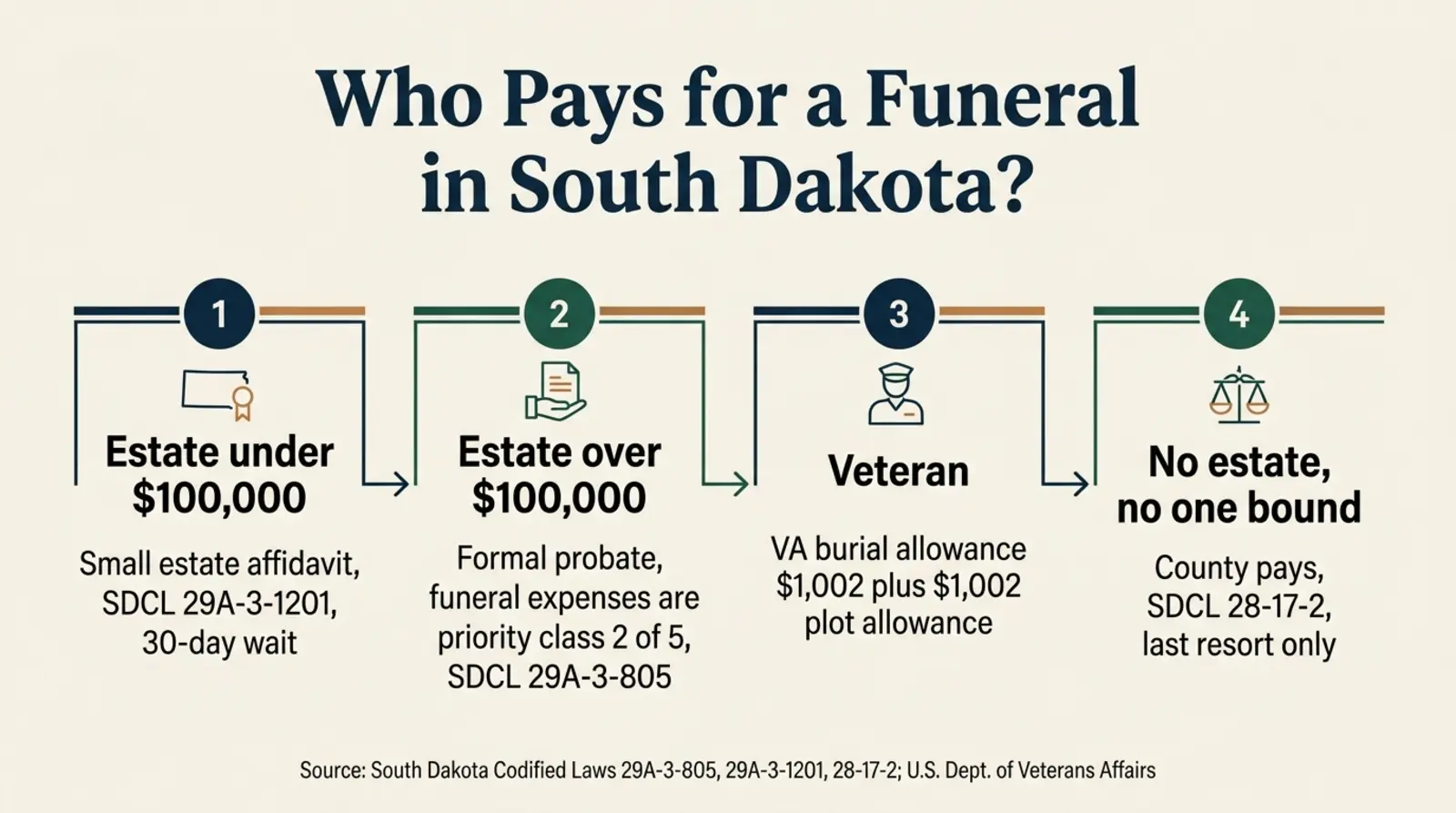
- South Dakota's estate handles funeral expenses first, as the second-highest priority claim behind only the costs of administering the estate, under SDCL 29A-3-805, ahead of credit cards, medical bills, and most other debts.
- If the entire estate is worth $100,000 or less, an entitled person can use a small estate affidavit under SDCL 29A-3-1201 to collect bank accounts and pay bills directly, but only after a mandatory 30-day wait from the date of death.
- Signing a funeral home's contract as the "authorizing agent" is a separate, personal promise to pay, on top of whatever the estate owes, and it's the single most common way a family member ends up personally on the hook.
- South Dakota's county-funded safety net, under SDCL 28-17-2, applies only when the deceased was destitute, left no estate, and had no one legally bound to pay, a narrow last resort, not a general backstop.
- South Dakota recorded 8,724 resident deaths in 2024, according to the state Department of Health, and national data from the National Funeral Directors Association shows more than 63% of those dispositions are now cremations rather than burials, a mix that changes what a family is actually planning for.
The fear: a bill shows up before the grief does
Here’s the version of this most families actually live through. Someone dies, often without much warning even when illness was involved, and within a day or two someone has to call a funeral home. The funeral home needs a decision on services, and before it will do anything, it needs someone to sign as the person responsible for the bill. Nobody in that room has read South Dakota’s probate code. Nobody knows whether the deceased person’s bank account is even accessible yet, or how long it will take to find out. Someone signs, because the alternative feels unthinkable, and the question of whether they were legally required to gets answered after the fact, if it gets answered at all.
That’s the actual pain, and it’s different from “how much does a funeral cost.” It’s “who is on the hook for that cost, right now, this week, before probate has even started.” Most people assume one of two things: either the family is automatically responsible because that’s how it’s always seemed to work, or the estate handles it cleanly and nobody has to think about timing. Neither assumption is quite right, and the gap between them is where families end up paying money they didn’t legally owe, or waiting on money they’re legally entitled to but can’t reach yet.
This is general education, not legal or financial advice
This article explains how South Dakota law generally handles funeral costs. It doesn't evaluate your specific estate, your family's situation, or any funeral contract you're being asked to sign. For an actual probate matter or a contract dispute, talk to a South Dakota probate attorney.
Why it happens: South Dakota’s actual liability structure
South Dakota law doesn’t make children, spouses, or other relatives personally responsible for a deceased person’s debts, including funeral costs, simply because they’re related. Liability for debt generally follows the person who incurred it, or the estate that person left behind, not their family by default. That single fact surprises a lot of people, because it doesn’t match how funeral homes are often experienced in the moment: someone in the family is always asked to sign something.
That “something” is usually a private contract with the funeral home, separate from anything South Dakota probate law requires. Funeral homes call the signer the authorizing agent, or sometimes the responsible party. By signing, that individual personally agrees to pay for the services selected, on the funeral home’s terms, regardless of what happens with the deceased person’s estate afterward. This is a contract between two private parties, and it creates real personal liability that exists independently of, and on top of, whatever the estate itself owes. If the estate later reimburses that person, that’s a separate transaction; the funeral home’s claim is against the signer either way.
Underneath that private contract sits the actual legal framework, which is about the estate, meaning everything the deceased person owned at death, minus what they owed. When someone dies, their assets and debts don’t just evaporate or transfer instantly to family. They become the estate, and someone has to be legally authorized to act on the estate’s behalf before bills can be paid from it. That person is called the personal representative (the modern term for what used to be called an executor), and getting someone appointed to that role, or qualifying to use a faster alternative, is the actual bottleneck between “there is money to pay this” and “the money is legally available to pay this.”
South Dakota gives estates two main paths, and which one applies depends almost entirely on size.
Path one: the small estate affidavit, for estates of $100,000 or less
Under SDCL 29A-3-1201, if the entire estate, wherever located, is worth $100,000 or less after subtracting liens and encumbrances, an entitled person (typically an heir or the person who paid funeral or estate expenses) can use a sworn affidavit to collect the decedent’s personal property, including bank accounts, directly from whoever is holding it, without opening a formal probate case in court. This is the faster of the two paths, and it’s the one most South Dakota families with a modest estate actually end up using. It has two hard conditions worth knowing before you count on it: at least 30 days must have passed since the date of death before the affidavit can be used, and it isn’t available at all if the decedent owed the state’s Department of Social Services for nursing home or other medical institutional care, a debt that has to be resolved differently.
That 30-day wait is the detail that catches families off guard. A funeral home typically wants payment within days or weeks of the service, not 30 days after death at the earliest. The affidavit is real and it works, but it was never designed to move at funeral-home speed.
Path two: formal probate, and where funeral expenses actually rank
For larger estates, or whenever the small estate affidavit doesn’t fit, the estate goes through formal probate: a court appoints a personal representative, who then has legal authority to collect assets, pay valid claims, and eventually distribute what’s left to heirs. Once a personal representative is appointed, they can pay the funeral bill directly from estate assets, and SDCL 29A-3-805 tells them exactly how to prioritize that payment if the estate can’t cover everything.
| Priority | Claim class | What it covers |
|---|---|---|
| 1st | Costs and expenses of administration | Court filing fees, the personal representative's compensation, attorney fees for handling the estate |
| 2nd | Reasonable funeral expenses | The funeral home bill, burial or cremation costs, and related final arrangements |
| 3rd | Debts and taxes with federal preference | Certain federal tax debts and other claims federal law puts ahead of ordinary creditors |
| 4th | Debts and taxes with state preference | South Dakota tax debts and other state-preferred claims |
| 5th | All other claims | Credit cards, medical bills, personal loans, and everything else |
Source: South Dakota Codified Laws § 29A-3-805, accessed September 2026.
That ranking matters for one practical reason: if the estate is solvent enough to cover administration costs and the funeral bill, but not enough to cover everything else, the funeral home still gets paid, ahead of the credit card company and the hospital. It’s one of the few places the law is unambiguously on the family’s side. The catch is timing, not priority. Formal probate, even a straightforward one, commonly takes months before a personal representative has full authority and enough liquidity to pay claims, which is far longer than most funeral homes are willing to wait without a signer on the hook in the meantime.
What it costs to get this wrong: the timing gap, not the sticker price
We’re not going to hand you a national average funeral price here, because every source that quotes one is pricing a specific mix of services from a specific survey year, and the honest answer is that yours will depend on what you and the funeral home actually select, which is exactly what the FTC’s Funeral Rule (16 CFR Part 453) is designed to make transparent. Under that rule, a funeral home must give you a written, itemized General Price List on request, must give you a completed itemized statement of exactly what you selected, and cannot force you to buy items you don’t want as a condition of getting the ones you do. Asking for that price list before you agree to anything is the single highest-leverage thing you can do in the moment, and it costs nothing to ask.
What we can quantify precisely is the timing gap, because that’s set by statute, not by a funeral home’s price list:
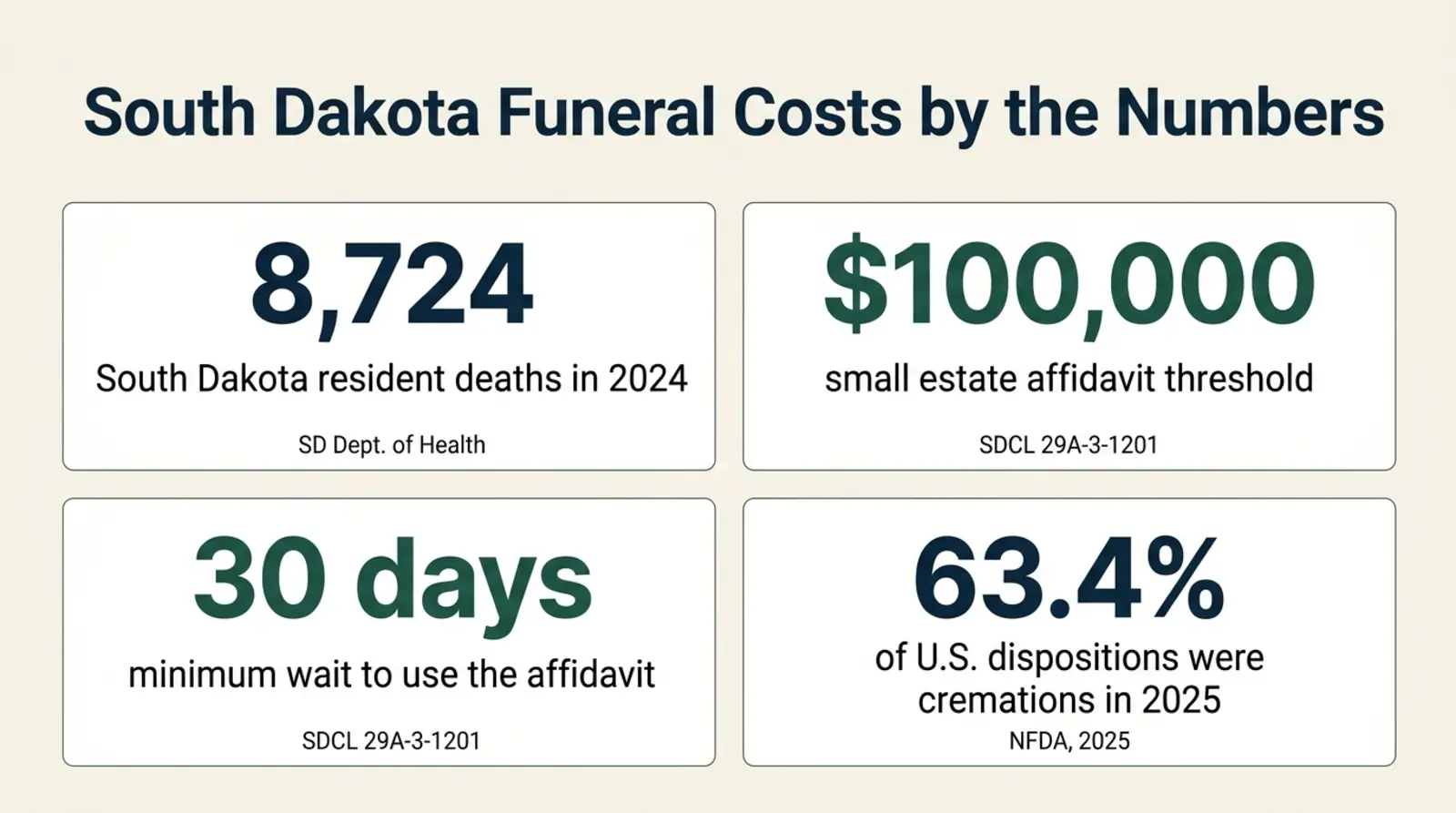
The practical effect: a funeral home in Sioux Falls, Rapid City, or anywhere else in the state generally wants to be paid at or shortly after the service. Neither the small estate affidavit nor formal probate is built to move that fast. That leaves a gap of at least several weeks, often longer, during which somebody either fronts the money personally, negotiates a delay with the funeral home, or leans on a source of funds that doesn’t run through probate at all, which is the part worth planning around before you need it.
The law isn't the problem. The estate really is responsible first, and funeral expenses really do get priority. The problem is that "responsible" and "accessible within a week" are two different things, and almost nobody plans for the gap between them.
— Mike Moore, Life Insurance Advisor, Big Sioux LifeHow to work out who’s actually on the hook, step by step
You can run this analysis yourself, right now, for your own situation or a parent’s. Here’s the method, in order.
- Find out whether there’s a payable-on-death or transfer-on-death beneficiary on any account. Bank accounts, credit union accounts, and some investment accounts can carry a named beneficiary who receives the funds directly at death, bypassing probate and the small estate process entirely. If one exists, that beneficiary can often access funds within days, not weeks, once they provide a death certificate to the institution. This is the fastest legal path there is, and it costs nothing to set up ahead of time.
- Estimate the size of the entire estate. Add up everything owned (bank accounts, vehicles, personal property, real estate equity) and subtract debts and liens. If the total is $100,000 or less, the small estate affidavit under SDCL 29A-3-1201 is likely available, once 30 days have passed and as long as there’s no outstanding Department of Social Services medical assistance debt.
- If the estate is larger, or the affidavit doesn’t fit, expect formal probate. A personal representative needs to be appointed by the court before estate funds can be legally distributed to pay claims. Ask a probate attorney how long that typically takes for an estate of that size and complexity in your county; it varies, but it is essentially never faster than a few weeks, and is commonly several months.
- Before signing anything with a funeral home, ask exactly what you’re signing. If you’re being asked to personally guarantee payment as an individual, distinct from signing as the estate’s personal representative, understand that you’re taking on a private, personal obligation that exists whether or not the estate ever reimburses you. Ask for the itemized General Price List required under the FTC Funeral Rule before agreeing to a package.
- Check for a veteran’s benefit. If the deceased served in the military, the VA’s burial and plot allowances (a combined $1,002 and $1,002 for deaths on or after October 1, 2025) can offset part of the cost, though this is typically reimbursed after the funeral home is paid, not disbursed up front.
- Only if there is genuinely no estate, no payable-on-death funds, and no one willing or legally bound to pay, does the county-funded provision under SDCL 28-17-2 apply. That statute puts the cost on the county where the deceased lived, or where death occurred if residency can’t be determined, but only as a true last resort for someone destitute with no other source of payment. It is not a general program families can opt into; it’s a narrow backstop for cases with no other path.
Everything routes through the estate
- Funeral home asks a family member to sign as personal guarantor, creating individual liability
- Estate funds aren't legally accessible for at least 30 days, often much longer
- Whoever signed may front the bill personally and hope for reimbursement later
Money bypasses probate entirely
- A payable-on-death account or a life insurance beneficiary receives funds directly, outside the estate
- Funds are typically available within days of providing a death certificate, not weeks
- No one has to personally guarantee a funeral home contract while waiting on the estate
Where this leaves cremation vs. burial planning
One more piece worth knowing before you plan: the mix of what families are actually choosing has shifted hard toward cremation, and that affects the timeline conversation too, since cremation services can sometimes move faster than a traditional burial with a viewing. The National Funeral Directors Association’s 2025 Cremation & Burial Report, published August 2025, projects the U.S. cremation rate at 63.4% for 2025 against a 31.6% burial rate, continuing a trend the report expects to reach roughly 82% cremation by 2045. Whichever you or your family prefers, the legal and timing framework above applies the same way; South Dakota law doesn’t distinguish burial from cremation when it comes to who pays or when the estate becomes accessible.
Read the funeral home contract before you sign it
The single most common way a family member becomes personally liable for a funeral bill they didn't legally owe is signing a funeral home's authorization contract without asking whether they're signing as an individual or as the estate's personal representative. Those are different roles with different consequences. Ask, in writing, before you sign.
How we help South Dakota families close this gap
This is exactly the kind of arithmetic we walk through with people, because it isn’t complicated once someone lays it out, it’s just something nobody hands you ahead of time. We start with what a realistic final expense need actually looks like for your situation, not a generic number, then compare final expense life insurance options across carriers, since we’re independent and not tied to selling one company’s product. A policy sized this way pays a death benefit directly to the beneficiary you name, in cash, outside of probate and outside any funeral home contract, so whoever you choose has money in hand within days of a claim being filed rather than weeks after an affidavit or months into formal probate.
Start with the real gap
We look at what's already in place, payable-on-death accounts, existing coverage, veteran's benefits, and identify what's actually missing before recommending anything.
Compare final expense options across carriers
Because we're independent, we can compare final expense life insurance across more than one carrier for the coverage amount that fits your situation.
Name a beneficiary who can act fast
A policy pays directly to the person you name, so they're not waiting on the small estate affidavit's 30-day clock or a probate court's calendar.
Stay available afterward
If your situation changes, you're calling us directly, not a call center reading from a different file than the one that matters.
If you’d rather have someone local walk through this with you, that’s what we do. Compare final expense options and we’ll help you figure out what actually closes the gap for your family.
What you get from working this out now
Doing this exercise before you need it changes what your family faces on the worst week of their lives. Instead of someone standing in a funeral home deciding, under pressure, whether to personally guarantee a bill they don’t legally owe, they’re holding a death certificate and a beneficiary designation that already tells them exactly where the money comes from and how fast. You also walk away knowing which of South Dakota’s actual mechanisms, the small estate affidavit, formal probate’s priority claims, a VA benefit, or the county’s narrow last-resort provision, would apply to your specific estate right now, instead of guessing under stress later.
Not ready to talk to anyone yet? Our Final Expense Planner walks through the same arithmetic on your own schedule. If you’re weighing final expense coverage against a prepaid funeral contract specifically, our guide to final expense insurance vs. prepaid funeral plans goes deeper on that comparison, and our 2026 guide to rising funeral costs covers what funeral homes are actually charging for. For families juggling a blended household or naming a beneficiary who isn’t a spouse, our blended family beneficiary guide is worth a look too.
Close the gap before your family needs to find it
An independent comparison of final expense coverage, sized to your real situation, across more than one carrier.
Frequently asked questions
Am I legally responsible for a parent’s funeral bill in South Dakota?
Not automatically, just by being their child. South Dakota law directs the deceased person’s estate to pay funeral expenses first, as a priority claim under SDCL 29A-3-805. You personally become liable only if you sign a contract with the funeral home as the person authorizing and agreeing to pay for the services, which most funeral homes ask someone to do before they’ll begin work. Read that contract before you sign it, and know that you’re agreeing to something the law doesn’t otherwise require of you.
What happens if there’s no money to pay for a funeral in South Dakota?
If the deceased person has any estate at all, funeral expenses are paid from it before most other debts, either through the small estate affidavit process for estates at or under $100,000 or through formal probate for larger ones. Only when someone is genuinely destitute, has no estate, and has no one legally bound to pay does South Dakota law shift the cost to the county where they lived, under SDCL 28-17-2. That’s a narrow, last-resort provision, not a general safety net.
How does South Dakota’s small estate affidavit help pay for a funeral?
Under SDCL 29A-3-1201, if the deceased person’s entire estate is worth $100,000 or less after liens and encumbrances, and at least 30 days have passed since the death, an entitled person can sign a sworn affidavit and use it to collect the decedent’s bank accounts and other personal property directly, without opening a formal probate case. That’s often faster than probate, but it still requires a 30-day wait, and it isn’t available if the decedent owed the Department of Social Services for nursing home or other medical institutional care.
Do funeral expenses get paid before other debts in a South Dakota probate?
Yes, with one exception. SDCL 29A-3-805 sets five priority classes for paying claims when an estate can’t cover everything: costs and expenses of administering the estate come first, reasonable funeral expenses come second, then federally preferred debts and taxes, then state-preferred debts and taxes, then everything else. Ordinary debts like credit cards and medical bills rank behind funeral costs, not ahead of them.
What is a funeral home “authorizing agent,” and am I liable if I sign?
It’s the person the funeral home identifies as legally responsible for approving the services and paying the bill, and it’s typically a private contract between that person and the funeral home, separate from what South Dakota probate law requires. Signing as the authorizing agent can make you personally liable for the bill even if the estate later turns out to have enough money to reimburse you, or even if it doesn’t. Ask whether you’re signing as an individual or as the personal representative of the estate; they are not the same thing.
Does the VA help pay for a veteran’s funeral in South Dakota?
Yes. The U.S. Department of Veterans Affairs pays a burial allowance toward a veteran’s funeral and burial costs, and a separate plot allowance if the veteran isn’t buried in a VA national cemetery. For deaths on or after October 1, 2025, both allowances are $1,002 each, according to the VA’s published rate table, and the amounts are adjusted most years. This helps, but it rarely covers a full funeral on its own, and it’s typically reimbursed after the fact rather than paid up front.
How is final expense life insurance different from a prepaid funeral contract?
Final expense life insurance pays a death benefit directly to the beneficiary you name, in cash, outside of probate and outside the funeral home’s own contract, so the money is available immediately and the beneficiary decides how to spend it. A prepaid funeral contract locks in specific services with one funeral home in advance. We compare both approaches, including how South Dakota law treats each one, in our separate guide to final expense insurance versus prepaid funeral plans.
Can a bank release a deceased person’s funds to pay for a funeral before probate opens?
Sometimes, but not automatically. Many banks will release a limited amount directly to a funeral home or a family member for funeral costs if the account has a payable-on-death beneficiary designation, or once presented with a valid small estate affidavit under SDCL 29A-3-1201. Without one of those, a bank generally has no legal basis to release a deceased customer’s funds to anyone, even a spouse or adult child, until a court appoints a personal representative or the 30-day small estate process is available.
Before you sign anything
This article is general education, not insurance, legal, financial, or tax advice, and it does not evaluate your specific estate, family situation, or any contract you're being asked to sign. Product availability, features, and rates vary by carrier and state and are subject to underwriting. No coverage exists until a policy is issued and in force. Any guarantees are subject to the claims-paying ability of the issuing insurer. Please review actual policy or contract documents and speak with a licensed agent or attorney about your specific situation.
Sources
- South Dakota Legislature — SDCL 29A-3-805, Classification of claims — accessed September 2026; sets the five-class priority order for paying claims against a South Dakota estate, with funeral expenses ranked second.
- South Dakota Legislature — SDCL 29A-3-1201, Collection of personal property by affidavit — accessed September 2026; sets the $100,000 estate-value threshold, the 30-day waiting period, and the Department of Social Services medical-assistance-debt exclusion for the small estate affidavit process.
- South Dakota Legislature — SDCL 28-17-2, Funeral expense borne by county of residence or where death occurred — accessed September 2026; the county-funded provision for a destitute person with no estate and no one legally bound to pay.
- U.S. Department of Veterans Affairs — Veterans burial allowance rates — accessed September 2026; current combined burial and plot allowance of $1,002 each for deaths on or after October 1, 2025, with the full historical rate table by effective date.
- Federal Trade Commission — Complying with the Funeral Rule — accessed September 2026; 16 CFR Part 453 requirements for the General Price List, the itemized statement of goods and services selected, and the consumer’s right to buy only what they want.
- National Funeral Directors Association — 2025 Cremation & Burial Report — published August 2025; U.S. cremation rate projected at 63.4% and burial rate at 31.6% for 2025, with cremation projected to reach 82.3% by 2045.
- South Dakota Department of Health, Office of Health Statistics — South Dakota Mortality Report, 2024 — published 2025; 8,724 total South Dakota resident deaths recorded in 2024.
Related reading: Final Expense Insurance vs. Prepaid Funeral Plans in South Dakota (2026), Final Expense Planning in 2026: Rising Funeral Costs in South Dakota, and Blended Family Life Insurance Beneficiaries: A 2026 SD Guide. See our current final expense insurance options, or start with how it works.