
Since January 1, 2023, South Dakota law has required anyone who recommends an annuity to you to actually work in your interest, not just clear a low bar of “reasonable.” Under SDCL 58-33A-16.1 through 58-33A-16.5, a producer must satisfy four specific obligations before you buy: care, disclosure, identifying conflicts of interest, and putting the reasoning in writing, according to the South Dakota Division of Insurance. Most people who buy an annuity have never heard of this rule, never seen the form it requires, and never asked the questions it entitles them to ask. This guide walks through what the law actually requires, the one-page disclosure you should get before you sign anything, and the questions that turn a legal requirement into something that actually protects you.
The short version
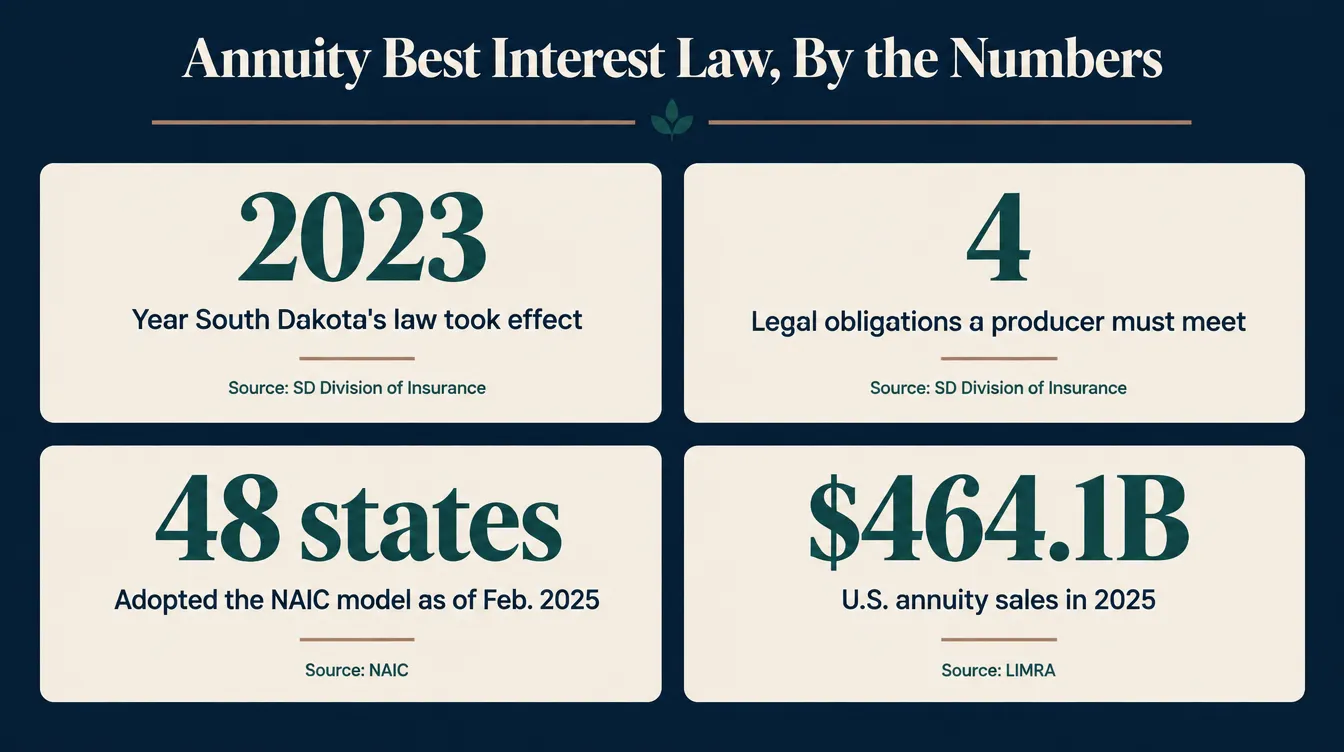
- South Dakota's annuity best interest standard, SDCL 58-33A-16.1 through 58-33A-16.5, has been in effect since January 1, 2023, according to the South Dakota Division of Insurance.
- A producer recommending an annuity must satisfy four obligations: care, disclosure, conflict of interest, and documentation.
- You are entitled to the "Insurance Agent (Producer) Disclosure for Annuities" form before a recommendation or sale, under SDCL 58-33A-16.5.
- 48 states had adopted the revised NAIC model this South Dakota law is based on as of February 1, 2025, according to the National Association of Insurance Commissioners.
- U.S. annuity sales hit a record $464.1 billion in 2025, up 7% from 2024, according to LIMRA, meaning more people are facing this exact decision than ever.
Do agents have to act in your best interest when they sell you an annuity in South Dakota?
Yes. Since January 1, 2023, a South Dakota-licensed producer who recommends an annuity to you is legally required to meet a “best interest” standard, not the older, looser “suitability” standard that used to govern the sale. The rule lives in South Dakota Codified Law, specifically SDCL 58-33A-16.1, 58-33A-16.5, and 58-33A-20, and it applies to the sale of annuities generally, both fixed and variable, according to the South Dakota Division of Insurance, the state agency that licenses every insurance producer and carrier authorized to do business here.
A few terms are worth defining plainly before anything else, since the whole rule turns on them:
- Producer is the person licensed to sell insurance and annuities. It’s the industry’s formal word for the person you might just call your agent or advisor.
- Recommendation is any advice from a producer that leads to a specific annuity transaction: buying a new contract, replacing an old one, or adding money to an existing one.
- Best interest standard means the producer’s recommendation must reflect your actual financial situation, needs, and goals, and the producer must be able to show, in writing, why the option they recommended addresses those things.
- Material conflict of interest is any financial incentive, like a higher commission on one product versus another, that could reasonably affect the objectivity of a recommendation. The law doesn’t ban conflicts; it requires they be disclosed to you.
- Suitability standard was the prior legal bar, which only required a producer to have “reasonable grounds” for believing a recommendation was suitable in general. It didn’t require the same individualized documentation or compensation disclosure the current law does.
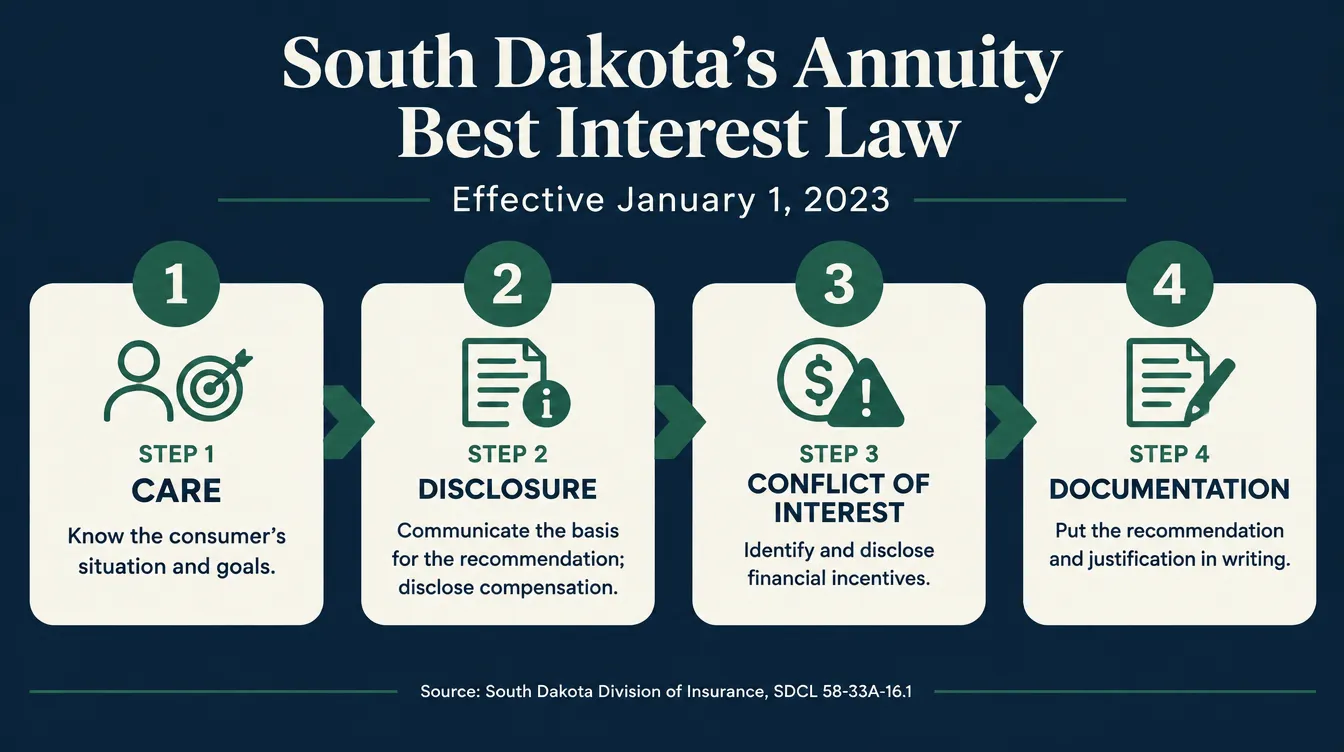
To satisfy the best interest standard, the South Dakota Division of Insurance lists four specific obligations a producer or insurer must meet:
- Care. Know the consumer’s financial situation, insurance needs, and financial objectives; understand the available recommendation options; and have a reasonable basis to believe the recommended option addresses those things.
- Disclosure. Communicate the basis of the recommendation to the consumer, and disclose the producer’s role in the transaction, their compensation, and any material conflicts of interest.
- Conflict of interest. Identify and avoid, or at minimum disclose and manage, financial incentives that could compromise the recommendation.
- Documentation. Document, in writing, the recommendation and the justification for it.
That last one is the quiet, structural change. Before 2023, a producer’s reasoning for recommending one annuity over another didn’t have to exist anywhere in writing that you, specifically, could ever see. Now it does.
This is general education, not legal or financial advice
Nothing here is insurance, legal, financial, or tax advice, and nothing here evaluates any specific annuity contract, carrier, or recommendation you may have received. It's a plain explanation of a South Dakota law and the paperwork it requires, sourced from the South Dakota Division of Insurance and other named sources below, so you can ask better questions before you commit to anything.
Why South Dakota changed the rule
Annuities are not simple products, and the industry has been changing shape faster than most buyers realize. Understanding why the standard tightened means understanding what a producer was actually allowed to do under the old rule, and why regulators nationally decided that wasn’t enough anymore.
Under the older suitability standard, a producer needed “reasonable grounds” to believe a recommendation was suitable based on facts the consumer disclosed. In practice, that bar could be cleared without the producer ever comparing your specific goals against more than one product, and without ever writing down why they picked the one they picked. Two products could pay wildly different commissions, and the suitability standard didn’t require the producer to tell you that, or to justify choosing the higher-paying one over another that might have fit you just as well or better.
The National Association of Insurance Commissioners, the organization that coordinates insurance regulation across all fifty states, revised its model Suitability in Annuity Transactions regulation in February 2020 to close that gap, aligning it more closely with the U.S. Securities and Exchange Commission’s Regulation Best Interest for securities. States then had to individually adopt the revised model into their own law for it to take effect. South Dakota did, effective January 1, 2023. As of February 1, 2025, 48 states had adopted the revised model, according to the NAIC, meaning South Dakota’s law reflects what has become the national norm rather than an unusual local requirement.
| Obligation | What it requires of the producer |
|---|---|
| Care | Know your financial situation, insurance needs, and goals; understand the available options; have a reasonable basis for the recommendation. |
| Disclosure | Communicate the basis for the recommendation; disclose their role, compensation, and material conflicts of interest. |
| Conflict of interest | Identify financial incentives that could affect the recommendation and disclose or manage them. |
| Documentation | Put the recommendation and its justification in writing. |
South Dakota Division of Insurance, Annuity Best Interest Standards, accessed September 2026.
Why this mattered enough for regulators to act becomes clearer when you look at what’s actually happening in the annuity market right now. It’s not a shrinking, niche product line. It’s the opposite.
What a “material conflict of interest” actually looks like
The phrase sounds abstract until you picture the ordinary situations it’s meant to cover. None of these examples describe wrongdoing by themselves. They describe the exact circumstances the disclosure and conflict-of-interest obligations exist to surface, so you can weigh them rather than discover them later.
- Commission differences between products. Annuities within the same broad category, say two different fixed indexed contracts, can carry different compensation to the producer. That difference doesn’t make either product wrong for you, but it’s exactly the kind of fact the disclosure obligation is meant to put in front of you before you decide, not after.
- A producer who only represents one insurer. A captive producer isn’t doing anything improper by recommending their only available carrier. But “care” requires understanding the options actually available, and a one-carrier shelf is a narrower set of options than an independent producer comparing several. Knowing which kind of producer you’re talking to changes what “comparing options” even means in your specific conversation.
- Replacing a contract you already own. A new sale generally pays new compensation; simply keeping your existing contract usually doesn’t. That asymmetry is precisely why a replacement recommendation carries its own documentation expectation under the law, addressed separately below.
- Bonus or incentive structures tied to sales volume. Some compensation arrangements reward hitting a threshold of sales in a period, which can create pressure that has nothing to do with any individual client’s situation. The law doesn’t ban these arrangements. It requires them to be disclosed as a potential conflict.
None of this means every annuity recommendation involving a commission is suspect. Commission-based compensation is how most insurance products in the United States have always been sold, including the policies this agency helps people compare. The point of the law isn’t to eliminate that structure. It’s to make sure a specific conflict, if one exists, is named out loud instead of left for you to guess at.
What it costs to get wrong: a market bigger than most buyers realize
U.S. annuity sales hit $464.1 billion in 2025, a record high and up 7% from 2024, according to LIMRA’s final full-year sales survey, which the organization says represents 93% of the total U.S. annuity market. That’s the fourth consecutive year of record annuity sales nationally. Growth wasn’t evenly spread across product types, and the differences matter, because each product type carries its own tradeoffs, fee structure, and, in some cases, an entirely different regulator.
| Product type | 2025 sales | Change vs. 2024 |
|---|---|---|
| Fixed indexed annuities (FIA) | $128.2B | +1% |
| Registered index-linked annuities (RILA) | $79.6B | +20% |
| Traditional variable annuities (VA) | $63.1B | +8% |
| All U.S. retail annuities | $464.1B | +7% |
LIMRA, U.S. Individual Annuity Sales Survey, full-year 2025 results, published March 23, 2026. Figures represent approximately 93% of the U.S. annuity market.
U.S. annuity sales by product type, 2025 ($ billions)
LIMRA, U.S. Individual Annuity Sales Survey, full-year 2025 results, published March 23, 2026.
Registered index-linked annuities grew 20% year over year, their eleventh straight year of growth, according to LIMRA, and they’re the product type most likely to surprise a buyer who doesn’t understand the distinction the law is built around: RILAs and traditional variable annuities are securities, regulated not just by South Dakota’s Division of Insurance but also by the U.S. Securities and Exchange Commission and FINRA, and they typically require a prospectus, according to FINRA. Fixed annuities and fixed indexed annuities are insurance products only, regulated solely at the state level. Either way, South Dakota’s best interest standard applies to the recommendation itself. But if you’re being shown a product that comes with a prospectus, that’s your signal it carries an extra layer of federal disclosure worth reading closely, not skipping because it’s long.
None of this makes annuities a bad idea. Record sales partly reflect real, reasonable demand: more retirees than in past decades are looking for protected income they can’t outlive, particularly as fewer employers offer traditional pensions. The law isn’t there to talk you out of an annuity. It’s there so the one you’re shown is actually chosen with your situation in mind, and so you can see that reasoning on paper instead of taking it on faith.
A worked, illustrative example: what the paperwork should have caught
Here’s a hypothetical, not a real client, built only to show how the four obligations are supposed to work together.
Say a 66-year-old retiree in Aberdeen rolls $180,000 from an old 401(k) into an IRA and is presented with a fixed indexed annuity carrying a 10-year surrender schedule. On paper, the product itself might be perfectly sound. The problem is what isn’t on paper yet: she also mentioned, in the same conversation, that she wants to set aside roughly $30,000 within the next two to three years for a home repair fund.
Under the care obligation, a producer is supposed to know that liquidity need before recommending anything. Under the documentation obligation, the written justification for the recommendation should address it directly, either by carving out a portion of the funds for something more liquid, choosing a product with an early withdrawal allowance that actually covers $30,000 without a penalty, or explaining plainly why the 10-year product still makes sense despite the near-term need. If the paperwork you’re handed doesn’t mention the thing you told your producer mattered most, that’s not a technicality. That’s the exact gap the best interest law was written to close.
This is also where the disclosure obligation earns its keep. If two products under discussion pay meaningfully different commissions, you’re entitled to know that before you decide, not after.
You can check this yourself before you sign anything
Write down your own timeline and liquidity needs before any annuity conversation, the same way the law requires your producer to gather them. If the recommendation you're handed doesn't visibly account for something you said mattered, ask directly how it does.
How to work it out yourself: use the law before you sign anything
You don’t need to be a lawyer or an insurance professional to use this rule. It was written to be usable by an ordinary buyer, which means the steps are straightforward.
Step 1: Ask for the disclosure form before you discuss any specific product. The “Insurance Agent (Producer) Disclosure for Annuities” is required under SDCL 58-33A-16.5 before a recommendation or sale, according to the South Dakota Division of Insurance. If it isn’t handed to you unprompted, ask for it. It should tell you whether the producer represents one insurer or several, and how they’re compensated.
Step 2: Ask what the producer’s compensation is on the specific product being recommended, and whether alternatives pay differently. The disclosure obligation exists so this question has an honest answer available. If a producer is reluctant to answer directly, that reluctance is itself useful information.
Step 3: Ask the producer to state, plainly, why this specific product fits your situation. Under the documentation obligation, this justification is supposed to exist in writing already. Asking for it verbally, and then comparing what they say to what’s on the form, is a simple way to check that the paperwork isn’t boilerplate.
Step 4: Write your own list first, before any recommendation. Your age, when you’ll need income to start, how much liquidity you need and by when, what other savings or income sources you already have, and anything specific about your health or legacy goals. Comparing this list against the written recommendation is the single fastest way to spot a mismatch, the same one in the Aberdeen example above.
Step 5: If you’re replacing an existing annuity, ask specifically why replacement beats keeping what you have. Replacing a contract usually resets surrender charges on a new schedule. The best interest standard still applies to a replacement recommendation, so the same written justification requirement holds; ask for it to address the replacement decision directly, not just the merits of the new product in isolation.
Step 6: If something doesn’t add up, you can file a complaint with the South Dakota Division of Insurance. The division maintains a public complaint process at dlr.sd.gov and can investigate whether a producer met their care, disclosure, conflict of interest, and documentation obligations, independent of anything you might also work out directly with the carrier.
The law doesn't promise you the perfect annuity. It promises you a written reason for the one you're shown, and the right to ask what else was on the table.
Mike Moore, Life Insurance AdvisorIf you’d rather have someone local walk through this with you before you’re in a recommendation conversation at all, that’s part of what we do: Compare My Options.
Why independence matters here specifically
An independent agency isn’t paid the same amount regardless of which carrier’s annuity you choose, but it also isn’t tied to one carrier’s shelf of products the way a captive agent is. That distinction matters more under a best interest standard than it did under the old suitability rule, because the “care” obligation specifically requires understanding the options actually available before recommending one. A producer who can only offer one company’s annuities has, by definition, a narrower set of options to compare than one who works across several.
How we help
We compare fixed, fixed indexed, immediate income, and multi-year guaranteed annuities across the carriers we work with, starting from your actual timeline, liquidity needs, and goals, the same information the best interest standard requires any producer to gather before recommending anything. We put the reasoning in front of you plainly, including what we’re comparing and why, so the documentation the law requires is something you actually see and understand, not paperwork filed away after the fact. We’re local to Sioux Falls and licensed to serve all of South Dakota, so the person walking you through it is someone you can call back with a follow-up question.
Annuities are also not always the right tool. Sometimes the honest answer, after going through your actual numbers, is that a simpler option, like keeping money in a high-yield account or CD for a near-term need, fits better than any annuity on the table. Part of doing this in your interest is being willing to say that.
What you get
A recommendation that accounts for your specific timeline and liquidity needs, not a generic pitch. A plain answer to what any specific annuity actually pays the person recommending it, before you decide. A comparison across more than one carrier’s products, since that comparison is the part of “care” hardest to do entirely on your own. And a copy of the disclosure and documentation you’re legally entitled to under South Dakota law, so you have something in writing to refer back to.
Going into a retirement income decision? Start with your own numbers.
We'll walk through your timeline, your liquidity needs, and what you're actually trying to accomplish, and show you how the products we compare stack up against South Dakota's best interest standard.
Not ready to talk to anyone yet? Read How It Works first and come back when you are.
You can also just ask for the disclosure form yourself at your next conversation with any producer, whether that’s us or someone else. It’s a short document, and it exists specifically so you don’t have to take anyone’s word for it.
Frequently asked questions
Do insurance agents have to act in your best interest when they sell you an annuity in South Dakota?
Yes, since January 1, 2023. Under SDCL 58-33A-16.1 through 58-33A-16.5, a producer who recommends an annuity to a South Dakota consumer must satisfy four legal obligations: care, disclosure, identification of conflicts of interest, and documentation, according to the South Dakota Division of Insurance. Before that date, South Dakota used an older “suitability” standard, which required only that a recommendation be reasonable, not that it be the option that actually served you best among what the producer had available.
What is the difference between the old suitability standard and the new best interest standard?
Suitability asked whether a recommendation was reasonable in general. Best interest asks the producer to know your specific financial situation, insurance needs, and goals; understand the annuity options actually available; have a documented, reasonable basis for believing the specific recommendation serves those goals; and disclose their role, their compensation, and any material conflicts of interest, according to the South Dakota Division of Insurance. The practical difference is paperwork you are entitled to see: a suitability-era recommendation didn’t have to be justified to you in writing. A best interest recommendation does.
What is the Insurance Agent (Producer) Disclosure for Annuities, and can I ask for it?
It’s a required form a South Dakota producer must give you before recommending or selling an annuity, under SDCL 58-33A-16.5, according to the South Dakota Division of Insurance. It’s meant to disclose the producer’s role in the transaction, such as whether they represent one insurer or several, and how they’re compensated. You can and should ask for it before you sign anything, even if it isn’t offered to you first.
What happens if a producer doesn’t follow South Dakota’s best interest law?
You can file a complaint with the South Dakota Division of Insurance, the state agency that licenses and regulates every insurance producer and carrier authorized to sell in South Dakota, through its complaint process at dlr.sd.gov. The division can investigate whether a producer met the care, disclosure, conflict of interest, and documentation obligations required by SDCL 58-33A-16.1, and can take licensing action independent of any dispute you might also have directly with the insurer.
Does the best interest standard apply if I’m replacing an existing annuity with a new one?
Yes. A recommendation to replace or exchange an existing annuity is still a recommendation under South Dakota’s best interest framework, so it still requires the producer to have a documented, reasonable basis for the switch and to disclose their compensation on the new contract. Replacing an annuity often resets surrender charges on a new schedule, so ask specifically why replacement is better for you than keeping what you have, not just why the new product is good.
Is a fixed indexed annuity regulated the same way as a variable annuity in South Dakota?
No. Fixed annuities and fixed indexed annuities are insurance products regulated solely by state insurance regulators, like South Dakota’s Division of Insurance. Variable annuities and registered index-linked annuities (RILAs) are also securities, so they carry a second layer of regulation from the U.S. Securities and Exchange Commission and FINRA, and typically come with a prospectus, according to FINRA. South Dakota’s best interest standard applies to the insurance-side recommendation either way, but a security-classified product adds federal disclosure requirements on top of it.
How is a best interest standard different from a fiduciary standard?
A fiduciary must recommend what is actually best for you and generally can’t be paid a commission that creates a conflict without extensive additional structure. South Dakota’s annuity best interest standard is a strong step toward that, requiring documented, individualized recommendations and disclosed compensation, but it does not prohibit commission-based sales or require the single best option in the entire market. It requires the producer to have a reasonable, documented basis for what they recommended to you specifically, and to tell you how they’re paid.
Do I have to complete any training or paperwork as the buyer, or is this all on the producer?
The obligations under SDCL 58-33A-16.1 through 58-33A-20 fall on the producer and the insurer, not on you. South Dakota does require producers to complete annuity best interest training, a one-time 4-hour course for those newly licensed after January 1, 2023, or a 1-hour update course for those already licensed, according to the South Dakota Division of Insurance. As the buyer, your part is simple: ask for the disclosure form, ask what you’re being told and why, and keep a copy of what you’re given.
What if I bought my annuity before January 1, 2023?
Your existing contract isn’t automatically reopened by the newer standard, since it applied going forward from its effective date. But if you’re considering any new transaction involving that contract now, adding funds, taking a withdrawal that triggers a new recommendation, or replacing it with a different annuity, that new recommendation falls under the current best interest standard, including the disclosure and documentation obligations, according to the South Dakota Division of Insurance.
Before you buy
This article is general education, not insurance, legal, financial, or tax advice, and it does not evaluate any specific annuity contract, carrier, or recommendation. Product availability, features, and rates vary by carrier and are subject to underwriting. No coverage exists until a contract is issued and in force. Any guarantees are subject to the claims-paying ability of the issuing insurer. Please review actual contract documents and speak with a licensed agent about your specific situation.
Sources
- South Dakota Division of Insurance — Annuity Best Interest Standards — accessed September 2026; statute citations (SDCL 58-33A-16.1, 16.5, 20), effective date of January 1, 2023, the four obligations, the required disclosure form, and producer training requirements
- South Dakota Division of Insurance — Complaint Process — accessed September 2026; consumer complaint process for producer conduct
- National Association of Insurance Commissioners — Annuity Suitability and Best Interest Standard — accessed September 2026; 48 states had adopted the revised NAIC Suitability in Annuity Transactions Model Regulation (#275) as of February 1, 2025
- LIMRA — Final U.S. Retail Annuity Sales Set New Sales High, Totaling $464.1 Billion in 2025 — published March 23, 2026; full-year 2025 U.S. annuity sales by product type
- FINRA — Annuities — accessed September 2026; variable annuities and RILAs are securities regulated by the SEC and FINRA in addition to state insurance regulation; fixed annuities are regulated solely by state insurance regulators
- AgentSync — South Dakota Insurance Licensing & Regulatory Compliance Updates — accessed September 2026; independent confirmation of South Dakota’s January 1, 2023 effective date and producer training requirements
Related reading: Fixed Indexed Annuities Explained: A 2026 South Dakota Guide, Annuity Surrender Charges: What They Really Cost in 2026, and What Happens to Your Annuity When You Die? 2026 SD Guide. See our page for seniors, current annuity options, or learn more about how it works.