
Final expense insurance and a prepaid funeral plan both let you handle funeral costs before you die, but they aren’t the same tool, and mixing them up costs South Dakota families real money. Final expense insurance is a small whole life insurance policy that pays cash to a beneficiary you name. A prepaid, or “preneed,” funeral plan is a contract with a specific funeral home, funded through a trust that South Dakota law regulates in detail. One pays a person. The other pays a business. Which one fits your situation depends on how much you value locking in today’s prices against a specific provider versus keeping your money flexible and your beneficiary in control.
The short version
- Final expense insurance pays cash to a named beneficiary. A prepaid funeral plan pays a specific funeral home for goods and services you selected in advance.
- South Dakota law requires at least 85% of a guaranteed-price prearranged funeral contract, and 100% of a non-guaranteed-price contract, to sit in a trust rather than the funeral home's general account (SDCL 55-11-1, 55-11-3).
- A traditional burial with casket and vault runs around $7,000 in South Dakota before flowers, a headstone, or a reception, according to the state's own consumer protection office.
- A revocable prearranged funeral trust can be canceled with 30 days' written notice for a full refund plus accrued interest (SDCL 55-11-5, 55-11-5.1). An irrevocable trust cannot be undone that easily, which is the tradeoff for the Medicaid and SSI protection it can offer.
What’s the actual difference between final expense insurance and a prepaid funeral plan?
The short answer: one is life insurance, the other is a service contract, and who gets paid is the difference that matters most.
Final expense insurance is a small whole life insurance policy, usually in the range of a few thousand to a few tens of thousands of dollars in coverage. You apply, name a beneficiary, and pay a level premium. When you die, the insurance company pays the death benefit directly to that beneficiary in cash. Your family decides how to spend it: on the funeral, on outstanding medical bills, on travel for relatives to attend the service, on anything at all. Qualification is typically simplified, meaning a policy may ask a handful of health questions instead of requiring a medical exam, though the specific underwriting each carrier offers varies and this article isn’t a promise of what any one applicant would qualify for.
A prepaid funeral plan, sometimes called a preneed funeral contract or prearranged funeral contract, is an agreement you sign directly with a funeral home. You pick the goods and services you want (a casket, embalming, a service, transportation) at today’s prices, pay for some or all of it in advance, and the funeral home holds that money, largely in trust, until you die. At that point, the funeral home performs the services you selected and the trust money is released to pay for them. Your family isn’t handed cash; they’re handed a funeral that’s already been chosen and, at least partly, already been paid for.
That distinction drives almost everything else in this comparison: who controls the money, what happens if plans change, what happens if the funeral home doesn’t outlast you, and how flexible your family’s options are on the day they actually need them.
This is general education, not a recommendation
Nothing here is a quote, an offer of insurance, or advice for your specific situation. Final expense insurance availability, features, and pricing vary by carrier and are subject to underwriting. Prepaid funeral contracts are agreements with individual funeral homes, not insurance products, and Big Sioux Life does not sell or administer them. Talk with a licensed agent and, separately, a South Dakota-licensed funeral director about what fits your household.
How does a South Dakota prearranged funeral trust actually work?
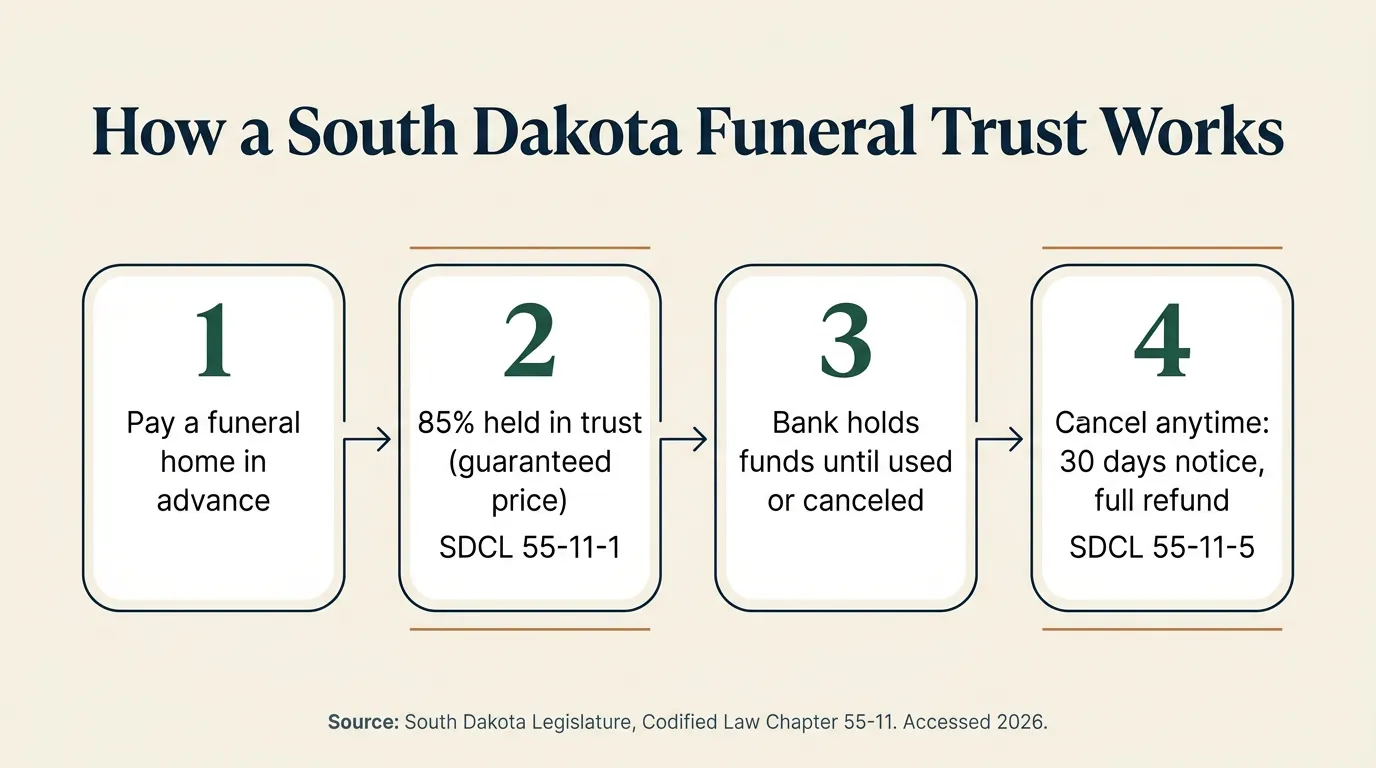
South Dakota law requires that most of the money you pay a funeral home under a prearranged contract be held separately, in trust, rather than treated as the funeral home’s own revenue the day you pay it.
Under South Dakota Codified Law (SDCL) 55-11-1, at least 85% of all money paid under a prearranged funeral contract must be held in a revocable or an irrevocable trust, at the purchaser’s option. SDCL 55-11-3 tightens that further for contracts that don’t lock in a guaranteed price: if the contract is not for a guaranteed price, 100% of the funds received must be placed in a funeral trust fund. In plain terms, a “guaranteed price” contract, where the funeral home promises to deliver the selected goods and services for the price you paid regardless of future cost increases, is allowed to keep up to 15% outside the trust, presumably to cover its own administrative costs of managing the arrangement over what could be decades. A contract that doesn’t guarantee the price has to put every dollar into trust, because the funeral home hasn’t taken on the same future-cost risk in exchange for that money.
| Contract type | Minimum in trust | Governing statute |
|---|---|---|
| Guaranteed-price prearranged contract | 85% | SDCL 55-11-1 |
| Non-guaranteed-price prearranged contract | 100% | SDCL 55-11-3 |
| Revocation of a revocable trust | 30 days' written notice | SDCL 55-11-5 |
| Refund on proper revocation | 100% of principal + 100% of accrued interest | SDCL 55-11-5.1 |
Source: South Dakota Legislature, Codified Law Chapter 55-11, Prearranged Funeral Trusts. Current codified law, accessed 2026.
Two more terms come up constantly in the paperwork, and they change what happens if your plans change.
A revocable trust can be canceled by the purchaser. You get your money back if you move, change your mind, or decide a different provider fits better. An irrevocable trust, once established, generally can’t be undone by the purchaser at will. People sometimes choose irrevocable specifically because certain government benefit programs treat irrevocable burial funds differently from countable savings, a tradeoff covered later in this guide. The choice between revocable and irrevocable is yours to make when you sign the contract, per SDCL 55-11-1, so it’s worth asking the funeral home to explain both options rather than accepting whichever one the paperwork defaults to.
What happens to your money if the funeral home closes or you change your mind?
This is the question the trust requirement exists to answer, and it has two separate parts: what happens if you change your mind, and what happens if the business on the other side of the contract doesn’t make it.
If you change your mind and you hold a revocable trust, South Dakota law is direct about it. SDCL 55-11-5 lets either party cancel a contract creating a revocable trust at any time on thirty days’ written notice. SDCL 55-11-5.1 says a person who revokes is entitled to receive 100% of all money paid into trust under the contract, together with 100% of the accrued interest. That’s a meaningfully strong consumer protection on paper: not a partial refund, not a penalty, the whole deposited amount plus what it earned. If your trust is irrevocable, this door is largely closed, which is exactly why the revocable-or-irrevocable choice at signing matters more than most buyers realize.
If the funeral home closes, is sold, or mismanages the trust, the picture is more mixed. The trust requirement means your money is supposed to sit at a banking institution, not inside the funeral home’s own accounts, which is meant to insulate it from the business’s day-to-day financial health. But it’s not a guarantee against every failure mode. A guaranteed-price contract only requires 85% in trust, meaning 15% was never protected in the first place. And a trust arrangement is only as reliable as the institution holding it and the oversight catching problems, which is one more reason to ask specific questions before signing, not after.
Questions worth asking before you sign a prepaid contract
Which bank holds the trust, and can the funeral home tell you the account information directly? Is the contract revocable or irrevocable, and do you understand what that choice actually locks in? Is the price guaranteed, and if so, what happens to costs the contract doesn't cover? What happens to your specific arrangement if the funeral home changes ownership? A funeral home confident in its own paperwork should be able to answer all four without hesitation.
Final expense insurance sidesteps the provider-specific version of this risk entirely, because the death benefit isn’t tied to one funeral home staying in business, being well-run, or being the one your family still wants to use in twenty years. The insurer’s obligation is to your named beneficiary, and any guarantees in a life insurance contract are themselves subject to the claims-paying ability of the issuing insurer, the same as any policy. It’s a different risk profile, not a risk-free one, but it’s not concentrated in a single local business the way a preneed trust is.
What does a funeral actually cost in South Dakota right now?
A traditional burial with a casket and vault costs around $7,000 in South Dakota, according to the state’s own consumer protection office, and that figure doesn’t include extras like flowers, obituary notices, or a limousine, which the same source notes can add thousands more. That’s the number worth anchoring your planning to if you’re picturing a traditional burial, and it’s meaningfully more than many families assume before they start pricing it out.
Two cost levers move that number the most: burial versus cremation, and how much you add beyond the base service. According to NFDA’s 2025 Cremation & Burial Report, the projected U.S. cremation rate for 2025 was 63.4%, more than double the projected burial rate of 31.6%. That national shift matters for your own planning because cremation services are typically less expensive than a full burial with a casket and vault, so the arrangement you actually want, not a generic average, should drive the number you plan around.
Projected 2025 U.S. disposition method
Source: National Funeral Directors Association, 2025 Cremation & Burial Report. 2025 projected figures; remaining share reflects other or unreported disposition methods.
South Dakota also offers specific benefits for eligible veterans that reduce the final bill, and they’re easy to miss if nobody mentions them. The state provides up to $100 for the burial of an honorably discharged veteran or their spouse. At the federal level, the VA burial allowance runs up to $2,000 for a service-connected death, or $300 to $700 for a non-service-connected death, plus up to $700 in plot allowance reimbursement, per the same state consumer protection source. Applications for these benefits must be submitted within one year from the date of the burial, so it’s worth flagging veteran status early in the planning conversation rather than after the deadline has passed.
| Benefit | Amount | Deadline |
|---|---|---|
| SD state burial benefit | Up to $100 | 1 year from date of burial |
| Federal burial allowance, service-connected death | Up to $2,000 | 1 year from date of burial |
| Federal burial allowance, non-service-connected death | $300 – $700 | 1 year from date of burial |
| Federal plot allowance | Up to $700 | 1 year from date of burial |
Source: South Dakota Consumer Protection, "Funerals," consumer.sd.gov. Accessed 2026.
How do you size final expense coverage yourself?
You don’t need our help to build this number, and it’s worth doing before you talk to anyone. Add up what you’d actually want covered, using your own local prices where you can get them rather than a national average:
- The core service. Get an itemized general price list from the funeral home or homes you’d consider. The FTC Funeral Rule requires them to give you one, covered in detail below, so use it.
- Disposition. Burial (casket, vault, cemetery plot, opening and closing) or cremation (container, cremation fee, urn), priced separately since they diverge significantly.
- A marker or headstone, if you want one, priced apart from the core service since it’s often bought separately and later.
- Extras: flowers, obituary notices, a reception, transportation for family. Small individually, real in total.
- Any veteran benefits you’re eligible for, subtracted from the total, since they offset real dollars if you apply within the one-year window.
- A cushion for inflation, if you’re buying coverage well before you expect to need it, since a level death benefit set today doesn’t grow with future funeral costs the way a guaranteed-price preneed contract’s promised services do.
Total that up, and you have a defensible number instead of a guess. Round it to the nearest common coverage tier your chosen carrier offers, and you’re done with the sizing exercise, whether you end up buying insurance, a prepaid plan, both, or neither.
What rights do you have either way, insurance or prepaid?
Regardless of which tool you use, you have specific rights at the point of shopping for the funeral itself. The FTC Funeral Rule is the federal rule that governs what funeral homes must disclose. It requires funeral providers to give accurate, itemized price information, and it gives you the right to buy only the individual goods and services you want rather than being pushed into a bundled package, according to the Federal Trade Commission’s own consumer guidance. Funeral homes must also give you a written, itemized statement after you decide what you want and before you pay, listing every good and service selected along with its price and the total cost.
Those protections apply whether you’re shopping at-need, after a death, or arranging a prepaid contract in advance, and they apply regardless of whether you’re paying with insurance proceeds, a preneed contract, or cash from savings. If a funeral home won’t give you a general price list on request, over the phone, without requiring your personal information first, that alone is worth treating as a red flag before you sign anything.
South Dakota funeral homes and funeral directors are separately licensed by the South Dakota Board of Funeral Service, under the Department of Health, which enforces the statutes and administrative rules governing funeral service practice in the state, codified in ARSD 20:45, and which investigates consumer complaints. If a prearranged contract or a funeral home’s conduct doesn’t match what was promised, the Board’s complaint process is the state-level avenue for raising it, separate from any dispute you might have with an insurance carrier over a final expense policy, which instead falls under the jurisdiction of the South Dakota Division of Insurance.
Does either option affect Medicaid or SSI eligibility?
This question comes up constantly for South Dakota seniors thinking about long-term care planning alongside final expenses, and the honest answer is: it depends heavily on structure, and it’s worth confirming current rules before you sign anything irrevocable.
Under Social Security Administration policy (POMS SI 01130.410), the SSI program can exclude up to $1,500 in funds set aside for an individual’s burial expenses as a countable resource. That $1,500 exclusion is reduced by any amount already held in an irrevocable trust, irrevocable burial contract, or other irrevocable arrangement for burial expenses, because those irrevocable arrangements are treated separately and are generally excluded from the resource count on their own, without the $1,500 cap applying to them the same way.
That’s the federal SSI framework. South Dakota’s Medicaid program, which governs nursing-home eligibility, uses related but not always identical resource rules, and the details can shift. This is precisely the kind of planning question where the cost of guessing wrong is high and irreversible, since an irrevocable trust is, by definition, hard to undo. If Medicaid or SSI eligibility is part of why you’re considering a prepaid funeral plan, confirm the current South Dakota-specific rules with the Department of Social Services or a qualified benefits specialist before signing, rather than relying on general federal policy alone. This article is general education, not legal or benefits advice for your situation.
Is either payout taxable?
Generally, no, for the insurance side. Under 26 U.S.C. Section 101(a) of the Internal Revenue Code, life insurance proceeds paid to a beneficiary because of the insured’s death are typically excluded from the beneficiary’s federal gross income, according to IRS Publication 525. The main exception: if the payout is deferred and accrues interest before it’s paid, that interest portion is taxable even though the underlying death benefit isn’t.
Prepaid funeral trusts work differently, since the money isn’t paid to you or a beneficiary as income at all in the ordinary course; it’s held in trust and released to the funeral home to pay for the services you selected. Interest that accrues in the trust is a separate question from the death benefit tax treatment above, and depending on how the trust is structured, that interest can have its own tax treatment. Neither situation is common enough in an ordinary household arrangement to summarize with a single rule here; if your plan involves a large sum, a trust transfer, or anything beyond a straightforward policy or contract, this is worth a conversation with a tax professional. This is general education, not tax advice.
Which one actually fits your situation?
Here’s the comparison laid out directly, since both tools solve a real problem and the right one depends on what you’re actually optimizing for.
Locks in a specific provider and price
- Pays a specific funeral home for goods and services you selected in advance
- A guaranteed-price contract can protect against future cost increases for what's covered
- Money sits in a trust under SDCL 55-11, not the funeral home's general account
- Generally tied to one provider; changing your mind about the funeral home can mean canceling and starting over
- Irrevocable versions can support Medicaid/SSI planning, at the cost of flexibility
Best fitYou already know exactly which funeral home and services you want
Pays cash to a person, not a provider
- Pays a death benefit directly to your named beneficiary in cash
- Beneficiary chooses any funeral home, and can use funds for anything, not just the funeral
- Level premiums and a level death benefit for permanent, whole life coverage
- Not tied to a single business staying open, well-run, or your family's first choice years from now
- Doesn't lock in today's prices the way a guaranteed-price contract can
Best fitYou want flexibility, or you're not sure which funeral home your family will actually use
Some South Dakota families reasonably use both: a modest final expense policy sized to the full cost, sitting alongside a written, non-binding letter of wishes rather than a full prepaid contract, so the family has cash in hand and a clear sense of what the person wanted, without locking anything to a single funeral home years in advance. There’s no single right answer here, and it’s fair to say plainly that a family confident in their local funeral home, who wants prices locked in and doesn’t mind the reduced flexibility, may be perfectly well served by a straightforward guaranteed-price prepaid contract with no insurance involved at all.
A worked example: two South Dakota households
Household A wants price certainty above everything else. They’ve used the same Sioux Falls funeral home for three family services already, trust the owner, and want to remove every decision from their adult kids’ hands. They sign a guaranteed-price prearranged contract for $7,000 of services, choosing a revocable trust. Under SDCL 55-11-1, at least $5,950 (85%) goes into trust immediately. If they ever move or change their mind, SDCL 55-11-5 lets them cancel with thirty days’ written notice and get the full amount back plus interest, under SDCL 55-11-5.1.
Household B isn’t sure they’ll stay in the same town, and they’d rather their spouse have cash and full control than a contract with one specific provider. They buy a final expense whole life policy with a death benefit sized to that same $7,000, plus a cushion for extras and inflation, rounding to $10,000 of coverage. When the insured dies, the beneficiary receives the death benefit in cash, chooses whichever funeral home fits at the time, negotiates using their FTC Funeral Rule rights, and keeps whatever isn’t spent on the funeral itself.
Same starting cost estimate, two different tools, two different tradeoffs: Household A traded flexibility for a locked-in price with a trusted local provider. Household B traded price certainty for portability and cash control. Neither is wrong. The point of walking through both is to know which tradeoff you’re actually making before you sign anything.
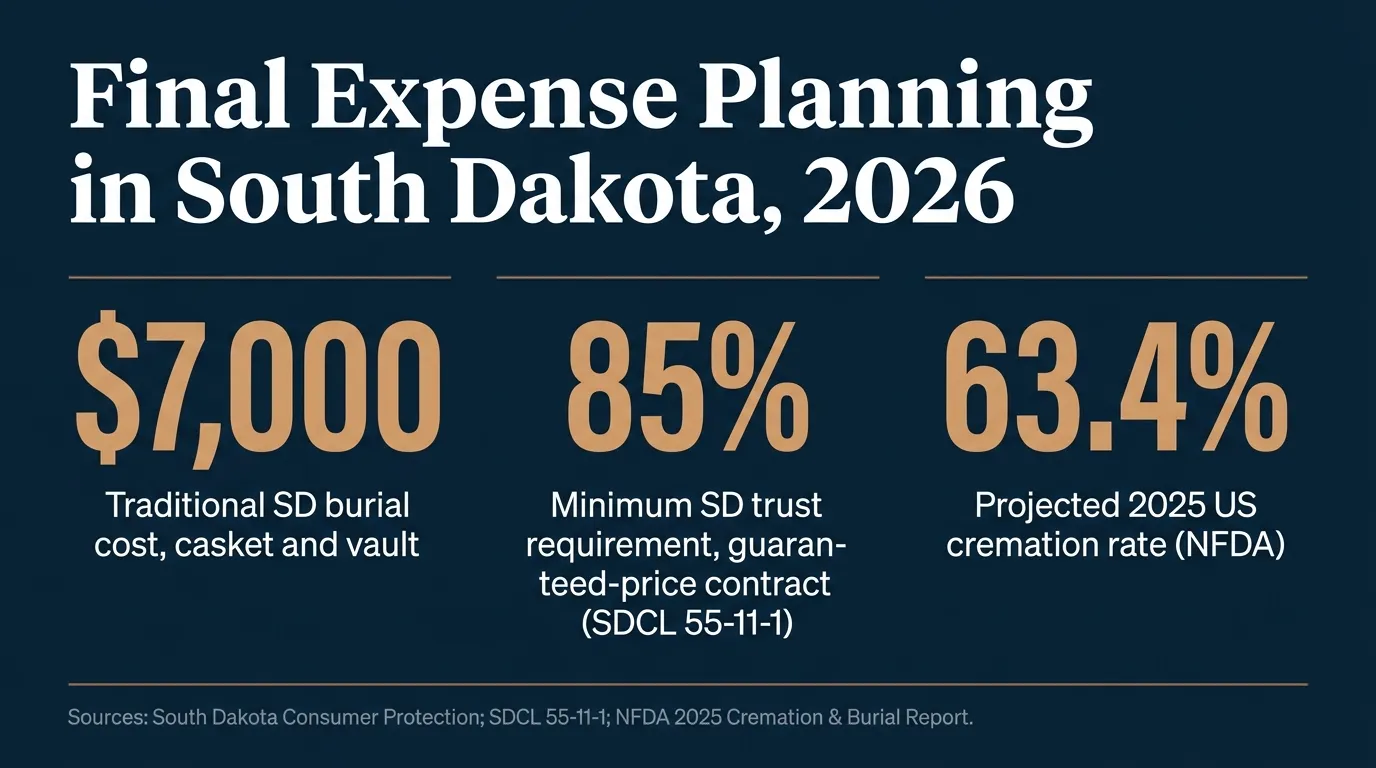
85% / 100%
Minimum SD trust requirement: guaranteed-price vs. non-guaranteed contracts (SDCL 55-11-1, 55-11-3)
~$7,000
Traditional SD burial with casket and vault, before extras (SD Consumer Protection)
30 days
Written notice to cancel a revocable SD funeral trust for a full refund (SDCL 55-11-5)
63.4%
Projected 2025 U.S. cremation rate (NFDA 2025 Cremation & Burial Report)
How we help you compare
We’re an independent life insurance agency, and final expense insurance is squarely inside what we do: we compare how different carriers structure and price small whole life policies sized to funeral and end-of-life costs, since qualification, coverage amounts, and structure vary more between carriers than people expect. What we don’t do is sell or administer prepaid funeral contracts; those are agreements you make directly with a South Dakota-licensed funeral home, governed by the trust law covered in this guide, and that’s a separate conversation with that provider.
If you’ve decided final expense insurance is the right tool, or you want a second opinion on whether it’s the better fit than a prepaid contract for your situation, that’s a comparison we can walk through with you. Compare My Options.
What you get
A clear-eyed comparison between two tools that get confused constantly, even though they work completely differently. A South Dakota-specific number to plan around instead of a national guess. And, if final expense insurance turns out to be the right fit, a side-by-side look at how the carriers we represent structure coverage, rather than a single quote from a single company.
One of these pays a person. The other pays a business. Know which one you're actually buying before you sign.
Mike MooreRelated reading
This guide focuses on the insurance-versus-prepaid decision specifically. For a deeper look at sizing the underlying cost, see our earlier guide on final expense planning and rising funeral costs in South Dakota. It’s also worth reviewing your beneficiary designations any time you add a policy, and our final expense insurance page walks through how the coverage itself works.
Not sure where to start?
Read how it works first and come back when you're ready.
Planning for a parent or spouse?
See how coverage fits seniors specifically.
Want to price your own number first?
Our final expense planner is a reasonable starting point.
Frequently asked questions
What’s the real difference between final expense insurance and a prepaid funeral plan?
Final expense insurance is a small whole life insurance policy. You name a beneficiary, and when you die, the insurer pays that person a cash death benefit they can use for the funeral or anything else. A prepaid (preneed) funeral plan is a contract with a specific funeral home. You pay in advance for goods and services you choose, the money goes into a trust under South Dakota law, and it’s released to that funeral home when you die, not to your family as cash. One pays a person. The other pays a business.
How much of my money is actually protected if I prepay a funeral in South Dakota?
It depends on the contract type. Under SDCL 55-11-1, if you sign a guaranteed-price prearranged funeral contract, the funeral home must place at least 85% of what you pay into a trust. Under SDCL 55-11-3, if the contract is not for a guaranteed price, 100% of the funds must go into the funeral trust fund. Either way, some or all of your payment sits in a bank trust, not just in the funeral home’s operating account, until the contract is fulfilled or canceled.
Can I get my money back if I change my mind about a prepaid funeral plan?
If your trust is revocable, yes. Under SDCL 55-11-5, you can cancel a revocable prearranged funeral trust at any time with thirty days’ written notice, and under SDCL 55-11-5.1 you’re entitled to 100% of the money paid into trust plus 100% of the accrued interest. If you chose an irrevocable trust instead, often to protect Medicaid or SSI eligibility, cancellation is much more restricted, which is the tradeoff for that protection.
What happens to a prepaid funeral contract if the funeral home closes or is sold?
The trust requirement exists for exactly this scenario: the money is supposed to be held at a banking institution, separate from the funeral home’s own finances, so a closure doesn’t automatically wipe out what you paid. But a trust only protects the percentage that was actually deposited and only up to what state oversight actually catches. Final expense insurance doesn’t carry this specific risk, because the death benefit isn’t tied to one funeral home staying in business. It’s paid to your beneficiary, who can use any provider.
Is the payout from final expense insurance taxable?
Generally no. Under 26 U.S.C. Section 101(a) of the Internal Revenue Code, life insurance proceeds paid to a beneficiary because of the insured’s death are typically excluded from the beneficiary’s federal gross income, according to IRS Publication 525. An exception applies if the payout is deferred and accrues interest before being paid; that interest portion is taxable. This is general education, not tax advice for your specific situation.
Does a prepaid funeral plan affect Medicaid or SSI eligibility?
It can help or hurt depending on how it’s structured. Under Social Security Administration policy (POMS SI 01130.410), up to $1,500 in revocable burial funds can be excluded as a countable resource for SSI, and irrevocable burial trusts or contracts are generally excluded from that resource count as well, though state Medicaid programs don’t always mirror SSI rules exactly. If Medicaid or SSI eligibility is part of your planning, confirm the current South Dakota rules with the Department of Social Services or a benefits specialist before you sign anything irrevocable.
Do I have to buy everything from one funeral home if I prepay?
With a traditional preneed contract, generally yes, since the trust is tied to that specific provider and the goods and services you selected. The FTC Funeral Rule still applies when you shop, meaning the funeral home must give you an itemized price list and let you buy only the individual items and services you want rather than a bundled package. Final expense insurance doesn’t lock you to a provider at all; your beneficiary chooses the funeral home after you’re gone.
Which one is better, final expense insurance or a prepaid funeral plan?
Neither wins in every case. A prepaid plan can lock in prices with a funeral home you trust and removes decisions from your family entirely. Final expense insurance is more flexible and portable, pays cash rather than services, and can be sized to cover more than just the funeral. Many South Dakota families use a mix: enough final expense coverage to handle the total cost, sometimes alongside a simple written plan of wishes rather than a full prepaid contract. The right fit depends on how much you value locking in a price versus keeping your options open.
Sources
- South Dakota Legislature — Codified Law 55-11-1, Prearranged Funeral Trusts — minimum trust percentage for guaranteed-price contracts; current codified law, accessed 2026
- South Dakota Legislature — Codified Law Chapter 55-11 — 55-11-3 (non-guaranteed-price trust requirement), 55-11-5 (revocation notice), 55-11-5.1 (refund terms); current codified law, accessed 2026
- South Dakota Consumer Protection — Funerals — South Dakota burial cost estimate, veteran burial benefits and deadlines, prepaid plan trust requirement; accessed 2026
- Federal Trade Commission — The FTC Funeral Rule — itemized pricing rights, bundling prohibition, written statement requirement; accessed 2026
- South Dakota Department of Health — Board of Funeral Service — licensing authority, ARSD 20:45, complaint process; accessed 2026
- National Funeral Directors Association — Media Center Statistics, 2025 Cremation & Burial Report — projected 2025 U.S. cremation and burial rates; accessed 2026
- Internal Revenue Service — Publication 525, Taxable and Nontaxable Income — federal tax treatment of life insurance death benefit proceeds; accessed 2026
- Social Security Administration — POMS SI 01130.410, Burial Funds Exclusion — SSI burial fund resource exclusion rules; policy effective August 1990, continuing, accessed 2026
Related reading: Final Expense Planning in 2026: Rising Funeral Costs in South Dakota. See our final expense insurance page, who we help: seniors, and the beneficiary checklist.
Before you act on any of this
This article is general education, not insurance, legal, financial, or tax advice. Coverage availability, features, and rates vary by carrier and state and are subject to underwriting. No coverage exists until a policy is issued and in force. Any guarantees are subject to the claims-paying ability of the issuing insurer. Prepaid funeral contracts are agreements with individual funeral homes and are governed by South Dakota trust law, not insurance regulation.
Decide once, with your eyes open
Both tools solve a version of the same problem: keeping a funeral bill from landing on your family as a surprise. They just solve it in different ways, one by locking in a provider and a price, the other by putting cash in your family’s hands to use wherever they choose. Know which tradeoff you’re making, price the number honestly using South Dakota’s own figures, and pick the tool, or the combination, that actually matches what you want for the people you leave the decision to.
Want to see how final expense insurance compares?
We'll walk through how the carriers we represent structure and price small whole life coverage sized to your situation.