
If you’re comparing a multi-year guaranteed annuity (MYGA) against a bank CD, the short answer is that a MYGA usually wins on tax deferral and sometimes on rate, and a CD usually wins on simplicity and on how easily you can get your money back if your plans change. Neither one is automatically the better choice. They solve the same basic problem, locking in a fixed rate for a set number of years, but they’re insured by two different systems, taxed on two different schedules, and penalize early withdrawal in two different ways. Getting those differences straight, using your actual numbers instead of a stranger’s rate table, is the whole decision.
The short version
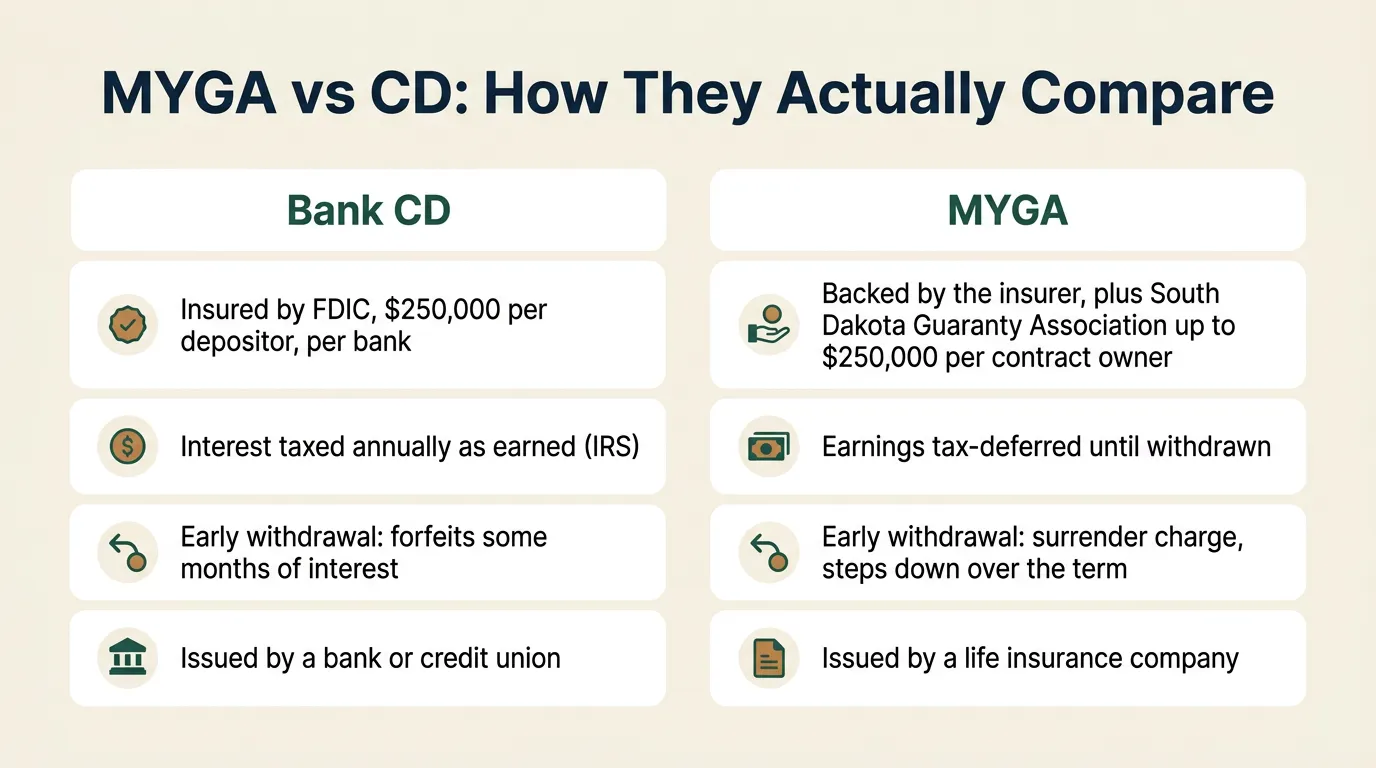
- A CD is insured by the FDIC up to $250,000 per depositor, per bank. A MYGA is backed by the issuing insurer and, as a backstop, by your state's guaranty association: in South Dakota, up to $250,000 in present value of annuity benefits per contract owner, capped at $300,000 in aggregate per insolvent insurer, per the South Dakota Life and Health Insurance Guaranty Association.
- CD interest is taxable the year it's credited, even if it's locked up, according to the IRS. A non-qualified MYGA's earnings are tax-deferred until you withdraw them, which changes the math even at an identical rate.
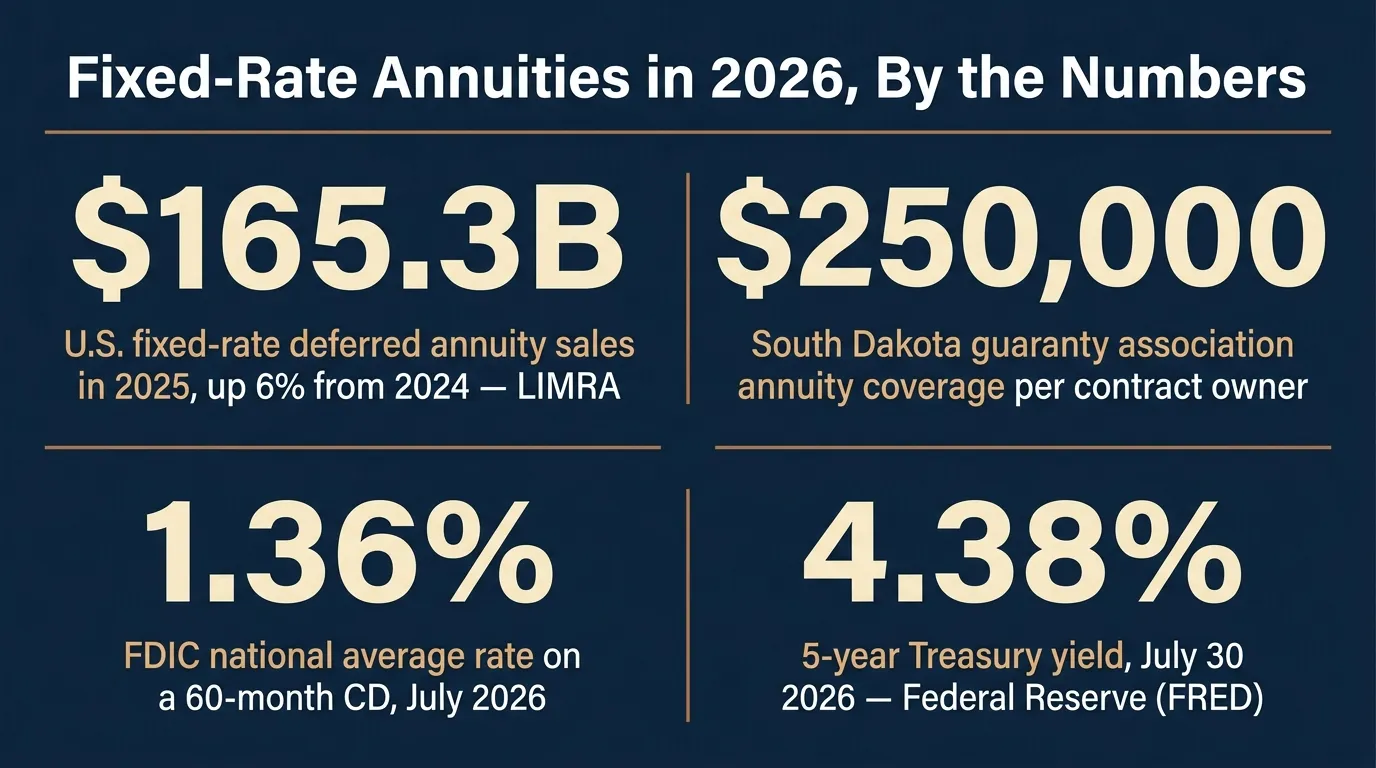
- The FDIC's own July 2026 national rate data shows the average bank actually pays 1.36% on a 60-month CD, well under the 5.78% regulatory rate ceiling for that same term, a gap worth knowing before you assume your bank's CD rate is competitive.
- U.S. fixed-rate deferred annuity sales, the category that includes MYGAs, hit $165.3 billion in 2025, up 6% from $153.2 billion in 2024, according to LIMRA, evidence that more savers are running this exact comparison, not that it's the right call for you specifically.
- South Dakota has required annuity recommendations to meet a documented best-interest standard since January 1, 2023, under the South Dakota Division of Insurance's adoption of the NAIC's 2020 Annuity Model Law.
The pain: a CD renewal notice that doesn’t feel like enough anymore
Here’s the moment this usually starts. A CD matures, the bank sends a renewal notice with a new rate on it, and the number feels lower than it should be for how long the money has been locked up. Or a neighbor mentions an annuity paying more, and now there’s a nagging feeling that money sitting in a CD ladder is quietly losing ground to something better that nobody explained clearly.
Picture a 63-year-old in Rapid City, recently retired from a job at Ellsworth Air Force Base, sitting on $50,000 that just came out of a 12-month CD. She doesn’t want it in the market. She’s not trying to get rich off it. She just wants to know if there’s a meaningfully better place to park it for the next several years without taking on risk she doesn’t want. She’s heard the word “annuity” used as both a smart move and a warning, sometimes in the same conversation, and she has no way to tell which reaction is accurate for her situation.
That confusion is reasonable. Annuities get lumped together in casual conversation, but a MYGA has almost nothing in common with the complicated, high-commission variable annuities that give the whole category a bad name. A MYGA is closer in spirit to a CD than to anything sold on Wall Street: deposit money, get a guaranteed rate, get it back at the end of the term. The differences are real, but they’re not complicated once you see them side by side, and none of them require you to trust anyone’s sales pitch to understand.
This is general education, not a recommendation
Nothing here tells you to buy a MYGA, renew a CD, or pick one over the other. It lays out how each one actually works, using sourced, current data, so you can run the comparison against your own rate quotes and your own timeline.
Why it happens: two products solving the same problem with two different rulebooks
Both a CD and a MYGA exist to answer the same request: “I want a fixed, predictable return on my money for a set period, without market risk.” That’s where the resemblance ends, because the rulebook behind each one comes from a completely different part of the financial system.
A certificate of deposit (CD) is a deposit product. You give a bank or credit union your money for a fixed term, and it pays you a stated interest rate, usually compounding, until the term ends. CDs are regulated as banking products. The FDIC (Federal Deposit Insurance Corporation), an independent federal agency, insures deposits, including CDs, up to $250,000 per depositor, per insured bank, for each account ownership category.
A multi-year guaranteed annuity (MYGA) is an insurance contract, not a deposit. You pay the insurer a lump sum (the premium), and in exchange it credits a fixed interest rate for a stated guarantee period, commonly 3, 5, 7, or 10 years. At the end of that period you can typically withdraw the money, roll it into a new annuity contract through a 1035 exchange (a tax-free transfer between annuity or life insurance contracts under Section 1035 of the tax code), or annuitize it into an income stream. A MYGA is not backed by FDIC insurance. It’s backed first by the issuing insurance company’s own assets and claims-paying ability, and second, if that company became insolvent, by your state’s life and health insurance guaranty association, a nonprofit entity funded by assessments on other insurers licensed in the state, which exists specifically to pay covered claims up to statutory limits when a member insurer fails.
Three mechanical differences follow from that structural split, and they’re the ones that actually decide which product fits your situation:
- What backs the guarantee. FDIC insurance is federal, automatic, and doesn’t depend on anyone filing a claim; if a bank fails, the FDIC has historically paid insured depositors promptly. A state guaranty association only activates if an insurer is declared insolvent, is capped at different dollar limits than FDIC insurance, and is a protection of last resort rather than a routine government guarantee.
- How earnings are taxed. CD interest is taxable in the year it’s credited to your account, according to the IRS, whether or not you can access it penalty-free. A non-qualified MYGA’s earnings (meaning the annuity isn’t held inside an IRA or other tax-qualified account) grow tax-deferred: no tax is owed on the interest as it accrues, only when it’s withdrawn.
- What it costs to get out early. A CD’s early-withdrawal penalty is usually a forfeiture of some months of interest, set by the bank. A MYGA’s early-withdrawal penalty, called a surrender charge, is a percentage of the withdrawn amount that starts higher in year one and steps down each year until it reaches zero at the end of the guarantee period, set out in a surrender charge schedule in the contract. Most MYGA contracts allow a limited penalty-free withdrawal each year, often around 10% of the contract’s value, though the exact terms vary by carrier.
| CD term | National average rate actually paid | National rate cap (regulatory ceiling) |
|---|---|---|
| 3 month | 1.15% | 5.39% |
| 6 month | 1.38% | 5.56% |
| 12 month | 1.68% | 5.53% |
| 24 month | 1.56% | 5.72% |
| 36 month | 1.34% | 5.73% |
| 60 month | 1.36% | 5.78% |
FDIC, "National Rates and Rate Caps," monthly rate cap information as of July 20, 2026. The "national average" is the actual weighted average rate banks pay; the "rate cap" is the maximum a less-than-well-capitalized institution is permitted to offer, not a typical rate.
That gap between the two columns is worth sitting with. The average bank in the FDIC’s own dataset was paying 1.36% on a 5-year CD in July 2026, less than a quarter of the 5.78% regulatory ceiling for that same term. Some banks and credit unions do offer rates well above the national average, so it’s worth shopping before assuming your current bank’s number is the best available, but the gap shows why a stale CD renewal notice can undersell what’s actually out there, in CDs or elsewhere.
What it costs to get wrong: the tax-timing gap, run with real numbers
The clearest way to see why tax treatment matters is to isolate it from everything else. Assume, purely for the sake of the math, that a CD and a MYGA credited the exact same rate: 5.78%, the FDIC’s published national rate cap for a 60-month CD in July 2026, used here only as a realistic top-of-market reference rate, not as a claim about what any specific MYGA is currently paying. Assume a $50,000 deposit, a 5-year term, and a 22% federal marginal tax bracket both while the money is growing and in the year it’s withdrawn, which is the threshold for married couples filing jointly with income over $100,800 under the IRS’s 2026 inflation-adjusted brackets. No state income tax applies to either scenario, since South Dakota doesn’t tax individual income, according to the South Dakota Department of Revenue.
CD path. Interest is credited annually and taxed that same year, per IRS Topic 403, so growth compounds at an after-tax rate of roughly 5.78% × (1 − 0.22) = 4.51% per year. $50,000 × (1.0451)^5 ≈ $62,334 after five years, already net of tax paid along the way.
MYGA path. Earnings aren’t taxed as they accrue, so the full 5.78% compounds untouched for five years. $50,000 × (1.0578)^5 ≈ $66,220 before tax. Withdrawing the full amount at the end of year five means the $16,220 of gain is taxed as ordinary income (annuity withdrawals come out earnings-first under IRS rules), so $16,220 × 0.22 ≈ $3,568 in tax. $66,220 − $3,568 ≈ $62,652 after tax.
At an identical rate, the MYGA comes out about $318 ahead over five years, purely from deferring tax to a single point instead of paying it annually. That’s a real but modest edge at this bracket and this term. The gap widens if the saver’s tax bracket is lower in the withdrawal year than during accumulation, which is common for someone who retires or reduces income during the term, and it widens further over longer terms, since deferral compounds. It shrinks or disappears if the MYGA’s actual quoted rate is lower than the CD’s, which is why the rate you’re actually quoted matters more than any generic rule of thumb.
$250,000
South Dakota guaranty association annuity coverage, per contract owner
$165.3B
U.S. fixed-rate deferred annuity sales in 2025, up 6% from 2024, per LIMRA
4.38%
5-year U.S. Treasury yield, July 30, 2026, per the Federal Reserve (FRED)
U.S. fixed-rate deferred annuity sales, 2024 vs. 2025
LIMRA, "LIMRA: 2024 Retail Annuity Sales Grow 13% to a Record $434.1 Billion" (March 11, 2025) and "LIMRA: Final U.S. Retail Annuity Sales Set New Sales High, Totaling $464.1 Billion in 2025" (2026).
A MYGA and a CD both promise a fixed rate. What they don't share is who backs that promise, who taxes it, and what it costs you to change your mind.
Mike Moore, Life Insurance AdvisorHow to work it out yourself: a five-step comparison
You can run every step of this without anyone’s help, as long as you have two real quotes in hand.
- Get your actual CD renewal rate and an actual current MYGA quote for the same term. Not a rate you saw in an ad, not a number from a year ago. Rates on both sides move often; the FDIC table above updates monthly, and MYGA rate sheets change on a similar or faster cadence.
- Match the terms. Compare a 5-year CD against a 5-year MYGA, not a 5-year CD against a 3-year MYGA with a higher headline rate. Term length changes both the rate and the surrender schedule.
- Run the after-tax math for your own bracket. Use the formula above: after-tax CD growth ≈ rate × (1 − your marginal tax rate), applied annually, versus the MYGA’s full rate compounding untouched until withdrawal, taxed once on the gain. If you expect your tax bracket to drop by the time you’d withdraw, the deferral advantage is larger than the flat-bracket example shown here.
- Check what backs each guarantee and where the dollar limits sit. FDIC insurance covers $250,000 per depositor, per bank, per ownership category. In South Dakota, the guaranty association covers annuities up to $250,000 in present value per contract owner, capped at $300,000 in aggregate per insolvent insurer. If you’re depositing an amount near either limit, that ceiling matters as much as the rate.
- Price the cost of changing your mind. Look at the CD’s early-withdrawal penalty and the MYGA’s full surrender charge schedule, not just the first year’s number. If there’s a real chance you’ll need the money before the term ends, that cost belongs in the comparison from the start, not as an afterthought.
You can do all five steps yourself
None of this requires a middleman. Where a second opinion tends to help is step 1: getting an actual, current MYGA quote to compare, since MYGA rates vary by carrier, term, and premium amount, and a single quote from one company isn't the same as knowing what's available across the market.
If you’d rather have someone local pull current quotes and run this comparison with you, that’s what we do: Compare My Options.
| Feature | Bank CD | MYGA |
|---|---|---|
| Issued by | A bank or credit union | A life insurance company |
| Protection | FDIC insurance, $250,000 per depositor, per bank | Insurer's claims-paying ability, backstopped by the South Dakota Life and Health Insurance Guaranty Association up to $250,000 per contract owner, $300,000 aggregate per insolvent insurer |
| Rate | Fixed for the CD term; varies widely by bank, per FDIC data | Fixed for the guarantee period, set by the issuing carrier |
| Taxation (non-qualified) | Interest taxed annually as earned, per IRS Topic 403 | Earnings tax-deferred until withdrawal, taxed as ordinary income when taken out, per IRS rules on annuities |
| Early withdrawal | Typically forfeits some months of interest | Surrender charge that steps down over the term; usually a limited penalty-free amount allowed each year |
| Regulatory oversight | Banking regulators (FDIC, state banking divisions) | State insurance regulators; in South Dakota, recommendations must meet a best-interest standard as of January 1, 2023 |
When a CD is genuinely the better answer
It’s worth saying plainly: if there’s a real chance you’ll need this money before the term ends, a CD’s simpler, generally cheaper early-withdrawal penalty makes it the safer default, and no tax-deferral math should talk you out of that. The same is true if the amount is modest enough that FDIC insurance covers it without a second thought and the rates you’re being quoted on both sides are close, since a CD comes without a surrender charge schedule to read or a carrier’s financial strength rating to check. A MYGA earns its keep for money you’re genuinely willing to lock away for the full term, where the tax deferral and, sometimes, the rate itself, are worth the reduced liquidity. If you’re not sure which category your situation falls into, that uncertainty itself is a sign it’s worth spending twenty minutes running both numbers before committing either way.
How we help
We’re independent, so we compare fixed, fixed indexed, immediate income, and multi-year guaranteed annuity options across carriers rather than steering you toward one company’s product. If you bring us your CD renewal rate and what you’re actually trying to accomplish, whether that’s a better guaranteed rate, tax deferral, or eventually converting savings into income, we’ll show you what current MYGA quotes actually look like against it, and we’ll say so plainly if a CD is the simpler, better fit for your situation instead.
What you get
A side-by-side comparison using current quotes, not stale rate-table screenshots. A plain-language read on what backs each option and what it would cost you to change your mind before the term ends. And, if a MYGA turns out to be the better fit, a comparison across more than one carrier instead of a single company’s pitch.
Compare a real MYGA quote against your CD rate
Bring us your CD renewal rate and your timeline, and we'll show you current MYGA options across carriers, plus the tradeoffs, so you can decide with real numbers instead of a rate-table guess.
Not ready to talk to anyone yet? Read How It Works first and come back when you are. If you’d rather understand where an annuity fits into a broader retirement income plan first, our guide on whether your retirement savings will last covers withdrawal rates and Social Security timing alongside this same MYGA comparison.
Frequently asked questions
What is a MYGA and how is it actually different from a bank CD?
A multi-year guaranteed annuity (MYGA) is a contract with an insurance company that credits a fixed interest rate for a set number of years, in exchange for a lump-sum deposit. A CD is a deposit product at a bank or credit union that does the same basic thing: lock in a rate for a fixed term. The differences that matter are what backs the promise, how the money is taxed, and what happens if you need it early. A CD is backed by FDIC insurance up to $250,000 per depositor, per bank, and its interest is taxable every year it’s credited, according to the IRS. A MYGA is backed by the issuing insurer’s claims-paying ability, backstopped by your state’s guaranty association up to a separate set of limits, and its earnings are usually tax-deferred until you withdraw them.
Is my money in a MYGA as safe as money in an FDIC-insured CD?
It’s protected by a different system, not the same one. A CD is insured by the FDIC, a federal agency, up to $250,000 per depositor, per insured bank, for each account ownership category. A MYGA is not FDIC-insured. Instead, if the issuing insurer became insolvent, the South Dakota Life and Health Insurance Guaranty Association would step in, covering up to $250,000 in present value of annuity benefits per contract owner, with an aggregate cap of $300,000 across all policies from the same insolvent insurer, according to the association’s own published FAQ. Guaranty association protection is a backstop of last resort, not a guarantee equivalent to federal deposit insurance, and it only exists at all because state insurance regulators pre-fund it through assessments on other insurers.
How are MYGA earnings taxed compared to CD interest?
CD interest is taxable income in the year it’s credited to your account, even if you can’t touch it without an early-withdrawal penalty, according to IRS Topic 403. A non-qualified MYGA (one funded with after-tax money, not an IRA) grows tax-deferred: you don’t owe tax on the interest as it’s credited, only when you actually withdraw it, and under IRS rules on annuity taxation, withdrawals from a non-qualified annuity are treated as coming from earnings first, so the withdrawn amount is fully taxable as ordinary income until all the gain has come out. If you take money out before age 59½, a 10% additional tax generally applies on top of ordinary income tax, unless an exception applies, per IRS Topic 410.
What happens if I need my money before the MYGA term ends?
You’ll likely pay a surrender charge, a penalty built into the contract that declines over the term and disappears once the guarantee period ends. Most MYGA contracts also allow a limited penalty-free withdrawal each year, commonly around 10% of the contract value, though the exact percentage and rules vary by carrier and contract, so read your specific contract rather than assuming a figure. A CD’s early-withdrawal penalty is usually smaller and simpler, often a forfeiture of some months of interest, which is why a CD tends to be the more liquid choice for money you might need on short notice.
Does South Dakota regulate who can recommend an annuity to me?
Yes. Since January 1, 2023, producers recommending an annuity in South Dakota must meet a best-interest standard built on the NAIC’s 2020 Annuity Model Law, according to the South Dakota Division of Insurance. That means the producer has to know your financial situation, insurance needs, and objectives, document the basis for the recommendation in writing, and disclose their role and compensation in the transaction. It doesn’t remove the need to read your own contract, but it does mean the recommendation itself has to be documented as being in your interest, not just suitable in a general sense.
When does a CD actually make more sense than a MYGA?
When you might need the money before the term ends, when the amount is small enough that FDIC insurance fully covers it without a second thought, or when the CD rate you’re being offered is close enough to a comparable MYGA rate that the tax-deferral advantage wouldn’t offset the MYGA’s lower liquidity. A CD is also simpler: no insurance contract, no surrender charge schedule to read, no state guaranty association math. If liquidity and simplicity matter more to you than a modest rate or tax-timing edge, a CD is a completely reasonable choice, and no one should talk you out of it.
How do I actually compare a specific MYGA rate quote against my CD renewal rate?
Line them up on five things: the guaranteed rate for the same term length, what backs the guarantee (FDIC vs. the insurer’s claims-paying ability plus your state guaranty association), how each is taxed, what it costs you to get the money out early, and the financial strength rating of the issuing carrier if it’s a MYGA. A higher headline rate on a MYGA doesn’t automatically win if you might need the funds in year two, and a CD’s simplicity doesn’t automatically win if you’re deferring income for a decade and won’t touch the money regardless of which vehicle holds it.
Can I lose money in a MYGA the way I could in the stock market?
No. A MYGA is a fixed annuity: it credits a stated interest rate for the guarantee period and doesn’t fluctuate with the market. Your principal isn’t at market risk. The way you can come out behind is by taking money out before the term ends and paying a surrender charge, or by choosing an insurer whose claims-paying ability turns out to be weaker than it looked, which is why checking the carrier’s financial strength rating matters before you sign. A MYGA is a different product from a fixed indexed annuity, which credits interest based partly on a market index; a MYGA’s rate is fixed and known on day one, full stop.
Before you sign anything
This article is general education, not insurance, legal, financial, or tax advice. Product availability, rates, surrender terms, and guaranty association limits vary by carrier and by state, and are subject to underwriting and contract terms. No coverage or guarantee exists until a contract is issued and in force. Any guarantees are subject to the claims-paying ability of the issuing insurer. Please review actual contract documents and speak with a licensed agent, and a tax professional about your specific situation, before making a decision.
Sources
- FDIC — National Rates and Rate Caps — monthly rate cap information as of July 20, 2026; national average CD rates and national rate caps by term
- Federal Reserve Bank of St. Louis (FRED) — 5-Year Treasury Constant Maturity Rate (DGS5) — 4.38% observation for July 30, 2026
- LIMRA — Final U.S. Retail Annuity Sales Set New Sales High, Totaling $464.1 Billion in 2025 — 2025 total annuity and fixed-rate deferred annuity sales figures
- LIMRA — 2024 Retail Annuity Sales Grow 13% to a Record $434.1 Billion — published March 11, 2025; 2024 total annuity and fixed-rate deferred annuity sales figures
- South Dakota Life and Health Insurance Guaranty Association — Frequently Asked Questions — annuity coverage limits per contract owner and aggregate cap per insolvent insurer
- IRS Topic 403 — Interest Received — timing and taxability of interest income, including CDs
- IRS Topic 410 — Pensions and Annuities — taxation of annuity and pension payments; 10% additional tax on early distributions
- IRS — Tax inflation adjustments for tax year 2026 — 2026 tax bracket thresholds and standard deduction
- South Dakota Department of Revenue — Individuals: Taxes — confirmation that South Dakota does not impose an individual state income tax
- South Dakota Division of Insurance — Annuity Best Interest Standards — effective January 1, 2023; producer requirements under the NAIC 2020 Annuity Model Law
Related reading: Will Your Retirement Savings Last? A South Dakota Guide and Final Expense Planning in 2026: Rising Funeral Costs in South Dakota. See current options for a multi-year guaranteed annuity and a fixed annuity, or learn more about who we help.