
At most carriers, yes. If you use a nicotine e-cigarette or vape, most life insurance companies will rate you as a tobacco user, the same as a cigarette smoker, for a set number of years after your last use. But “most” isn’t “all,” and the exceptions matter. Some carriers still price a longtime vaper at full smoker rates no matter what a lab test shows. Others will move a vaper into a standard non-smoker class once specific conditions are met. The carrier you apply to can change your rate class more than the vaping itself does, which is exactly the kind of thing worth knowing before you fill out an application in South Dakota in 2026.
The short version
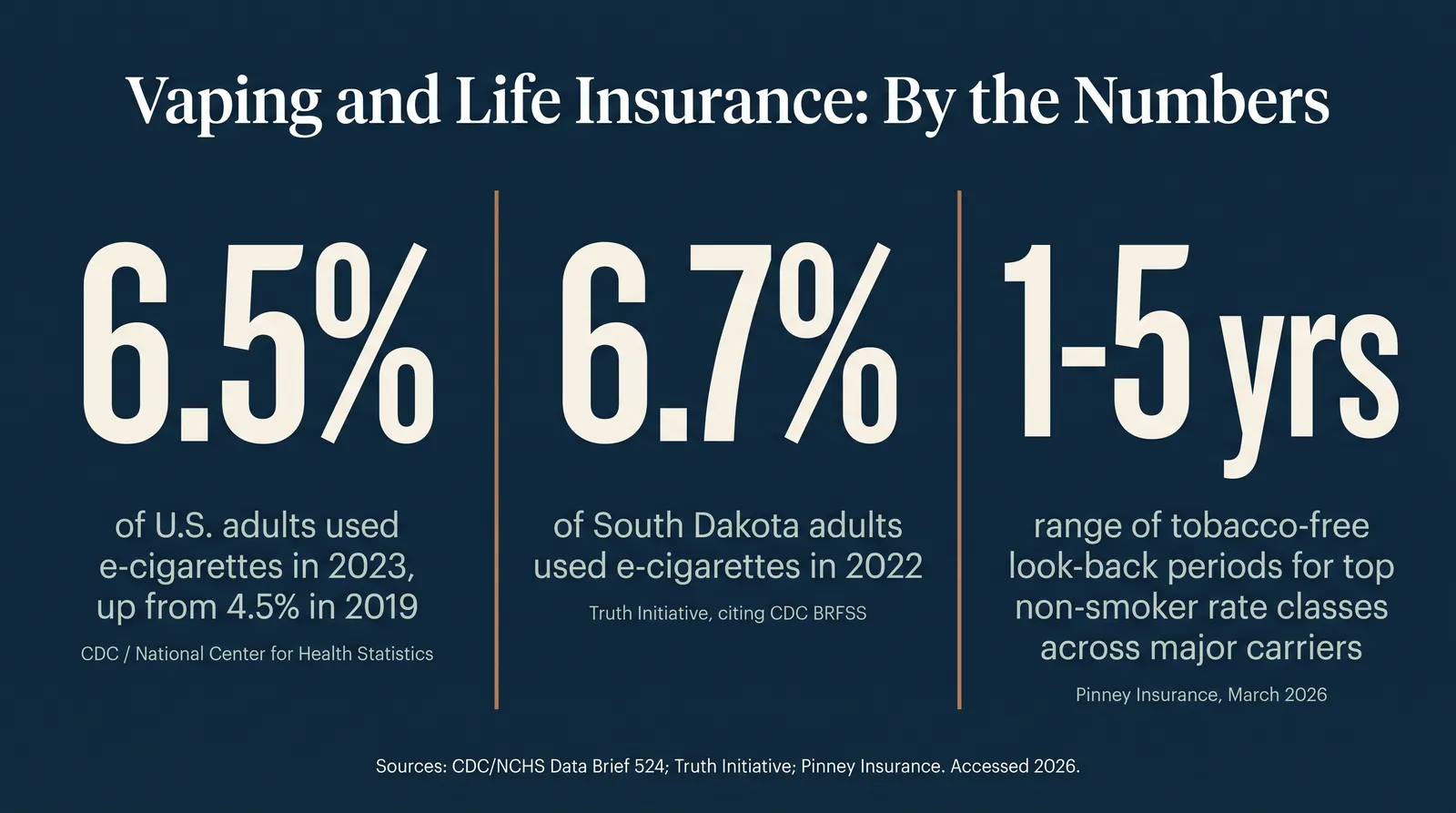
- 6.5% of U.S. adults used e-cigarettes in 2023, up from 4.5% in 2019, per the CDC's National Center for Health Statistics.
- Most carriers require 1 to 5 years of being tobacco- and nicotine-free to qualify for their top non-smoker rate class, and the exact number is carrier-specific, per Pinney Insurance's March 2026 underwriting guideline matrix.
- Carriers don't agree on vaping. Some exclude e-cigarette use from non-smoker rates entirely; others will consider a vaper for standard non-smoker rates under specific lab and history conditions.
- Labs test for nicotine and cotinine, and a positive result overrides what you wrote on the application.
- South Dakota law bars unfair discrimination between applicants with similar risk profiles, but it does not require carriers to treat vaping identically, which is why comparing more than one carrier changes outcomes here.
What actually counts as “tobacco use” on a life insurance application?
More than you’d guess. Life insurance applications ask about tobacco and nicotine product use broadly, and that category has grown well past cigarettes. Cigars, chewing tobacco, snuff, nicotine gum and patches, hookah, and e-cigarettes or vape devices, with or without nicotine depending on the carrier’s own rule, can all trigger a tobacco classification. The application isn’t asking “do you smoke cigarettes.” It’s asking whether you use nicotine or tobacco in any form, and vaping falls squarely inside that question even though it doesn’t involve burning a cigarette.
Carriers sort applicants into rate classes, and the exact names vary by company, but the underlying structure is consistent: a preferred best non-smoker class (the lowest-priced tier a carrier offers), a preferred non-smoker class, one or two standard non-smoker classes, and then smoker classes above those. Each class requires a minimum period of being tobacco- and nicotine-free, confirmed by both your answers and a lab result. Here’s the shape of that ladder, using the terms carriers actually use in their guidelines.
| Class (common abbreviation) | What it means | Typical requirement |
|---|---|---|
| Preferred Best Non-Smoker (PBNS) | The lowest-priced rate class a carrier offers, reserved for the healthiest, longest tobacco-free applicants | Often the longest look-back period a carrier offers, commonly 3 to 5 years nicotine- and tobacco-free |
| Preferred Non-Smoker (PNS) | A step down from the top class, still a strong rate | Commonly 1 to 3 years tobacco-free, carrier-dependent |
| Standard Non-Smoker Plus (SNS+) | A mid-tier non-smoker class some carriers use as a bridge | Often 1 to 2 years tobacco-free where the class exists |
| Standard Non-Smoker (SNS) | The entry-level non-smoker rate, still meaningfully cheaper than any smoker class | Commonly 1 year tobacco-free at most carriers |
Source: Pinney Insurance, "Underwriting Guidelines for Tobacco/Nicotine Use," a broker reference summarizing published carrier guidelines, last updated March 16, 2026. Class structure and look-back windows are illustrative of common carrier patterns and vary by company; not every carrier offers every class listed.
This is general education, not a promise about your application
Rate class names, look-back periods, and how a specific carrier treats vaping all vary by company and change over time. Nothing here is a quote or a guarantee of approval, a rate class, or coverage terms. Coverage availability and pricing vary by carrier and are subject to underwriting.
Why don’t carriers agree on how to treat vaping?
Because e-cigarettes are a genuinely new category, and the life insurance industry’s underwriting rules were built around cigarettes decades before vaping existed. Modern e-cigarettes reached the U.S. mass market roughly in the early 2010s, and long-term health data on vaping specifically, separate from cigarette smoking, is still accumulating. Carriers set their own underwriting guidelines as a business decision, and each one is making its own call about how much long-term risk to assign to a category the actuarial world hasn’t fully settled on yet.
That shows up as real, documented disagreement between companies. Per Pinney Insurance’s underwriting matrix, John Hancock’s guidelines specifically exclude e-cigarette, cigarillo, and hookah use from non-smoker rate consideration, meaning no amount of time vape-free moves a vaper into that company’s non-smoker classes under that rule. Lincoln Financial similarly states no e-cigarette use for non-smoker classification. Prudential’s guidelines note plainly that e-cigarettes are now rated at smoker rates. On the other side, Securian’s guidelines allow e-cigarette use to still support a standard non-smoker class, specifically when there’s been no other combustible tobacco use in 10 or more years and the applicant tests negative for thiocyanate, a chemical marker more closely tied to burning tobacco than to vaping alone. One America takes yet another approach: any tobacco or nicotine use, including vaping, in the past 12 months is treated as smoker classification, with no gradual class ladder at all.
That’s not a rounding error. That’s the same applicant potentially landing in a smoker class at one company and a standard non-smoker class at another, based only on which carrier reviewed the file.
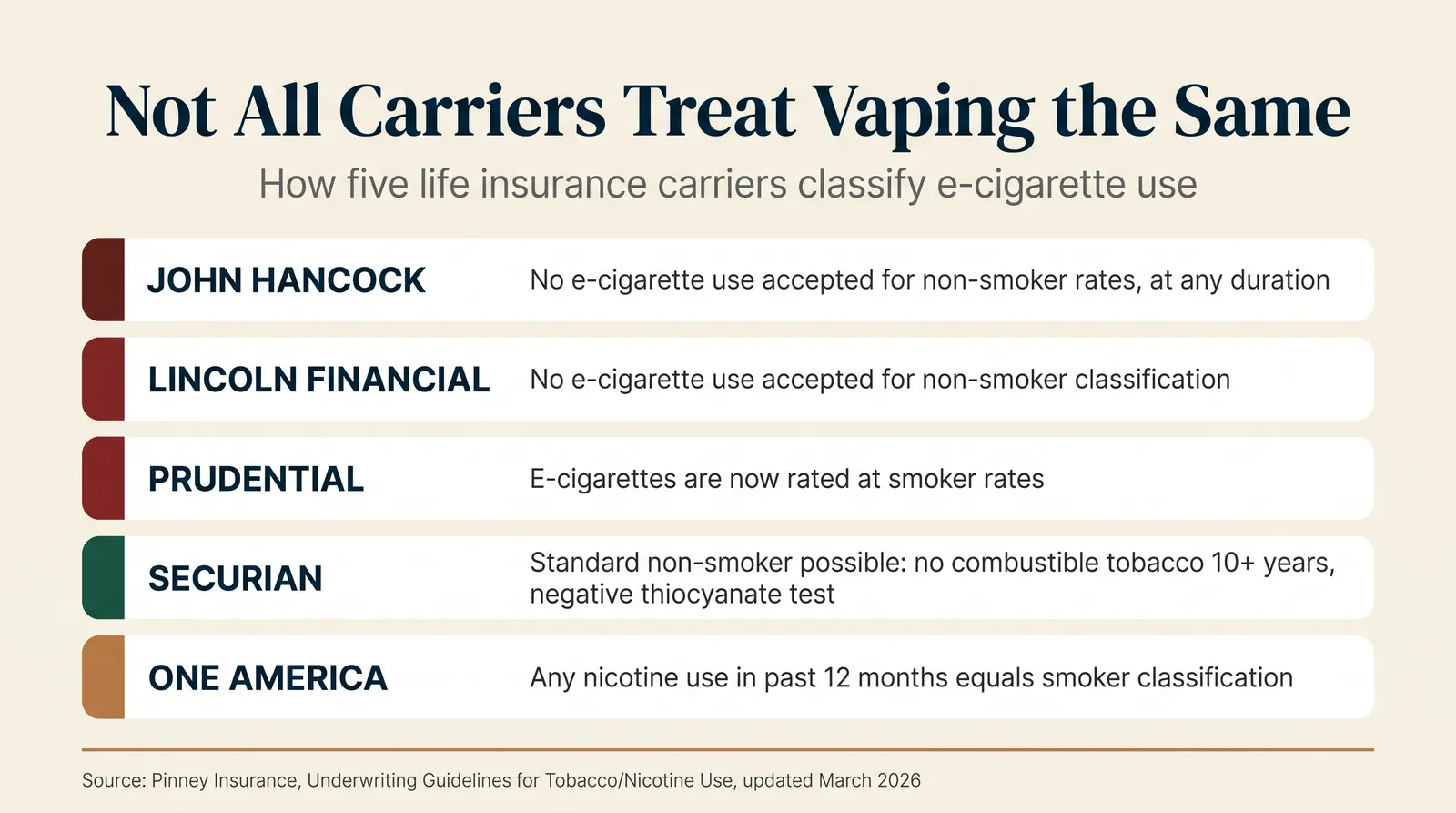
Underneath the rate classes, the mechanism is a lab test. A fully underwritten policy generally includes a paramedical exam, where blood and urine are collected and screened for nicotine and its main metabolite, cotinine. Some carriers, per Securian’s guidelines above, also screen for thiocyanate, which helps distinguish combustible tobacco exposure from nicotine delivered by other means. According to MIB Group, the member-owned corporation that life insurers use to share underwriting information with each other, a positive nicotine or cotinine result leads to tobacco classification regardless of what the applicant wrote on the form, and it can be reported into the shared MIB record other member carriers may check on a future application.
How many South Dakotans are actually dealing with this question?
More than you’d think, and the number has been climbing. Nationally, 6.5% of U.S. adults currently used e-cigarettes in 2023, up from 4.5% in 2019, according to the CDC’s National Center for Health Statistics, based on the National Health Interview Survey. South Dakota’s own numbers tell a similar story of growth, even though the exact figure depends on which year and survey you’re looking at.
| Measure | South Dakota | National | Period / source |
|---|---|---|---|
| Current e-cigarette use, adults | 3.5% | Not reported in this dataset | 2018–2019, CDC / Preventing Chronic Disease (Tobacco Use Supplement to the Current Population Survey) |
| Current e-cigarette use, adults | 6.7% | 7.7% | 2022, Truth Initiative, citing CDC Behavioral Risk Factor Surveillance System data |
| Current cigarette smoking, adults | 15.5% | Not reported in this dataset | 2018–2019, CDC / Preventing Chronic Disease (Tobacco Use Supplement to the Current Population Survey) |
| Current cigarette smoking, adults | 14.0% | 14.0% | 2022, Truth Initiative, citing CDC Behavioral Risk Factor Surveillance System data |
Sources: CDC, "State-Specific Prevalence of Adult Tobacco Product Use and Cigarette Smoking Cessation Behaviors, United States, 2018–2019," Preventing Chronic Disease, accessed 2026; Truth Initiative, South Dakota tobacco use fact sheet, 2023 publication citing 2022 CDC BRFSS data, accessed 2026. Different surveys and years are not directly comparable to each other, only within their own row.
Both readings point the same direction: e-cigarette use among South Dakota adults nearly doubled between the two survey periods shown here, tracking the national trend of rising vaping and slowly declining cigarette smoking. If you’re applying for life insurance in South Dakota in 2026, the odds that either you or someone in your household has this exact question are real and getting more common every year, not less.
6.5%
of U.S. adults used e-cigarettes in 2023, up from 4.5% in 2019 (CDC/NCHS)
6.7%
of South Dakota adults used e-cigarettes in 2022, per Truth Initiative/CDC BRFSS
1–5 yrs
range of tobacco-free look-back periods for top non-smoker classes across major carriers (Pinney Insurance, 2026)
14.0%
of South Dakota adults currently smoked cigarettes in 2022 (Truth Initiative/CDC BRFSS)
What does it actually cost you to guess wrong about which carrier to ask?
Not a specific dollar figure, because rates depend on your age, health, coverage amount, and the carrier’s own pricing, and nobody can promise you a premium without underwriting your file. But the real cost here isn’t hidden in a number; it’s hidden in which door you knock on first.
Picture two South Dakota applicants with the identical vaping history: both switched from cigarettes to a nicotine vape 11 years ago, both have used only the vape since, and both would test negative for cotinine tied to combustible tobacco. If either of them applies to a carrier whose guidelines exclude e-cigarette use from non-smoker consideration as a category, per the John Hancock and Lincoln Financial guidelines cited above, the outcome is the same regardless of how clean their file otherwise is: no non-smoker class available through that company’s stated rules. If either applies to Securian instead, whose guidelines allow standard non-smoker consideration for vapers with no other combustible tobacco use in 10-plus years and a negative thiocyanate test, per that same matrix, the exact same eleven-year history can support a meaningfully better rate class.
That’s the whole cost. It isn’t that vaping makes you uninsurable, it’s that applying to the wrong carrier first, without knowing the guidelines vary this much, can lock in a worse outcome than your actual health history would otherwise support elsewhere. And every application you submit and get rated poorly on becomes part of your file for the next one.
Sample carriers: years tobacco-free required for the top non-smoker rate class
Source: Pinney Insurance, "Underwriting Guidelines for Tobacco/Nicotine Use," Preferred Best Non-Smoker column, updated March 16, 2026. Figures reflect that specific rate class only; other classes at the same carriers have shorter look-back windows. Guidelines change; confirm current requirements before applying.
| Carrier | Documented treatment of vaping/e-cigarettes |
|---|---|
| John Hancock | No e-cigarette, cigarillo, or hookah use accepted for non-smoker rate consideration, at any duration |
| Lincoln Financial | No e-cigarette use accepted for non-smoker classification |
| Prudential | E-cigarettes are now rated at smoker rates |
| Securian | E-cigarette use can qualify for standard non-smoker class with no other combustible tobacco use in 10-plus years and a negative thiocyanate test |
| One America | Any tobacco or nicotine use, including vaping, within the past 12 months is treated as smoker classification |
| Nationwide, Equitable, Banner Life, MassMutual, and most others | Not singled out separately from general tobacco/nicotine guidelines; standard look-back periods and lab testing apply |
Source: Pinney Insurance, "Underwriting Guidelines for Tobacco/Nicotine Use," updated March 16, 2026. Guidelines summarized here are subject to change; an independent agent can confirm the current version before you apply.
How do you work this out for yourself before you apply?
You don’t need anyone’s help to get your own picture straight first. This is the same method that works for any tobacco or nicotine history on a life insurance application.
- Write down your actual timeline. When did you start vaping, did you switch from cigarettes or start fresh, and when, if ever, did you last use any nicotine product, vape included? Underwriters are reading for a pattern, not a single answer, so having the dates straight before you apply matters.
- Know what’s actually in your e-liquid. If you use nicotine-free vape juice, that’s a meaningfully different underwriting picture at carriers that don’t have a blanket rule against any vaping device, but it only helps if a lab test backs it up. Guessing at the nicotine content isn’t the same as knowing it.
- Disclose fully, including past use. Applications ask about tobacco and nicotine history, not just current use, and a lab test or an attending physician statement can surface a gap between what you wrote and what your body shows. Underreporting isn’t a shortcut; it’s a misrepresentation that can put a claim at risk later, during the contestability period.
- Understand that “smoker rates” and “no coverage” are not the same thing. Even at the carriers with the strictest vaping rules, you can typically still qualify for coverage at a smoker rate. The question isn’t usually whether you can get covered; it’s which rate class you land in and at which company.
- Decide whether your timeline points toward waiting or applying now. If you’re a few months from clearing a specific carrier’s look-back period, it may be worth waiting. If you’re not on a quit timeline at all, or you’re not sure when you’ll clear it, applying now to a carrier whose current guidelines fit your actual situation is a real option worth weighing against not applying at all.
- Compare more than one carrier’s current guidelines before you commit to an application. Because carriers haven’t converged on identical vaping rules, as the guidelines above show, the same history can land very differently depending on where you apply first. This is the step that costs the most when it’s skipped.
Does it matter if the vape juice is nicotine-free?
It can, but only if you can prove it. The underwriting mechanism runs on lab results, not on the label of the product you buy. A nicotine and cotinine test that comes back negative supports non-smoker consideration at carriers that evaluate vaping on its actual chemical findings rather than treating any vape device as an automatic tobacco classification.
That’s a real distinction, but it isn’t a universal one. As the carrier comparison above shows, John Hancock and Lincoln Financial’s guidelines exclude e-cigarette use from non-smoker rates as a category, independent of what a lab test shows, per Pinney Insurance’s matrix. If you genuinely use nicotine-free e-liquid, that fact matters most at carriers whose guidelines actually leave room for it, which is one more reason to compare guidelines before applying rather than assuming any one company’s rule applies everywhere.
What about occasional or social vaping? Do you still have to disclose it?
Yes. There’s no threshold below which vaping stops counting as tobacco or nicotine use on a life insurance application. The application asks about use, not about how often you’d personally describe yourself as a vaper.
That said, carriers do build specific low-frequency allowances into their guidelines, and they’re worth knowing about because they show underwriters aren’t looking for an excuse to penalize an occasional habit. Per Pinney Insurance’s matrix, several carriers, including MassMutual, Mutual of Omaha, and Foresters, allow a defined number of occasional cigars per year, sometimes up to 24, without moving an applicant out of non-smoker consideration, provided it’s disclosed and the lab result is negative. The pattern across the industry is that carriers want accurate disclosure paired with an actual negative test, not a guess about what counts as “occasional enough” to leave off the form.
"I only vape sometimes, so I'll just say I don't"
- Applies without disclosing, hoping the lab test won't catch it
- Risks a misrepresentation finding if nicotine or cotinine shows up in the exam
- Never learns which carriers actually have room for their real history
ResultA rate class, or a claim, built on a guess
Writes down the real timeline, discloses fully, compares carriers
- Knows exactly when nicotine use started, changed, or stopped
- Discloses accurately and lets the lab result confirm it
- Has an independent agent check which carriers' current guidelines fit that specific history
ResultA rate class grounded in an actual offer, not an assumption
How does South Dakota law factor into this?
South Dakota regulates how insurers can treat applicants who share similar risk profiles. Under SDCL 58-33-26, no insurer may make or permit unfair discrimination between insureds having like insuring or risk characteristics, in the premium or rates charged for insurance, or in any other term or condition of the insurance; a violation is a Class 2 misdemeanor. In plain terms, a carrier’s underwriting decision has to trace back to that company’s own stated, individualized risk assessment, not an arbitrary rule applied inconsistently to people with comparable histories.
That protection does not require every carrier to treat vaping the same way as every other carrier. Setting underwriting guidelines, including how strictly to treat e-cigarette use, is a business decision each company makes for itself within the law, and this is precisely the area where guidelines are still evolving fastest, as the range from John Hancock’s blanket exclusion to Securian’s conditional allowance shows. What the law protects is consistency within a given carrier’s own stated rules, not identical treatment across the industry. That’s also exactly why comparing carriers, rather than accepting the first answer you get, is both a reasonable and a legally grounded thing to do.
How we help
We’re an independent life insurance agency, which means we aren’t limited to one carrier’s vaping guidelines, and those guidelines are exactly the part of this topic that keeps shifting. When a South Dakota applicant with a vaping history comes to us, we help lay out the actual timeline, then compare how the carriers we represent currently treat that kind of file, rather than sending in one application and hoping it lands somewhere favorable. Compare My Options.
What you get
A straight answer about whether vaping rules you out (generally, no, though it usually means a different rate class than a lifetime non-smoker gets). A method for laying out your own nicotine timeline clearly before you talk to anyone. And, if you decide to move forward, a side-by-side look at how more than one carrier’s current guidelines would treat your specific history, instead of a single answer from a single company.
Carriers aren't rating whether you vape. They're rating which rule they've decided to apply to it, and that rule is different at every company. Know the timeline before you let one carrier's answer stand in for all of them.
Mike MooreRelated reading
This guide focuses on vaping and e-cigarettes specifically. For a broader look at how underwriting handles other maintenance medications and habits, see our guide on getting life insurance after a health condition and our guide to life insurance and marijuana use in South Dakota. If you’re weighing speed and convenience against price generally, our no-medical-exam life insurance guide and our underwritten-versus-no-exam comparison walk through that tradeoff directly.
Not sure what "tobacco use" covers?
See what a life insurance medical exam actually tests for.
Have a health condition too?
See how coverage works for people with health conditions.
Not sure where to start?
Read how it works first and come back when you're ready.
Frequently asked questions
Does vaping count as smoking for life insurance?
At most carriers, yes. The majority of life insurance companies classify any nicotine-containing e-cigarette or vape use within the past 12 months to 5 years as tobacco use, which means smoker rates, according to Pinney Insurance’s carrier-by-carrier underwriting guideline matrix (updated March 2026). A few carriers, such as Prudential, explicitly state e-cigarette use is now rated at smoker rates. But the field isn’t uniform. Securian’s guidelines allow e-cigarette use to still qualify for a standard non-smoker class, provided there’s been no other combustible tobacco use in 10 or more years and the applicant tests negative for thiocyanate. Which carrier you apply to changes the answer.
Do all life insurance carriers treat vaping the same as cigarettes?
No, and the gap between carriers is wider than most applicants expect. Per Pinney Insurance’s tobacco underwriting matrix, John Hancock and Lincoln Financial exclude e-cigarette use from non-smoker rate consideration entirely, no matter how long ago someone last vaped. Securian will consider e-cigarette users for its standard non-smoker class under specific conditions. Prudential moved e-cigarettes to smoker rates outright. One America counts any tobacco or nicotine use, vaping included, within the past 12 months as smoker classification, full stop. The same vaping history can land a very different rate class depending entirely on which company reviews the file.
How long do you have to be vape-free to get non-smoker life insurance rates?
It depends entirely on the carrier and the rate class you’re targeting, and there’s no single industry-wide answer. For the best available non-smoker class, look-back requirements documented in Pinney Insurance’s March 2026 underwriting matrix range from as little as 1 year (MassMutual) to as long as 5 years (Equitable, American General, Nationwide, Symetra, SBLI, and others). Mid-tier non-smoker classes are often faster to reach, sometimes 1 to 3 years. Because the range runs 1 to 5 years across major carriers for the same class, the carrier you pick can matter as much as the calendar.
Can a life insurance company test for vaping or nicotine?
Yes. A fully underwritten policy typically includes a paramedical exam with a blood or urine sample, and labs test for nicotine and its metabolite, cotinine, along with markers like thiocyanate that can flag combustible tobacco use specifically. According to MIB Group, the member-owned clearinghouse life insurers use to share underwriting information, a positive test for nicotine or cotinine leads a carrier to classify the application as tobacco use regardless of how the applicant answered the health questions, and a mismatch between what you disclosed and what the lab finds can be treated as a misrepresentation on the application.
Does it matter if the vape juice is nicotine-free?
It can help, but you still have to prove it, and not every carrier accepts the distinction the same way. Underwriters classify based on nicotine and cotinine lab results, not on what the label of your vape juice claims. If you genuinely use nicotine-free e-liquid, a negative nicotine and cotinine test supports non-smoker consideration at carriers that don’t have a blanket rule against any vaping device. But carriers like John Hancock exclude e-cigarette use from non-smoker rates as a category, independent of lab results, per Pinney Insurance’s underwriting matrix, so nicotine-free vaping alone doesn’t guarantee non-smoker treatment everywhere.
Do you have to disclose vaping if you only do it occasionally or socially?
Yes. Life insurance applications ask about tobacco and nicotine product use, not about frequency thresholds you get to decide for yourself. Occasional or social vaping is still vaping, and several carrier guidelines specifically address low-frequency use with exact caps, such as a set number of cigars per year, rather than leaving it to interpretation. Underreporting frequency, or leaving vaping off the application entirely, is a misrepresentation that a lab test or a follow-up records request can surface later, and that can put a claim at risk during the contestability period.
Can a carrier deny you coverage just because you vape?
A carrier can decline any individual application under its own underwriting guidelines, and those guidelines are a business decision each company makes for itself. What South Dakota law prohibits is unfair discrimination between people with similar risk characteristics. SDCL 58-33-26 states that no insurer may make or permit unfair discrimination between insureds having like insuring or risk characteristics in premium, rates, or any other term or condition of the insurance, and a violation is a Class 2 misdemeanor. In practice, a decline has to trace back to that carrier’s stated underwriting rules, not an arbitrary decision, and a decline at one company is often not a decline everywhere, since guidelines vary company to company within that legal framework.
Should you quit vaping before you apply for life insurance?
That’s a decision between you and your own health goals, not something this article can tell you to do, but it’s worth understanding the underwriting math either way. If you quit and stay nicotine-free long enough to clear a specific carrier’s look-back period, testing negative for nicotine and cotinine at the exam supports non-smoker consideration at that company. If you’re not planning to quit, or you’re mid-way through quitting, an independent agent comparing current carrier guidelines can help you find which companies are likely to underwrite your actual situation most favorably right now, rather than waiting on a timeline that may not fit your life.
Sources
- CDC / National Center for Health Statistics — Electronic Cigarette Use Among Adults in the United States, 2019–2023 (Data Brief No. 524) — 6.5% of U.S. adults used e-cigarettes in 2023, up from 4.5% in 2019; based on the National Health Interview Survey; published January 2025; accessed 2026
- CDC — State-Specific Prevalence of Adult Tobacco Product Use and Cigarette Smoking Cessation Behaviors, United States, 2018–2019 (Preventing Chronic Disease) — South Dakota adult e-cigarette use 3.5% (95% CI 2.3–4.7%), cigarette smoking 15.5% (95% CI 13.2–17.7%); Tobacco Use Supplement to the Current Population Survey, 2018–2019, 137,471 respondents; accessed 2026
- Truth Initiative — Tobacco Use in South Dakota, 2023 fact sheet — South Dakota adult e-cigarette use 6.7% vs. 7.7% nationally; South Dakota adult cigarette smoking 14.0%; both figures cite 2022 CDC Behavioral Risk Factor Surveillance System data; accessed 2026
- Pinney Insurance — Underwriting Guidelines for Tobacco/Nicotine Use — carrier-by-carrier look-back periods and vaping/e-cigarette-specific underwriting notes across more than 20 carriers; broker reference document, last updated March 16, 2026; accessed 2026
- South Dakota Legislature — Codified Law 58-33-26, Unfair Discrimination as to Terms and Conditions of Insurance — prohibits unfair discrimination in premiums, rates, or terms between insureds with like risk characteristics; classifies a violation as a Class 2 misdemeanor; current codified law, accessed 2026
Related reading: Life Insurance and Marijuana Use: A 2026 South Dakota Guide, Underwritten vs. No-Exam Life Insurance in 2026, and No-Medical-Exam Life Insurance: How It Works in 2026. See who we help: people with health conditions and current options for term life insurance.
Before you act on any of this
This article is general education, not insurance, legal, financial, or medical advice. Coverage availability, features, and rates vary by carrier and state and are subject to underwriting. No coverage exists until a policy is issued and in force. Any guarantees are subject to the claims-paying ability of the issuing insurer. Nothing here should be read as guidance about starting, changing, or continuing any nicotine product; that's a decision for you and your own health goals.
Vaping isn’t the verdict, the carrier’s rule is
A vaping history on your application is a fact an underwriter will read, not a sentence every company hands down the same way. What actually decides your rate class is which carrier’s specific rule gets applied to that history, and those rules currently range from a flat smoker classification to a real path back to standard non-smoker rates. Write down your actual timeline honestly, disclose it fully, and let more than one carrier’s current guidelines weigh in before you accept any single answer as the final one.
Want a second opinion before you apply?
We'll help you lay out your nicotine history and compare how the carriers we represent currently treat it.