
Yes: as of July 1, 2026, a South Dakota insurer cannot decline you, cancel you, or charge you more for life, disability, or long-term care insurance solely because you are a living organ donor. That protection comes from House Bill 1101, signed into law this year and now part of South Dakota’s insurance code under SDCL chapter 58-1. It closes a gap that, until this year, let an underwriter treat the fact that someone gave a kidney to a stranger or a sibling as reason enough to say no.
The short version
- House Bill 1101 (2026) added a new section to SDCL chapter 58-1 barring insurers from declining, limiting, or repricing life, disability, or long-term care coverage solely because an applicant is a living organ donor.
- The bill carried no emergency clause, so under Article III, Section 22 of the South Dakota Constitution it took effect July 1, 2026. It is current law today.
- The American Kidney Fund moved South Dakota from an F to a D on its Living Donor Protection Report Card after the bill passed, and counts South Dakota as the 36th state with this kind of protection.
- A 2010 JAMA study of 80,347 live kidney donors found perioperative mortality of 3.1 per 10,000 donors and better 12-year survival among donors (1.5% mortality) than matched nondonors (2.9%), the actuarial backdrop the new law is responding to.
- The law bars discrimination based solely on donor status. It does not bar underwriting a genuine complication or an unrelated health condition turned up during the application.
The pain: you want to help someone, and you’re afraid it will cost you your own coverage
Living organ donation is not abstract for the person considering it. It is usually a sibling, a spouse, a coworker, or sometimes a stranger on dialysis, and a real surgery with real recovery time. What stops a lot of people before they ever call a transplant center is a smaller, quieter worry: will this show up on an insurance application later and get held against me?
That fear was not paranoia. Before July 1, 2026, nothing in South Dakota law stopped an insurer from treating “living organ donor” as its own underwriting category, separate from your actual health. A person in excellent health who gave a kidney to their brother could, in theory, be quoted a higher rate, handed a table rating, or turned down outright, not because of any medical finding but because the word “donor” sat on the application. The American Kidney Fund, the organization that has tracked this issue nationally for six years running, rated South Dakota an F for living donor protections every year before this bill passed.
This is general education, not a recommendation
Nothing here tells you whether to become a living organ donor or which insurance product to buy. It explains what changed in South Dakota law on July 1, 2026, what the change does and does not cover, and how to apply for coverage with that change in mind.
Why it happened: donor status got treated as its own risk category, without the data to back it up
To understand what changed, it helps to define a few terms the way an underwriting file actually uses them.
- Underwriting is the process an insurer uses to evaluate an applicant’s health, habits, and history and decide whether to offer coverage, at what price, and under what conditions.
- Underwriting class (also called a risk class) is the category an insurer sorts an approved applicant into, such as Preferred Plus, Preferred, Standard Plus, or Standard, each with its own premium.
- Substandard risk, per the National Association of Insurance Commissioners’ consumer glossary, describes an applicant considered undesirable enough, because of a medical condition or hazardous occupation, to require a higher premium, a special policy form, or a waiver.
- Table rating is how an insurer prices a substandard risk: instead of a flat decline, the applicant is offered coverage at an added percentage load above the standard premium, in tiers insurers typically label with letters or numbers.
- Actuarial risk is the measurable, data-supported likelihood of a claim, the thing underwriting classes and table ratings are supposed to be built on.
The mechanism that produced the F rating is straightforward once you see it: nothing in the law required an insurer’s underwriting guide to distinguish “someone who donated a kidney and fully recovered” from “someone with a genuine, elevated health risk.” An underwriter working from a guide that flagged “history of nephrectomy” (surgical kidney removal) as a category, without a carve-out for planned, voluntary living donation, could apply the same caution to a healthy donor that the guide intended for someone who lost a kidney to cancer or trauma. The result was not necessarily malice. It was a gap: the guide had no separate lane for a category of applicant who, on the data, does not carry the added risk the flag was written for.
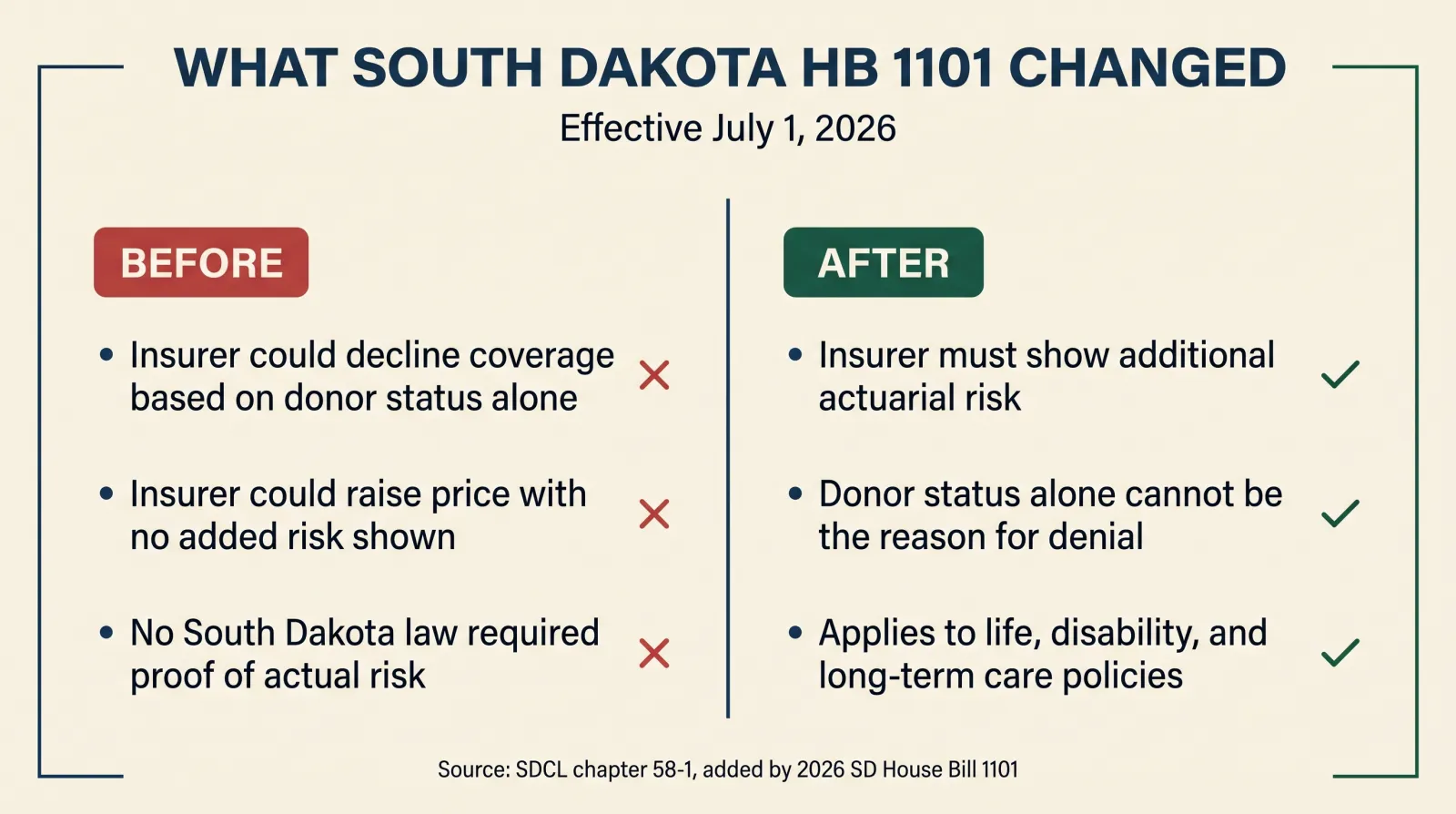
Donor status alone could count against you
- An insurer could decline or limit a life, disability, or long-term care policy solely because the applicant had donated a kidney or part of another organ
- An insurer could condition keeping a policy in force on the insured not becoming a living donor in the future
- No South Dakota statute required an underwriter to show additional actuarial risk beyond the donation itself
- American Kidney Fund rated South Dakota an F for living donor protections, every year before the bill passed
No statutory floorPractice varied by carrier and underwriter
Donor status alone cannot be the reason
- An insurer may not decline, limit, cancel, or reprice a life, disability, or long-term care policy solely due to living organ donor status
- An insurer may not require an insured to promise not to become a donor to keep a policy in force
- Any adverse decision now has to point to actual additional actuarial risk, not the word "donor" on the file
- American Kidney Fund moved South Dakota to a D; South Dakota is the 36th state with this type of protection
Statutory floor now existsSDCL chapter 58-1, as amended by 2026 HB 1101
2026 South Dakota House Bill 1101, enrolled act, South Dakota Legislature; American Kidney Fund, "American Kidney Fund Applauds South Dakota for Passing Living Donor Protections," March 10, 2026.
What it cost to get wrong: the data underneath the fear, and what the F rating actually measured
The strongest argument for HB 1101 is not sentiment. It is that the largest available research on living kidney donors does not support treating donor status as an elevated mortality risk in the first place.
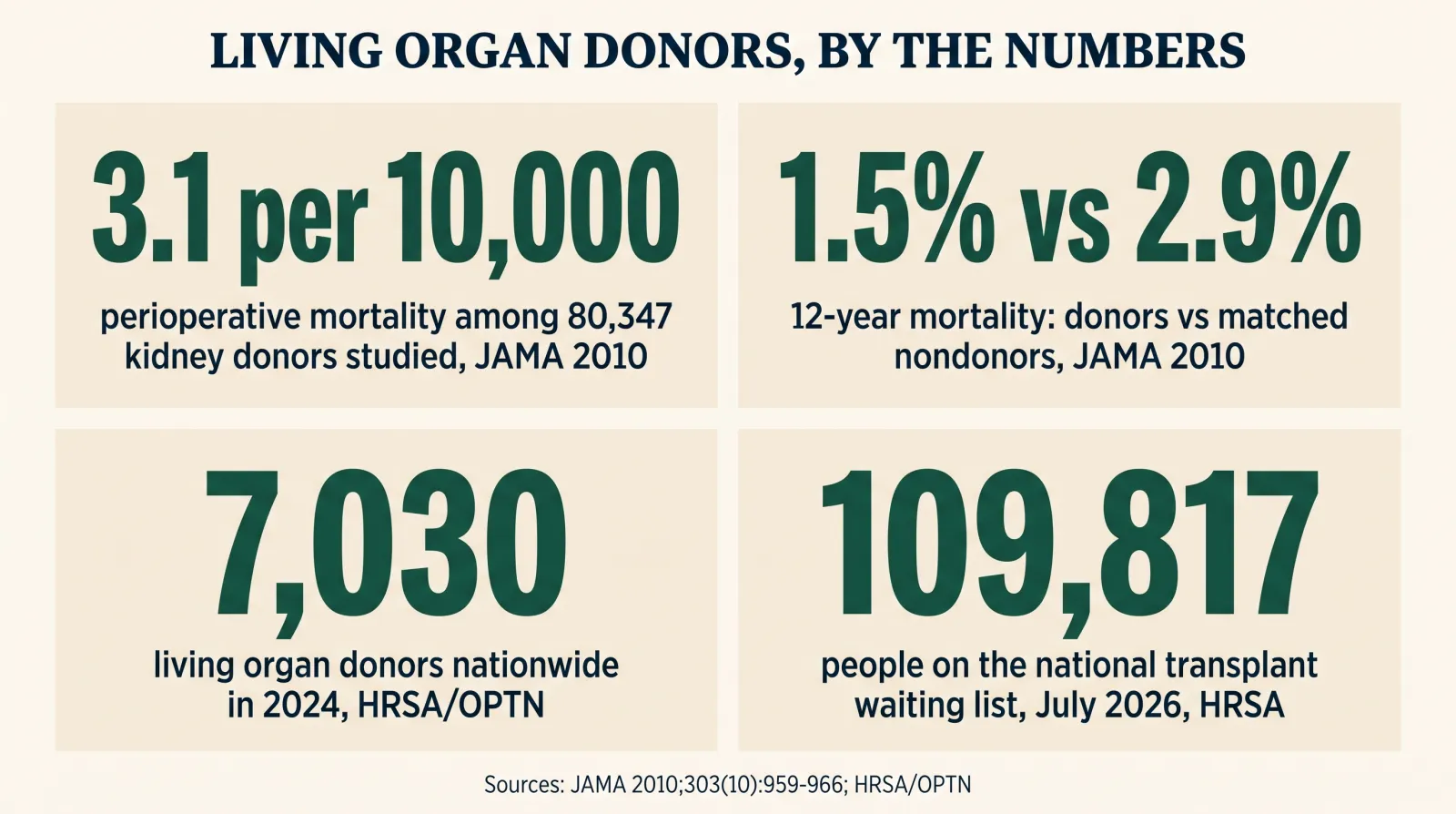
The 2010 JAMA study by Segev and colleagues is the largest of its kind: 80,347 live kidney donors nationally, matched against an equal number of similar nondonors drawn from a national health survey, tracked from 1994 through 2009. Surgical mortality within 90 days of donation was 3.1 per 10,000 donors. At 12 years out, only 1.5% of donors had died, compared with 2.9% of the matched comparison group, a statistically significant difference in the donors’ favor, not against them. A smaller 2021 study out of South Korea, following 1,701 donor-and-control pairs for a median of about 7.7 years, found a higher hazard ratio for donors, 1.82, but the result was not statistically significant once socioeconomic status was accounted for, meaning the researchers could not rule out chance as the explanation.
| Study | Sample | Result |
|---|---|---|
| Segev et al., JAMA, 2010 | 80,347 donors matched with 80,347 nondonors, 1994-2009 | 3.1 perioperative deaths per 10,000 donors; 12-year mortality 1.5% donors vs. 2.9% matched nondonors (p<.001) |
| South Korean cohort study, Kidney Research and Clinical Practice, 2021 | 1,701 donors matched with 1,701 controls, median follow-up 7.7 years | Adjusted hazard ratio 1.82 for donors (95% CI 0.87-3.80); not statistically significant (p=.11) |
Segev DL, Muzaale AD, Caffo BS, et al. JAMA. 2010;303(10):959-966; South Korean live kidney donor cohort study, Kidney Research and Clinical Practice, November 2021.
2024 U.S. organ transplants: living donors, deceased donors, and the total
Health Resources and Services Administration / Organ Procurement and Transplantation Network, "Organ Transplants Exceeded 48,000 in 2024," published January 15, 2025, covering calendar year 2024.
Put plainly: the best available evidence does not show that giving a kidney makes you a worse mortality risk than a similar person who did not. Some studies show donors doing slightly better on long-term survival, likely because donors are pre-screened for good health before they are ever allowed to donate. None show a clear, reproducible signal large enough to justify an automatic decline or rate-up.
Living donors save lives, and they shorten the waiting list for everyone else. HB 1101 removes an unnecessary and documented barrier to donation.
Rep. Nicole Uhre-Balk, HB 1101 prime sponsorThat gap between the data and the old underwriting practice is exactly what the American Kidney Fund’s report card measures. It is not a survey of donor opinions; it grades each state on whether its statutes actually require insurers to treat living donors fairly across seven categories, including life, disability, and long-term care insurance nondiscrimination, job-protected leave, and reimbursement of donor expenses. South Dakota held an F for five consecutive years before HB 1101, meaning the state had none of those statutory protections in place. After the bill passed, the American Kidney Fund moved South Dakota to a D and counted it as the 36th state nationally with life, disability, or long-term care insurance protections for living donors on the books. A D is not a perfect score; it reflects that South Dakota now has the insurance-discrimination piece in place while other categories on the report card, such as paid leave requirements, remain unaddressed.
Nationally, the stakes are not small. The Health Resources and Services Administration reported 48,149 total organ transplants in 2024, a record year and a 3.3% increase over 2023, including 7,030 procedures made possible by living donors and 16,988 from deceased donors. As of July 30, 2026, 109,817 people remained on the national transplant waiting list. Every barrier that talks a healthy, willing donor out of donating, including a fear about future insurability, has a cost measured in that waiting list number.
What the report card actually measures, and why a D is not the finish line
The American Kidney Fund’s grading system covers seven separate protection categories, only one of which is insurance nondiscrimination. The full list includes protection from life, disability, and long-term care insurance discrimination; job-protected leave for both private and public employees who donate; tax credits for employers who support donor employees; direct reimbursement of a donor’s own expenses, such as travel and lost wages; and paid leave provisions layered on top of existing family and medical leave law. HB 1101 addresses exactly one of those seven, the insurance piece, which is why South Dakota’s grade moved from an F to a D rather than jumping straight to an A. A living donor in South Dakota today has a statutory insurance floor that did not exist before July 1, 2026, but still has no state-level guarantee of job-protected leave or reimbursed expenses during recovery, the categories most donors describe as the bigger practical hurdle to actually scheduling the surgery.
A worked example: how the same application looks before and after
Take a hypothetical applicant: a healthy 34-year-old in Sioux Falls who donated a kidney to a sibling eighteen months ago, fully recovered, with no complications noted in her post-surgical records, and who now wants a term life policy to cover a new mortgage.
Before July 1, 2026, that application could legally be evaluated in a way where “living kidney donor” itself functioned as a flag, independent of the clean recovery in her chart. Depending on the carrier’s own guide, that could mean a table rating added to her premium, a request for additional exams beyond what her actual health history would otherwise call for, or in some cases a decline, with the reason given as her donor history rather than any specific finding.
Since July 1, 2026, SDCL chapter 58-1, as amended by HB 1101, requires the underwriter to evaluate her the way it would evaluate anyone else: her actual labs, her surgical follow-up records, her family history, her habits. If her post-donation kidney function and overall health are unremarkable, which the JAMA data suggests is the typical outcome, nothing about the word “donor” on her application can be the stated reason for a worse outcome. If an underwriter still wants to rate her, the file has to point to something else: a specific lab value, a documented complication, an unrelated condition. “You were a living donor” is no longer, by itself, an allowed answer.
This is an illustration of how the underwriting question changes, not a projection of any specific premium, rate class, or approval outcome. Actual results depend on the applicant’s full health history, the carrier, and underwriting at the time of application.
The same logic carries over to the other two coverage types HB 1101 names. Consider a second hypothetical: a 41-year-old in Rapid City who donated part of his liver to his daughter and, a year later, applies for a long-term disability policy through his employer’s group carrier or on his own in the individual market. Before this year, “living liver donor” could have been treated the same way “living kidney donor” was, as a category rather than a case file. Now, the insurer has to evaluate his actual recovered function and any documented complications, the same way it would evaluate anyone else’s post-surgical history. Long-term care applications work the same way: the question the underwriter is allowed to ask is about his current health, not about the fact that he once gave part of an organ to someone who needed it.
How to work it out yourself: five steps whether you’ve already donated or are considering it
- Get your post-donation medical records in order. Your surgical summary, any follow-up labs on kidney function, and a note from your transplant team confirming an uncomplicated recovery are the documents that actually answer an underwriter’s real question. These matter more now than “donor” as a label, because the law requires the underwriter to look at your actual risk.
- Apply, and if you’re declined or rated, ask why in writing. South Dakota insurers are required to give the specific reason for an adverse underwriting decision when asked. Get it in writing rather than a verbal explanation over the phone.
- Check whether the stated reason is donor status alone. If the only reason given is that you are a living organ donor, with no additional actuarial risk cited, that decision runs against SDCL chapter 58-1 as amended by HB 1101.
- File a complaint with the South Dakota Division of Insurance if the law was violated. The Division can be reached at 605-773-3101. Bring your written denial or rate-up letter and your post-donation medical documentation.
- Shop more than one carrier before assuming the answer is no. Underwriting guides are not identical across insurers even when the law is. A guide at one carrier may still be more conservative than another’s, entirely within the bounds of the new law, simply because carriers set their own standards for actuarial risk beyond what the statute requires them to prove.
| Situation | What South Dakota law now requires |
|---|---|
| Applicant is a living donor with a clean recovery | Cannot be declined, limited, or repriced based solely on donor status |
| Applicant is a living donor with a documented surgical complication | Insurer may underwrite the complication itself as it would any other health finding |
| Existing policyholder becomes a living donor | Insurer cannot condition keeping the policy in force on not becoming a donor |
| Applicant has an unrelated health condition in addition to donor history | That unrelated condition can still be underwritten normally; only donor status itself is off-limits as a standalone reason |
South Dakota Codified Law, chapter 58-1, as amended by 2026 House Bill 1101, South Dakota Legislature.
You can run steps 1 through 3 yourself
Gathering your records and applying is something you can do without anyone's help. Where a second opinion tends to help is step 5, comparing how different carriers' underwriting guides actually treat the same post-donation file, since the law sets a floor, not an identical standard across every insurer.
If you would rather have someone local walk through carrier options with your specific post-donation history instead of applying blind, that is what we do: Compare My Options.
How we help
Because we work across carriers instead of selling for just one, we can put the same application in front of insurers whose underwriting guides handle post-donation applicants differently, and see where the strongest offer actually lands for your specific health record. If you already applied somewhere and were declined or rated on donor status alone, we can help you understand whether that decision lines up with SDCL chapter 58-1 as amended by HB 1101, and what a complaint to the South Dakota Division of Insurance would need to include. If you are still weighing whether to donate and want to know how the timing around surgery and recovery typically affects an application, we can walk through that with you before you commit to a date.
What you get
A clearer read on how your own post-donation health record, not the word “donor” on a form, is supposed to be underwritten under South Dakota law as of July 1, 2026. A comparison across more than one carrier if your first application did not go the way you expected. And, if you believe an insurer denied or rated you in a way that conflicts with the new law, a straight answer on what documentation the South Dakota Division of Insurance would want to see.
Applying as a living organ donor?
We can walk through your post-donation health record and compare how different carriers currently underwrite it, before or after you've already applied elsewhere.
Not ready to talk to anyone yet? Read How It Works first and come back when you are.
Frequently asked questions
Does South Dakota law protect living organ donors from being denied life insurance?
Yes, as of July 1, 2026. South Dakota House Bill 1101 added a new section to SDCL chapter 58-1 that prohibits an insurer from declining or limiting a life, disability, or long-term care insurance policy solely because the applicant is a living organ donor. The law does not ban underwriting altogether; it bans using donor status by itself, without any additional actuarial risk, as the reason for a denial, a higher price, or a cancellation.
What does HB 1101 actually prohibit an insurer from doing?
Three specific things, under the new section added to SDCL chapter 58-1: an insurer may not decline or limit coverage solely due to living organ donor status, may not condition keeping a policy in force on the person not becoming a donor, and may not otherwise discriminate in offering, issuing, canceling, pricing, or setting any other condition of a life, disability, or long-term care policy based solely, and without additional actuarial risk, on donor status. An insurer can still underwrite the medical facts of a specific case, such as a complication from the surgery itself or an unrelated health condition.
When did South Dakota’s living organ donor insurance law take effect?
House Bill 1101 carried no emergency clause. Under Article III, Section 22 of the South Dakota Constitution, an act without an emergency clause takes effect on July 1 following the session that passed it. The 2026 session passed HB 1101, so it took effect July 1, 2026, and is already the law in South Dakota as of this writing.
Can an insurer still charge a living organ donor more for life insurance?
Only if it can point to actual additional actuarial risk beyond the donation itself, such as a documented surgical complication or a separate health condition the underwriting file turns up. The law’s own text draws that line: discrimination is prohibited when it is based “solely, and without any additional actuarial risk,” on donor status. What it forecloses is an underwriter treating the word “donor” on an application as its own red flag.
Is donating a kidney actually risky enough to justify higher life insurance rates?
The largest study on the question does not support it. A 2010 JAMA study by Segev and colleagues followed 80,347 live kidney donors matched against 80,347 similar nondonors over 15 years: perioperative mortality was 3.1 per 10,000 donors, and at 12 years, 1.5% of donors had died compared with 2.9% of the matched comparison group. A smaller 2021 South Korean study of 1,701 donor pairs found a higher, but not statistically significant, mortality hazard ratio of 1.82. Neither result is the kind of clear, consistent signal that normally justifies a rate-up in underwriting.
What should I do if an insurer denies me or rates me because I’m a living organ donor?
Ask the insurer, in writing, for the specific reason behind the decision. Under South Dakota law, insurers already have to provide the reason for an adverse underwriting decision on request. If donor status by itself is the stated reason and no other actuarial risk is cited, that decision conflicts with SDCL chapter 58-1 as amended by HB 1101, and you can file a complaint with the South Dakota Division of Insurance at 605-773-3101. Because we are independent, we can also submit the same application to other carriers, since underwriting guidelines are not identical across every insurer.
Does the law cover disability and long-term care insurance too, or just life insurance?
All three. HB 1101 names life, disability, and long-term care insurance policies specifically. It does not extend to health insurance, homeowners insurance, or any other line, and it does not create a federal protection; it is a South Dakota state law, so it only governs policies written under South Dakota’s insurance code.
Should I buy life insurance before or after donating an organ?
There is no rule requiring either order, and HB 1101 protects you either way once you are a living donor. Some people prefer to have their coverage in place and their health history documented before surgery simply to remove one more variable from a busy period. Others donate first and apply afterward once they are fully recovered. If you are actively planning to donate and want to compare how different carriers currently handle post-donation applications, that is a conversation worth having before you pick a date.
Before you sign anything
This article is general education, not insurance, legal, financial, or tax advice. Product availability, features, and rates vary by carrier and state and are subject to underwriting. No coverage exists until a policy is issued and in force. Any guarantees are subject to the claims-paying ability of the issuing insurer. Please review actual policy documents and speak with a licensed agent about your situation.
Sources
- South Dakota House Bill 1101 (2026), enrolled act — South Dakota Legislature, 101st Legislative Session, adding a new section to SDCL chapter 58-1
- South Dakota Legislature — HB 1101 bill record, 2026 session — South Dakota Legislature, sponsor and session detail
- South Dakota Constitution, Article III, Section 22 — Effective date of acts — Justia, current constitutional text
- American Kidney Fund — “American Kidney Fund Applauds South Dakota for Passing Living Donor Protections” — published March 10, 2026
- HRSA/OPTN — “Organ Transplants Exceeded 48,000 in 2024; a 3.3 Percent Increase” — published January 15, 2025, covering calendar year 2024
- HRSA — Organ Donation Statistics — national transplant waiting list figure as of July 30, 2026
- Segev DL, Muzaale AD, Caffo BS, et al. “Perioperative Mortality and Long-term Survival Following Live Kidney Donation.” JAMA. 2010;303(10):959-966. — peer-reviewed study, 80,347 matched donor-nondonor pairs, 1994-2009
- “Long-term risk of all-cause mortality in live kidney donors.” Kidney Research and Clinical Practice, November 2021 — peer-reviewed study, 1,701 matched donor-control pairs, South Korean cohort
- NAIC — Glossary of Insurance Terms — National Association of Insurance Commissioners, definitions of substandard risk and related underwriting terms
- South Dakota Division of Insurance — Consumer Complaints — South Dakota Department of Labor and Regulation, complaint contact information
Related reading: Life Insurance After a Health Condition: 2026 Underwriting Guide, No-Medical-Exam Life Insurance in South Dakota: A 2026 Guide, and Underwritten vs. No-Exam Life Insurance: Price vs. Convenience in 2026. See current options for term life and whole life, or learn more about who we help.