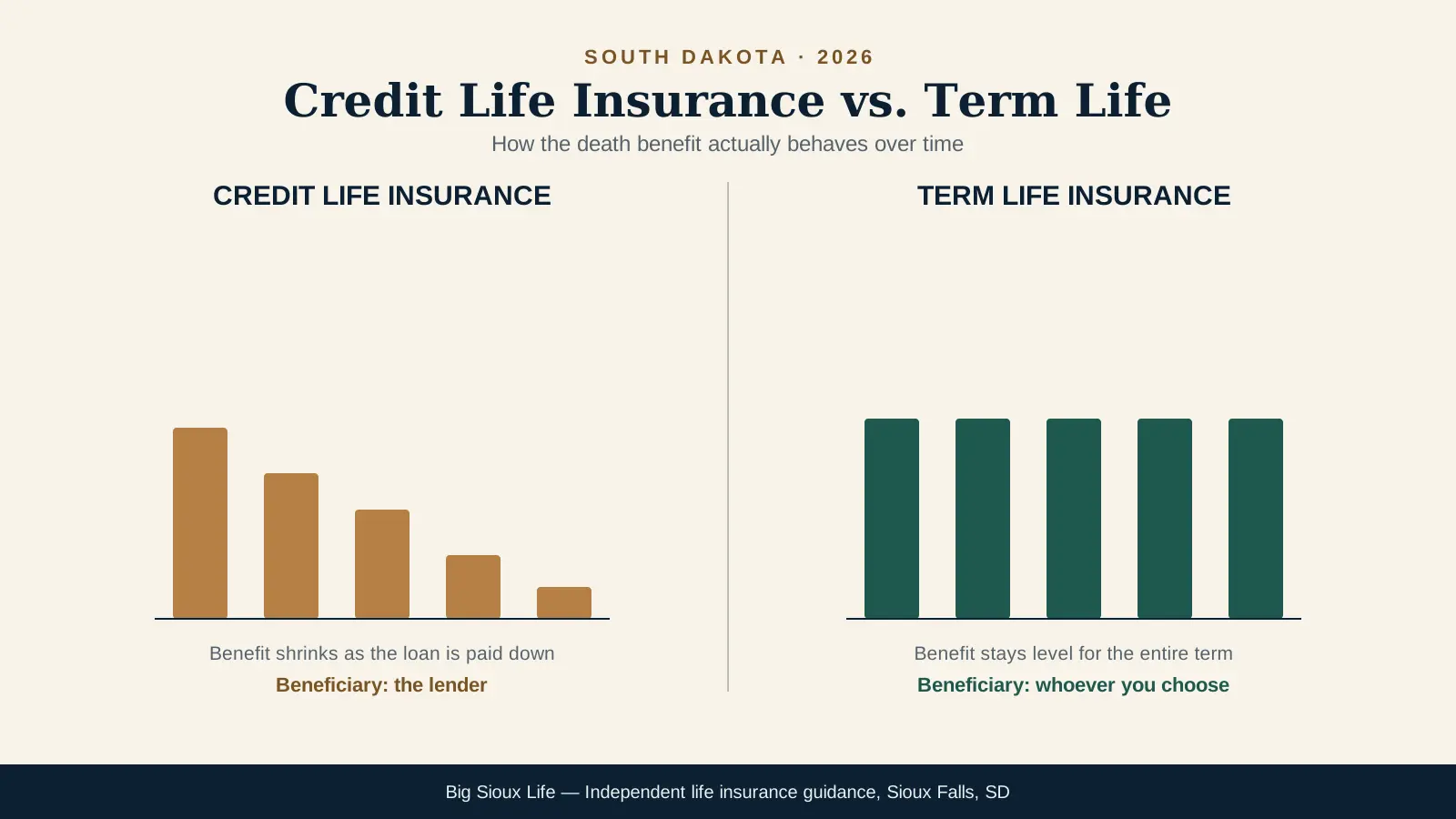
If your term life insurance policy is getting close to its end date, here is the direct answer: coverage stops on the last day of the term you selected, no death benefit is paid if you outlive it, and unless you act before the deadline, you go from insured to uninsured overnight. Millions of 20-year level term policies bought in the mid-2000s, when term life buying was near a modern high, are reaching that exact wall in 2026. What happens next, whether you renew, convert to permanent coverage, reapply for a new policy, or simply let it lapse, depends on choices you have to make before the term ends, not after.
The short version
- When a term policy's level period ends, coverage does not automatically continue. If you outlive the term, no benefit is paid and nothing you paid in comes back, unless a return-of-premium rider says otherwise.
- Some policies allow annual renewal without a new exam, but the premium resets every year based on your current age and climbs fast, per the California Department of Insurance.
- A conversion privilege lets you exchange term coverage for a permanent policy, usually without new health questions, but the premium is set at your age when you convert and runs higher than the term rate you were paying, according to the NAIC.
- Just 51% of American adults say they own life insurance in 2025, down from 63% in 2011, and about 100 million say they need coverage or need more, per LIMRA, a gap that widens every time a policy expires unreplaced.
- One-year mortality risk roughly doubles each decade after 45, according to the Social Security Administration, which is the actuarial reason waiting to requalify for coverage gets more expensive the longer you put it off.
The pain: your policy is ending, and nobody sent a warning label
Most people buy a 20-year term policy the way they buy anything with a distant expiration date: they read the coverage amount, check that the premium fits the budget, sign, and stop thinking about it for two decades. There is no annual reminder that says “13 years left,” no dashboard tracking the countdown, and no agent calling to check in, because the policy has been running quietly on autopay the entire time, doing exactly what it was designed to do. Then a renewal notice arrives, or a premium jumps without warning, or you go looking for the paperwork for some unrelated reason and notice the date on the declarations page, and the question becomes urgent all at once: what actually happens now?
The people this catches hardest are not careless. They are the same disciplined household that bought coverage responsibly in the first place. A couple in their late 40s who bought a 20-year term in 2006, right after their first child was born, still has a teenager at home and a mortgage balance that has not been paid off yet, and their policy ends this year. A 58-year-old who bought term coverage at 38 assumed, reasonably, that “the insurance company will tell me” if something changes, and is startled to learn that the entire burden of acting before the deadline sits on the policyholder, not the carrier. A small business owner in Sioux Falls who used a term policy to secure a loan is realizing the lender may still require coverage on the debt, even though the original policy is about to lapse.
None of this is a scam or a trick buried in the fine print. It is simply how term life insurance was built from the start: a fixed number of years of coverage at a fixed premium, full stop. (For the condensed version of what happens when a term life insurance policy expires, see our answer page.) The confusion is not that the product failed anyone. It is that almost nobody explains, at the point of sale, what the actual mechanics look like on the other end, twenty years later, when the term is about to run out.
This is general education, not a recommendation
Nothing here tells you to renew, convert, reapply, or let a specific policy lapse. It is the mechanics behind how term life insurance actually ends, sourced from state and federal consumer guidance, so you can see your own situation clearly before your deadline arrives.
Why it happens: term life was built to end, on purpose
A term policy answers a simple design question directly: how do you make life insurance affordable for the years you actually need it? By selling coverage for a fixed period, an insurer does not have to price in the cost of covering you for your entire remaining life, the way a permanent policy does. That is the whole reason term premiums are so much lower than permanent premiums for the same death benefit in the early years. The tradeoff is built into the name: it is temporary, on purpose, and the policy is not designed to quietly continue past the period you paid for.
A handful of terms explain exactly what happens at the boundary, and they are worth defining once, plainly, because a declarations page uses them without translation:
- Level term period is the number of years, commonly 10, 20, or 30, during which your premium is guaranteed to stay the same and your coverage stays in force as long as you pay it. This is the period most people think of as “my policy.”
- Attained age is your age at a given point in the policy’s life, as opposed to your issue age, your age when the policy was first written. Nearly every cost increase you encounter after the level term ends is driven by a switch from issue-age pricing to attained-age pricing.
- Annual renewable term (ART) is a provision, present in some but not all policies, that lets coverage continue year to year past the level term without new health questions, with the premium recalculated every year based on your attained age. It climbs fast, and it is meant as a short bridge, not a long-term plan.
- Conversion privilege is a contract provision, common on individual term policies but not universal, that lets you exchange term coverage for a permanent, cash-value policy, typically without a new medical exam, according to both the National Association of Insurance Commissioners (NAIC) and the California Department of Insurance. It is a different mechanism from renewal: you are not extending the same coverage, you are trading it for a different kind of policy.
- Conversion deadline is the date after which the conversion privilege disappears, usually stated as the earlier of a specific age, commonly 65 or 70, or the end of the level term itself. Miss it, and the option is gone even if the policy technically has not lapsed yet.
- Lapse is what happens when a premium goes unpaid and the policy ends without a death benefit and, for term insurance, without any cash value returned, per the California Department of Insurance.
Put together, these terms describe a structure that works exactly as designed from the insurer’s side. The confusion is not that the mechanism is unfair. It is that the mechanism is largely invisible until the deadline is close, and the options available to you narrow the longer you wait to look at them.
What it costs to get wrong: the numbers behind the coverage gap
Letting a term policy expire unreplaced, without a deliberate decision either way, feeds directly into a gap that shows up in national data every year. According to LIMRA, the life insurance industry’s own research organization, just 51% of American adults say they own life insurance in 2025, down from 63% in 2011. LIMRA also estimates that roughly 100 million Americans say they need life insurance or need more of it, a need-gap of about 40%, even as the industry sold 9.4 million individual policies and $16 billion in new annualized premium in 2024. Some of that gap is people who never bought coverage. A meaningful piece of it is people who had coverage, let it end at the term boundary, and never replaced it.
Cost misconceptions make the problem worse in both directions, according to LIMRA’s 2025 Insurance Barometer Study: 66% of people who have not bought life insurance say they believe it is too expensive, and three in four Americans overestimate what it actually costs. Among adults age 18 to 30, LIMRA found the median overestimate of a $250,000, 20-year level term policy runs 10 to 12 times the real cost. If that same misconception shows up when someone is staring at a renewal notice or a conversion quote at 55 or 60, priced on attained age rather than the low issue-age rate they remember, sticker shock can push people toward letting coverage lapse entirely rather than shopping the alternatives.
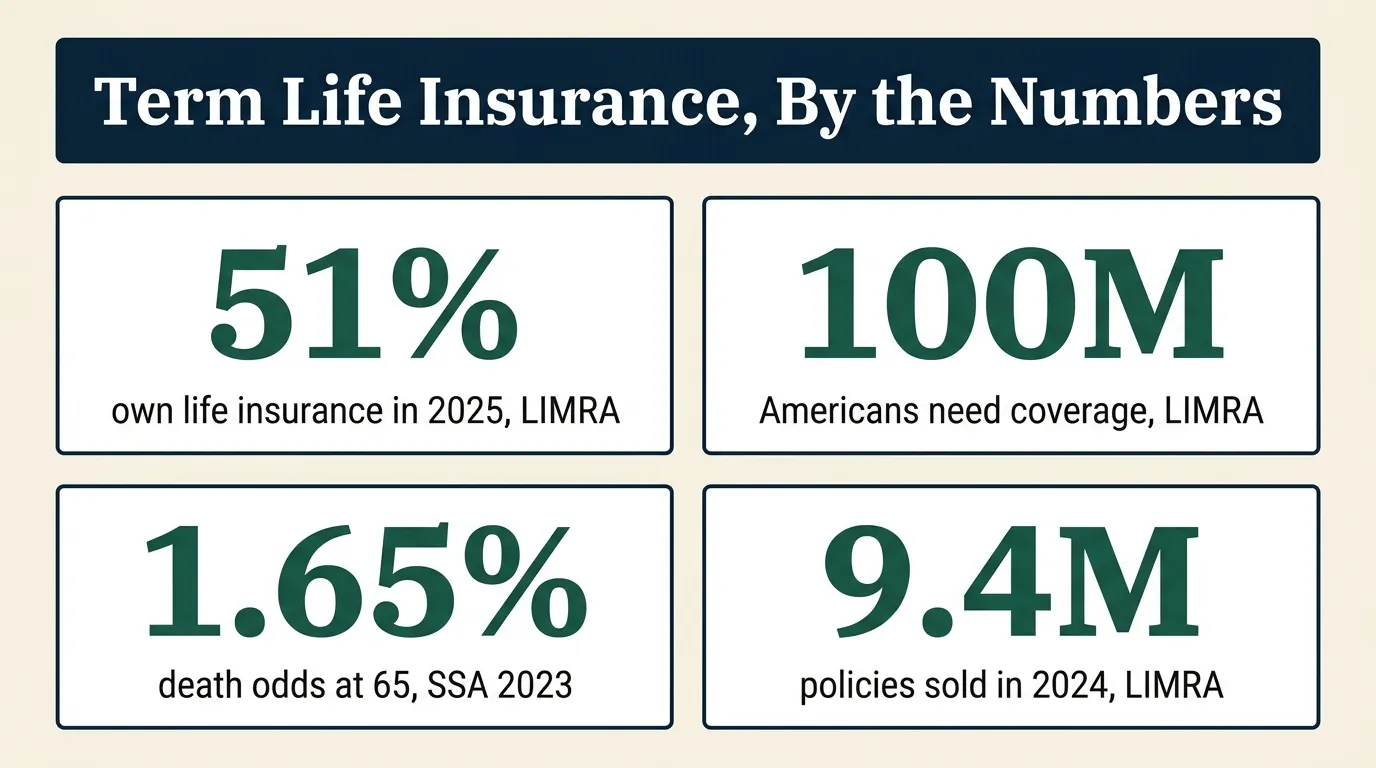
| Measure | 2011 | 2025 |
|---|---|---|
| Adults who say they own life insurance | 63% | 51% |
| Adults who say they need coverage, or need more | — | ~40% (about 100 million people) |
LIMRA, "How to Convert Intent to Action: Closing the Life Insurance Coverage Gap," 2025.
There is also a purely actuarial reason waiting matters. The Social Security Administration’s period life table, using 2023 mortality data as applied in the 2026 Trustees Report, shows the one-year probability of death roughly doubling each decade after 45 for both men and women.
One-year death probability by exact age, men, 2023 period life table
Social Security Administration, Office of the Chief Actuary, Period Life Table, 2023 mortality data as used in the 2026 Trustees Report. Figures shown are for men; the same table shows 0.22% at 45, 0.45% at 55, and 1.02% at 65 for women.
That rising curve is exactly why insurers price attained-age renewal and conversion premiums higher every year you wait, and why a fresh, medically underwritten policy applied for while you are younger and healthy is almost always the cheapest path to lock in new coverage, compared with requalifying later.
How to work it out yourself: a five-step check before your term ends
You do not need anyone’s help to find out where you stand. This takes about twenty minutes with your policy documents in front of you, ideally starting a year or more before your level term ends, since some options close earlier than the final day.
- Find your policy’s declarations page and read the conversion section. It will state whether a conversion privilege exists, the deadline (often the earlier of a set age or the end of the level term), and whether annual renewal is available as a bridge option.
- Confirm the exact date your level term ends, not just the year. Insurers calculate deadlines to the day, and a conversion window that closes 90 days before the policy’s final date is not unusual on some contracts.
- Get a current health read on yourself, honestly. If you are in materially the same or better health than when you first applied, a newly underwritten policy is worth pricing before you assume conversion or renewal is your only option. If a diagnosis or medication would complicate new underwriting, the conversion privilege becomes far more valuable, regardless of cost.
- Add up what still needs protecting. A mortgage balance, years of income a spouse or kids still depend on, remaining debt, and final expenses are the same four categories that determine how much coverage you need the first time you buy it; they do not disappear just because your original term is ending. If you have not run this math recently, our related article on figuring out how much coverage you need walks through the same method.
- Decide before the deadline, not after. Once a conversion window closes or a policy lapses past its grace period, those options do not reopen. Knowing your decision even a few months early gives you room to shop, rather than reacting under pressure in the final weeks.
You can run this yourself first
Steps 1 through 4 just require reading a document you already have and being honest about your health and your obligations. Where a second opinion tends to help is comparing what a guaranteed conversion would actually cost against what a newly underwritten policy costs today, across more than one carrier, while you still qualify to apply on your own terms.
If you would rather have someone local run these numbers with you instead of doing it alone, that is what we do: Compare My Options.
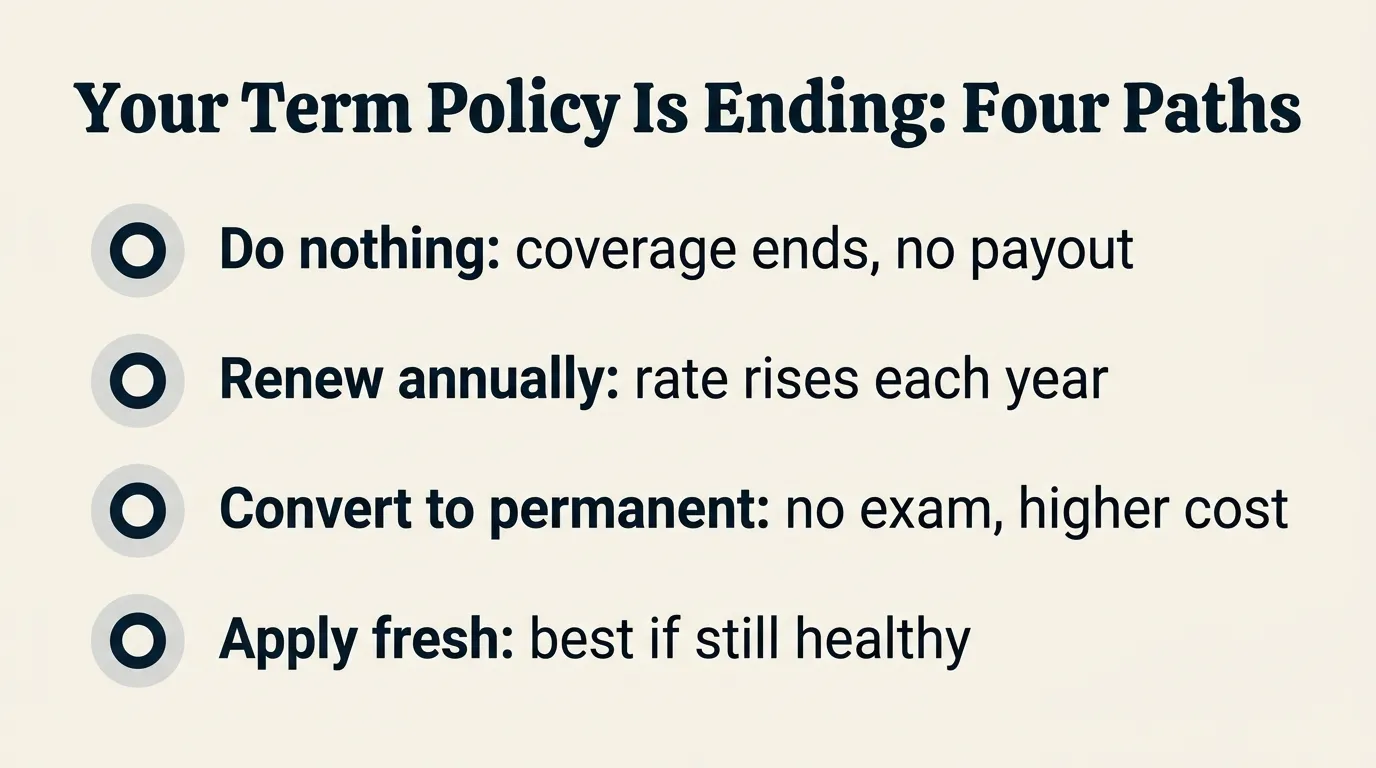
The four paths, side by side
| Path | What happens |
|---|---|
| Do nothing | Coverage ends on the term's final day. No benefit is paid, and unless a return-of-premium rider applies, nothing you paid in comes back, per the California Department of Insurance |
| Renew annually (if your policy allows it) | Coverage continues year to year without new health questions, but the premium resets each year based on your attained age and climbs steadily, making this a short bridge rather than a long-term answer |
| Convert to a permanent policy | You exchange term coverage for lifetime, cash-value coverage, usually without a new exam, at a premium set for your age at conversion, generally higher than the term rate you were paying, per the NAIC |
| Apply for a new individual policy | If you are still in good health, a freshly underwritten term or permanent policy priced on your current health class is often the most cost-effective way to replace the coverage, and it stays with you regardless of any prior insurer's rules |
Based on general term life insurance contract mechanics as described by the California Department of Insurance and the NAIC. Specific terms vary by policy and carrier; check your own contract.
None of these four is automatically the right answer. Someone whose health changed in a way that would complicate new underwriting is often better served by the conversion privilege, even at a higher cost, because it is guaranteed regardless of health. Someone in good health, on the other hand, usually finds that shopping the individual market before the old policy lapses, while still healthy, gets more coverage for less money than either renewing or converting.
A worked example: a policy bought in 2006
Take a South Dakota couple, both 52 this year, who bought a 20-year level term policy in 2006, shortly after their first child was born, with a $350,000 death benefit. That policy’s level term ends in 2026. Their mortgage balance is down to $95,000, their youngest is a junior in high school, and both are still working. Neither has had a major health change since 2006.
| Path | What it would mean for this couple |
|---|---|
| Let it lapse | The $95,000 mortgage and the two remaining years of a child's household expenses would fall on savings and income alone if either spouse died, with no life insurance behind either obligation |
| Convert to permanent coverage | Guaranteed issuance without new health questions, but priced at age 52 rather than the age-32 rate they started with, and structured as lifetime coverage they may not need once the mortgage is paid and their child is independent |
| Apply for a new term policy | Since neither has had a major health change, a newly underwritten 10- or 15-year term, sized to the shrinking mortgage balance and the two remaining years of dependency, is worth pricing against the conversion option before deciding |
Illustrative example only, based on a hypothetical policy and household. Not a quote, projection, or guarantee of any rate; actual premiums depend on age, health, tobacco use, carrier, and underwriting outcome.
The honest takeaway from an example like this is that the couple’s remaining obligations, a smaller mortgage and two more years of one dependent, look different from what they insured against in 2006, when both kids were young and the mortgage was much larger. That is precisely why the decision at expiration deserves its own fresh look rather than a default renewal, conversion, or lapse chosen without comparing what each path actually costs and covers against what they need today.
A term policy ending is not a problem to solve in the final week. It is a scheduled decision point you can see coming years in advance, if you know where to look.
Mike Moore, Life Insurance AdvisorWhen it is genuinely fine to let coverage end
Not every expiring term policy needs to be replaced, and saying so plainly is part of doing this honestly. If your mortgage is paid off, your spouse does not depend on your income, your kids are financially independent, and you have savings set aside to cover final expenses, letting a term policy lapse on schedule can be exactly the right, deliberate outcome. Our related article on final expense planning walks through how to size that specific, smaller need if it is the only piece left once the bigger obligations are gone.
The decision gets less obvious, not more, when only part of the picture has changed. A shrinking mortgage balance still needs some coverage. A spouse with a smaller income than yours may still face a real gap. A remaining year or two of a child’s dependency is still worth protecting, even if the amount needed is smaller than what you carried in your 30s. This is where sizing new, shorter-term coverage to your actual remaining obligations, rather than defaulting to whatever the conversion privilege offers, tends to be the more cost-effective path.
If your health has changed since you first bought coverage
If a diagnosis, a medication, or a health event since your original application would complicate new underwriting, this is exactly the scenario a conversion privilege exists to protect, and it is worth taking seriously even if the premium is higher than you would like. Our related guide on getting life insurance after a health condition covers how underwriting actually treats different conditions in 2026 and where options exist even when a first answer from one carrier is discouraging.
How we help
We are independent, so we are not selling one company’s conversion product or one carrier’s replacement term policy. We start with your actual policy, your conversion deadline, and your current health and obligations, then compare what a guaranteed conversion would cost against what a freshly underwritten policy could offer across the carriers we work with. If your health has changed, that changes the math, and it is worth asking about directly. Independent agencies see how different carriers evaluate the same file, which matters most exactly when a single company’s guaranteed option looks expensive.
What you get
A clear picture of what your specific policy’s conversion deadline and terms actually are, read from your own contract rather than guessed at. A side-by-side comparison of renewing, converting, and reapplying, priced against what you actually still need to protect today, not what you needed the year you first bought the policy. And, if a new policy makes more sense than converting, coverage shopped across more than one carrier instead of a single company’s default option.
Find out what your options actually look like
We will go through your policy's conversion deadline, your health, and what you still need to protect, and show you what renewing, converting, or applying fresh would each mean for your situation.
Not ready to talk to anyone yet? Read How It Works first and come back when you are.
Frequently asked questions
What happens when my term life insurance expires?
Coverage simply stops. If you outlive the term you selected, no death benefit is paid and, unless your policy includes a return-of-premium rider, nothing you paid in comes back, according to the California Department of Insurance’s consumer life insurance guide. You are not insured the day after the term ends, even though you may have paid premiums faithfully for 10, 20, or 30 years.
Can I renew term life insurance after the level period ends?
Sometimes, if your policy includes that provision. Some term policies let you renew for one or more additional years without a new medical exam, but the premium resets each year based on your attained age, meaning the cost climbs annually and can become very expensive within a few years. Not every policy offers this, and it is rarely a long-term solution, more a short bridge while you sort out a better option.
What is a conversion privilege, and how is it different from renewing?
A conversion privilege lets you exchange your term policy for a permanent, cash-value policy, usually without a new medical exam, according to both the NAIC and the California Department of Insurance. Renewal keeps you in a term-style structure with rising annual costs; conversion moves you into a different kind of policy altogether, one that lasts the rest of your life as long as premiums are paid, at a premium set for your age at conversion, which is generally higher than either the term rate you were paying or a newly underwritten term rate would be.
Is converting to permanent coverage cheaper than applying for a brand-new term policy?
It depends entirely on your health. If you are still in good health, a newly underwritten term or permanent policy priced on your current health class is often more cost-effective than a guaranteed conversion priced purely on attained age. If your health has changed since you bought the original policy, in a way that would make new underwriting difficult or impossible, the conversion privilege may be the only way to lock in guaranteed coverage regardless of price, which is exactly the situation it exists to protect.
What happens if I outlive my term policy and never file a claim?
That is the normal, expected outcome for most term policyholders, not a failure of the product. Term life insurance is priced on the assumption that most people who buy it will outlive the term, similar to how most auto insurance policyholders never total their car. The policy did its job every month it was in force by standing behind your family in case the worst happened; the fact that it did not happen is the outcome everyone hopes for.
How do I find out if my own policy has a conversion privilege and when it expires?
Check your policy’s declarations page or contract for a section labeled “conversion privilege” or “conversion option,” which will state the deadline, often the earlier of a specific age (commonly 65 or 70) or the end of the level term period. If you cannot locate the document, contact the insurer directly or ask an independent agent to pull the details for you well before the term is set to end, since conversion windows do not reopen once they close.
Should I let my term life insurance lapse if I no longer have a mortgage or young kids?
Possibly, and that is a legitimate outcome to work toward, not something to feel bad about. If you are debt-free, your spouse is financially independent, your kids are grown, and you have enough savings to cover final expenses, letting a term policy end on schedule can be the correct, deliberate choice. The arithmetic changes if a spouse still depends on your income, if a mortgage or business debt remains, or if final expenses would otherwise fall on family savings; running that math for your specific situation is the point of the how-to-work-it-out section above.
Before you sign anything
This article is general education, not insurance, legal, financial, or tax advice. Product availability, features, conversion terms, and rates vary by carrier, by individual policy, and by state, and are subject to underwriting. No coverage exists until a policy is issued and in force. Any guarantees are subject to the claims-paying ability of the issuing insurer. Please review your actual policy documents and speak with a licensed agent about your situation.
Sources
- LIMRA — How to Convert Intent to Action: Closing the Life Insurance Coverage Gap — 2025; ownership rate, need-gap, 2024 policy sales, and cost-misconception figures
- LIMRA — Adults Age 30 and Younger Overestimate Life Insurance Cost by 10–12 Times — published June 25, 2025, from the 2025 Insurance Barometer Study
- Social Security Administration, Office of the Chief Actuary — Period Life Table — 2023 mortality data, as used in the 2026 Trustees Report
- National Association of Insurance Commissioners — Consumer Insight: Life Insurance — conversion privilege description
- California Department of Insurance — Life Insurance Guide — term renewal, conversion, and lapse mechanics
Related reading: Term vs. Whole Life in 2026: A Data-Driven Comparison, How Much Life Insurance Do You Actually Need? A Working Method for South Dakota Families, and Getting Life Insurance After a Health Condition: 2026 Underwriting Trends. See current options for term life and whole life, or learn more about how it works.