
If you name a child or dependent with a disability directly as your life insurance beneficiary, the payout can end their Supplemental Security Income the same month it arrives, because the Social Security Administration counts almost anything a person owns over $2,000 against the SSI resource limit, a figure that hasn’t moved since 1989. The fix isn’t complicated once you know it exists: name a properly drafted special needs trust as the beneficiary instead of your family member, and the money can support them for the rest of their life without ever counting as their resource. This guide walks through why the $2,000 rule works the way it does, the two tools South Dakota families actually use to get around it, a worked example with real numbers, and the questions to bring to an attorney before you touch your beneficiary form.
The short version
- SSI counts almost anything over $2,000 for an individual, or $3,000 for a couple, as a disqualifying resource, per SSA POMS SI 01110.003. Those dollar limits have not changed since January 1, 1989.
- South Dakota's own Medicaid disability programs, including the CHOICES Waiver and the Disabled Children's Program, apply the same $2,000 individual resource limit, according to the South Dakota Department of Social Services.
- A third-party special needs trust, funded with a parent's life insurance rather than the beneficiary's own money, isn't counted as the beneficiary's resource and carries no Medicaid payback requirement, under SSA POMS SI 01120.200.
- An ABLE account is the other tool: up to a $350,000 total balance and a $20,000 annual contribution limit for 2026, confirmed by the ABLE National Resource Center and Ohio's STABLE Account program.
- The ABLE Age Adjustment Act took effect January 1, 2026, raising ABLE eligibility from a disability that began before age 26 to before age 46, opening the door to more than 6 million more people nationwide, per the ABLE National Resource Center and STABLE Account.
What happens when you name your family member directly
A grandmother in Brookings names her adult son, who has an intellectual disability and has received SSI and Medicaid since he turned 18, as the sole beneficiary on her $150,000 term life policy. It’s the obvious choice. He’s her son. When she dies, the insurance company does exactly what the form says: it pays him $150,000, deposited directly into his bank account.
That single deposit ends his SSI within 30 days. The Social Security Administration treats cash and most anything convertible to cash as a countable resource, and the individual limit has been fixed at $2,000 since January 1, 1989, according to SSA POMS SI 01110.003, the Program Operations Manual System section that governs SSI resource limits. His balance goes from a few hundred dollars to $150,000 overnight, more than 74 times the limit. In many states, losing SSI also triggers automatic loss of Medicaid, since SSI eligibility is often the gateway to it. He doesn’t lose his disability. He loses the benefits that were paying for it, at the exact moment his mother meant to help him the most.
This isn’t a rare mistake. It’s the default outcome of the single most common beneficiary decision a parent makes, because naming your own child feels like the obvious, loving choice, and nobody along the way tells you that a means-tested benefit and a lump-sum inheritance are built to conflict with each other.
This is general education, not legal, financial, or tax advice
Nothing here evaluates your family's specific benefits, assets, or legal situation. It's a plain explanation of how SSI resource rules and special needs trusts work, using named federal and South Dakota sources, so you can ask sharper questions before you set up anything.
Why it happens: the mechanism behind losing benefits
Supplemental Security Income, SSI, is a means-tested federal benefit, which means eligibility depends on how little you own and earn, not on whether you paid into a system the way Social Security retirement benefits work. SSI has two separate financial tests: an income test and a resource test. A resource, in SSA’s own terms, is cash or anything else you own that you could convert to cash and use for food or shelter, including bank accounts, most investments, and a lump-sum payout. The resource limit is the ceiling on what a person can own and still qualify: $2,000 for an individual, $3,000 for a couple, unchanged since 1989, per SSA POMS SI 01110.003. If countable resources exceed the limit on the first moment of any month, SSI stops for that entire month, and in a lot of states, so does the Medicaid coverage that rides along with it.
South Dakota’s own Medicaid disability programs run on the same math. The South Dakota Department of Social Services applies a $2,000 individual resource limit across its CHOICES Waiver, HOPE Waiver, Family Support 360 Waiver, and Disabled Children’s Program, the state’s core home- and community-based programs for South Dakotans with disabilities, with monthly income limits tied to 300 percent of the SSI Standard Benefit Amount, $2,982 in 2026. A South Dakota family isn’t dealing with some separate state quirk here. The federal $2,000 figure and the state Medicaid figure are the same number, working together.
A handful of terms are worth defining before you go further, because a special needs attorney will use all of them:
- Means-tested benefit. A benefit, like SSI or Medicaid, where eligibility depends on staying under set income and resource ceilings, unlike Social Security retirement or disability insurance benefits, which are based on a work record.
- Countable resource. Anything SSI counts toward the $2,000/$3,000 limit: cash, most bank accounts, stocks, a second vehicle, and a lump-sum insurance payout. A home you live in and one vehicle are generally excluded.
- Special needs trust (SNT). A trust drafted specifically to hold assets for a person with a disability without those assets counting as the person’s own resource, as long as it meets SSA’s structural requirements.
- Third-party special needs trust. An SNT funded with someone else’s money, such as a parent’s life insurance proceeds or an inheritance the parent leaves. Governed by SSA POMS SI 01120.200. Because the money never belonged to the beneficiary, no Medicaid payback provision is required.
- Self-settled (first-party) special needs trust. An SNT funded with the disabled person’s own assets, such as a personal injury settlement they received directly. Governed by SSA POMS SI 01120.203. This type must name the state Medicaid program as a payback beneficiary before any other beneficiary can receive what’s left.
- Sole benefit rule. A requirement that a special needs trust exist for the benefit of the person with a disability, not as a general family fund, per SSA POMS SI 01120.203.
- ABLE account. A tax-advantaged savings account, authorized under the federal Achieving a Better Life Experience Act, that a person with a qualifying disability can hold without it counting as an SSI resource, up to a set balance.
The core idea to hold onto: what matters to SSI isn’t whose name is on the money in some abstract sense, it’s whether the person with a disability has the legal power to reach in and spend it on themselves whenever they want. A trust drafted so they can’t do that, holding money that was never theirs to begin with, doesn’t count against them. Money paid straight into their own bank account always does.
What it costs to get wrong
Go back to the Brookings example, and put real numbers on what “losing benefits” actually means in a single year. South Dakota’s Standard Benefit Amount referenced in the state’s own Medicaid income limits implies a federal SSI base rate of roughly $994 a month in 2026, derived directly from the state’s published figure that 300 percent of that base amount equals $2,982. Twelve months of that SSI payment alone is about $11,928 a year, and that’s before counting the Medicaid coverage, often paying for personal care attendants, therapy, day programs, or medication, that frequently ends when SSI does.
| When | What happens | Resource level |
|---|---|---|
| Before the claim | Countable resources near $0, SSI and Medicaid in force | ≈ $0 |
| Payout deposited | $150,000 lands in beneficiary's own bank account | $150,000 |
| Following month | Resources exceed the $2,000 individual limit; SSI stops (SSA POMS SI 01110.003); Medicaid often stops with it | Over limit by $148,000 |
| Spend-down period | Family pays out of pocket for care Medicaid used to cover, while spending the payout down toward $2,000 to requalify | Declining |
| Re-application | Once back under $2,000, the family reapplies for SSI and Medicaid from scratch | ≈ $2,000 |
Illustrative example built on SSA POMS SI 01110.003 ($2,000 individual resource limit) and South Dakota DSS's published $2,000 disability program resource limit. Not a description of any specific family's benefits.
The irony is that the entire $150,000, sized specifically to support this person for the rest of their life, gets spent down to $2,000 covering costs Medicaid was already paying for, before benefits can even restart. None of that protects anyone. It just burns through the gift.
Two ways to fix it: the trust, and the ABLE account
South Dakota families generally reach for one or both of two tools, and they solve different parts of the same problem.
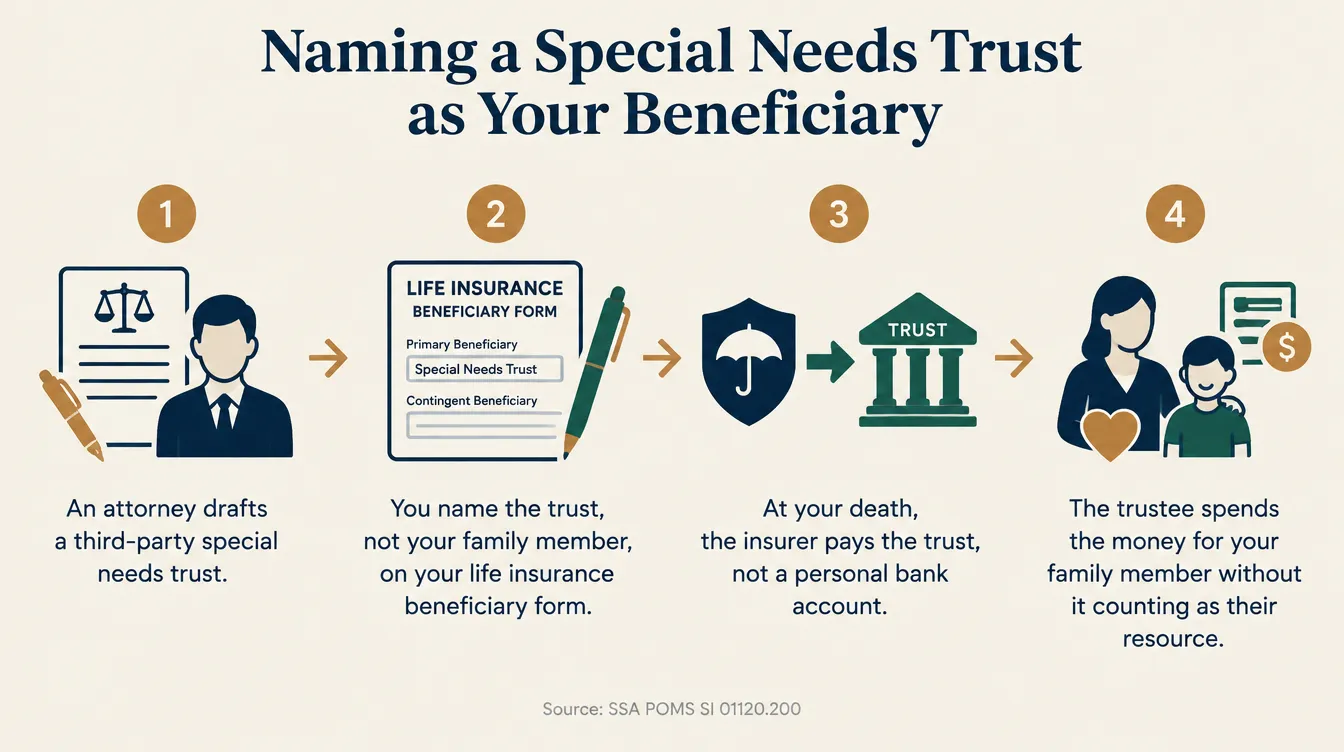
The third-party special needs trust. Instead of naming your family member as beneficiary, you name the trust. When you die, the insurance company pays the death benefit to the trust, not to your family member’s own account. A trustee you choose, often a sibling, another relative, or a professional trustee, manages the money and spends it on your family member’s behalf for things Medicaid and SSI don’t cover: a specially equipped vehicle, therapies outside a covered plan, travel, hobbies, or a nicer place to live, as long as disbursements don’t function as unrestricted cash the beneficiary could use for basic food or shelter costs already covered by benefits. Because the trust was funded with your money, not theirs, SSA POMS SI 01120.200 governs it as a third-party trust: the beneficiary can’t revoke it or direct its principal for their own support, so it isn’t their countable resource, and no Medicaid payback provision is required when they die. Whatever’s left can go to other beneficiaries you name in the trust document, such as siblings.
The ABLE account. An ABLE account works more like a personal savings and spending account than a trust. The person with the disability (or someone acting for them) owns it directly, and up to a $350,000 total balance doesn’t count against the SSI resource limit, according to the ABLE National Resource Center’s South Dakota program review. South Dakota doesn’t run its own ABLE program, one of only three states that don’t, so South Dakotans typically open an account through another state’s plan that accepts out-of-state residents, using the ABLE National Resource Center’s comparison tool to pick one. The annual contribution limit for 2026 is $20,000, confirmed independently by both the ABLE National Resource Center and Ohio’s STABLE Account program, one of the larger national ABLE plans. Money inside grows tax-free and comes out tax-free for qualified disability expenses.
| Feature | Third-party special needs trust | ABLE account |
|---|---|---|
| Who owns it | Trustee, for the beneficiary's benefit | The person with the disability |
| Funding limit | No cap; sized to your life insurance and estate | $20,000/year in 2026; $350,000 total balance excluded from SSI |
| Good fit for a life insurance payout | Yes, name it directly as beneficiary | Limited; a large death benefit exceeds the annual contribution cap fast |
| Medicaid payback at death | None, if funded only with third-party money (SSA POMS SI 01120.200) | Varies by state Medicaid program on remaining balance |
| Who sets it up | An attorney drafts the trust document | The account holder or representative opens it directly online |
| Disability onset requirement | None | Must have begun before age 46 as of 2026 (previously before 26) |
Sources: SSA POMS SI 01120.200 and SI 01120.203; ABLE National Resource Center South Dakota program review; STABLE Account (Ohio).
Most families use both: a third-party special needs trust as the life insurance beneficiary to hold the bulk of what’s meant to last a lifetime, with the trustee making periodic transfers into an ABLE account for spending money the beneficiary can access more directly, within the ABLE account’s own contribution limits.
Dollar limits that govern this decision in South Dakota, 2026
Sources: SSA POMS SI 01110.003; South Dakota Department of Social Services; ABLE National Resource Center; STABLE Account. Bars scaled to dollar amounts.
A worked example: a Sioux Falls family
Picture a Sioux Falls couple with two children, one of whom, age 9, has a developmental disability and receives SSI and South Dakota Medicaid waiver services through the state’s CHOICES Waiver program. The parents want a $400,000 term life policy on the primary earner, sized using their own DIME calculation, and they want to make sure their younger child’s inheritance doesn’t cost him the benefits paying for his therapies and in-home support.
Here’s the sequence, in the order it actually needs to happen:
- They consult a South Dakota attorney who handles special needs planning to draft a third-party special needs trust naming a sibling and a professional co-trustee. This is a legal document; it isn’t something an insurance agent drafts or should draft.
- The trust document is finalized and gets its own tax ID number, issued once the trust exists.
- The parents update their life insurance beneficiary designation on the $400,000 policy, naming the trust, using the exact trust name and date as the attorney provides it, rather than naming their son directly.
- They review the designation with whoever sold them the policy to confirm the paperwork was accepted correctly, since a beneficiary form filled out wrong is functionally the same as never fixing the problem at all.
- They also open an ABLE account for their son, funded gradually by the trustee after the parents’ deaths, within the $20,000 annual contribution limit for 2026, so he has direct, spendable savings alongside the larger trust.
| Beneficiary structure | Counted as son's SSI resource? | Effect on SSI/Medicaid |
|---|---|---|
| Son named directly | Yes, immediately | SSI stops the month it's received; Medicaid waiver eligibility typically stops with it, per SSA POMS SI 01110.003 |
| Third-party special needs trust named instead | No, if drafted to meet SSA POMS SI 01120.200 | SSI and Medicaid continue uninterrupted; trustee spends on his behalf |
Illustrative example. Actual eligibility depends on the trust's drafting and the family's full benefits picture; confirm with an attorney and the relevant benefits office.
Every dollar figure in this example beyond the sourced $2,000, $3,000, and $20,000 limits above is a stated assumption for this illustration, not a real family’s finances or a specific policy quote.
What the 2026 age-adjustment changes mean
If your family member’s disability began after they turned 26, it’s worth a second look at ABLE accounts specifically, because the rules just changed. The ABLE Age Adjustment Act took effect January 1, 2026, raising the disability age-of-onset requirement for ABLE eligibility from before age 26 to before age 46, according to the ABLE National Resource Center’s published fact sheet on the law. Ohio’s STABLE Account program, one of the national ABLE plans open to South Dakota residents, states this single change extends ABLE eligibility to more than 6 million additional people nationwide, a group that includes adults whose disability developed later in adulthood, and veterans whose service-connected disabilities began after their mid-20s.
Practically, that means a South Dakota adult whose disability started at, say, 34, who wasn’t eligible for an ABLE account under the old rule, can open one now. It’s worth revisiting the whole picture, trust and ABLE account together, any time your family’s disability status or age crosses one of these thresholds, rather than assuming the plan you made years ago still fits.
This also applies to adult children, not just minors
Everything in this guide applies whether your family member is 9 or 49. SSI's resource rules and the special needs trust exceptions don't distinguish by age. If your dependent is a minor, our separate guide on naming a minor as your life insurance beneficiary covers the additional South Dakota rules around who can legally receive money on a child's behalf, which apply on top of everything here if disability benefits are also involved.
How we help
We’re an independent life insurance agency, not an attorney, and we don’t draft special needs trusts or give legal advice about them. What we do is the life insurance side of this plan: helping you figure out how much coverage actually makes sense to fund a trust like this one, comparing term and permanent options across the carriers we work with, and making sure your policy’s beneficiary designation is filled out correctly once your attorney has the trust in place, so the form matches the plan instead of accidentally undoing it.
A life insurance policy that names your child directly can undo decades of benefits planning in a single deposit. The beneficiary line is the whole plan.
Mike Moore, Life Insurance Advisor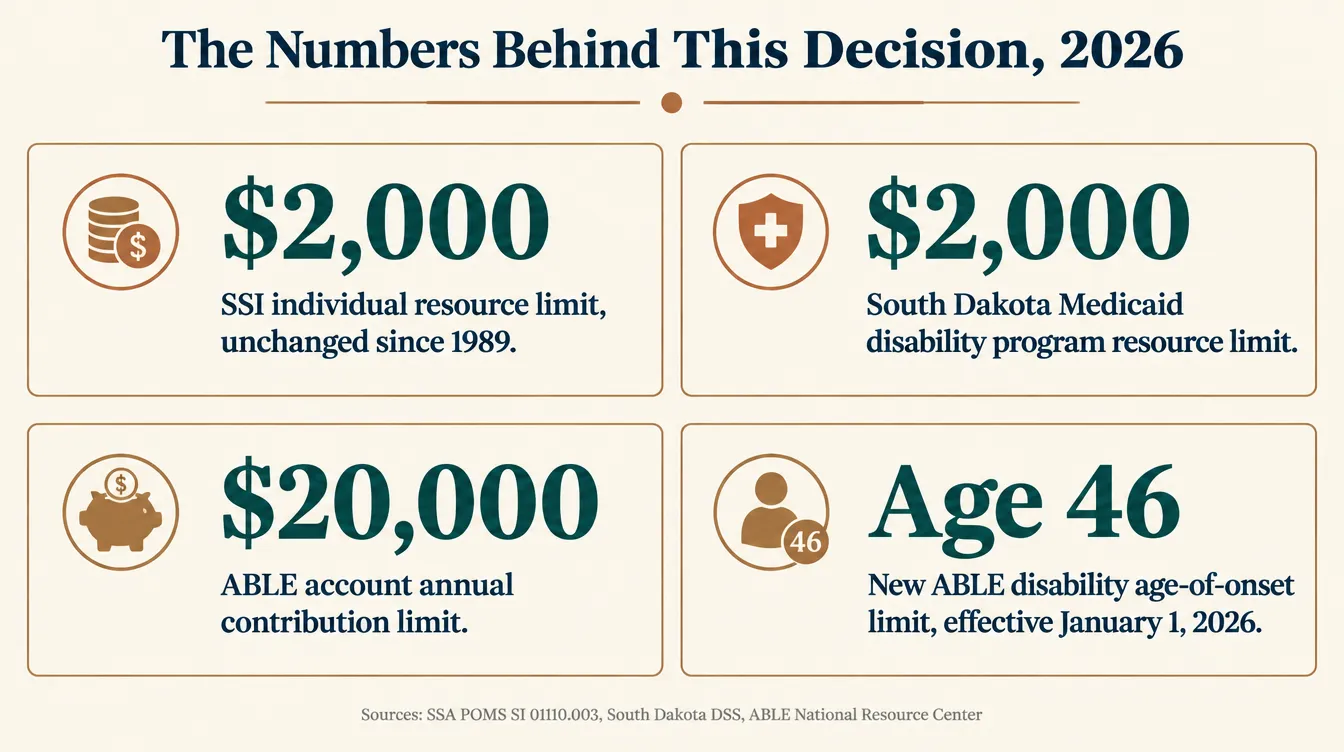
What you get
A beneficiary designation that actually matches what you meant to happen, instead of one that technically follows the form but undoes years of benefits planning the moment a claim is paid. A life insurance policy sized to fund a trust for the long haul, not just a round number. And a plain explanation of which parts of this plan are ours to help with, the coverage, and which parts need to go to an attorney first, the trust document itself, so you don’t end up with a policy and no trust to receive it, or a trust with nothing funding it.
Want to make sure your policy actually protects the plan you're building?
Talk it through with a local advisor who works for you, not one carrier, once you know where things stand with your attorney.
If you haven’t talked to an attorney yet, that’s the first call, not the last one. Once the trust exists, or while you’re still deciding whether it’s the right tool for your family, you’re welcome to book a strategy call to work through the insurance side, or read how it works first if you’re not ready to talk to anyone yet.
Frequently asked questions
Can I name my child with a disability directly as my life insurance beneficiary?
You can, but for most families receiving SSI or Medicaid, it backfires. The Social Security Administration counts almost any resource a person owns over $2,000 against the SSI resource limit, per SSA POMS SI 01110.003, so a life insurance payout landing in your child’s name can end their SSI and, in many states, the Medicaid coverage tied to it, the same month it arrives. Naming a properly drafted special needs trust as the beneficiary instead lets the money help your child without counting as their resource.
What is the difference between a third-party special needs trust and a self-settled special needs trust?
A third-party trust is funded with someone else’s money, such as a parent’s life insurance proceeds, and never belonged to the person with a disability. Under SSA POMS SI 01120.200, the trust principal isn’t the beneficiary’s countable resource as long as they can’t revoke it or direct its use for their own support, and no Medicaid payback provision is required at the beneficiary’s death. A self-settled trust, funded with the disabled person’s own money, such as an injury settlement, falls under SI 01120.203 instead and must include a provision repaying Medicaid before other beneficiaries receive anything.
What is the SSI resource limit in 2026?
$2,000 for an individual and $3,000 for a couple, and those figures haven’t changed since January 1, 1989, according to Social Security Administration POMS SI 01110.003. South Dakota’s own Medicaid disability programs, including the CHOICES Waiver and the Disabled Children’s Program, use the same $2,000 individual resource limit, according to the South Dakota Department of Social Services.
What is an ABLE account and how much can go into one in 2026?
An ABLE account is a tax-advantaged savings account for a person with a disability that doesn’t count against the SSI resource limit up to a $350,000 total account balance, according to the ABLE National Resource Center. For 2026, the annual contribution limit is $20,000, confirmed by both the ABLE National Resource Center and Ohio’s STABLE Account program, one of the ABLE plans open to South Dakota residents since South Dakota doesn’t run its own.
Did anything change with ABLE accounts in 2026?
Yes, and it’s a significant expansion. The ABLE Age Adjustment Act took effect January 1, 2026, raising the disability age-of-onset requirement for ABLE eligibility from before age 26 to before age 46, according to the ABLE National Resource Center. Ohio’s STABLE Account program states this extends eligibility to more than 6 million additional people nationwide, including many adults whose disability began later in life or who returned from military service with a disability after age 26.
Does Big Sioux Life draft special needs trusts?
No. We’re an independent life insurance agency, not an attorney. A special needs trust is a legal document that needs to be drafted by a South Dakota attorney experienced in special needs and elder law, coordinated with the family’s benefits picture. What we help with is the life insurance side: choosing coverage sized to fund the trust, and making sure the policy’s beneficiary designation actually names the trust once your attorney has it in place, rather than naming your child directly by accident.
What happens to the trust’s money after my child with a disability dies?
It depends on which type of trust holds it. A third-party special needs trust, funded with a parent’s money such as life insurance proceeds, has no Medicaid payback requirement under SSA POMS SI 01120.200, so whatever remains can go to siblings or other beneficiaries named in the trust document. A self-settled trust, funded with the disabled person’s own assets, generally must repay any state Medicaid program for benefits paid during their lifetime before anything else is distributed, under SI 01120.203.
Before you change any beneficiary form
This article is general education, not insurance, legal, financial, or tax advice, and it does not evaluate any specific policy, trust, or your family's benefits situation. Product availability, features, and rates vary by carrier and state and are subject to underwriting. No coverage exists until a policy is issued and in force. Any guarantees are subject to the claims-paying ability of the issuing insurer. Speak with a South Dakota attorney about a special needs trust and with a licensed agent about your specific insurance situation before you make changes.
Sources
- Social Security Administration — POMS SI 01110.003, Resources Limits for SSI Benefits — accessed September 2026; SSI countable resource limit of $2,000 for an individual and $3,000 for a couple, unchanged since January 1, 1989
- Social Security Administration — POMS SI 01120.200, Trusts, Including Trusts Established with the Assets of Third Parties — accessed September 2026; treatment of third-party trusts, including that trust principal is not the beneficiary’s resource when they cannot revoke or direct its use for their own support
- Social Security Administration — POMS SI 01120.203, Exceptions to Counting Trusts Established on or after January 1, 2000 — accessed September 2026; sole-benefit rule and Medicaid payback requirement for self-settled special needs trusts
- South Dakota Department of Social Services — Medicaid Coverage Groups — accessed September 2026; $2,000 individual resource limit and $2,982 (300% of the SSI Standard Benefit Amount) 2026 monthly income limit for South Dakota’s disability waiver and Medicaid programs
- ABLE National Resource Center — South Dakota State Review — accessed September 2026; South Dakota does not operate its own ABLE program; $350,000 state account limit; $20,000 federal annual contribution limit for 2026
- ABLE National Resource Center — The ABLE Age Adjustment Act Fact Sheet — accessed September 2026; ABLE Age Adjustment Act effective January 1, 2026, raising the disability age-of-onset requirement from before age 26 to before age 46
- STABLE Account (Ohio ABLE program) — How It Works — accessed September 2026; independent confirmation of the $20,000 annual ABLE contribution limit for 2026
- STABLE Account (Ohio ABLE program) — Age Adjustment — accessed September 2026; independent confirmation of the January 1, 2026 age-of-onset change and the estimate that it extends eligibility to more than 6 million additional people nationwide
Related reading: Naming a Minor Life Insurance Beneficiary: 2026 SD Guide, Beneficiary Rules After Divorce in South Dakota, and How Much Life Insurance Do Sioux Falls Families Need?. See our current life insurance for families options, or start with how it works.