Yes, in most cases, and it’s probably more than you think, but it also stops sooner than you’d guess. If you die and you’ve worked long enough to earn Social Security credits, your spouse and minor children can generally receive monthly survivor benefits, sized as a percentage of your earnings record, according to the Social Security Administration’s own Survivors Benefits publication (No. 05-10084, April 2026). The part almost nobody accounts for is that a big piece of that benefit is tied to having a child under 16 in the house, and it generally shuts off the month that child turns 16, sometimes leaving a household with two teenagers and no survivor income at all until the surviving parent turns 60. This guide walks through exactly what Social Security pays, when it pays it, when it stops, and how to use your own numbers, not a guess, to figure out what life insurance actually needs to cover.
The short version
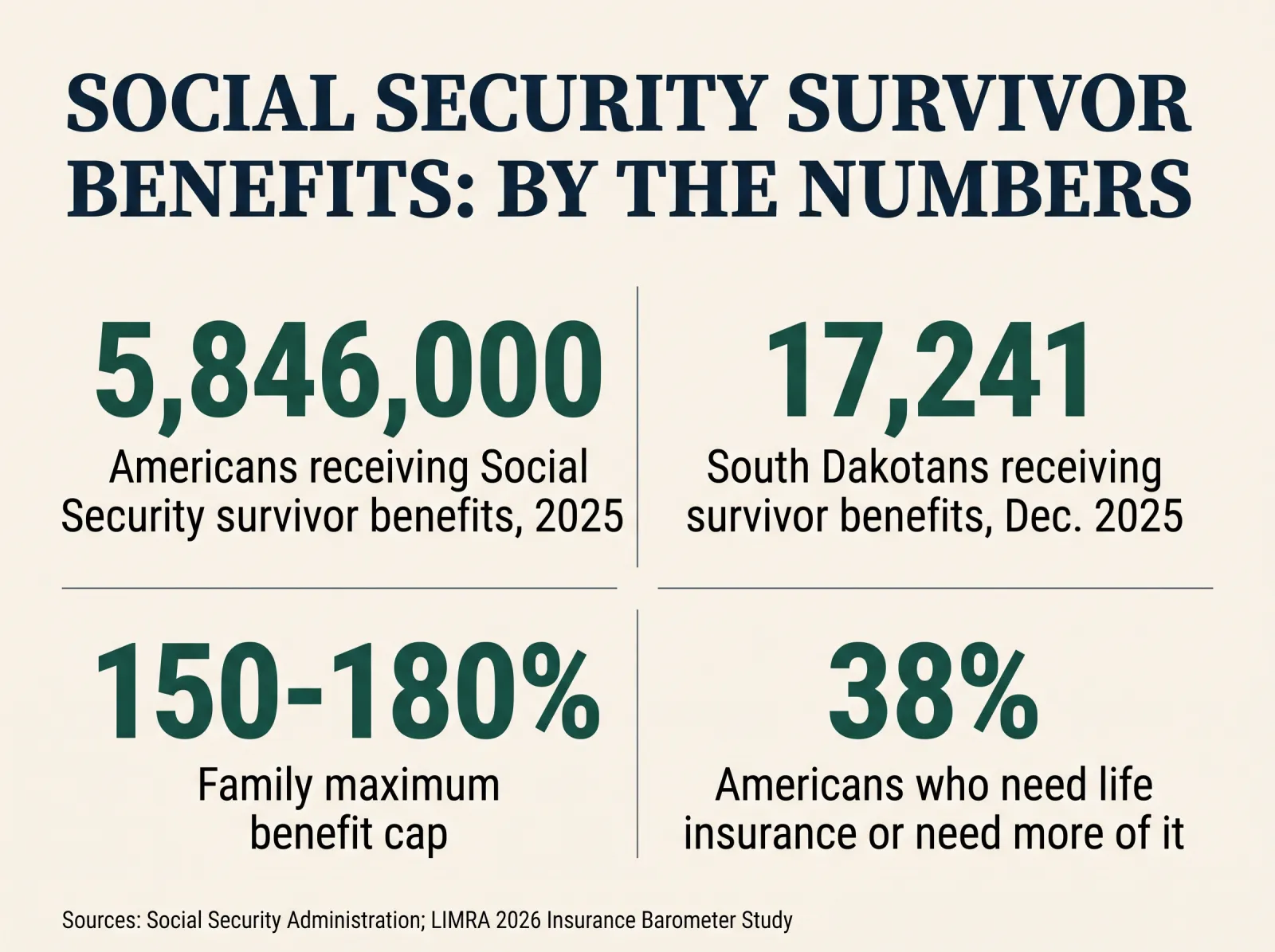
- A surviving spouse caring for a child under 16, and each eligible child, generally gets 75% of the deceased worker's basic benefit amount, but a family maximum caps the combined total at 150% to 180% of that amount, not the sum of everyone's individual percentage, per the Social Security Administration.
- The spouse's "any age" survivor benefit is tied to having a child under 16 in the home. It typically stops the month the youngest child turns 16 and doesn't resume until the spouse turns 60, or 50 if disabled — a gap some financial planners call the survivor benefit "blackout period."
- As of December 31, 2025, 5,846,000 Americans were receiving Social Security survivor benefits, 8.3% of all Social Security beneficiaries, including 2,036,000 children, according to the Social Security Administration's official fact sheet.
- In South Dakota specifically, 17,241 people were receiving survivor benefits as of December 2025 — 9,178 widow(er)s and parents, and 8,063 surviving children — per the SSA's state-level beneficiary data.
- Nationally, 38% of adults say they need life insurance or need more of it, representing roughly 98 million Americans, and about 2 in 5 Americans overestimate what life insurance actually costs, per the 2026 Insurance Barometer Study from LIMRA, Life Happens, the Society of Actuaries, and the American Council of Life Insurers.
What does Social Security actually pay if a parent dies?
Before the numbers, a few terms are worth pinning down, because the Social Security Administration uses them precisely and the details change the answer:
- Primary Insurance Amount (PIA): the base monthly benefit calculated from your lifetime earnings record. Every survivor benefit is a percentage of this number, not a flat dollar amount, so it’s different for every worker.
- Full retirement age (FRA) for survivors: the age at which a surviving spouse can collect 100% of the worker’s PIA. It is 66 for survivors born 1945–1956, rising gradually to 67 for anyone born in 1962 or later, per the SSA. This is a different schedule than the FRA used for your own retirement benefit.
- Family maximum: a monthly cap on the combined total Social Security pays to all of a worker’s survivors, regardless of how many individually qualify.
- The lump-sum death payment: a one-time $255 payment, not a monthly benefit, paid to an eligible spouse or child, per the SSA.

With those defined, here is what the Social Security Administration’s own Survivors Benefits publication (No. 05-10084, April 2026) and its survivor benefit amount page state, in plain terms, for the most common claims:
| Who | Condition | Percentage of worker's PIA |
|---|---|---|
| Surviving spouse | At full retirement age or older | 100% |
| Surviving spouse | Claimed at exactly age 60 | 71.5% |
| Surviving spouse | Claimed at age 61 through full retirement age | Rises gradually from about 75% to just under 100% |
| Surviving spouse | Any age, caring for the worker's child under 16 or disabled | 75% |
| Each eligible child | Unmarried, under 18 (19 if a full-time secondary student), or disabled before age 22 | 75% |
| Dependent parent | Age 62 or older, received at least half support from the worker | Varies by number of qualifying parents |
Source: Social Security Administration, Survivors Benefits (Publication No. 05-10084, April 2026) and ssa.gov/survivor/amount. Accessed August 2026.
That table already tells you something most online calculators skip: a spouse and two kids don’t just stack their percentages. A caretaking spouse at 75%, plus a child at 75%, plus a second child at 75%, would add up to 225% of the worker’s basic benefit amount if nothing capped it. Nothing pays 225%. That’s where the family maximum comes in.
This is general education, not a benefit estimate
Nothing in this article tells you what your own family would actually receive. Your Primary Insurance Amount depends entirely on your personal earnings history. The one way to get a real number is your own Social Security Statement, covered later in this guide.
Why the family maximum exists, and why most people never hear about it
The Social Security Administration caps what it pays to a single worker’s survivors each month “between 150% and 180% of the deceased worker’s benefit amount,” according to its Survivors Benefits publication. In practice, that means a spouse caring for two young children doesn’t receive three separate 75% checks adding up to 225%. Social Security calculates the family maximum, then reduces each individual survivor’s payment proportionally so the total lands inside that 150–180% band.
Here’s why that detail matters more than it looks like it should: a family with one child sees a much smaller haircut from the family maximum than a family with two or three children, because a single spouse-plus-child claim (75% + 75% = 150%) often sits right at or near the bottom of that cap already, while a spouse-plus-two-children claim (75% + 75% + 75% = 225%) gets compressed harder to fit under it. Add a third or fourth child, and the compression gets more severe still, even though every additional child is, on paper, “eligible” for their own 75%.
This isn’t a rare, abstract situation. As of December 31, 2025, 5,846,000 people nationally were receiving Social Security survivor benefits, 8.3% of all Social Security beneficiaries, including 2,036,000 children of a deceased worker, according to the SSA’s own fact sheet. In South Dakota specifically, 17,241 people were receiving survivor benefits as of December 2025: 9,178 widow(er)s and dependent parents, and 8,063 surviving children, per the SSA’s state and county beneficiary data. That’s a real, ongoing program touching thousands of South Dakota households right now, not a hypothetical.
The same fact sheet reports national average monthly benefit amounts that give a sense of scale: a widowed mother or father caring for a child averaged $1,369 a month, a surviving child averaged $1,174 a month, and an aged widow or widower averaged $1,921 a month, all as of December 2025. These are national averages, not a promise about what any specific family receives — your own benefit depends entirely on your earnings record — but they’re useful for understanding the rough size of the program relative to a typical household’s monthly obligations.
The gap almost nobody plans for: the survivor benefit “blackout period”
Read the spouse’s eligibility rule again carefully: “Your surviving spouse may be able to get benefits at any age if they take care of your child who is younger than age 16 or who has a disability.” That word “if” is doing enormous work. The benefit isn’t attached to being a widow or widower. It’s attached to actively caring for a child under 16.
Here’s the mechanism, laid out step by step, using only the Social Security Administration’s own published rules:
- While the youngest child is under 16, the caretaking spouse can collect a survivor benefit “at any age,” generally 75% of the worker’s PIA (subject to the family maximum).
- The children themselves also collect, generally 75% of the worker’s PIA each (also subject to the family maximum), until they turn 18, or 19 if still a full-time secondary school student.
- The month the youngest child turns 16, the spouse’s caretaker-based benefit generally stops. The SSA’s rule is explicit: the “any age” eligibility applies specifically to caring for a child “younger than age 16.”
- The spouse is not eligible for their own survivor benefit again until age 60 (or 50 if they have a disability), per the SSA’s eligibility rules, unless they are working and building their own retirement record in the meantime.
- Meanwhile, if the children are between 16 and 18 (or up to 19 and still in high school), they may still be individually eligible for their own child benefit, even though the spouse’s benefit has stopped.
Put a real family into that sequence. A couple has two kids born four years apart. When the surviving spouse claims survivor benefits, the youngest is 10. For six years, that household has a spouse benefit and two child benefits (subject to the family maximum) coming in. Then the youngest turns 16. The spouse’s own monthly check generally stops that month, even though the mortgage doesn’t care, the car payment doesn’t care, and the older child might be a year or two from starting college. The younger child, still under 18, may keep collecting their own benefit for a couple more years, but the spouse’s income is gone until they turn 60, which in this example could be more than two decades away.
"Blackout period" is a planning term, not an official Social Security term
The Social Security Administration doesn't use the phrase "blackout period" in its own publications. Financial planners coined it to describe the gap between when a caretaker spouse's benefit stops (youngest child turns 16) and when it can resume (spouse turns 60, or 50 if disabled). The mechanism itself, not the label, is what matters for your planning: it comes directly from the SSA's own eligibility rules cited throughout this guide.
This is, in plain terms, exactly the pain point behind the phrase “I have no idea how much I need.” Most people who think about Social Security survivor benefits at all picture one flat number that continues indefinitely. The real program pays a meaningful amount for a defined stretch of years, tied to specific ages and specific conditions, and then a piece of it disappears on a schedule you can actually calculate in advance, once you know your own children’s birthdays.
A worked example: a South Dakota family sizes their actual gap
Take a hypothetical, illustrative South Dakota household: a 38-year-old parent earning the primary income, a spouse earning less, two kids ages 6 and 9, and a $240,000 mortgage balance. This is an illustrative profile built to demonstrate the mechanics, not a real family or a benefit estimate.
If the 38-year-old dies, using the rules and national average figures cited above as a rough illustration (not this specific family’s actual benefit, which depends entirely on their own earnings record):
- The surviving spouse, caring for two children under 16, and each child individually, are all eligible for survivor benefits, subject to the family maximum of 150–180% of the worker’s PIA.
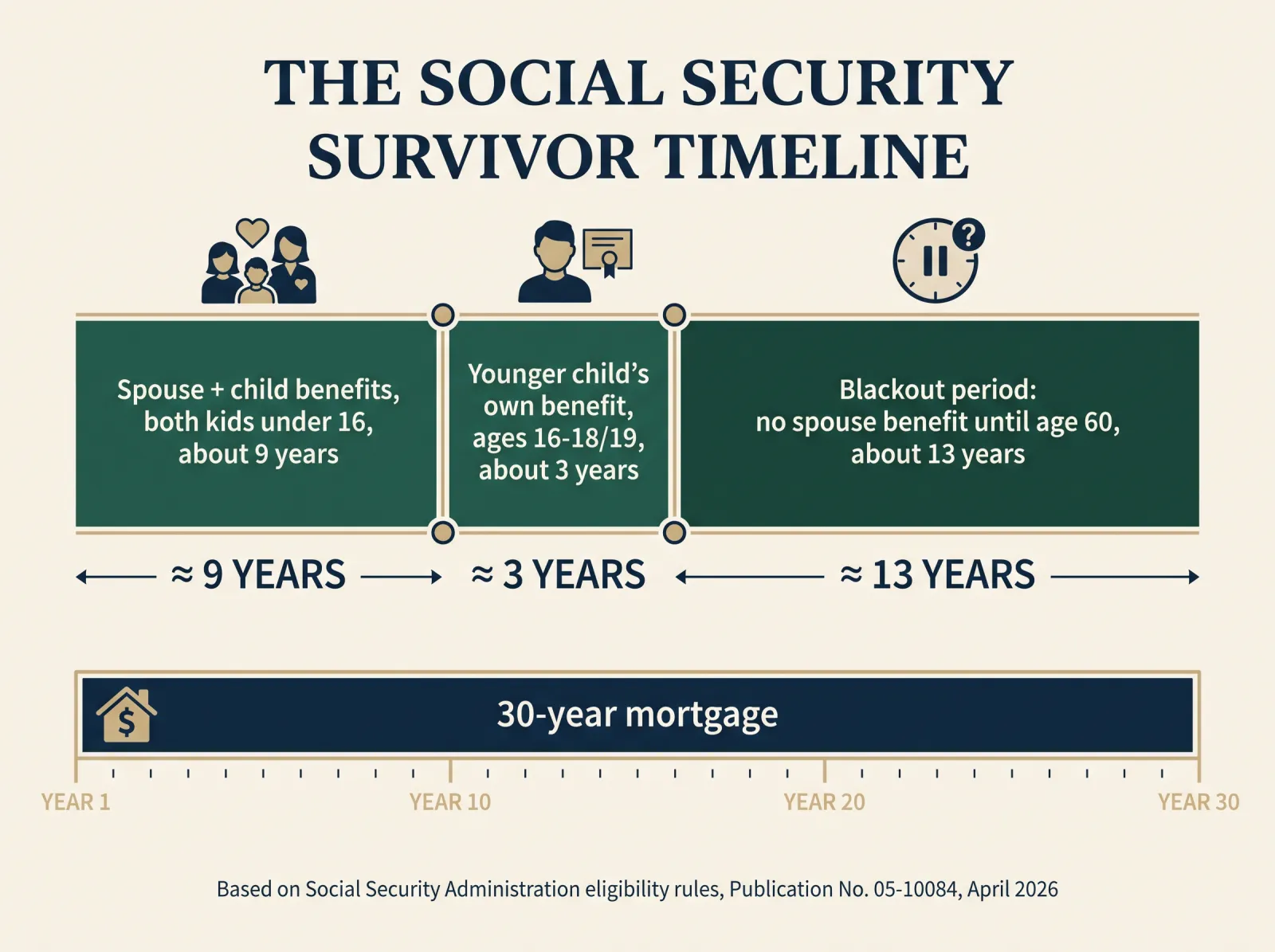
- That income continues for years while both kids are under 16 — nine years, in this example, until the older child turns 16.
- At that point, the spouse’s caretaker-based benefit generally stops. The younger child, then 12, may still be individually eligible for a smaller check until 18 or 19.
- The spouse’s own survivor benefit does not resume until age 60, which in this example is 22 years after the death — long after both kids have grown up, long after the mortgage would have needed to be paid some other way, and likely well past any point where the surviving spouse could rebuild lost income on their own timeline.
Years of Social Security survivor income vs. years of the mortgage, illustrative example
Illustrative timeline built from Social Security Administration eligibility rules (Publication No. 05-10084, April 2026; ssa.gov/survivor/eligibility) applied to a hypothetical family. Not a benefit estimate for any real household.
That chart is the entire argument in one picture. Social Security survivor income, in this illustrative example, covers roughly a third of the mortgage’s remaining term, concentrated in the earliest years when the kids are youngest, and then a long stretch of years exists with no spouse benefit at all, right when the family may still be carrying most of its original debt. None of that means Social Security “doesn’t help.” It means it helps for a specific, calculable window, and the years outside that window are exactly where life insurance, sized deliberately rather than guessed at, is doing the real work.
Treating Social Security as either "nothing" or "everything"
- Either ignores survivor benefits entirely and over-insures, or assumes they'll cover the family indefinitely and under-insures
- Never accounts for the family maximum capping what multiple survivors actually receive together
- Doesn't plan around the specific age when a spouse's own benefit stops
Common outcomeA coverage amount disconnected from what the household would actually receive and when
Pulling your own Social Security Statement and mapping the timeline
- Uses your actual PIA, not a national average, from your my Social Security account
- Maps survivor income against your kids' actual birthdays to find your household's blackout years
- Sizes life insurance to the gap years, not the whole need or none of it
Common outcomeA coverage amount you can explain and defend, tied to your own numbers
How to find your own numbers, not a national average
Everything above uses national figures and a hypothetical family to show how the mechanics work. Your household’s actual situation depends on your own earnings record and your kids’ actual ages. Here’s how to work it out yourself, in an afternoon:
- Create a my Social Security account at ssa.gov/myaccount. Your online Social Security Statement shows your current earnings record and gives estimates for the survivors benefits your family may be eligible for, based on your actual work history, not a national average, per the SSA.
- Find your children’s 16th birthdays. That date is when a caretaking spouse’s “any age” benefit generally stops for that child, and it’s the single most useful date in this whole exercise. With more than one child, the relevant date is the youngest child’s 16th birthday, since that’s when the spouse becomes ineligible.
- Map out the family maximum’s effect. If more than one person in your household would qualify at once (a spouse plus two or more kids), understand that the family won’t receive the simple sum of everyone’s individual percentage. The Statement and a conversation with the Social Security Administration directly can clarify your specific family’s capped total.
- List your fixed obligations by year, not as one lump sum. A mortgage balance, remaining years of a car loan, and each child’s remaining years until 18 or through college all have their own end dates. Overlay those against the survivor-benefit timeline from step 2 to see which years have a real gap and which don’t.
- Size coverage to the gap years, not the whole obligation. If Social Security genuinely covers a meaningful share of the early years, term life insurance sized and timed to cover the years with the biggest actual shortfall, especially the blackout years, is usually more efficient than insuring the full obligation for every year regardless of what Social Security already provides.
Term length is where this actually gets used
Once you know your household's blackout years, a level term policy with a term length that runs through those years, rather than a shorter or longer term chosen at random, is where this whole exercise pays off. A 20-year term bought when your youngest is 6 runs until they're 26, which may cover both the pre-16 years Social Security helps with and a meaningful chunk of the blackout years that follow.
Why the $255 lump sum isn’t final expense coverage
Separate from the monthly survivor benefit, the Social Security Administration pays a one-time $255 lump-sum death payment to an eligible spouse or child, and survivors must apply within 2 years of the death, per the SSA’s Survivors Benefits publication. That figure has stood unchanged for decades. It was never designed to keep pace with funeral costs, and it doesn’t. Families sometimes hear “Social Security pays a death benefit” and assume it functions like a small life insurance payout for final expenses. It doesn’t come close, and it was never meant to.
A separate need, a separate plan
Sizing coverage for final costs — funeral, burial, and immediate expenses in the weeks after a death — is a distinct exercise from sizing income-replacement coverage for a surviving spouse and kids. Treating the $255 lump-sum payment as if it covers that need leaves a real gap. If final expenses are the piece you're most worried about, that's its own planning conversation, separate from the survivor-benefit math in this guide.
A federal rule change worth knowing if a pension is part of your picture
If part of your household’s income comes from a job that didn’t pay into Social Security, such as certain public-sector jobs, a recent federal change is worth knowing. The Social Security Fairness Act, enacted January 5, 2025, eliminated the Windfall Elimination Provision (WEP) and Government Pension Offset (GPO) reductions that used to lower Social Security benefits, including survivor and spousal benefits, for people who also receive certain pensions from non-covered work, per the SSA’s Survivors Benefits publication. Those reductions no longer apply to benefits payable for January 2024 and later. If your household includes a pension from work that didn’t pay Social Security taxes, this change may directly affect what a survivor benefit calculation looks like for you, and it’s worth confirming your own situation directly with the Social Security Administration rather than assuming an older rule still applies.
How we help
We’re an independent agency, and this is exactly the kind of math we sit down and do with people. We don’t start by pitching a coverage amount pulled from a rule of thumb. We start with your actual mortgage balance, your kids’ actual ages, and what your own Social Security Statement says you’d be eligible for, and we work out where the real gap sits and for how many years. Then we compare term lengths and carriers against that specific timeline, not a generic number. Compare My Options.
What you get
A number you can explain to your spouse, not a guess pulled from an online calculator that never asked about Social Security at all. A clear picture of which years your family would have real income if something happened to you, and which years would be the hardest, so any coverage you buy is doing specific, identifiable work instead of sitting on top of income you’d already have anyway.
Social Security survivor benefits are real money for a real number of years. The mistake isn't ignoring them. It's assuming they cover more years, or more dollars, than the rules actually say.
Mike MooreRelated reading
For the broader question of sizing coverage to your actual obligations, see how much life insurance Sioux Falls families need and how much life insurance do I need in Sioux Falls: 4 buckets. If your mortgage is the biggest piece of what you’re sizing coverage for, see mortgage protection insurance vs. term life. And if final expenses, not income replacement, are the bigger worry, see final expense planning and rising funeral costs in South Dakota.
New parents sizing coverage for the first time?
See our guide on life insurance before or after a baby arrives.
Deciding between term lengths?
See our comparison of 10, 20, and 30 year term life.
Not ready to talk to anyone?
Read how it works first and come back when you're ready.
Frequently asked questions
Does Social Security pay my family if I die?
Yes, if you worked and paid Social Security taxes long enough. Your spouse, minor or full-time-student children, or dependent parents may qualify for monthly survivor benefits based on your earnings record, according to the Social Security Administration’s Survivors Benefits publication (No. 05-10084, April 2026). How much they get, and for how long, depends on their age and relationship to you, and it is smaller and more time-limited than most people assume.
How much Social Security survivor benefit does a spouse get?
It depends entirely on age and circumstance. A surviving spouse at full retirement age or older generally gets 100% of the worker’s basic benefit amount. Claimed at exactly age 60, it is 71.5%, rising gradually to 100% at full retirement age, per ssa.gov/survivor/amount. A spouse of any age who is caring for the worker’s child under 16 gets 75% of the worker’s benefit amount, but only while that condition holds.
How much does each child get in Social Security survivor benefits?
Each eligible child generally gets 75% of the deceased worker’s basic benefit amount, per the Social Security Administration. To qualify, a child must be unmarried and younger than 18, or up to 19 if still attending elementary or secondary school full time, or any age if a disability began before age 22.
What is the Social Security family maximum, and how does it limit what my family gets?
The family maximum caps the total monthly amount Social Security pays to all of a worker’s survivors combined, regardless of how many people would otherwise qualify. The Social Security Administration states this limit varies between 150% and 180% of the deceased worker’s benefit amount. A spouse getting 75% plus two children each getting 75% would add up to 225% on paper; the family maximum caps the actual combined payment well below that.
What happens to my spouse’s Social Security survivor benefit once our youngest child turns 16?
It generally stops. The rule that lets a surviving spouse collect benefits “at any age” applies specifically while they are caring for the worker’s child who is younger than 16 or disabled, per the Social Security Administration. Once the youngest child turns 16, that benefit typically ends, and the surviving spouse is not eligible again until age 60 (or 50 if they have a disability), unless they are working and have their own retirement benefit instead. Financial planners commonly call the years in between the survivor benefit “blackout period.”
Does the $255 Social Security lump-sum death payment cover a funeral?
No. The Social Security Administration pays a one-time $255 lump-sum death payment to an eligible spouse or child, and survivors must apply for it within 2 years of the death. That figure has not been adjusted for inflation in decades and covers a small fraction of what a funeral actually costs today. It is not designed to function as final expense coverage.
How do I find out my own Social Security survivor benefit estimate?
Create a personal my Social Security account at ssa.gov/myaccount. Your online Social Security Statement shows your current earnings record and gives estimates for the retirement, disability, and survivors benefits you and your family may be eligible for, based on your actual earnings history rather than a national average.
Does having Social Security survivor benefits mean I don’t need life insurance?
Not on its own. Social Security survivor benefits are real, and for many families they cover a meaningful piece of the picture, but they were never designed to replace a full income, they are capped by the family maximum, and for many households they stop years before the mortgage is paid off or the kids are through school. The honest approach is to find your own numbers first, then size any life insurance you buy to fill the specific gap that is left over, not to guess at the whole amount from scratch.
Sources
- Social Security Administration — Survivors Benefits, Publication No. 05-10084 — April 2026 edition; survivor eligibility, benefit percentages (100% at full retirement age, 71%–99% ages 60 to FRA, 75% for a caretaking spouse or child), family maximum (150%–180%), $255 lump-sum death payment, Social Security Fairness Act (WEP/GPO elimination); accessed August 2026
- Social Security Administration — Survivor benefit amount — detailed widow/widower percentage schedule by claiming age (71.5% at 60, over 75% at 61, over 80% at 63, over 90% at 65, 100% at full retirement age); child benefit percentage; family maximum; $255 lump-sum payment; accessed August 2026
- Social Security Administration — Survivor benefit eligibility — spouse marriage-duration and age requirements, children’s age cutoffs (17 and younger, or 18–19 in school; disabled before 22), dependent parent requirements; accessed August 2026
- Social Security Administration — Fast Facts & Figures, OACT — as of December 31, 2025: 5,846,000 survivor beneficiaries (8.3% of all beneficiaries); 2,036,000 children receiving survivor benefits; average monthly benefits by category (widowed mother/father with child $1,369, child $1,174, aged widow(er) $1,921, disabled widow(er) $982); accessed August 2026
- Social Security Administration — OASDI Beneficiaries by State and County, South Dakota — December 2025: 206,052 total OASDI beneficiaries in South Dakota; 17,241 survivor beneficiaries (9,178 widow(er)s and parents; 8,063 surviving children); accessed August 2026
- LIMRA, Life Happens, Society of Actuaries, and ACLI — 2026 Insurance Barometer Study — published July 20, 2026: 52% total U.S. life insurance ownership; 38% life insurance need gap (29% need coverage, 9% need more), representing 74 million uninsured and 24 million underinsured Americans; about 2 in 5 Americans overestimate the actual cost of life insurance; only 4% of consumers under 31 correctly priced a basic policy; accessed August 2026
Related reading: How much life insurance Sioux Falls families need, how much life insurance do I need in Sioux Falls: 4 buckets, mortgage protection insurance vs. term life, and final expense planning in South Dakota.
Before you act on any of this
This article is general education, not insurance, legal, financial, or tax advice, and it is not a Social Security benefit estimate. Your own survivor benefit depends entirely on your personal earnings record; get your actual numbers from your my Social Security account or directly from the Social Security Administration. Product availability, features, and rates vary by carrier and are subject to underwriting. No coverage exists until a policy is issued and in force. Any guarantees are subject to the claims-paying ability of the issuing insurer. Please review actual policy documents and speak with a licensed agent about your own situation.
The number worth knowing before you guess at another one
Social Security survivor benefits are not nothing, and they are not everything. They’re a defined program with defined rules: specific percentages, a family maximum, and an age-16 cutoff for a caretaking spouse that most people never hear about until it directly affects them. You can find your own household’s numbers this week: your Social Security Statement, your kids’ 16th birthdays, and your remaining mortgage balance. Once you line those up against each other, what’s left over is the part worth insuring, and that’s the number worth a second opinion.
Want help lining up your Social Security timeline against your actual obligations?
We'll walk through your Statement, your kids' ages, and your mortgage together, and compare carrier options sized to the years that actually need it.