
If you’re raising kids and also helping an aging parent financially, the life insurance number most people land on is too small, because it only counts one of those two obligations. Researchers call this the “sandwich generation,” and Pew Research Center found that 54% of American adults in their 40s were in it as of a September 2025 survey.1 That’s not a niche situation. It’s the ordinary shape of midlife for more than half the people currently raising kids while their own parents are getting older. This guide walks through why the standard coverage math misses the second obligation, what it actually costs when someone gets this wrong, and how to size a policy that covers both generations without guessing.
The short version
- 54% of American adults in their 40s have a living parent 65 or older and either a minor child, a grown child they help financially, or both, according to a September 2025 Pew Research Center survey.
- South Dakota's filial support statute, SDCL 25-7-27, can require an adult child with the financial ability to help a parent who can't provide for themselves, but only after written notice and a refusal to help.
- A South Dakota assisted living community averaged $52,200 a year and a semi-private nursing home room averaged $105,850 a year in 2024, according to Genworth's Cost of Care data, both figures the household's income has to absorb somewhere.
- 59% of Americans in the sandwich generation say they reduced or stopped retirement contributions specifically because of supporting both a child and a parent, per the Allianz Life 2025 Annual Retirement Study.
- The fix is arithmetic, not a product: add a separate "parent obligation" number to your normal coverage calculation instead of assuming one policy sized for your kids automatically covers everything else you're responsible for.
The pain: you already know the number you have isn’t the number you need
Here’s the situation a lot of South Dakota households are living through right now, whether or not anyone’s named it out loud. You ran the numbers for life insurance a few years ago, maybe when your first kid was born or when you bought a house. You landed on a term policy sized around income replacement, the mortgage, and some cushion for the kids. That number felt complete at the time, and for a while it was.
Then your mother started needing help getting to appointments. Or your dad’s retirement account turned out to be thinner than anyone realized, and now you’re the one covering part of his assisted living bill every month. Maybe it’s not money yet, just time, but the time is starting to cost money too, in missed work and a slower career track. None of that shows up in the policy you bought years ago, because that policy was never built to account for it. It was sized for your kids. It says nothing about your parents.
This is the quiet failure mode of otherwise responsible planning: doing the math once, doing it correctly for the situation you were in, and never re-running it when the situation changed underneath you. Nobody sends a notice when you become part of the sandwich generation. You just wake up one year and realize you’re paying for two directions at once, and your coverage is still priced for one.
This is general education, not legal, financial, or tax advice
This article explains how caregiving obligations affect life insurance planning in general terms. It doesn't evaluate your specific family situation, your parent's care needs, or any legal duty that may apply to you. For an actual filial-support question or an estate matter, talk to a South Dakota attorney.
Why it happens: the second obligation nobody re-runs the math for
The mechanism here isn’t complicated once you see it, but it’s genuinely easy to miss because life insurance is usually sold and bought as a single-purpose tool: replace the income a household would lose if the insured person died. That framing works fine when the household is the standard unit, one working adult (or two), some kids, a mortgage. The moment a parent enters the picture as a financial dependent in practice, even an informal one, the single-purpose framing quietly stops covering everything it needs to.
A few terms are worth pinning down before going further, because they get used loosely and the loose version causes confusion:
Sandwich generation is a demographic term, not a legal or insurance term. It describes anyone with a living parent 65 or older who is also raising a minor child, financially supporting an adult child, or both. Pew Research Center’s own definition, from its September 2025 survey, requires only the aging-parent condition plus one of the two child conditions.1 There’s no dollar threshold; you’re in it based on the shape of your household, not the size of your bank account.
Filial support (sometimes “filial responsibility”) is the legal category for laws that can require an adult child to help support a parent. South Dakota has one: SDCL 25-7-27, titled “Adult child’s duty to support parent when necessary.”2 The actual text matters more than the summary, so here it is in full:
| Element of the statute | What it means in practice |
|---|---|
| Who it applies to | Any adult child who has the financial ability to help. If you genuinely can't afford it, the duty doesn't attach. |
| What triggers it | A parent who is unable to provide necessary food, clothing, shelter, or medical attendance for themselves. |
| Notice requirement | No claim can be made against the adult child until they receive written notice that the parent can't provide for themselves. |
| Refusal requirement | The adult child must have refused to provide for the parent after that notice, before any claim exists. |
| Timing of the notice | Notice must generally be given within 90 days after the care being claimed was first provided to the parent. |
| County involvement | If a parent applies for county assistance under SDCL chapter 28-13, the county must give the required written notice within 90 days of that application. |
Source: South Dakota Codified Laws § 25-7-27, accessed September 2026.
Read plainly, this is not a bill that shows up automatically. It’s a legal mechanism that requires a parent (or a county, on the parent’s behalf) to put an adult child on formal written notice, and it only creates liability if the adult child then refuses to help. Most families never encounter this statute directly, because most families are already doing informally, out of choice, exactly what the law would otherwise require. But the statute’s existence is a useful reminder of something the arithmetic below takes seriously anyway: in South Dakota, a parent’s unmet care need doesn’t just disappear into a general safety net. Somewhere in the chain, a family member is often the backstop, whether or not a court ever gets involved.
Accelerated death benefit rider (also called a living benefit) is a feature attached to some life insurance policies that lets the insured person access part of their own death benefit while still alive, if they’re diagnosed with a qualifying chronic, critical, or terminal illness. This matters for sandwich-generation planning in one specific way: if your parent has their own life insurance policy with this rider, it can help fund their own care from their own coverage while they’re alive, rather than only paying out after death. It does nothing for a policy where the parent isn’t the insured person. We go deeper on how these riders actually work, including the trade-offs, in our guide to living benefits reshaping life insurance.
Long-term care insurance is a separate product built specifically to pay for the cost of care, in a facility or at home, while the insured person is alive. It solves a different problem than life insurance does, and the two get confused constantly in this exact conversation because caregiving sits at the intersection of both.
What it costs to get wrong: two numbers that both went up
The reason this deserves its own calculation, instead of being waved off as “add a little extra,” is that both halves of the sandwich have real, quantified pressure behind them right now, from sources with no reason to exaggerate in either direction.
On the parent side, long-term care in South Dakota is not cheap, and it isn’t getting cheaper. Genworth’s Cost of Care data, gathered from providers between July and December 2024 and released March 4, 2025, put South Dakota’s average costs at:3
Nationally, CareScout’s (Genworth’s parent-affiliated survey group) 2025 data, collected July through November 2025 and released March 2, 2026, showed the national median assisted living cost at $6,200 a month ($74,400 a year) and a semi-private nursing home room at $315 a day ($114,975 a year), with most care settings seeing 1% to 5% year-over-year growth.4 These are two different survey years for two different geographies (South Dakota 2024, national 2025), so treat the comparison directionally rather than as an apples-to-apples year-over-year figure. Either way, the pattern holds: whichever number applies to your family, it’s a five- or six-figure annual number, not a rounding error in a household budget.
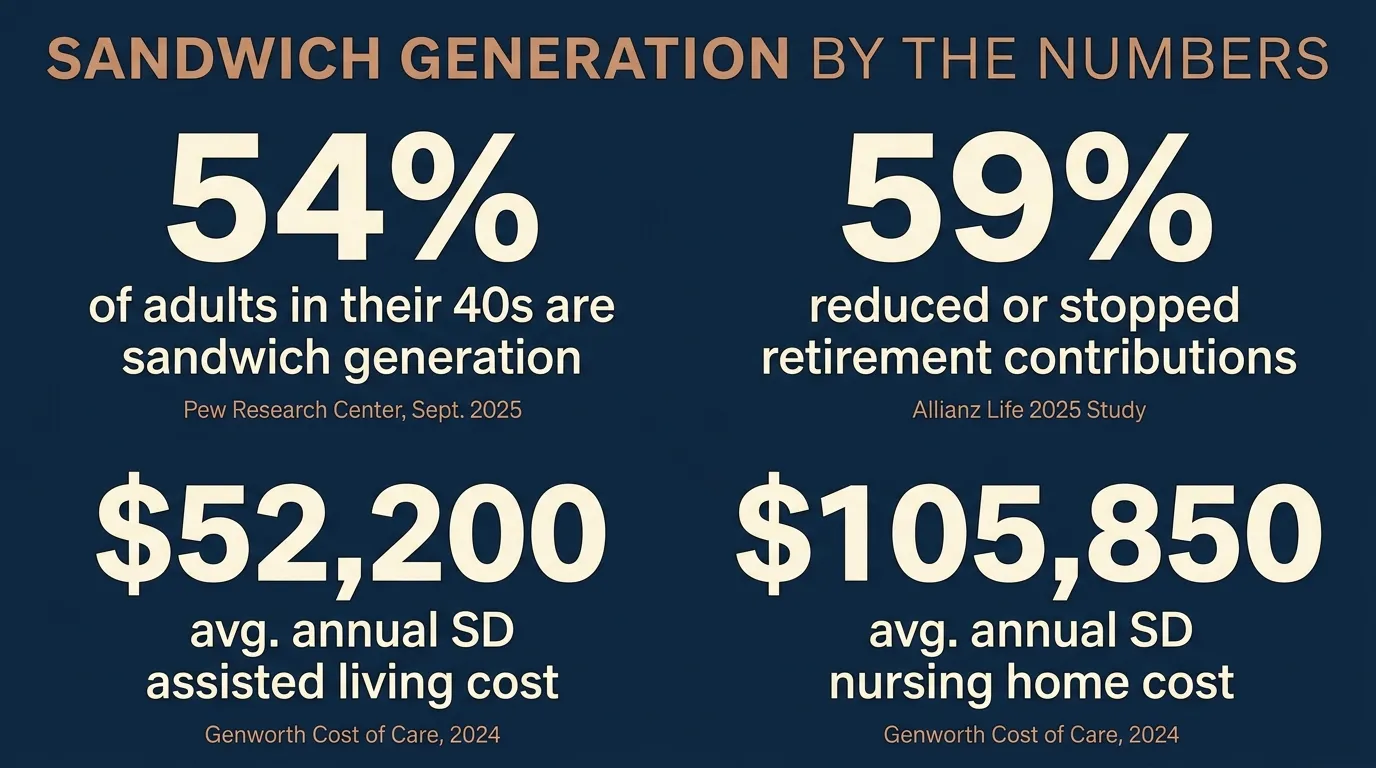
On the retirement side, the damage compounds quietly instead of showing up as a single bill. The Allianz Life 2025 Annual Retirement Study, based on a nationally representative online survey of 1,000 U.S. adults conducted in January and February 2025, found that 75% of people in the sandwich generation say it’s hard to juggle their financial goals because they’re supporting both a child and a parent, and 59% say they’ve reduced or stopped contributing to retirement savings specifically because of that dual support.5 That 59% figure is the one that should worry a financially disciplined household the most, because it means the damage isn’t limited to people who were already behind. It’s happening to people who were on track, and got knocked off by an obligation their original plan never priced in.
Pew’s own numbers sharpen exactly who’s affected: among adults in their 40s specifically, 23% are supporting both a minor child under 18 and a grown child financially, on top of having a living parent 65 or older, while a further 58% have an aging parent plus a minor child but no grown-child support yet.1 Zooming out across all age groups, Pew found that about one in seven middle-aged adults (roughly 15%) is providing financial support to both an aging parent and a child, minor or grown, at the same time.1 If that’s you, both halves of this math apply, not just the one that happens to feel most urgent this month.
Nobody sends you a notice when you become part of the sandwich generation. You just wake up one year and realize you're paying for two directions at once, and your coverage is still priced for one.
— Mike Moore, Life Insurance Advisor, Big Sioux LifeHow to work out your own number, step by step
You don’t need to buy anything to run this. Here’s the method, in order, and it’s the same one we’d walk through with you.
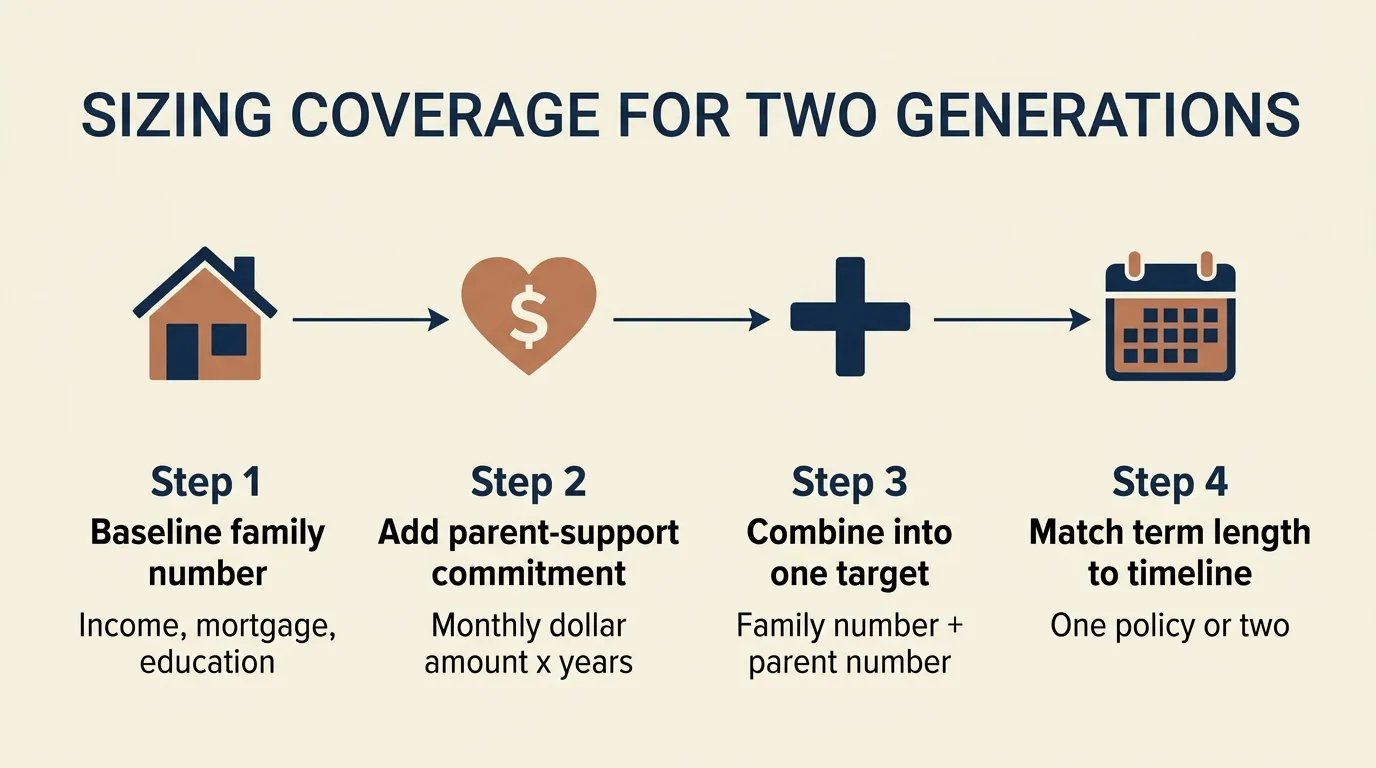
1. Calculate your baseline family number first, the way you would without a parent in the picture. Use whatever version of income replacement fits your household: years of income your family would need until your youngest is grown, remaining mortgage balance, any other debt, and a rough estimate for future education costs. If you’ve already got a policy, this is the number it was probably sized to.
2. Write down your actual current commitment to a parent, in dollars, per month. Be specific. If you’re sending your mother $400 a month toward her assisted living community, that’s $4,800 a year. If you’re covering a home health aide two days a week, price that out at whatever the actual invoice says, not a guess. If your contribution is time rather than money right now, estimate what it would cost to replace that time with paid help, because that’s what would have to happen if you weren’t there.
3. Estimate how many more years you realistically expect to carry that commitment. This is a judgment call, not a precise figure, but don’t skip it. A parent in early-stage assisted living might need this kind of support for 10 to 15 years. A parent already in a nursing home with a serious diagnosis might have a much shorter, harder-to-estimate horizon. Use the honest middle of your own expectation, not the most optimistic version.
4. Multiply your monthly commitment by 12, then by your estimated remaining years, to get a straight-line total. Using the earlier example: $400 a month for an estimated 10 more years is $48,000. This is intentionally a simple, conservative starting point. It ignores that a lump-sum death benefit invested and drawn down carefully can often stretch further than a strict monthly total, and it ignores that costs tend to rise over time, which push in opposite directions. For a first pass, the simple multiplication is the right amount of precision; a full present-value calculation is a reasonable next step once you have a ballpark to react to.
5. Add that number to your baseline family number from step one. This combined figure, not the baseline alone, is your actual coverage target if you’re serious about not leaving your parent’s obligation unfunded along with your family’s.
6. Check whether the parent-support number and the family number run on the same clock. If your kids need 18 more years of support but you only expect to be helping your parent for another 8, you have a choice: size one term policy for the longer window (simpler, one policy, one underwriting process) or run two policies on different term lengths (potentially cheaper in total, since you’re not paying for 18 years of coverage on an obligation that only needs 8). Run the math both ways before deciding; the answer depends on current rates for your age and health class, which change often enough that a specific comparison beats a general rule.
The parent obligation is unfunded
- Coverage was calculated years ago, before a parent needed financial help
- If the insured person dies, the family's income is replaced, but the parent's monthly support disappears with no plan behind it
- A sibling, another family member, or the parent themselves absorbs the gap with no notice and no lead time
Both directions are covered
- The baseline family number and the parent-support number are both explicit line items, added together on purpose
- If the insured person dies, the parent's support continues on the same terms it did while they were alive
- The family isn't forced to choose between honoring a commitment to a parent and covering their own kids
A worked example
Take a hypothetical household to see the arithmetic in one place. This is an illustration with assumed, round numbers, not a real family or a quoted rate.
Say a 42-year-old South Dakota parent has two kids, ages 9 and 12, and a standard income-replacement calculation (covering income until the youngest turns 22, the remaining mortgage, and a rough education estimate) lands at $650,000. That’s the baseline family number, calculated the same way it would have been calculated five years ago, before a parent needed help.
Now add the second half. This person has been sending their mother $350 a month toward the cost of an in-home aide for the past year, and realistically expects that arrangement, or something like it, to continue for another 12 years based on her age and health. That’s $350 × 12 months × 12 years = $50,400, using the simple straight-line method from step four above.
Combined coverage target: $650,000 + $50,400 = $700,400. Rounded to a clean policy amount, that’s roughly $700,000, not $650,000. The $50,400 difference isn’t a rounding error; it’s the exact size of the gap that would otherwise open up the day this person dies, right at the moment their mother could least absorb a sudden loss of support.
How we help South Dakota families size this correctly
This is exactly the kind of arithmetic we walk through with people, because it isn’t complicated once someone lays it out, it’s just something almost nobody hands you the format for. Most calculators online ask about your income, your mortgage, and your kids. Almost none of them ask whether you’re also supporting a parent, so almost none of them give you a real number if you are.
Start with both halves of your real obligation
We ask about your parent-support commitment specifically, not just your kids and your mortgage, so the number we land on actually matches what you're responsible for.
Compare term length options across both timelines
Because we're independent, we can run the math on a single longer policy versus two policies on different term lengths, and compare carrier options for whichever structure actually costs less for your situation.
Explain living benefit riders honestly
If a living benefit rider is relevant to your own policy, or to a policy you're helping a parent evaluate, we explain what it does and doesn't cover before you assume it solves a problem it doesn't.
Stay available as the numbers change
A parent's care needs rarely stay flat for a decade. When your commitment changes, you're calling us directly to re-run the math, not starting over with someone new.
If you’d rather have someone local run these two numbers with you instead of doing it alone at the kitchen table, that’s what we do. Compare your options and we’ll help you land on a figure that actually covers both directions.
What you get from doing this arithmetic now
The value here isn’t a bigger policy for its own sake. It’s knowing, with an actual number instead of a guess, whether the coverage you have matches the obligations you actually carry today, not the obligations you carried when you first bought it. If it doesn’t match, you find that out now, while you can still do something about it, instead of a sibling or a parent finding it out the hard way later.
It also gives you a concrete way to talk about this with the rest of your family. “I want to make sure Mom’s support continues if something happens to me” is a much easier conversation to have with siblings or a spouse when it comes with a specific number attached, rather than a vague worry nobody’s pinned down.
Not ready to talk to anyone yet? Work through the six steps above on your own first; the arithmetic doesn’t require us. If your parent’s own coverage is part of the picture, our guide to living benefits reshaping life insurance is worth reading next, and if you’re also reassessing what you need now that the kids are older, our guide for empty nesters covers that side of the recalculation. If retirement savings pressure from caregiving is the part keeping you up at night, Will Your Retirement Savings Last? walks through that math separately. And if you’re the grandparent side of this instead of the adult-child side, our guide for grandparents raising grandchildren approaches the same overlap from the other direction.
Get both halves of your obligation into one honest number
An independent comparison of coverage options, sized to your family and your parent-support commitment, across more than one carrier.
Frequently asked questions
What is the “sandwich generation,” and does it actually change how much life insurance I need?
It’s the term researchers use for adults who have a living parent age 65 or older and are also raising a minor child, supporting a grown child financially, or both. Pew Research Center found that 54% of American adults in their 40s fit that description as of a September 2025 survey. It changes your coverage math because a standard calculation only replaces income for your spouse and kids. If you’re also the reason a parent’s assisted living bill gets paid, your death creates a second gap that a kids-only number doesn’t cover.
How much life insurance do I need if I’m financially supporting both my kids and my parents?
Add a second line to your normal calculation. Start with your usual income-replacement number (covering your kids’ years to adulthood, any debt, and future education), then add what it would take to fund your specific dollar commitment to a parent for as many years as you realistically expect to keep making it. If you send a parent $500 a month and expect to for another 8 years, that’s roughly $48,000 of straight-line obligation, before accounting for the fact that a lump sum invested conservatively can stretch further than a strict monthly total. Treat it as its own number, then add it to your family total.
Does South Dakota law require me to pay for my parents’ care?
Only in a narrow, specific circumstance. SDCL 25-7-27 creates a duty for an adult child who has the financial ability to do so to provide necessary food, clothing, shelter, or medical attendance for a parent who can’t provide for themselves. But no claim can be made against you until you’re given written notice that your parent can’t provide for themselves and you’ve refused to help after that notice. It’s not an automatic bill; it’s a legal backstop that requires notice and a refusal first.
Can life insurance help pay for a parent’s assisted living or nursing home costs while they’re alive?
A standard death benefit can’t, since it only pays after death. But some life insurance policies include an accelerated death benefit rider, sometimes called a living benefit, that lets the policy owner access part of the death benefit while alive if they’re diagnosed with a qualifying chronic or terminal illness. That’s a feature of the insured person’s own policy, not a tool for paying a parent’s bills unless the parent is the one insured. We cover how these riders work, and their trade-offs, in our separate guide to living benefits.
Should I buy long-term care insurance, or does life insurance cover the same risk?
They cover different risks and neither substitutes for the other. Life insurance replaces income and pays obligations after a death. Long-term care insurance (or a hybrid life/LTC policy) is specifically built to pay for the cost of care, like an assisted living community or in-home aide, while the insured person is still alive. If you’re worried about your own future care costs, that’s a long-term care conversation. If you’re worried about what happens to your family’s finances if you die while carrying caregiving responsibilities, that’s a life insurance conversation. Many households eventually need to think about both, just not through the same product.
What happens to my retirement savings if I’m supporting a parent right now?
The math gets worse than most people expect, and you don’t have to guess: the Allianz Life 2025 Annual Retirement Study found that 59% of Americans in the sandwich generation reduced or stopped contributing to retirement savings specifically because of supporting both a child and a parent financially. Every dollar redirected to a parent’s care today is a dollar not compounding for your own retirement, on top of the years you may spend caregiving instead of earning. Our separate guide on whether your retirement savings will last walks through how to model that gap.
My parent isn’t my legal dependent. Does that change how I should size coverage for them?
It changes the label, not the math. “Dependent” for tax and legal purposes has a specific meaning that usually doesn’t apply to a parent you’re helping informally. But for insurance sizing purposes, the question isn’t whether they’re a legal dependent, it’s whether your death would create a financial gap for them. If you’re the reason a bill gets paid every month, that’s a real obligation regardless of what a tax form calls it, and it belongs in your coverage math the same way a mortgage payment would.
Is it better to increase my own term policy or buy a separate policy to cover a parent’s needs?
Usually it’s simpler and often cheaper to size one term policy to cover your full obligation, both your family’s needs and your parent-support number, rather than carrying two separate policies with two sets of fees and underwriting. The exception is timing: if you expect the parent-support obligation to end well before your kids are grown (say, in 8 years instead of 20), a shorter, separate policy sized to that shorter window can cost less over time than paying for 20 years of coverage you only need for 8. It’s worth running both ways before deciding.
Before you act on any of this
This article is general education, not insurance, legal, financial, or tax advice, and it does not evaluate your specific family situation or any legal duty that may apply to you. Product availability, features, and rates vary by carrier and state and are subject to underwriting. No coverage exists until a policy is issued and in force. Any guarantees, including accelerated death benefit riders, are subject to the claims-paying ability of the issuing insurer and the specific policy's terms. Please review actual policy documents and speak with a licensed agent or attorney about your specific situation.
Sources
- South Dakota Legislature — SDCL 25-7-27, Adult child’s duty to support parent when necessary — accessed September 2026; establishes the financial-ability condition, the written-notice requirement, the refusal requirement, and the 90-day notice window for South Dakota’s filial support duty.
- Pew Research Center — More than half of Americans in their 40s are sandwiched between an aging parent and their own children — published August 27, 2026, based on a survey of 8,750 U.S. adults conducted September 2-8, 2025 through Pew’s American Trends Panel; source of the 54% (adults in their 40s), 23% and 58% subgroup splits, and the roughly 15% dual-support figure across middle-aged adults.
- Allianz Life — ‘Sandwich Generation’ Neglecting Retirement Savings, Allianz Life Study Finds — published September 2, 2025, based on a nationally representative online survey of 1,000 U.S. adults age 25+ conducted January-February 2025 by the Allianz Center for the Future of Retirement; source of the 75% financial-juggling figure, the 59% reduced/stopped retirement contributions figure, and the 78% support-provision figure.
- Genworth — Long-Term Care Costs Increase in South Dakota, Exceeding National Costs — press release dated March 4, 2025, based on Cost of Care Survey data collected July-December 2024; source of the South Dakota-specific assisted living, nursing home, and home health aide annual cost figures.
- CareScout (Genworth) — 2025 Cost of Care Survey Results — press release dated March 2, 2026, based on survey data collected July-November 2025 from providers in all 50 states; source of the national median assisted living and nursing home figures used for directional comparison. Note: this is a single-publisher source for the cost-of-care figures; we could not locate an independently produced second survey with directly comparable South Dakota-specific figures for the same period.
Related reading: Living Benefits Are Reshaping Life Insurance in 2026, Do Empty Nesters Still Need Life Insurance? A 2026 SD Guide, Will Your Retirement Savings Last? A South Dakota Guide, and Grandparents Raising Grandchildren: SD Life Insurance Guide. See our current life insurance for families options, our who we help: parents page, or start with how it works.
Footnotes
-
Pew Research Center, “More than half of Americans in their 40s are sandwiched between an aging parent and their own children,” published August 27, 2026, survey conducted September 2-8, 2025. ↩ ↩2 ↩3 ↩4
-
South Dakota Codified Laws § 25-7-27, accessed September 2026. ↩
-
Genworth, “Long-Term Care Costs Increase in South Dakota, Exceeding National Costs,” press release dated March 4, 2025, data collected July-December 2024. ↩
-
CareScout (Genworth), “2025 Cost of Care Survey Results,” press release dated March 2, 2026, data collected July-November 2025. ↩
-
Allianz Life, “‘Sandwich Generation’ Neglecting Retirement Savings, Allianz Life Study Finds,” press release dated September 2, 2025, survey conducted January-February 2025. ↩