A 38-year-old asked us the same question three different agents had already answered three different ways: does the “get your money back” term policy actually make sense, or is it a sales pitch dressed up as a feature? The honest answer, once you run State Farm’s own published numbers side by side, is that return of premium (ROP) term life insurance usually costs close to four times what standard term costs for the identical coverage, and the “refund” you’re promised is just your own money coming back to you with no interest, years or decades later. This guide walks through the real mechanics, the actual math using rates carriers publish themselves, what happens at tax time, and how to decide for your own situation instead of taking either side of the argument on faith.
The short version
- ROP term refunds your premiums if you outlive the policy term and the death benefit is never paid. If you die during the term, it pays exactly what standard term would pay, no more.
- State Farm's own "starting at" online rates in September 2026: $15.22/month for standard 20-year term at $250,000, versus $58.94/month for the same coverage with the return-of-premium rider, about 3.9 times as much.
- The refund is nominal dollars, not adjusted for inflation. Consumer prices rose 2.3% in just the twelve months from April 2024 to April 2025 alone, according to the Bureau of Labor Statistics, so a flat-dollar refund 20 or 30 years out buys less than it does today.
- State Farm states the return-of-premium benefit itself is not taxable, and IRS Publication 525 confirms the general rule: you only owe tax on proceeds above what you actually paid in.
- Term life insurance made up 17% of new U.S. individual life sales in 2025, according to LIMRA, while ROP has narrowed to a small handful of carriers still offering it.
The pitch that sounds like a free lunch
Here’s roughly how it gets presented. You sit down for a term life quote, and the agent mentions there’s a version of the same policy where, if you don’t die, you get every premium dollar back at the end. No risk, they say. Worst case, you get your money back. Best case, your family gets the death benefit. It sounds like the closest thing to a free lunch insurance has ever offered.
Something about that pitch should make you pause, and if it did, you were right to pause. Insurance companies do not build products that lose them money, and a return-of-premium rider is priced, underwritten, and profitable for the carrier well before it’s ever offered to you. The question worth asking isn’t “do I get my money back.” It’s “what does it actually cost me to have that option, and is there a better use for that same money.” That’s the question this guide answers with real numbers instead of a sales script.
Two agents telling you opposite things about whether ROP is worth it usually just means neither one ran the arithmetic out loud for you. It isn’t complicated once someone does.
Why it happens: the mechanism behind the “free” refund
Term life insurance, in its plain form, is straightforward. You pay a level premium for a set period, called the term, usually 10, 20, or 30 years. If you die during that term, your beneficiary receives the death benefit. If you outlive the term, the policy simply ends. There’s no cash value, no refund, and no payout if you’re still alive when the term is up, according to the National Association of Insurance Commissioners’ Life Insurance Buyer’s Guide, which describes standard term as intentionally lower-cost coverage for a specific period.
A return-of-premium rider changes the outcome in the “you outlive it” scenario. Instead of the policy simply ending with nothing paid, the insurer refunds the premiums you paid over the life of the policy, provided every scheduled premium was actually paid and the death benefit was never triggered, according to State Farm’s own description of how its ROP product works. To fund that promise, the insurer charges you substantially more every single month for the entire term, not just at the end. That extra money isn’t free float sitting in a vault waiting to be handed back. The insurer invests it over the life of the policy the same way it invests any other premium dollar, and the spread between what it earns on your money and what it eventually returns to you (nothing, since the “refund” is only your own premiums, not premiums plus growth) is a meaningful part of how the rider is priced to be profitable regardless of whether you die or survive.
A few terms worth knowing before you compare quotes:
- Level premium. A premium amount that stays the same for the entire term, rather than increasing every year as you age (the way annually renewable term does).
- Renewable term. Most term policies can be continued past the initial term without a new medical exam, but at a much higher premium reflecting your older age, according to the NAIC’s buyer’s guide. A return-of-premium rider is a separate feature from renewability.
- Cash value. The savings-like component inside permanent policies like whole life. Standard term generally has none, per the NAIC guide. A return-of-premium refund is not cash value; you can’t borrow against it, and it doesn’t grow inside the policy the way cash value does in a permanent policy.
- Free-look period. The window after you receive a new policy where you can return it for a full refund, no questions asked. The NAIC’s 2026 buyer’s guide describes this as usually at least 10 days, stated on the first page of the policy; confirm the exact number on your own contract, since it can run longer.
The core idea to hold onto: a return-of-premium rider doesn’t add value to the coverage itself. Your death benefit is the same $250,000 or $500,000 either way. What you’re actually buying is a forced-savings feature bolted onto term insurance, priced by the same company that’s also selling you the insurance, and you’re paying for that feature every month whether or not you ever collect on it.
This is general education, not financial or tax advice
Nothing here evaluates any specific policy, carrier, or your personal tax situation. It's a plain explanation of how return-of-premium term works and what named sources say it actually costs, so you can ask sharper questions before you buy anything.
What it costs to get wrong: the real math, using a carrier’s own published rates
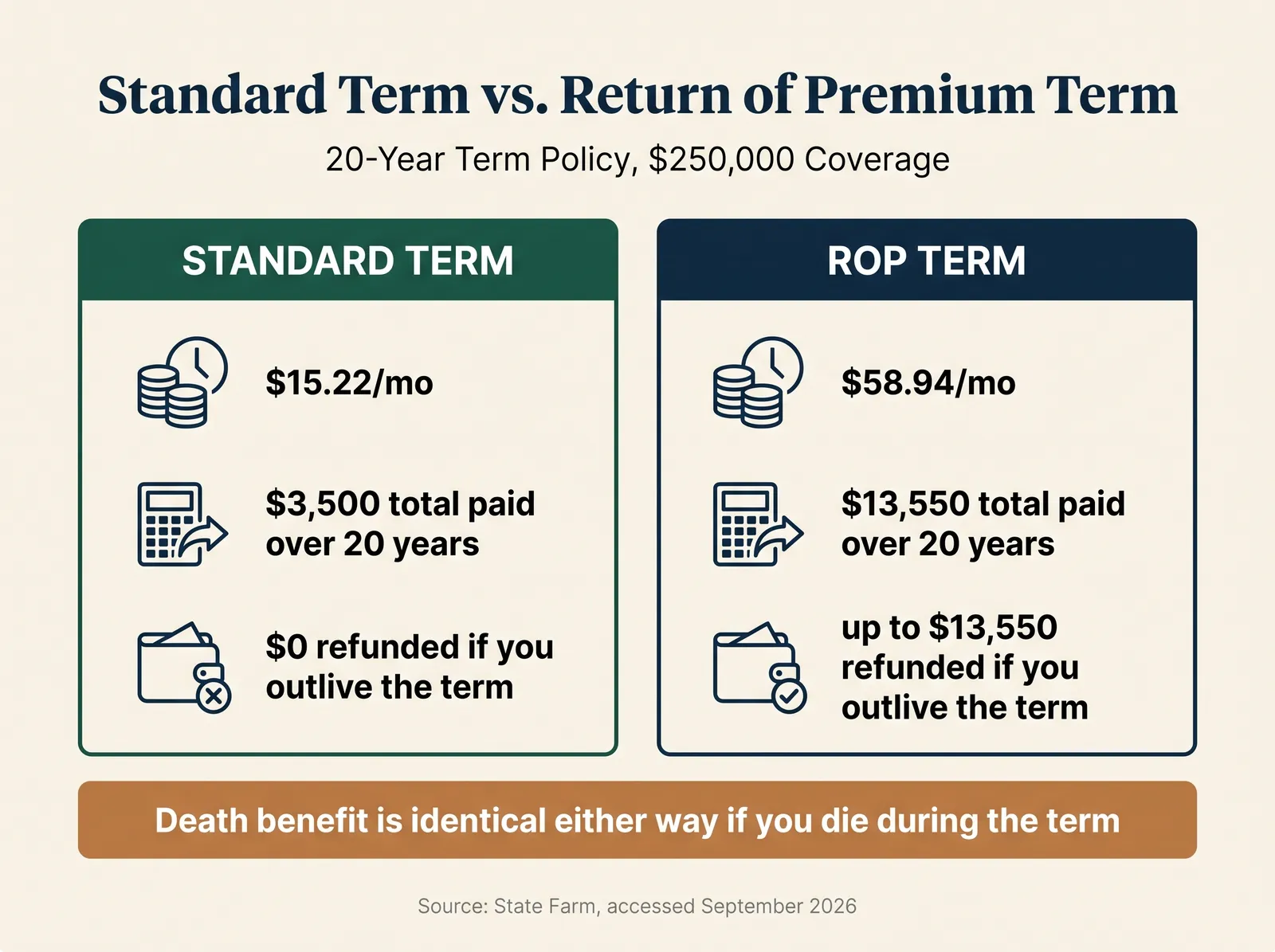
Most ROP comparisons online use estimated or invented numbers. Here’s what one real carrier actually publishes for itself. State Farm’s own website lists a “starting at” rate for standard 20-year term life insurance with $250,000 of coverage of $15.22 a month, or $175.00 a year, explicitly stated for a 25-year-old female in excellent health in Illinois. On the same carrier’s return-of-premium term page, the “starting at” rate for a 20-year term with the same $250,000 of coverage is $58.94 a month, or $677.50 a year; that page does not state the demographic assumptions behind its own rate. Even without a perfectly matched comparison, the gap between the two “starting at” prices a single company advertises for itself, roughly 3.9 times as much for the ROP version, is the real order of magnitude you should expect to see when you get your own quotes.
| Product | Monthly | Annual | Total paid over 20 years (if all premiums are paid) |
|---|---|---|---|
| Standard 20-year term | $15.22 | $175.00 | $3,500 |
| 20-year term with ROP rider | $58.94 | $677.50 | $13,550 |
| Extra cost of ROP over 20 years | +$43.72 | +$502.50 | +$10,050 |
State Farm, Term Life Insurance and Return of Premium Term Life Insurance pages, "starting at" published online rates, accessed September 2026. Standard-term figure stated for a 25-year-old female in excellent health in Illinois; the ROP page does not state a demographic assumption. Annual totals shown reflect each product's own stated annual price, not monthly price multiplied by 12, since carriers often discount the annual payment mode.
Walk the outcome through to the end of the term and the tradeoff becomes concrete. If you survive the full 20 years and pay every premium, the ROP buyer in this example gets back roughly $13,550, the same amount they paid in, in nominal dollars with no interest. The standard-term buyer paid only $3,500 total over the same 20 years and gets nothing back, because that was never the deal. The standard-term buyer also had an extra $502.50 a year, on average, in their own pocket the entire time, money they could save, invest, pay down debt with, or spend, rather than having it tied up with an insurer for two decades.
Total premiums paid over 20 years: standard term vs. ROP term ($250,000 coverage)
State Farm, "starting at" published online rates for 20-year term, $250,000 coverage, accessed September 2026.
That $10,050 gap is the number worth sitting with. It isn’t a loss in the sense that you never see it again; if you outlive the term and pay every premium, you do get it back. But it comes back to you as flat, nominal dollars, decades later, with none of the growth that money could have earned almost anywhere else it was put to work in the meantime. Consumer prices rose 2.3% in just the twelve months from April 2024 to April 2025 alone, according to the Bureau of Labor Statistics’ Consumer Price Index report. Stretch that kind of erosion out across 20 or 30 years and a flat-dollar refund buys meaningfully less than the same number of dollars would buy the year you paid them in. A refund that isn’t adjusted for any of that is a weaker deal than the sticker number suggests.
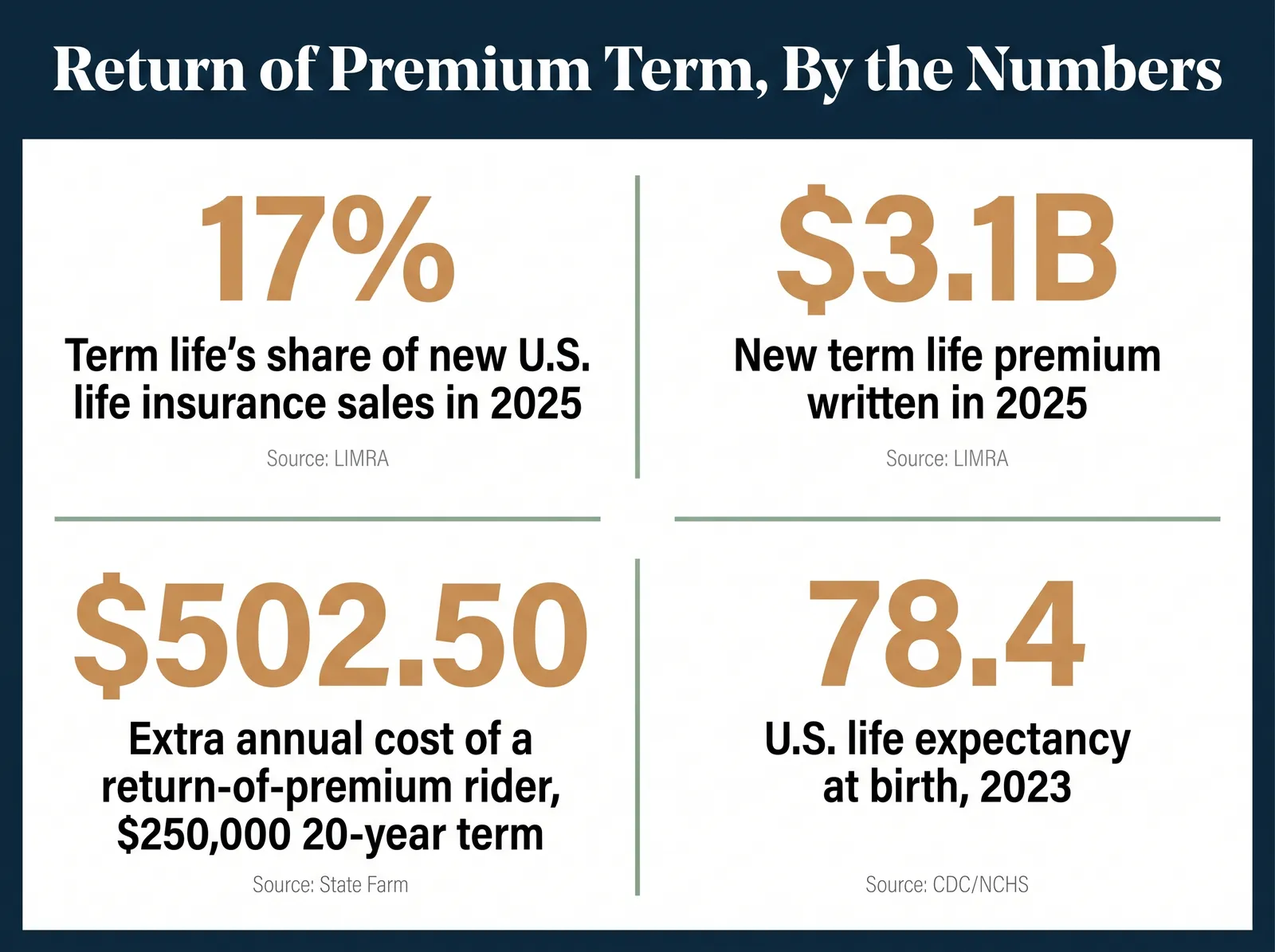
There’s a mortality angle worth naming honestly, too, since it’s the actual reason the rider can be priced the way it is. In 2023, the annual death rate for Americans ages 45 to 54 was 411.8 per 100,000, and for ages 55 to 64 it was 899.6 per 100,000, according to the CDC’s National Center for Health Statistics. U.S. life expectancy at birth was 78.4 years in 2023, and life expectancy at age 65 was an additional 19.5 years, per the same report. In plain terms: for most people buying a 20- or 30-year term policy in their 30s, 40s, or even 50s, surviving to the end of the term is the statistically likely outcome, not the exception. That’s exactly why an insurer can afford to promise a refund on survival. It’s the expected outcome in most cases, priced accordingly, not a generous coin flip in your favor.
What happens to your tax bill
State Farm states plainly on its own product page that “the Return of Premium benefit on the base policy is not taxable.” That lines up with the general federal tax rule. IRS Publication 525, covering taxable and nontaxable income, states that “if you surrender your policy for cash, you must include in your income the excess of the amount you receive over the cost of the insurance.” A straight return of your own premiums, with nothing extra added on top, generally isn’t income, since you’re not receiving more than what you put in.
Two carve-outs are worth knowing before you assume every dollar is automatically clean. First, State Farm notes separately that any Waiver of Premium for Disability Rider premiums returned as part of a Return of Premium benefit may be taxable, a narrower category most buyers won’t have. Second, IRS Publication 525 also notes that interest paid on life insurance proceeds is taxable income in the year you receive it, even when the underlying proceeds themselves are not. If your specific contract pays any interest alongside the returned premiums, rather than a flat, interest-free refund of what you paid, that interest portion would be taxable. Ask the carrier directly whether your specific refund includes any interest component, and get the answer in writing rather than assuming.
One thing neither carrier's website answers
We checked both State Farm's and Protective's own published pages for what happens to your refund if you cancel the policy early or miss enough payments to let it lapse before the term ends. Neither addresses it. Get this answered directly, in writing, by the specific carrier and contract you're considering, before you sign anything. It's the single most consequential unanswered question in this whole decision.
How to work out whether ROP makes sense for you
You don’t need an actuary to run this comparison. The method is the same one the numbers above walked through; you’re just plugging in your own quotes.
Step 1: Get a real quote for standard term, and a real quote for the ROP version, from the same carrier, for the same coverage amount and term length. “Starting at” marketing rates are a starting point, not your actual price, which depends on your age, health, tobacco use, and the specific carrier’s underwriting. Get both quotes from the same company so the comparison is apples to apples.
Step 2: Subtract the two premiums to find your real extra monthly and annual cost. In the State Farm example above, that gap was $43.72 a month and $502.50 a year. Multiply the annual gap by the number of years in the term to see the total extra dollars you’d have tied up by the end.
Step 3: Ask directly, in writing, what happens to the refund if you cancel early or the policy lapses. As noted above, this is the single biggest unknown across the two published pages we reviewed. Don’t buy an ROP policy without a clear, written answer specific to that contract.
Step 4: Ask whether any part of the refund includes interest, or whether it’s strictly a return of the premiums you paid. This determines whether any part of your eventual refund is taxable income, per IRS Publication 525.
Step 5: Decide honestly whether you’d actually save or invest the difference on your own. If the answer is genuinely no, that you’d otherwise spend that $40 to $50 a month without a second thought, a forced-savings structure like ROP has real behavioral value even at a real cost. If you already have a retirement account, an emergency fund, or any other place that extra money would reliably go instead, standard term plus your own saving generally leaves you with more control and more flexibility for the same protection.
Step 6: Compare the total extra cost against what you’re protecting. If the extra $10,050 over 20 years in the example above would be better spent building an emergency fund, paying down a mortgage faster, or funding coverage for a larger death benefit on a standard term policy instead, that’s worth weighing directly against the appeal of “getting my money back.”
Run it side by side before you decide
Write down four numbers before your next conversation with any agent: the standard-term monthly premium, the ROP monthly premium, the difference multiplied by the number of years in the term, and what you'd otherwise do with that difference each month. Comparing a written recommendation against those four numbers takes the guesswork out of the decision.
Is ROP even common anymore? What the market actually looks like in 2026
Term life insurance overall remains a large, active part of the U.S. life insurance market. New term premium totaled $3.1 billion in 2025, up 3% from 2024, and term represented 17% of total U.S. individual life insurance sales that year, according to LIMRA’s full-year 2025 sales report, published March 19, 2026. Whole life, by contrast, represented 37% of the market, with new premium of $6.4 billion, a 7% increase and a new sales record for the product, per the same report. Indexed universal life (IUL) set its own record at $4.5 billion in new premium, 25% of the market and up 17% year over year, and variable universal life (VUL) grew 17% to $2.6 billion.
| Product type | 2025 new premium | Market share | Change vs. 2024 |
|---|---|---|---|
| Term life | $3.1B | 17% | +3% |
| Whole life | $6.4B | 37% | +7% (record) |
| Indexed universal life | $4.5B | 25% | +17% (record) |
| Variable universal life | $2.6B | — | +17% |
LIMRA, U.S. Individual Life Insurance Sales Survey, full-year 2025 results, published March 19, 2026.
LIMRA’s report doesn’t break out return-of-premium term as its own separate category, which is itself telling; it’s a small slice of the term market, not a mainstream product line the industry tracks separately from level term. Fewer carriers actively market it today than a decade ago. As of September 2026, State Farm and Protective both publish return-of-premium term products on their own sites, based on the pages each maintains; that’s a narrower shelf than the dozens of carriers actively competing on standard term pricing. A smaller, less competitive corner of the market is exactly where comparing more than one carrier’s actual quote, rather than accepting the first one you’re shown, tends to matter most.
The refund isn't free. It's your own money, held for twenty or thirty years, and handed back with none of the growth it could have earned anywhere else.
Mike Moore, Life Insurance AdvisorIf you’d rather have someone local run these numbers with your actual quotes instead of a generic example, that’s part of what we do: Compare My Options.
Why independence matters for a decision like this
A captive agent who works for one company can only show you that company’s return-of-premium product, if it has one, against that same company’s standard term. An independent agency isn’t limited to one carrier’s shelf, so the comparison can include multiple carriers’ standard term pricing against whatever ROP option, if any, actually fits what you’re trying to accomplish. That matters here specifically because, as the LIMRA data above shows, ROP has narrowed to a small number of carriers, which means the odds that the first company you talk to happens to have the best-priced version of a niche product are lower than with a mainstream product like standard term.
We’re not going to tell you ROP is universally a bad idea, because for a specific kind of buyer, someone who knows with certainty they will not otherwise save the difference on their own, the forced-savings structure has genuine value even at a real cost. What we will do is show you your own numbers, from more than one carrier, side by side, so the decision is based on your actual quotes instead of a sales pitch built around the word “free.”
What you get
A side-by-side quote comparison across more than one carrier for both standard term and, if it still makes sense after we talk through your situation, any return-of-premium option available to you. The actual dollar gap between the two, calculated from real quotes rather than “starting at” marketing rates. A plain answer about what your specific contract does if you cancel early or miss a payment, gotten in writing before you commit, not discovered after. And a comparison that accounts for what you’d realistically do with the difference on your own, since that’s the number that actually decides whether the rider is worth it for you.
Want your own numbers instead of a sales pitch?
We'll pull real standard-term and ROP quotes across the carriers we compare, side by side, so you can see the actual dollar gap before you decide anything.
Not ready to talk to anyone yet? Read How It Works first and come back when you are. If a health condition is part of what’s made you hesitant to compare options at all, it’s worth asking rather than assuming; independent agencies see how differently carriers can treat the same file. You can also book a strategy call if you’d rather talk through your numbers directly.
Frequently asked questions
What is return of premium (ROP) term life insurance?
It’s a rider added to a term life policy that refunds some or all of the premiums you paid if you outlive the term and never file a death claim. You pay a level premium for 20 or 30 years, and if the term ends with you still alive and every scheduled premium paid, the insurer sends the premiums back, according to State Farm’s own published product description. If you die during the term, it pays the death benefit like ordinary term insurance and the refund doesn’t apply.
How much more does ROP term life insurance cost than standard term life insurance?
A lot more. State Farm’s own published “starting at” online rates in September 2026 showed $15.22 a month for standard 20-year term with $250,000 of coverage, versus $58.94 a month for the same coverage with the return-of-premium rider, roughly 3.9 times as much. Protective, a separate carrier, also states on its own site that the rider “will typically cost you more than a traditional term policy,” though it doesn’t publish an exact percentage.
Do I get my money back if I cancel a return of premium policy early?
We could not confirm this from either State Farm’s or Protective’s own published pages, and neither addresses what happens if you cancel or let the policy lapse before the term ends. That is exactly the kind of question to get answered in writing, from the specific carrier and contract you’re looking at, before you buy, not after.
Is the return of premium refund taxable?
Generally, no, up to what you paid in. State Farm states directly that “the Return of Premium benefit on the base policy is not taxable.” The IRS backs this up more generally in Publication 525: if you surrender a life insurance policy for cash, you only owe tax on the amount you receive above the actual cost of the insurance, not on a straight return of your own premiums.
What happens to the refund if I die during the term?
Nothing changes about the death benefit, and the refund doesn’t apply. Return of premium only pays out the extra refund if the insured is still alive when the term ends and the death benefit was never paid, per State Farm’s product description. If you die during the term, your beneficiary gets the same death benefit a standard term policy would have paid, no more and no less.
Is return of premium term life insurance worth it for someone in South Dakota?
It depends entirely on what you’d otherwise do with the extra premium. For most South Dakota families we talk with, standard term life insurance plus keeping the difference gives you more control over that money and the same death benefit protection. ROP can make sense for someone who knows they won’t save or invest the difference on their own and wants a forced way to get every premium dollar back nominally. It’s a decision worth running your own numbers on rather than taking an agent’s word for.
Which carriers sell return of premium term life insurance in 2026?
Availability has narrowed. State Farm and Protective both publish return-of-premium term products as of September 2026, based on the pages each carrier maintains. Because this is a smaller, shrinking corner of the term market, and because South Dakota is licensed for many more term carriers than just these two, comparing specific current rates and contract terms across more than one carrier before you decide is worth the extra step.
What’s an alternative to return of premium term life insurance?
Buy standard level term for the coverage you actually need, and put the monthly difference between the ROP and standard premium into a separate account or existing retirement contribution on your own schedule. You keep full control of that money the entire time, it isn’t locked to a single insurer’s refund terms, and you can access it before the term ends if you need to, none of which is true of the premium sitting inside a return-of-premium policy.
Before you buy
This article is general education, not insurance, legal, financial, or tax advice, and it does not evaluate any specific policy, carrier, or your personal tax situation. Product availability, features, and rates vary by carrier and state and are subject to underwriting. No coverage exists until a policy is issued and in force. Any guarantees are subject to the claims-paying ability of the issuing insurer. Please review actual policy documents and speak with a licensed agent and, for tax questions, a tax professional, about your specific situation.
Sources
- LIMRA — U.S. Individual Life Insurance New Premium Tops $17.5 Billion to Set New Sales Record in 2025 — published March 19, 2026; full-year 2025 U.S. individual life insurance sales by product type, including term, whole life, IUL, and VUL new premium and market share
- NAIC — Life Insurance Buyer’s Guide — 2026 edition; definitions of term insurance, cash value, renewable term, and the free-look/right-to-return period
- State Farm — Term Life Insurance — accessed September 2026; standard 20-year term “starting at” rate of $15.22/month for $250,000 coverage, stated for a 25-year-old female in excellent health in Illinois
- State Farm — Return of Premium Term Life Insurance — accessed September 2026; ROP product mechanics, “starting at” rates of $58.94/month (20-year) and $61.57/month (30-year) for $250,000 coverage, and tax treatment of the refund
- Protective — What Is a Term Insurance Return of Premium Rider? — accessed September 2026; confirms ROP riders typically cost more than standard term
- IRS — Publication 525 (2025), Taxable and Nontaxable Income — 2025 tax year; taxation of life insurance proceeds, policy surrenders, and interest on proceeds
- CDC/NCHS — Mortality in the United States, 2023 (NCHS Data Brief No. 521) — published December 2024; U.S. life expectancy at birth and age 65, and age-specific death rates, 2023 final data
- U.S. Bureau of Labor Statistics — Consumer prices up 2.3 percent from April 2024 to April 2025 — published May 19, 2025; 12-month CPI-U change
Related reading: Term vs. Whole Life: A 2026 Data-Driven Comparison, 20-Year vs. 30-Year Term Life Insurance, and Term Life Insurance Cost by Age: A 2026 Guide. See our current term life insurance options, or start with how it works.