Indexed universal life insurance is permanent life insurance whose cash value earns interest tied to the change in a market index, such as the S&P 500, inside a floor that limits how much it can lose in a bad year and a cap that limits how much it can gain in a good one. It is not an investment in the market itself, and it is not a bank account with a guaranteed rate. It is a flexible-premium life insurance policy with an interest-crediting method that behaved well enough during a strong 2025 stock market that indexed universal life, IUL for short, set a sales record: $4.5 billion in new premium, 25% of the entire U.S. individual life insurance market, according to LIMRA. If an agent has pitched you one recently, in Sioux Falls or anywhere else in South Dakota, you are part of that wave, and the pitch you got probably sounded better than the mechanics underneath it. This is what those mechanics actually are.
The short version
- Indexed universal life (IUL) new premium hit $4.5 billion in 2025, a record high and 17% above 2024, representing 25% of the total U.S. individual life insurance market, according to LIMRA.
- Actuarial Guideline 49, adopted by the NAIC in 2015, requires that a carrier's illustrated non-guaranteed values not exceed what its own product's crediting method has actually delivered historically, according to the NAIC. That limits the pitch; it does not guarantee the outcome.
- Universal life policies, including IUL, can lapse if premiums paid plus cash value stop covering the internal cost of insurance, according to a December 2021 Wisconsin Office of the Commissioner of Insurance consumer alert describing exactly this happening to real policyholders.
- U.S. life expectancy at birth reached 78.4 years in 2023, according to the CDC's National Center for Health Statistics, one reason a permanent, not temporary, death benefit is the kind of need IUL is actually built to answer.
- The South Dakota Division of Insurance's complaint line is 605.773.3563, worth knowing before you sign anything, not just after.
The pain: an agent called it “tax-free retirement income,” and now you don’t know what’s real
Here is roughly how the conversation goes. Someone, maybe an agent, maybe a coworker, maybe a video that turned up while you were looking for something else, describes a policy that grows your money in the stock market without the risk of losing it, lets you pull that money out tax-free in retirement, and pays your family a death benefit on top of it. It sounds like the best parts of a 401(k), a savings account, and life insurance combined into one product with none of the downsides. That description is not entirely made up. It is also not the whole picture, and the gap between the pitch and the mechanics is exactly where people get hurt.
The honest version is less dramatic and more useful. Indexed universal life is a real product with a real, definable mechanism. It can be a reasonable fit for the right household. It can also be sold with an illustration built on assumptions that never come close to matching what actually happens to your specific policy, and it can lapse, sometimes years after you started paying into it, in a way that whole life insurance generally cannot. None of that means IUL is a scam. It means it is complicated enough that you deserve to understand the mechanism before you decide whether the pitch matches the product.
This is general education, not a recommendation
Nothing here tells you to buy, avoid, or replace any specific policy. It explains how the indexed crediting mechanism, the illustration rules, and the lapse risk actually work, using sourced 2025 and 2026 data, so you can evaluate a pitch you've already received or decide whether it's worth a conversation in the first place.
What indexed universal life actually is, term by term
A few words get used loosely in this market. Here is what each one actually means, since the whole product only makes sense once these are defined correctly.
- Universal life. A form of permanent life insurance with flexible premiums and a cash value account, as opposed to whole life’s fixed premium and fixed guaranteed growth, or term life’s fixed premium and no cash value at all. You can generally pay more or less than a target premium in a given year, within limits, as long as the policy has enough value to cover its internal charges.
- Cash value. The savings-like component inside a permanent policy. Part of every premium dollar, after the policy’s internal charges are deducted, goes into this account, which grows over time and which you can borrow against or withdraw from, subject to rules and consequences described below.
- Indexed crediting. The method IUL uses to credit interest to the cash value, based on the percentage change in a market index over a set period, commonly one year, rather than a fixed interest rate the insurer declares. You do not own shares of the index and do not receive dividends from it; the index’s movement is only a reference point the carrier uses to calculate how much interest to credit.
- Floor. The minimum interest rate the policy will credit for a given indexed period, commonly 0%, regardless of how far the index actually fell. A 0% floor means a bad year for the index does not subtract from your existing cash value, though it also means that year credited you nothing.
- Cap. The maximum indexed interest rate the policy will credit for a given period, even if the index’s actual gain was higher. The carrier sets the cap, discloses it in your contract, and can change it in future periods, usually subject to a guaranteed minimum cap stated in the policy.
- Participation rate. The percentage of the index’s gain that counts toward your credited interest, applied before the cap. A 100% participation rate counts the full index gain up to the cap; a lower participation rate, say 70%, only counts 70% of that gain before the cap is applied.
- Cost of insurance (COI). The internal charge deducted from your cash value, typically monthly, to pay for the death benefit itself. It rises as you age, because the underlying mortality risk the insurer is covering rises as you age, and it is separate from any premium you choose to pay.
- Surrender charge. A fee for withdrawing cash value or canceling the policy during an initial period after purchase, commonly the first 10 to 15 years, that declines over time and eventually disappears.
- Illustration. A projection, required by state insurance regulation, showing how a policy’s cash value and death benefit might perform under both guaranteed and non-guaranteed assumptions. It is not a guarantee, and the section below on Actuarial Guideline 49 explains exactly what regulators do and do not require of it.
How the floor, cap, and participation rate work together
The mechanism is easier to see with numbers, so here is a hypothetical example. These figures are not a real carrier’s current rates and are not a projection for any actual policy; they exist only to show how the calculation works.
| Index performance that year | What the participation rate and cap do | Interest actually credited |
|---|---|---|
| Index falls 12% | The 0% floor stops any loss from reaching the indexed portion of cash value | 0% |
| Index rises 5% | 100% participation counts the full 5%; it is under the 8% cap, so the cap does not apply | 5% |
| Index rises 19% | 100% participation would count the full 19%, but the 8% cap limits what is credited | 8% |
Hypothetical figures for illustration only, not the rates of any specific carrier or policy. Actual caps, floors, and participation rates are set by the insurance company, vary by product, and can change after the policy is issued, subject to any guaranteed minimums stated in the contract.
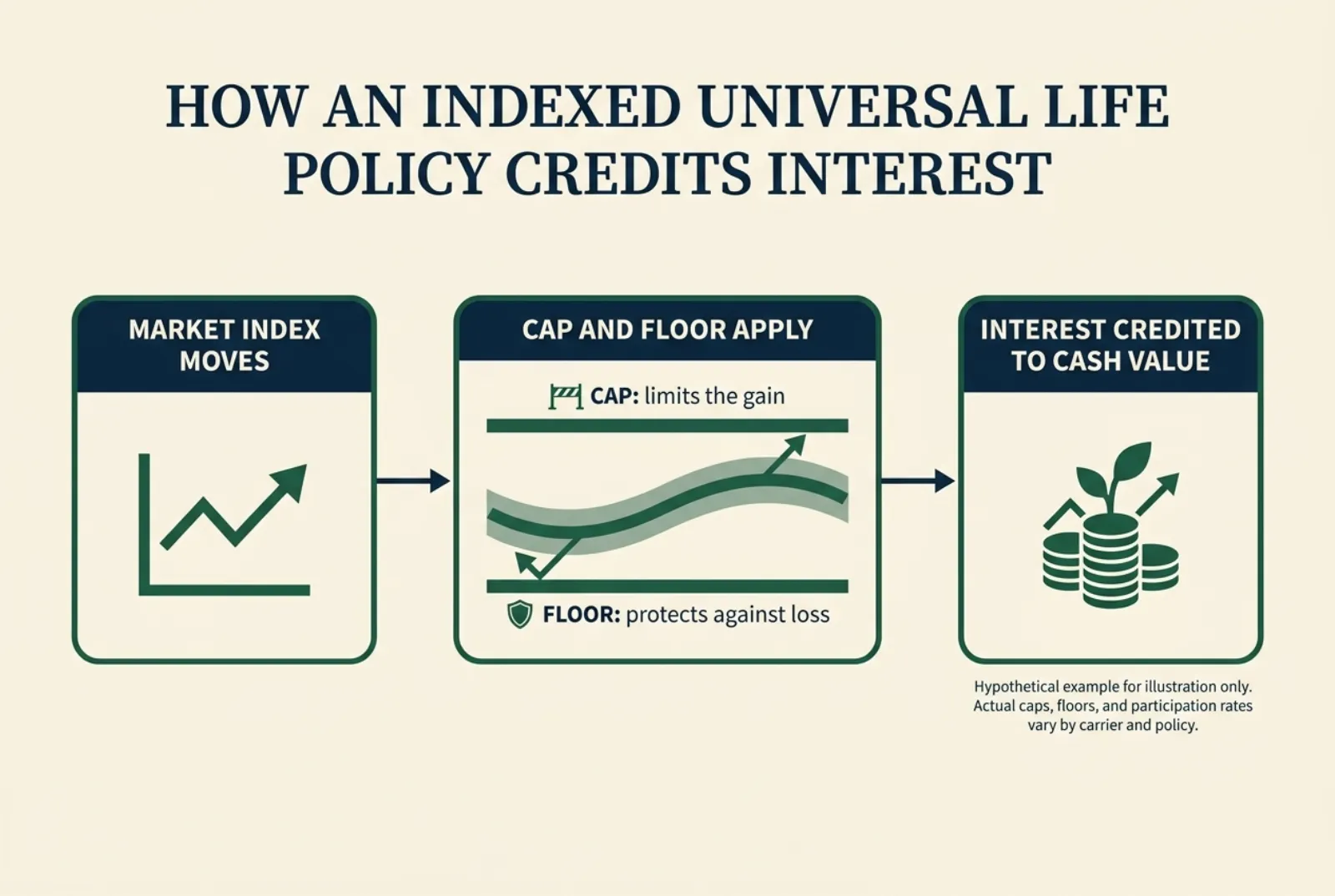
The pattern worth noticing: in the good year, you did not get the market’s 19%. You got the cap, 8% in this example, because the insurer is the one absorbing the risk of the down years through the floor, and it prices that protection by capping your upside. That trade, giving up the top of the market in exchange for a guaranteed floor against the bottom, is the actual product. Whether that trade is worth it to you depends on how much you value downside protection versus upside participation, which is a personal answer, not a universal one.
It is also worth being precise about what the floor protects. A 0% floor protects the indexed interest calculation for that period from going negative. It does not mean your total cash value can never decline, because the policy’s cost of insurance and other charges are still deducted from cash value regardless of how the index performed that year. A policy can credit 0% interest and still lose cash value in the same period, once internal charges are subtracted.
Indexed universal life as a share of the U.S. individual life insurance market, 2025
Source: LIMRA, "U.S. Individual Life Insurance New Premium Tops $17.5 Billion to Set New Sales Record in 2025," published March 19, 2026. IUL new premium reached $4.5 billion in 2025, 25% of total U.S. individual life insurance new premium.
Why sales are booming, and what that does and doesn’t tell you
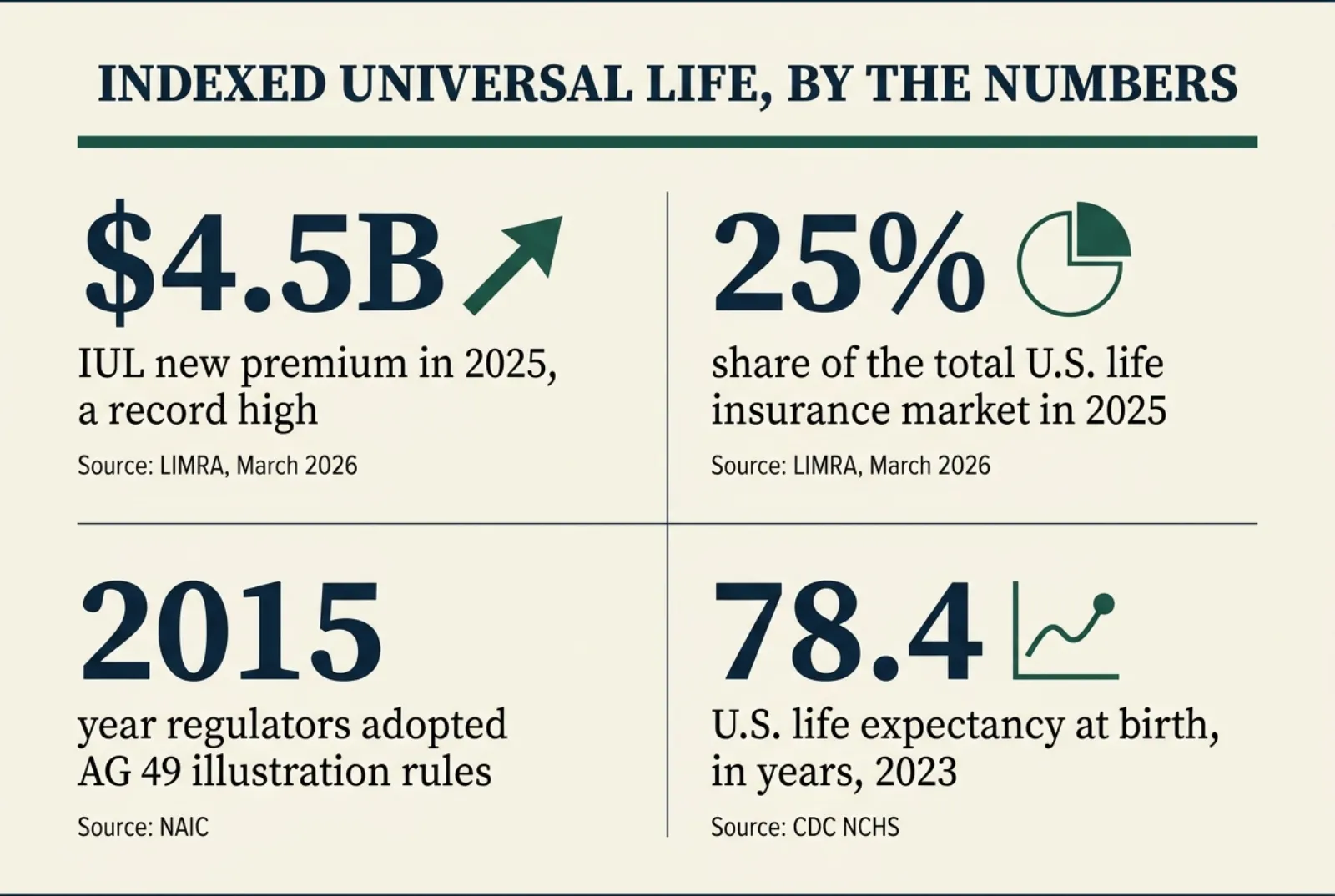
U.S. indexed universal life new premium reached $4.5 billion in 2025, a record high and 17% higher than 2024, representing 25% of the total U.S. individual life insurance market, according to LIMRA’s release published March 19, 2026. Total individual life insurance new premium across all product types reached $17.5 billion in 2025, up 10% over 2024, also a sales record, according to the same release. LIMRA attributes the growth specifically to broader distribution, enhanced product designs, and a strong equity market in 2025. LIMRA is the primary industry source that tracks and publishes this sales data at this level of detail; this figure is reported by that single source rather than independently corroborated by a second organization, which is worth knowing as you weigh how much to make of it.
A record sales year is a fact about how a product is currently selling, driven in real terms by more agents offering it, newer product features, and a stock market that made the indexed crediting story look good. It is not, on its own, evidence that indexed universal life is the right fit for your household, any more than a hot year for a particular stock is evidence that you personally should buy it. The sales figure explains why you are more likely to be pitched an IUL in 2026 than you were five years ago. It does not answer whether the pitch fits your actual goals, and a strong equity year in particular is the environment where indexed crediting looks its most flattering, since the cap gets reached more often. A weaker market year changes that picture without changing the product’s underlying structure at all.
A record sales year tells you the product is being sold more. It does not tell you it was sold to the right person, for the right reason, at the right funding level.
Mike Moore, Life Insurance AdvisorThe illustration problem, and how AG 49 tries to fix it
Before 2015, an insurer selling an indexed policy could build its sales illustration around whatever hypothetical growth assumption it chose, and different carriers assumed wildly different things, which made honest comparison between two IUL products nearly impossible for a buyer to do on their own. Regulators responded with Actuarial Guideline 49 (AG 49), adopted by the NAIC in 2015, which applies the NAIC’s Life Insurance Illustrations Model Regulation specifically to policies with index-based interest. Under AG 49, the non-guaranteed, illustrated values a carrier can show cannot be more favorable than what that company’s own product, using its own actual recent historical crediting experience, would have produced, according to the NAIC.
That is a meaningful consumer protection, and it is also narrower than it sounds. It stops a carrier from illustrating a growth rate untethered from its own product’s track record. It does not, and cannot, guarantee that the cap, participation rate, or cost of insurance you are illustrated today will still apply in year 10 or year 20 of your policy, because those are set by the carrier and can change going forward, and it does not predict what the underlying index will actually do over the decades your policy is in force. An illustration compliant with AG 49 is a more disciplined document than what existed before 2015. It is still not a guarantee, and every illustration you are shown should be read with that distinction in mind, guaranteed columns versus non-guaranteed columns are not the same promise.
Read the guaranteed column, not just the illustrated one
Every compliant IUL illustration shows a guaranteed-minimum scenario alongside the non-guaranteed, current-assumption scenario. The guaranteed column, often using minimum caps and maximum charges, is the worst-case the contract actually promises. If the guaranteed column shows your policy lapsing decades before the non-guaranteed column does, that gap is the real risk you are being asked to accept, not a detail to skip past.
What it costs to get wrong: the lapse most people don’t see coming
Universal life insurance, indexed or not, does not work like whole life. A whole life policy has a fixed premium that, if paid as scheduled, guarantees the policy stays in force. A universal life policy’s flexibility cuts both ways: if what you are paying, combined with existing cash value, is not enough to cover the policy’s rising cost of insurance and other charges, the policy can lapse, sometimes with little or no cash value left and sometimes after paying premiums for many years.
This is not a hypothetical risk. The Wisconsin Office of the Commissioner of Insurance issued a consumer alert on December 3, 2021 specifically about universal life insurance, stating that many policyholders “found that their policies had lapsed (were no longer in effect) with little to no value” and warning that “if charges increase or interest rates decrease, the cash value may not be sufficient to cover the costs of the contract over time, and additional premiums may be required later.” The alert includes a real case in which a policyholder’s premium, sufficient at purchase to fund the policy to age 100, was only sufficient to fund it to age 80 after a 2019 cost increase, a 20-year gap in expected coverage the policyholder did not create and had to discover on their own.
| At original purchase | After the 2019 increase | Gap |
|---|---|---|
| Coverage funded to age 100 | Same premium now only funds coverage to age 80 | 20 years of expected coverage |
Source: Wisconsin Office of the Commissioner of Insurance, Consumer Alert on Universal Life Insurance, published December 3, 2021.
The mechanism behind that gap is the same one described above: cost of insurance rises with age, and if the premium you chose to pay does not keep pace, the shortfall comes out of cash value until there is none left, at which point the policy lapses. Indexed crediting can help fund that gap in strong years and does nothing to close it in flat or weak years, because the cap limits how much a good year can help while the cost of insurance keeps climbing regardless of market performance. The 0% floor prevents the market from making a bad year worse; it does not prevent rising internal charges from doing exactly that on their own.
This is also why permanence matters as a design goal, not just a marketing word. U.S. life expectancy at birth reached 78.4 years in 2023, an increase of 0.9 year from 2022, according to the CDC’s National Center for Health Statistics. A policy sized and funded to genuinely last through your 80s or 90s, with cost of insurance charges that keep climbing the entire time, requires a funding plan built for that reality from day one, not a minimum premium chosen to make the initial illustration look attractive.
How to check a pitch, or your own policy: the method
You do not need to take an agent’s word for any of this, and you do not need to wait for a problem to check. Here is the same process an independent review would walk through, laid out so you can run it yourself first.
- Ask for the guaranteed-column numbers, not just the illustrated ones. Every AG 49-compliant illustration includes both. If the person walking you through it only shows you the non-guaranteed column, ask directly for the guaranteed scenario and compare how many years of coverage each one actually shows.
- Ask what the current cap, floor, and participation rate are, and whether they are guaranteed for the life of the policy. In most IUL contracts, they are not; the contract states a guaranteed minimum cap, often far below the current cap, and that minimum, not the current number, is the real floor on what you can count on long term.
- Ask what premium is required to fund the policy to a specific age, using the guaranteed assumptions, not the current ones. This is the number that tells you what you would need to pay if crediting rates stayed at their guaranteed minimum for the rest of the policy’s life, which is the honest worst case to plan around.
- If you already own a policy, request a current in-force illustration from the carrier. This is different from your original sales illustration; it reflects your policy’s actual current cash value, current charges, and current crediting, and projects forward from where the policy actually stands today rather than from assumptions made when you bought it.
- Compare the in-force projection’s lapse age against the age you originally expected coverage to last. A meaningful gap, the way the Wisconsin OCI’s example showed a 20-year gap, is the signal that the policy needs more funding, a design change, or a serious conversation, not a reason to assume it will resolve itself.
- If a policy was sold to you in a way that feels misleading, you can contact the South Dakota Division of Insurance directly at 605.773.3563 to ask questions or file a complaint; that is a state regulator, not the carrier or the agent who sold you the policy.
You can request an in-force illustration yourself, today
You do not need anyone's permission to call your carrier and ask for a current in-force illustration on a policy you already own. It is a routine, no-cost request, and it is the single most useful document for finding out whether your policy is actually on track.
When IUL genuinely fits, and when it doesn’t
The need has an end date
- The goal is replacing income until a mortgage is paid off or kids are grown
- Budget is a primary constraint and low cost per dollar of death benefit matters most
- You want a simple, fixed premium with no cash value mechanics to monitor
- You have not yet maximized simpler tax-advantaged retirement accounts
The need is genuinely permanent
- The death benefit need does not expire, such as estate liquidity or a special-needs dependent
- You can commit to consistent, adequate funding for decades, not just the minimum premium
- You've already maximized more straightforward retirement accounts and want a permanent policy on top
- You understand and accept that caps, participation rates, and charges can change over the life of the policy
Neither column is a verdict on you personally. It’s a description of what each product is actually built to do well. A lot of the bad outcomes described by regulators like Wisconsin’s OCI trace back to a term-length need, income replacement for 15 or 20 years, being funded through a universal life chassis at a premium level that was never going to sustain the policy for a genuinely permanent time horizon. Matching the product’s design to your actual time horizon is most of the decision.
How we help
We’re independent, so we’re not built around selling one company’s indexed universal life product or steering every conversation toward permanent insurance because that’s what we have on the shelf. When someone brings us an IUL illustration, ours or someone else’s, we walk through the guaranteed column, the current cap and participation rate, and what funding level actually supports the coverage you expect at the age you expect it. If your need is genuinely permanent and you can fund a policy consistently, we’ll compare how different carriers structure that. If what you actually need is income replacement for a defined period, we’ll say so plainly, because a level term policy priced for that job is usually the more honest answer, and a harder sell for us to make money on than it should be for you to hear.
What you get
A plain read of an illustration you’ve already been shown, guaranteed numbers included, not just the flattering column. A comparison across carriers if a permanent policy genuinely fits your situation, since caps, participation rates, and cost-of-insurance structures vary meaningfully company to company. And an honest answer about whether indexed universal life is solving the problem you actually have, or a different problem than the one you walked in with.
Bring the illustration, and we'll read it with you
Whether it's a pitch you just received or a policy you've owned for years, we'll walk through the guaranteed column, the current cap and participation rate, and what funding level actually keeps the coverage on track.
Not ready to talk to anyone yet? Read How It Works first and come back when you are. If you’d rather run the guaranteed-column comparison yourself first, that’s a reasonable place to start, most people find the carrier comparison, not the arithmetic, is the part worth a second opinion.
Frequently asked questions
What is indexed universal life insurance in plain terms?
It is permanent life insurance, meaning it does not expire the way term life does, built on a flexible-premium chassis called universal life. Part of your premium pays for the death benefit and the policy’s internal costs, and part goes into a cash value account. Instead of earning a fixed interest rate the way older universal life policies did, an indexed universal life (IUL) policy credits interest based on the change in a market index, most commonly the S&P 500, subject to a cap that limits the upside and a floor that limits the downside. You are not invested in the index directly, and the policy is not a security.
What do cap rate, participation rate, and floor actually mean?
The floor is the minimum interest the policy will credit in a given period, commonly 0%, which protects the indexed portion of your cash value from a market decline in that period. The cap is the maximum indexed interest the policy will credit even if the index performs better than that, and the carrier sets it and can change it going forward, subject to any guaranteed minimum cap stated in your contract. The participation rate is the percentage of the index’s gain the policy counts before applying the cap; a 100% participation rate with an 8% cap and a 10% index gain would credit 8%, while an 80% participation rate on that same 10% gain would credit 8% as well, since 80% of 10% is 8%. These figures are set by the insurance company, vary by carrier and by policy, and are not fixed for the life of the contract unless your specific policy guarantees otherwise.
Why did indexed universal life insurance sales hit a record in 2025?
U.S. indexed universal life new premium reached $4.5 billion in 2025, a record high and 17% above 2024, and represented 25% of the total U.S. individual life insurance market, according to LIMRA. LIMRA’s release attributes the growth to broader distribution, enhanced product designs, and a strong equity market in 2025. A record sales year describes how a product is currently selling; it is not, by itself, evidence that indexed universal life is the right fit for any specific household, and the decision still depends on your own goals, health, budget, and how long you plan to fund the policy.
What is AG 49, and how does it protect me from an unrealistic illustration?
Actuarial Guideline 49, adopted by the National Association of Insurance Commissioners in 2015, applies the NAIC’s Life Insurance Illustrations Model Regulation specifically to policies with index-based interest, including IUL. Under that guidance, the non-guaranteed values a carrier illustrates cannot show results more favorable than the company’s own actual recent historical experience, according to the NAIC. In plain terms, it stops a carrier from showing you a hypothetical growth rate that has no relationship to how its own product’s crediting method would have actually performed. It does not guarantee the policy will perform as illustrated going forward, since future index performance and future cap rates are unknown.
Can an indexed universal life policy actually lapse?
Yes. Universal life policies, including indexed universal life, do not have a fixed premium the way whole life does; if the premium paid plus the existing cash value is not enough to cover the policy’s internal cost of insurance and other charges, the policy can lapse, and the death benefit can end even after years of premium payments. The Wisconsin Office of the Commissioner of Insurance issued a consumer alert in December 2021 describing policyholders who found their policies had lapsed with little to no value, or who had to pay substantially higher premiums to keep coverage in force, after cost of insurance charges increased. The alert recommends requesting an in-force illustration every year to check whether your current funding level still supports the coverage you expect.
Is the cash value in an IUL a good substitute for a 401(k) or Roth IRA?
This is a decision worth working through with a licensed agent and, for the tax and retirement-planning pieces, a tax professional, since it depends on your specific goals and time horizon; nothing here is that advice. What is true structurally is that an IUL’s cash value growth is limited by the cap and reduced by internal insurance and policy charges before it starts accumulating, a 401(k) or IRA has no cap on market-linked growth and no cost-of-insurance charge, and accessing IUL cash value through a policy loan or withdrawal reduces the death benefit and can cause the policy to lapse if not managed carefully, which can also trigger a taxable event. An IUL is a life insurance policy with a cash value feature, not a retirement account, even when it is marketed around retirement income.
When does indexed universal life genuinely fit a South Dakota household?
It tends to fit people who have a permanent, not temporary, need for a death benefit, who have already maximized more straightforward tax-advantaged retirement accounts, who can commit to funding the policy consistently for a long time horizon, and who understand and accept that the cap, participation rate, and cost of insurance can change. It tends to be a poor fit for someone whose main goal is inexpensive income replacement for a defined period, such as until a mortgage is paid off or children are grown, where term life insurance is built for that specific job at a lower cost. An independent comparison of your actual goals against both product types, before you commit to either, is the useful step.
How do I check whether my existing IUL policy is underfunded?
Contact the carrier and request a current in-force illustration, which projects your policy’s cash value and coverage duration based on your actual current funding level and the policy’s current charges and crediting rates, not the original sales illustration from when you bought it. Compare the age at which the in-force illustration shows the policy lapsing against the age you originally expected coverage to last. If there is a meaningful gap, that is the conversation to have with your carrier or an independent agent before the gap becomes a lapse. The South Dakota Division of Insurance can also be reached at 605.773.3563 if you believe a policy was sold to you in a misleading way.
Before you sign anything
This article is general education, not insurance, legal, financial, or tax advice. Product availability, illustration assumptions, cap rates, participation rates, charges, and pricing vary by carrier and are subject to underwriting. No coverage exists until a policy is issued and in force. Any guarantees, including any guaranteed minimum cap or guaranteed cash value, are subject to the claims-paying ability of the issuing insurer. Please review your actual policy documents and speak with a licensed agent and a tax professional about your situation.
Sources
- LIMRA — U.S. Individual Life Insurance New Premium Tops $17.5 Billion to Set New Sales Record in 2025 — published March 19, 2026; IUL new premium $4.5 billion in 2025, up 17% over 2024, 25% of total U.S. individual life insurance market; total individual life new premium $17.5 billion, up 10%. Single-sourced to LIMRA, the primary industry aggregator for this data.
- NAIC — Life Insurance Illustrations (CIPR Topics) — Actuarial Guideline 49 adopted April 2015, applying the Life Insurance Illustrations Model Regulation (#582) to index-linked policies; non-guaranteed illustrated values cannot exceed the company’s actual recent historical experience.
- Wisconsin Office of the Commissioner of Insurance — Consumer Alert on Universal Life Insurance — published December 3, 2021; documents universal life policy lapses after cost-of-insurance increases, including a case where coverage originally funded to age 100 was only funded to age 80 after a 2019 increase.
- CDC National Center for Health Statistics — Data Brief No. 521, Mortality in the United States, 2023 — published December 2024; U.S. life expectancy at birth was 78.4 years in 2023, up 0.9 year from 2022.
- South Dakota Division of Insurance — File a Complaint — consumer complaint process and phone number, 605.773.3563.
Related reading: Term vs. Whole Life in 2026: A Data-Driven Comparison, Living Benefits Are Reshaping Life Insurance in 2026, and Will Your Retirement Savings Last? A South Dakota Guide. See current options for indexed universal life insurance, whole life insurance, or learn more about who we help: seniors.